
Prologue: Female Privilege’s Jealous Last Stand beneath the Blood Moon, before a Lone English Patrician
She came to him already disappointed in the modern England that had formed her. Its promises had begun to look thin. She was aware that there were problems with the things she had been told. The country that had fostered Mary Wollstonecraft’s Vindication of the Rights of Woman and the later machinery of militant and terroristic female political insurrection, from Emmeline and Christabel Pankhurst’s Women’s Social and Political Union, through Millicent Fawcett’s National Union of Women’s Suffrage Societies and Charlotte Despard’s Women’s Freedom League, to Sylvia Pankhurst’s East London Federation of Suffragettes, had long since absorbed their victory into its civic creed.
Freedom had not bestowed direction; choice had multiplied without revealing what was worth choosing; relations between men and women had become at once overfamiliar and estranged, full of speech, charged with fervour, hatred, resentment, yet curiously barren of meaning. She spoke of feeling misunderstood for her intelligence. She questioned modern life, doubted some of the doctrines she had inherited, and seemed weary of the polished emptiness around her. There was enough dissatisfaction in her to make another order appear conceivable, though she still carried the assumptions of the old one invisibly within her.
His bearing intrigued her. He spoke without the nervous qualifications to which she was accustomed from men. There was something distant in him, something old, already fully formed before the conversation began and it existed independently of whether she approved. It was his ritual fire, like the old family fires of Rome, that first caught her eye.
He spoke of ancient Rome and the Olympian patricians as though they were more than the collective delusion of primitives from a dead civilisation obsessed with their own delusions of grandeur; more like it already existed now, or soon would.
He spoke of Britain’s own Roman pride and inheritance, sewn into its Latin script and Anglo idioms, into the jurisprudence inherited from the equivalent of a Roman supreme court that had presided in the nation for more than four hundred years, and into the patrician religion whose influence still survived in royal ceremony, the once widely-accepted Trojan Brutus origin, the iconography and regalia of sovereigns claiming descent from Alba Longa, funeral rites, and English Common Law, continuing in its American inheritance; he spoke of Servius Tullius, Julius Caesar, Augustus, and Romulus-Quirinus, and of the Palatine and Aventine as opposed cosmic principles still contending beneath modern institutions; he spoke of Apollonian primogeniture that persisted for millennia as the inheritance of Europe through Roman jurisprudence; of paternal right, sacred authority, the doctrine of the Four Ages, and the distinction between a civilisation ordered by Being and one surrendered to restless becoming. The English-Olympian Thomas Taylor, a philological giant seemingly born for the recovery of the ancient sacred world, had even earned a mention; so too had his aristocratic hostility to the earliest proto-feminists, whose appeals to Judaeo-Christian egalitarianism and the Judaeo-Masonic French Revolution embodied the same levelling current he opposed. The names were ancient, though the conflict felt oddly present to her. It seemed to describe the world around them more exactly than the shallow slogans and catechisms she had been instructed in all her life.
And what did he see? He saw a girl that was not like the others. She was polite and spoke in the language of honour, for one. She did not casually abase and rebuke him for her own amusement like the others, she remained attentive and did not recoil in fickle capriciousness at the earliest inconvenience. She had not turned away, she did not close herself off or shut down, and she seemed disaffected by modernity just as he was; curious and receptive. Perhaps there was a woman beneath the surface like the ones he had known in his family, and those great women he recalled.
She praised his intelligence. She called his thoughts and richness of speech profound. She had never heard anything like this before, from anyone. She returned with more questions.
Before the mirror, she primped her hair and touched up her make-up in a particularly stubborn spot on her right cheek; then turned and cast him a glance.
At first, the questions carried the warmth of fascination. What did he mean by Roman patriarchy? What place did woman possess within it? How could an order so remote from the present still speak to life after technology had appeared and the alarm bell of progress had sounded? He answered through figures rather than abstractions alone: severe mothers, widowed queens, devoted wives, women who had understood fidelity without imagining it as humiliation. He spoke of the Naishosama, samurai brides of honour and faithfulness. He spoke of Shizuko Nogi, whose life had disclosed a form of feminine allegiance wholly unintelligible to the modern doctrine of antagonistic sexes, disclosed as flattened, warring sexes. He spoke of Queen Victoria, who recoiled from the disaster that she predicted, that would soon be brought by political revolution conducted in woman’s name. He spoke of his own mother, whose severity had never required ideological instruction, and whose authority over others had never depended upon revolt against masculine, solar form, but its very embodiment.
In all of these examples, women did not exist as atomised individuals interchangeable with men, or collectivised with other women, but bore household, father, name, ontological essence, ancestors, and posterity.
Yet the woman before him did not at all yield her inherited premise. She admired the depth of a penetrating intellect while resisting its very centre. She praised the architecture while refusing to enter it. She declared, with the casual certainty of someone repeating a truth too obvious to require defence, that she did not believe women should be placed under men; she did not think she even needed to explain or to question the assumptions of why. Still she asked him to explain. Still she pressed. Still she sought the concrete answer concealed, as she imagined it, somewhere behind the histories, symbols, and examples.
When her tone sharpened, he noticed. She flippantly dismissed one of his comparisons as ‘unintelligent’ and proclaimed ‘progress’. He told her that she was criticising what she had not understood.
Above it all, a blood moon hung low in the sky, enduring for scarcely the lesser part of an hour.
‘Then why are you speaking to me?’ he asked. If she already despised the position, why continue soliciting it? Her true meaning and derision had begun to come out, at last; beyond the glamour, beyond the servile posture before mere attraction.

She reassured him. She had not meant to insult him, it was a simple debate. She was simply less educated in these matters. She wished to understand. Her persistence seemed to restore the appearance of good faith, but the sanctity of the order between man and woman had already been cracked, he nevertheless permitted the conversation to continue.
He showed her the larger civilisational argument: that modern progress was no neutral ascent, that its roots lay in a long rebellion against form, hierarchy, and transcendence; that capitalism and Marxism alike reduced man to material measure; that Christianity itself had helped prepare the levelling logic later completed by universal suffrage and mass society. He placed before her the distinction between civilisations of Being and civilisations of becoming. He cited a Cambridge study tracing the rhetoric of progress into St Ambrose. He gave her the opportunity to withdraw without humiliation. Amidst the furious gesticulating he noticed, peeking through the fabric, scars on her upper-sides of her arms and legs.
The questions grew more direct. Where, then, should a woman be? What did male authority mean in practice? What, in fact, did the old Roman jurists Ulpian and Gaius prescribe as the proper condition of woman? She knew that there were problems, but she thought there was another way.
By then he had begun to tire. It was not the first time he had been asked these questions, and he had learned they were dependant on the inner apprehension of a higher law, not on any one historical fact, or convincing argument; that would be like confusing the finger for the moon it points towards. At best, they could only draw out what was already innate. He almost answered with a single sentence: no woman in his family, nor any woman he had known closely, had needed to be taught these things. He found it profoundly pathetic that the ‘emancipators’ to whom women had zealously attached themselves, and to whose order they had become acclimatised, were truly interested in them only as objects of weaponisation and exploitation, and, ultimately, of total destruction. There could be no greater ‘objectification’ and ‘oppression’, in their lexical terms, than this. The words rose in him as a final distinction between inherited form and ideological argument: either one recognised the principle by an innate essential nature, or one did not. He almost told her stories of women who had recognised it without resentment, women whose strength had never depended upon pretending that sex was metaphysically meaningless.
Instead, he gave her the benefit of the doubt once more.
He spoke no lecture. He issued no command. He did not even formulate the answer in his own voice. He silently gestured towards a succession of quotations from Roman law, Cato, Queen Victoria, traditional authorities, and modern material concerning fertility, emancipation, and intentional Malthusian demographic decline. Some she had already heard him reference. Others supplied the concrete evidence she had repeatedly requested. They arrived one after another, spare and impersonal, leaving her free to read, consider, reject, or fall silent. He had withdrawn from persuasion. The authorities stood where his own speech had ceased.
Within scarcely a minute, she erupted; the infernal flame of the radical suffragettes flickered its last outrage.
There was no measured objection, no attempt to distinguish one quotation from another, no evidence that the sequence had been read as a whole. Beneath her venomous ire, swallowed by the feminine impulse to profane and destroy something beautiful—including womanhood itself—the civilisational argument vanished. The women he had honoured vanished. The contrast between metaphysical form and material accomplishment vanished. In their place appeared the familiar little arsenal of the modern Puritan schoolmatron and moral censor: ‘sexist’, ‘sad man’, unable to find a wife, ‘obsessed with ancient law’, inferior to the ‘millions of women who had accomplished more than you ever would’, the imaginary collective in whose voice she assuredly spoke, laced with crude profanity and a low, guttural seethe familiar to the drunken sailor who had allowed a more basal darkness to consume him, or the schoolyard tyrant laying the groundwork for a much more violent and profane future.
In her bemusement at how such men like him, refusing to conform as well as she and the ones she knew, ‘could possibly still exist’ she blamed men that considered women ‘inferior’ and not sovereign equals, equals that could only be contested as opponents. She had intended to defeat him, and to this end, Victoria dissolved, Shizuko became an example of class oppression, and Malthusian social policies delaying childbirth were legitimised because ‘there are too many people’. War, poverty, rich men, women’s rights, and female achievement were summoned in a single disordered rush, as though the accumulated grievances of an entire political class had suddenly found a mouth. His own mother ceased to count as an example.
He was being humiliated and told to ‘get his head out of the gutter’, as if he had been a schoolboy caught with naughty magazines, and she, the schoolmatron, demanded dominion over his very inner state, to shame and guilt him as one that had lapsed from the collective equality men knew never to upset, and the deference they owed the collective class of women.
She crowned her act of domination and sexual humiliation with the manly, all-encompassing sigh of ‘fucking hell’, an exhalation that seemed to gather the whole scene into a single gesture of triumphant finality, severing at last every pretence of reciprocity and understanding, which had been, until then, only nominal.
As if she were wilfully trying despite any better minds, Cato’s ‘licence’ of women, the Onna Daigaku‘s cautions about yin feminine nature, and Queen Victoria’s warnings of the dangers of women’s emancipation were, in an instant, made manifest before him. A live performance, put on for all to see the truth. The other women had simply silently withdrawn, but for this one, where existence lacked, she compensated with force. Through self-hatred and envy, she collapsed, destroying herself before him, utterly and devastatingly.
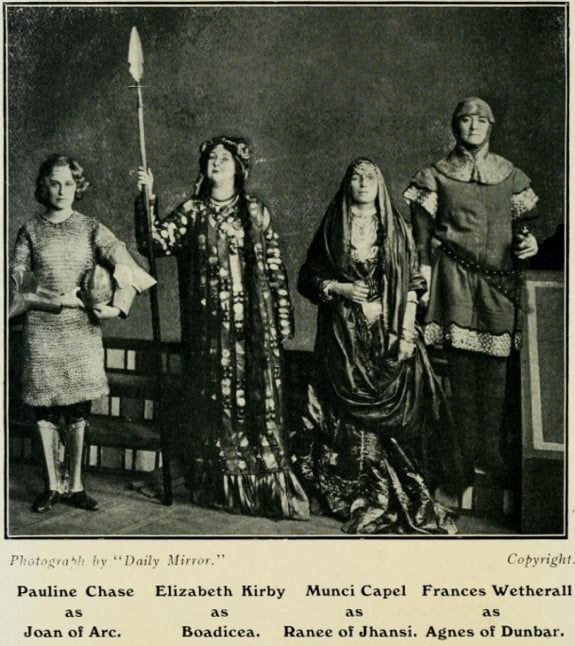
Just as the Italian woman who had earlier disgraced him cackled in an old voice issuing from the Aventine of Remus, so too did her lineage rise from the maternal-nationalist revolt of Boudicca, risen in arms once more, whose uprising had turned against tens of thousands of Britons themselves until order was restored beneath the standards of Mars’ legions; the same ancient violence would later bear itself through that current into the communist suffragettes of the French Revolutionary inheritance and the Marxist-Feminist emancipationists. He, by contrast, stood within the scene bearing the weight of an English Caesar: patrician in instinct, paternal in authority, possessed of gravitas, disciplina, pietas, and the cold verticality of imperium, his principle descending from the solar height of Apollo and Jupiter through the law of the fathers, the mos maiorum, and the ordering power of Rome. Where she gathered grievance, maternity, tumult, and collective passion into the old revolt of the tribe, he bore the counter-principle of the Roman Briton: measure, hierarchy, command, sacred law, paternal sovereignty, and the solar imperium of the City; against all this, she could therefore assume the posture that Cicely Hamilton’s suffrage pageant of emancipated womanhood had assigned Boudicca, ‘a Briton in arms’ who ‘spat defiance at the hosts of Rome’, confronting in modern English form the very Roman principle she had been prepared all her life to fear, hate, and despise, the entire encounter assuming the form of feminine, pathos-driven, gynaecocentric maternal authority risen in rebellion against the stoic and solar masculine principle.
Principle and counter-principle, borne together in the very marrow of ancient Britannia, the Roman goddess of the island, had quarrelled for ages beneath the surface of her history; now, as the Final Age turned upon itself and loosed every restraint, they rose at last and stood face to face. In this sort of tableau, the disagreement ceased to be merely personal and assumed a civilisational and mythic dimension. She became the chariot rushing from the margins upon the sacred City, while he became the aquila-bearing standard planted against it: the Palatine against the Aventine, imperium against insurrection, paternal right against maternal sovereignty, solar form against telluric passion, and Caesar against Boudicca. Her defiance thus repeated the ancient gesture celebrated upon the suffrage stage; his refusal to yield repeated the older Roman answer to it.
Where she sought to destroy him, she was destroyed. Where she sought to double-down and demonstrate substance, she revealed the emptiness of being. Where she sought to stand up, she stooped down to tyrannise a man into conformity, as only an equal brother. Where he sought to elevate and raise her, she collapsed.
The entire women’s liberation movement had plainly been built upon lies, and beneath his cold, discerning gaze they had now utterly disintegrated; he had absorbed every detail, weighed every contradiction, and documented the collapse, while its deeper significance unfolded in a metaphysical register she had neither reached nor ever perceived.
Returning to her mirror, in an attempt to get away, she noticed it was cracked quite badly, in the very spot her stubborn beauty spot had been. She gazed at it intently.
Then she left him.
Every catechism of the social structures that had parasitised and claimed her lashed out at him with the fury of an inferno, as the emancipation he had brought her had been denied as too high, primitivist, not in line with the cult of ‘progress’ expected of equal brothers and sisters that had now moved on, with no need to look back at what had been left behind, because it had been pre-empted as useless. So why bother? We were free now, and there was no going back.
He permitted himself one silent, inwards ‘So, I’m right, then?’ amidst the aftermath.
The incident was reported to the relevant powers, and she was never permitted to return. Later, when the surprise wore off, he knew he would never accept a call from her again, and that a bullet had been dodged.
A few weeks later, while passing her in the way, he would mysteriously present her a black feather for her conduct, before withdrawing, as had been suggested to him by a sympathetic man from the old Italian wine country.
The speed of the transformation was revealing. She had not uncovered a mysterious hidden doctrine. Its marks had been visible from the beginning: a clear advocation for Roman patriarchy, a stern defence of paternal right, an explicit rejection of egalitarianism, and repeated explanations of the metaphysical opposition between the Palatine and the Aventine as something beyond mere capitalist critique. She had known before she entered. She had asked after entering. She had continued after being offered a dignified exit. Yet, at the decisive moment, she behaved as though a stranger had accosted her in the street and forced the whole matter upon her.
Her invitation disappeared from the story. Her questions disappeared. Her assurances of good faith disappeared. Her praise, curiosity, and persistence were all silently annulled. Only his answer remained, detached from everything that had called it forth and recast as an act of aggression. As she was accustomed to, she destroyed another man who had, in her mind, vied for her attention.
This was the first asymmetry.
She possessed full agency while approaching, questioning, pressing, and demanding clarity; the instant the answer offended her, that agency dissolved. She became the passive object of a doctrine inflicted upon her, while he became guilty for having taken her invitation seriously. The woman who had opened the door cried out as though the man had broken it down.
Her question had never been free in the sense she implied. It contained an undisclosed condition: he might answer only if the answer ultimately returned to her own moral premises. He might speak of hierarchy, provided hierarchy proved merely symbolic; of patriarchy, provided it meant solicitude without command; of sexual difference, provided difference never implied rank; of tradition, provided tradition surrendered before the modern woman’s right to approve its terms. He was invited to reveal himself only on condition that nothing genuinely alien to egalitarianism was revealed.
When he refused that condition without even arguing against it, as he simply placed the authorities before her and withdrew, the concealed nature of the invitation appeared. It had not been an opening into another world. It had been a summons to translate and flatten a superior world into hers.
Unable to obtain the translation, she criminalised the original.
Thus he became guilty because she had asked. His sincerity became cruelty; her curiosity became innocence; her outrage became evidence; and the answer she had repeatedly solicited was retrospectively transformed into something imposed. The question remained virtuous because she had asked it. The answer became vicious because it had answered her.
This is the peculiar privilege concealed within the modern language of equality: the right to invite revelation without accepting responsibility for what is revealed. She may ask what a man believes, but he alone bears the moral consequences of the encounter. She may draw him outwards, yet accuse him of intrusion when what emerges exceeds her capacity to receive it. She may demand the truth and then punish him for failing to substitute reassurance in its place.
She asked; he answered; therefore he was guilty.
And thus the pretence of equality yielded its final truth: one sex had, against all protestations to the contrary, become more equal than the other.
STOP—High Tide Warning: Female Privilege and the Gradual Encroachment of Revolutions
Female privilege is any legal, institutional, social, or interpersonal advantage, exemption, presumption, protection, or latitude afforded to women by virtue of their sex, where an equivalent benefit is not extended to men or where the corresponding burden, duty, or accountability is distributed asymmetrically. Among female privileges exist the aggregate of formal and informal advantages attached to female status: preferential protections, exemptions from burdens, favourable presumptions, greater toleration of particular conduct, or claims upon male and institutional support in academia, corporations, policing and jurisprudence, social media, journalism, healthcare, and social care, that are unavailable to men on equivalent terms. It may persist even within a society committed rhetorically to sexual equality, particularly where older conventions of female protection survive after older reciprocal duties have been discarded.
Emancipation’s advance flows like a rising tide: almost imperceptibly the waters climb until suddenly one finds oneself on the brink of drowning, each conceded claim cascading into the next, and it is precisely upon this surreptitious momentum, the seemingly natural forces of deconstruction once set in motion, that revolutionists hinge their advance.
Emancipation rarely transforms a civilisation all at once. Its deepest effects are generational. A legal disability may be removed in a year, a political right granted in a session of Parliament, or an institutional barrier abolished by decree; yet the social order formed under the previous arrangement does not immediately disappear with it. Habits of deference, expectations between the sexes, family structures, inherited standards of conduct, and the moral instincts attached to them may persist for decades after the law has changed. The first generation therefore often experiences emancipation less as a completed revolution than as an opening through which later consequences will gradually pass.
This is one reason contemporary observers so often underestimate the magnitude of such changes. The first women admitted to a profession may retain many of the manners, assumptions, and restraints of the order into which they were born. The first generation possessing a new liberty may exercise it cautiously, precisely because it was raised under the discipline of the older norm. Its conduct can therefore be misleadingly reassuring. The institution appears to have changed while society remains recognisable; critics are told that nothing catastrophic has occurred, because the beneficiaries of the reform still carry within themselves habits formed before the reform existed.
Only with the second and third generations does the principle begin to reveal its full force. Children grow up regarding as ordinary what their grandparents experienced as an exception. What had once required justification becomes an expectation; what had been tolerated becomes a right; what had been a right becomes an entitlement whose limitation itself appears immoral. At this stage the reform no longer merely permits new conduct. It alters the horizon against which conduct is judged. The old restraint ceases to be experienced as restraint voluntarily inherited and comes instead to appear as an arbitrary imposition from a superseded world.
Emancipation therefore works not merely by changing laws, but by changing what a society can remember as normal. Its most powerful operation occurs when the generation formed under the previous order dies away and is replaced by one that has never known it. A woman granted a new freedom at forty may continue to think with assumptions formed in childhood; her daughter may treat that freedom as ordinary; her granddaughter may regard any surviving limitation upon it as incomprehensible. In this sense, the full social consequence of emancipation may take the span of a human life to become palpable.
This delayed action also explains why reforms of this kind can appear modest at the moment of enactment and profoundly revolutionary only in retrospect. The hidden architects of subversion emerge from the shadow into public knowledge. The decisive transformation does not always occur at the instant the law is passed. It occurs gradually, as the principle penetrates education, employment, courtship, marriage, family authority, institutional practice, language, etiquette, and moral expectation. Each alteration may seem small when considered separately. Taken across several generations, however, they accumulate into a new social order.
The historical significance of emancipation must therefore be judged longitudinally rather than episodically. One cannot ask merely what changed in the year a reform was enacted; one must ask what became thinkable twenty years later, ordinary forty years later, and morally compulsory sixty years later. A revolution need not announce itself by overturning everything in a single season. Subversives play the long game precisely because it at once escapes scrutiny and is highly effective. It works by allowing one generation to acclimatise to what the next will inherit as self-evident.
The Ebbing of the Tide; Gynaecocentric Tyranny’s Rise and Fall
The deepest success of emancipation may lie in the type of consciousness it eventually produces. The ‘modern woman’ is formed within an order whose victories are already behind her. She inherits conclusions without having witnessed the arguments by which they were established, and therefore experiences historically contingent gains as though they were self-evident truths of nature. What earlier generations demanded as reform, she receives as moral axiom. The result is a peculiar assurance: she does not merely possess a point of view, but often inhabits a world in which her point of view has been institutionalised so thoroughly that opposition to it appears scarcely intelligible except as malice, backwardness, or pathology.
This produces a blindness peculiar to triumphant movements. Because the emancipatory tide has risen throughout her lifetime, she mistakes its direction for an eternal law. Every previous concession seems to prove the necessity of the next; every dissolved boundary becomes evidence that the remaining boundary must also be dissolved. One claim cascades into another. Equality before the law becomes equality of condition; equality of opportunity becomes equality of outcome; freedom from arbitrary restraint becomes freedom from judgement; freedom from dependence becomes suspicion of obligation itself. The movement acquires momentum precisely because each victory supplies the premise for another demand.
Yet tides do not rise for ever. A civilisation may exhaust the moral capital upon which a particular direction of reform depended; institutions may begin to discover that rights severed from reciprocal duties generate instability; men may cease consenting to expectations which offer them diminishing authority in return; families, workplaces, courts, and political systems may encounter limits which ideological confidence had declared unreal. The historical tide can therefore begin to ebb long before those formed by its advance are capable of recognising what is occurring. As explored elsewhere, first in the recurring conflict between the Palatine and Aventine, and then in the broader recurrence of the motif itself, scholars have discerned behind this opposition a deeper Proto-Indo-European pattern: the overthrow of the native paternal and aristocratic order by an outsider lineage claiming power through the feminine, plebeian, and democratic, a pattern whose recurrence gives the Roman struggle a significance extending far beyond the immediate contests of the City.
The irony is that the consciousness produced by emancipation may actively accelerate the conditions of its reversal. A person completely assured of the righteousness of her inherited position has little reason to exercise restraint. She does not perceive herself as pressing an advantage, because she has learned to interpret each advantage as the correction of an injustice. Concessions accordingly become foundations for further claims rather than occasions for equilibrium. The very inability to imagine a legitimate counter-interest drives the process onwards, even where moderation might have preserved what had already been gained.
This is one of the recurrent pathologies of revolutionary success: a victorious principle loses consciousness of itself as a principle and begins to masquerade as reality itself. Its adherents cease to experience themselves as partisans. They become, in their own understanding, merely reasonable people confronted by unreasonable resistance. History has ended at precisely the point at which they entered it. Everything preceding their settlement is oppression; everything extending it is progress; anything reversing it is reaction.
From such a standpoint, an ebbing tide is almost impossible to perceive. Its first signs are interpreted as anomalies: resentment becomes ‘backlash’, withdrawal becomes ‘insecurity’, refusal becomes ‘misogyny’, exhaustion becomes insufficient education. The possibility that the social bargain itself has become unacceptable cannot readily enter a moral vocabulary constructed upon the assumption that emancipation possesses only beneficiaries and obstruction only culprits. And so the answer to every symptom produced by the process is more of the process.
Here lies the paradox. The modern emancipatory consciousness can become most aggressive precisely when the historical conditions sustaining it are beginning to weaken. Unable to imagine reversal except as wickedness, it presses forward when prudence would counsel consolidation; converts residual customs into fresh grievances; and demands that institutions enforce ever more completely a settlement whose legitimacy may already be eroding beneath them. It is therefore possible for the tide to be turning while those standing deepest within it continue commanding the sea to rise.
Revolutionary movements have often depended upon this blindness. Their greatest ally is rarely open fanaticism alone, but the gradual naturalisation of each previous conquest through a process known as ‘normalisation’. Once a reform ceases to look revolutionary, it becomes the unquestioned premise from which the next revolution proceeds. Deconstruction thus acquires the appearance of organic development. What yesterday would have seemed an extraordinary rupture is today described as elementary justice, and tomorrow becomes the argument by which another inherited distinction is condemned.
This gradual conversion of an inherited moral principle into the justification for an opposite institutional outcome has a close analogue in Marxist theories of cultural transformation. Particularly useful here is the Gramscian logic later described as disarticulation and rearticulation: existing moral and cultural concepts are detached from their former relationships and recombined within a new ideological order until the altered meaning becomes intelligible and eventually normal.
Thus ‘protection’, ‘justice’, ‘dignity’, ‘family’, ‘authority’, or ‘morality’ need not be abolished. They may retain their familiar names while acquiring radically altered implications. ‘Protection of women’, for example, can cease to imply masculine guardianship and be rearticulated as a justification for female institutional authority: the traditional concern for feminine modesty is preserved, its former institutional consequence negated, and the same moral material returned in support of an opposite arrangement.
Antonio Gramsci provides a particularly institutional expression of this dialectical method, locating the struggle within civil society and ‘common sense’, where inherited beliefs and social assumptions may be reorganised until a new conception acquires the appearance of ordinary consensus. In this sense, disarticulation–rearticulation may be understood as the political-cultural operationalisation of a recognisably dialectical logic.1
The force therefore advances less like an army crossing a frontier than like water filling a chamber. The level rises by increments too small to command attention; each new height becomes the apparent floor from which the next is measured. Only when the water approaches the throat does the inhabitant discover that what seemed a succession of minor adjustments has transformed the entire conditions of existence. By then, those most habituated to the rising tide may be the least capable of believing that it can move in any direction but upwards—and, in their certainty, the most determined to drive it higher still.
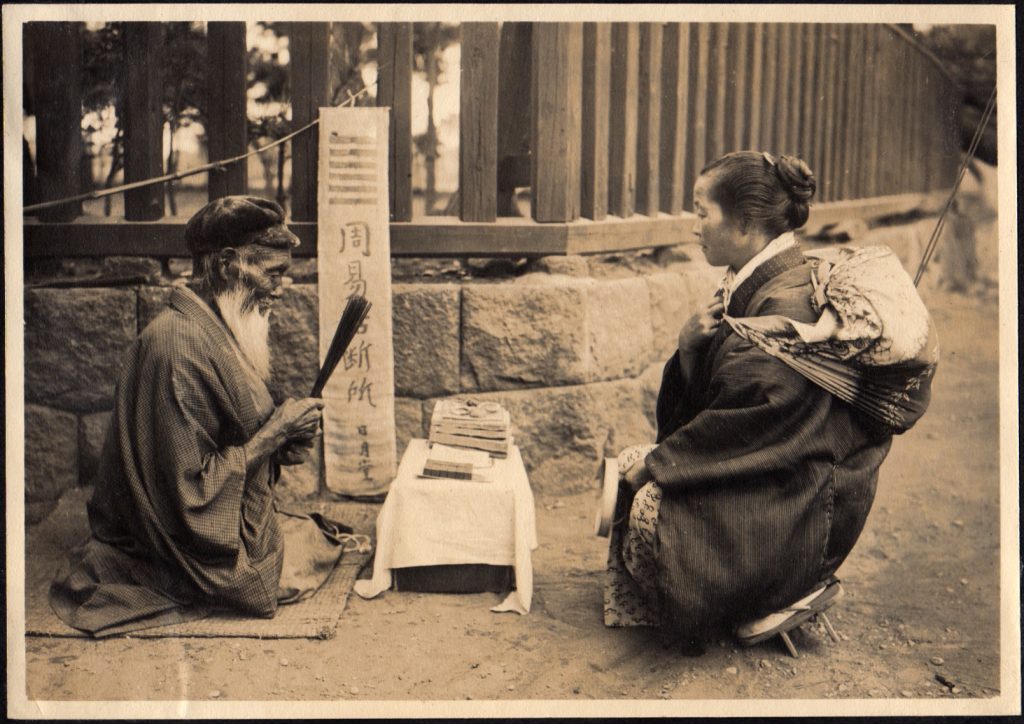
In the I Ching (易經, Yijing), often translated as the Book of Changes or the Classic of Changes, yin and yang are not fixed substances standing in absolute opposition, but phases within a single movement of transformation. Even the words themselves preserve this original image: yin and yang referred to the shaded and sunlit sides of the same mountain, as they swap roles during the course of the day. Yin is the feminine, dark, receptive, yielding, and descending principle, associated with the villain or inferior person; yang is the masculine, light, active, firm, and ascending principle, associated with the gentleman or superior person. They are opposed, yet inseparable; the mountain does not cease to be one because one face lies in darkness while the other receives the sun. As the heavens move, what was illuminated passes into shadow and what was shadowed comes again into light. Opposition is therefore already movement.
This is the metaphysical grammar of the I Ching. Nothing reaches its fullness without beginning, at that very point, to generate its contrary. At the height of yang, yin has already begun; at the height of yin, yang secretly returns. The culmination of one principle is simultaneously the first moment of the other. Summer at its zenith already contains the seed of winter, just as the deepest winter contains within itself the invisible return of spring. Noon inclines towards evening from the very instant it reaches its height; midnight, precisely because darkness can deepen no further, is already the beginning of the return of light.
The apparent paradox is fundamental to the Book of Changes: extremity is the threshold of reversal. What appears strongest is not therefore necessarily most secure. A force at its maximum has exhausted the direction in which it was travelling and begins to create the conditions of its own transformation. Conversely, what appears weakest may already contain the nascent power that will succeed it. Yin exists within yang as possibility, and yang within yin; neither is ever completely absent from the other because each carries within itself the tendency towards change.
This is why the I Ching does not describe reality as a collection of permanent conditions, but as a sequence of configurations whose meaning lies partly in what they are becoming. To see only the manifest condition is to see only half of it. One must also perceive the concealed tendency produced by its very culmination. The mountain face blazing beneath the sun is already moving towards darkness; the face lying in shadow awaits illumination. The greater the ascent towards an extreme, the nearer the point at which movement must turn.
Thus the highest summer is not simply summer: it is summer beginning to become winter. The deepest winter is not simply winter: it is winter beginning to become spring. Yang does not merely defeat yin, nor yin yang. Each fulfils itself, reaches its limit, and from that limit calls forth the other. Change is therefore not an interruption of order but the order itself.
In the I Ching, the predominance of yin is not merely a condition of passivity or darkness: in its political and moral symbolism it becomes the time of the villain, the period in which inferior forces ascend while the gentleman is displaced. Hexagram 12, Pi—Stagnation or Obstruction—expresses the principle starkly: yang departs while yin advances, and with it ‘evil and the villain’ begin to prevail. The disorder is therefore more profound than the commission of particular wrongs. The very conditions under which right and wrong are recognised have become inverted.2
This is the peculiar character of injustice under predominating yin. Wrongdoing no longer necessarily appears as wrongdoing. The villain occupies the place from which judgement is pronounced; partiality becomes administration, corruption becomes convention, and the punishment of what is upright can itself be performed in the name of morality. Hence the I Ching repeatedly associates the advance of yin with the retreat of the gentleman. In Hexagram 33, Dun, yin rises from below while yang withdraws: the inferior element advances precisely because the superior element can no longer act freely within the prevailing conditions.3
The culmination appears in Hexagram 23, Bo, Splitting Apart. Here yin has progressively consumed the yang lines until only the uppermost remains. The image is not simply of an isolated evil act but of erosion from beneath: the foundations are eaten away until what is upright survives only precariously at the summit. I Ching 123 accordingly describes Bo as the struggle in which feminine yin, represented morally as evil or the villain, overpowers masculine yang, represented as goodness or the gentleman.4 What has been corrupted at such a time is not only behaviour but the structure which formerly restrained behaviour.
This is why periods of predominating yin may be especially difficult to recognise from within. When injustice is still exceptional, it shocks; when it becomes predominant, it acquires procedure, vocabulary, officials, and moral justification. The wrong is no longer merely overlooked—it may be protected, rewarded, and enforced. Those who resist it then appear troublesome precisely because the social field itself has ceased to be neutral. The gentleman is compelled to retreat not because truth has ceased to exist, but because the institutions capable of recognising it have fallen under another principle.
Yet the I Ching never permits predominance to be mistaken for permanence. The very extremity of yin contains the beginning of reversal. Once splitting apart has reached its limit, the sequence turns toward return: what has been driven out begins again from below. Thus the age in which injustice appears most complete may already contain the hidden seed of its dissolution. The villain mistakes predominance for victory because he sees only possession of the present; the I Ching sees the movement already concealed within it.
Scholia
- Antonio Gramsci, Selections from the Prison Notebooks, Quintin Hoare and Geoffrey Nowell Smith, eds. and trans. (New York: International Publishers, 1971), particularly ‘State and Civil Society’ and ‘The Study of Philosophy’; Stuart Hall’s later Gramscian theory of articulation developed the language of disarticulation and rearticulation more explicitly in relation to hegemony and ‘common sense’.
- I Ching 123, Hexagram 12, Pi: as yang departs and yin advances, ‘evil and the villain’ begin to prevail.
- I Ching 123, Hexagram 33, Dun: yin grows upward while yang retreats; the image is explicitly associated with the advance of the villain and withdrawal of the gentleman.
- I Ching 123, Hexagram 23, Bo: presents the struggle between predominating yin—‘evil or the villain’—and yang—‘goodness or the gentleman’; cf. Hexagram 20, whose inner hexagram Bo signifies the feminine overpowering the masculine when evil prevails.
Introduction: The Sex More Equal Than the Other—Britain’s Man-, Nation-, and Self-Hating Feminist Dystopia
A further special circumstance must be emphasised, one which confirms the fact already mentioned, namely that those races which have biologically preserved the Nordic type to the greatest extent are sometimes inwardly in a higher degree of regression than others of the same family. It is precisely certain Nordic peoples—above all the Anglo-Saxons—in whom the tradition-determined, normal relationship between the sexes is most profoundly distorted. The so-called emancipation of woman—which in reality signifies nothing other than her mutilation and degradation—did in fact originate among these peoples and found its widest dissemination among them, whereas among other peoples—if only in a bourgeoisised and conventionalised echo—there has still been preserved, in this respect, something of the normal and tradition-determined views.
Baron Julius Evola, Grundrisse der faschistischen Rassenlehre (Outlines of the Fascist Doctrine of Race), Part II, §13, ‘Geschlecht und Rasse’ (‘Sex and Race’), p. 42; original translation from the German
Scarlett Maguire introduced the New Statesman cover as an examination of the ‘femosphere’: Gen-Z women ‘in revolt against a country they don’t like and don’t think works for them’.5 The accompanying Merlin Strategy survey of 2,000 British adults aged eighteen to thirty found that the widening ideological division between young men and women is being driven chiefly by women moving towards the radical left. Maguire identified the most intense form of this disposition among young, white, educated, middle-class women.
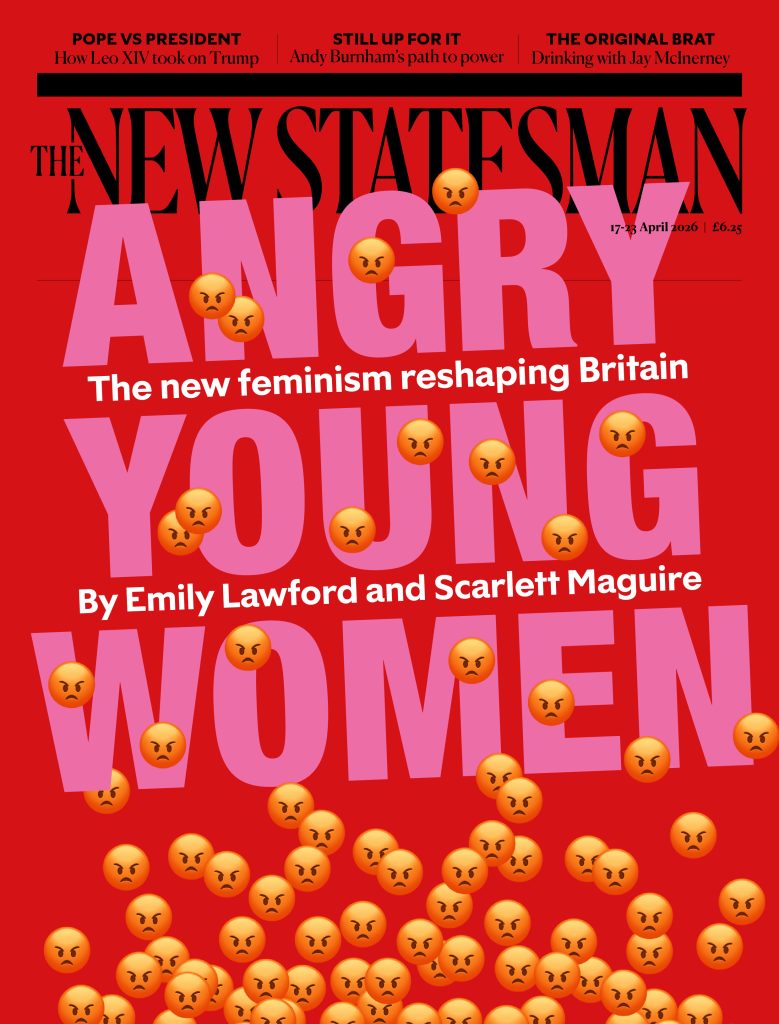
Emily Lawford’s reportage in ‘Meet the Angry Young Women’ gave that statistical hostility a human voice: asked how she felt about the young men she knew, a member of the University of Leeds feminist society replied, ‘I don’t care for them’, before accusing them of tolerating friends who made women uncomfortable and laughing at sexist, racist, and homophobic jokes.6 She offers several further points: one activist defined herself as a revolutionary seeking the destruction of existing systems; another had subordinated her studies, private future, and personal advancement to political activity; the Leeds group unanimously rejected dating across political lines; only one admitted to male friendships, and even she feared that this might make her a ‘pick me’. Lawford ultimately found that these women regarded men principally as prospective threats who might harm or entrap them, while the online ‘femosphere’ both reflected and intensified that estrangement.
The economic findings are remarkably stark. Young women were 26 percentage points less favourable towards capitalism than young men. Men under thirty gave capitalism a net favourability rating of +28; women gave it only +2, while rating communism at +11—nine points above capitalism. Among women under twenty-five, only 16 per cent held a favourable view of capitalism, exactly the same proportion that held a favourable view of fascism. Maguire therefore summarised the finding with complete accuracy: these women disliked capitalism so intensely that they regarded it no more favourably than fascism.
Their economic instincts were explicitly redistributive. Young women preferred the proposition that unequal possession is unfair and wealth ought to be redistributed by 43 to 40 per cent over the proposition that people should retain what belongs to them even where others possess less. Young men divided 37 to 51 per cent against redistribution. Maguire further reported that young women supported British slavery reparations by approximately two to one, while female graduates were especially likely to favour reparations, increased state intervention to produce fairness, and redistribution of wealth.
It was a Wednesday night and seven members of the University of Leeds’ feminist society had invited me to join their book swap. I asked how they felt about the young men they knew. “I don’t care for them,” said a girl called Ruby imperiously. “They’re not bad people, but they refuse to call out their friends who make other girls uncomfortable. They’ll laugh at jokes that are sexist, racist, homophobic, they don’t care about political issues… I don’t think they like women a lot.” If a man is attracted to you, she said, he might talk about things like toxic misogyny. If he doesn’t fancy you, he won’t bother. “I feel like a lot of it is quite sexually motivated with men.”
Emily Lawford, ‘Meet the Angry Young Women’, New Statesman, 15 April 2026
Education strengthened rather than moderated the radicalism. Female graduates held substantially more favourable views of communism, feminism, socialism, environmentalism, Greta Thunberg, and Extinction Rebellion than women without degrees. They were also more supportive of slavery reparations, government intervention, and the ‘redistribution of wealth’. The most highly educated women were therefore furthest from capitalism and most sympathetic to its revolutionary or collectivist alternatives.
Class produced an equally revealing inversion. Only 17 per cent of ABC1 women, those in professional, managerial, and middle-class categories, viewed capitalism positively, compared with 32 per cent of C2DE women, encompassing manual workers, the unemployed, and those dependent upon state support. Maguire’s summary was that the young, middle-class, educated woman feels the strongest revolt against the existing order.
The same class inversion appeared in perceptions of the economy. Among ABC1 women, only 21 per cent thought the economy worked well for people like them, 50 per cent thought it worked against them, and 30 per cent were unsure. Among C2DE women, 39 per cent thought it worked well, 44 per cent thought it worked against them, and 17 per cent were unsure. Across the sexes, 48 per cent of young men thought the economy worked well for people like them, against 37 per cent who thought it worked against them; among young women, only 34 per cent thought it worked well, while 43 per cent thought it worked against them, and 23 per cent were unsure.
This pessimism exceeds their comparative material position. The New Statesman noted that among sixteen- to twenty-four-year-olds, more women than men were in full-time work, the average young woman earned 9 per cent more than the average young man, and male unemployment was 6.3 percentage points higher. Nevertheless, young women were markedly more pessimistic about their careers, earning potential, and ability to acquire property.
Only 58 per cent of young women believed they would earn more than their parents, compared with 73 per cent of young men; 30 per cent of women were pessimistic about doing so, compared with 22 per cent of men. Only 60 per cent of women expected to buy the house they wanted, compared with 69 per cent of men; 35 per cent of women were pessimistic, against 25 per cent of men. On finding a loved occupation, women divided 69 per cent optimistic, 5 per cent unsure, and 26 per cent pessimistic, compared with 72, 5, and 23 per cent among men. The magazine described young women as less happy, ambitious, excited, fulfilled, and hopeful about life generally.
The revolt also extended to Britain itself. Young women were less proud to call themselves British than young men, by 53 to 68 per cent. Among young women generally, 43 per cent judged Britain racist and 38 per cent said it was not; young men divided 29 to 57 per cent in the opposite direction. The survey found a similar sex division over whether Britain is sexist.
Maguire stressed that young white women were more critical of Britain and of their own prospects than ethnic-minority women. After correcting labels that had initially been reversed in the published graphic, the New Statesman reported that 45 per cent of young white women considered Britain racist, 37 per cent did not, and 18 per cent were unsure. Young BAME women divided 39 per cent racist, 39 per cent not racist, and 22 per cent unsure.
Young white women were also less likely to feel valued by society: 48 per cent felt valued, 29 per cent did not, and 24 per cent were unsure. Among BAME women, 56 per cent felt valued, 23 per cent did not, and 21 per cent were unsure. Ethnic-minority women were also more likely to believe that hard work would bring success, more optimistic about exceeding their parents’ earnings, and more content with their careers.
The class panel attached to the racism question recorded 40 per cent of C2DE women calling Britain racist, 40 per cent saying it was not, and 20 per cent unsure; among ABC1 women, the respective figures were 30, 48, and 23 per cent. This particular graphic conflicts with the article’s accompanying prose, which says ABC1 women are more likely to call Britain racist and sexist; the contradiction should be retained or checked against Merlin Strategy’s underlying tables rather than silently harmonised.
Maguire also identified a distinct ‘Covid generation’. Six in ten women under twenty-five said the pandemic had significantly affected their lives and opportunities. This younger group was especially likely to believe that circumstances were ‘stacked against me, no matter how hard I try’, and was markedly more radical and pessimistic than women aged twenty-five to thirty. Keir Starmer’s net approval stood at −27 among women under twenty-five, compared with +17 among the slightly older female cohort.
Time spent online intensified the pattern. Women online for more than five hours each day were more inclined towards redistribution and prioritising the reduction of inequality over economic growth; they were more sympathetic towards environmentalism, Thunberg, Zack Polanski, and the claim that climate change is the greatest global threat. They were also more likely to believe abortion access was under attack in Britain.
The political radicalism was accompanied by pronounced hostility towards men. Among women under twenty-five, only 35 per cent held a positive view of men, 37 per cent were neutral, and 27 per cent were negative; a mere 11 per cent held a very positive view. Among all women under thirty, 50 per cent were positive, 29 per cent neutral, and 21 per cent negative. Young men’s views of women were dramatically warmer: 72 per cent positive, 21 per cent neutral, and 7 per cent negative. Women under thirty were therefore three times as likely to hold a negative view of men as young men were to hold a negative view of women. Among all under-thirties, 38 per cent of men felt very positively towards women, compared with only 18 per cent of women towards men.
Class again sharpened the hostility in the unexpected direction: only 36 per cent of ABC1 young women viewed men positively, compared with 61 per cent of C2DE young women. Among women under twenty-five, fewer than half, 47 per cent, felt understood by men. More than four in ten women also said men lacked women’s understanding of sexual consent, whereas 25 per cent of men made the corresponding judgement of women.
The social consequences were already visible in intimate selection. One quarter of young women regarded political disagreement itself as a relationship warning sign. Around six in ten would find it difficult to date someone who disagreed with them over Israel and Palestine or Donald Trump; 74 per cent would find a relationship difficult where the other person differed over ‘social justice’, and women were also more likely than men to refuse someone with differing immigration views.
Young women were twice as likely as young men to say they did not want children at 15 per cent against 8 per cent, rising to one in five among white women under thirty. The cover report described the young women interviewed as frightened of being trapped or harmed by men, alienated from mainstream politics, fearful of Reform, socially isolated, and increasingly radicalised by an online ‘femosphere’ that both reflects and perpetuates their disaffection. One Leeds feminist-society member dismissed the young men she knew with the phrase, ‘I don’t care for them’; the women interviewed treated pessimism itself as evidence of moral seriousness.
Maguire’s complete portrait was therefore consistent: young British women, most intensely the youngest, white, graduate, and professional women, were simultaneously more favourable towards communism and socialism, more hostile towards capitalism, more supportive of redistribution, reparations, intervention, feminism, and radical environmentalism, more convinced that Britain is racist and sexist, more pessimistic about their prospects despite comparatively favourable economic circumstances, and considerably more hostile towards the opposite sex than young men were. She summarised them as a generation in revolt against a country they neither liked nor believed worked for them.
Literally, Literally Off the Charts

John Burn-Murdoch’s comparative Financial Times graph places this British development in international perspective.7 The chart measures the political ideology of eighteen- to twenty-nine-year-olds as the percentage identifying as liberal minus the percentage identifying as conservative, separated by sex. It is measured in net percentage points rather than standard deviations. On that scale, young British women surged beyond +40, approximately another full ten-point chart division above young American women, forcing the British female line beyond the graphic’s original upper boundary: quite literally off the chart. Young British men remained around +20, approximately the position occupied by young German women; the British male who now appears comparatively conservative beside his female compatriot is therefore about as liberal as the young woman of another major European state.
The FT graphic drew upon Daniel Cox and the Survey Center on American Life, the Gallup Poll Social Series, FT analysis of the General Social Surveys of Korea, Germany, and the United States, and the British Election Study. The American series used self-declared ideology; the other national series used support for liberal and conservative parties, with the figures adjusted for broader changes over time.
The same deviation towards one sex is reflected in the dating market. The premise of modern dating was supposed to be equality; yet equality is a strange description of a market in which the other sex is ordinarily expected to initiate, pursue, expose itself to rejection, and compete for attention, while one receives the greater volume of approaches and can exercise its selectivity from that position of privileged abundance. In large heterosexual online-dating samples, women received substantially more incoming messages than men, while men sent the great majority of first approaches; women could therefore afford to be markedly more selective in deciding which approaches even deserved a response.8 The emancipated dating market thus did not abolish sex asymmetry: it redistributed its burdens, leaving male desire to do much of the approaching while female choice retained the stronger gatekeeping position.
Scholia
- Scarlett Maguire, ‘Revealed: the New Radicalism among Young Women’, New Statesman, 15 April 2026; Merlin Strategy survey of 2,000 British eighteen- to thirty-year-olds; https://archive.is/kXv0E; Scarlett Maguire, X thread summarising the polling as the rise of a British ‘femosphere’, 15 April 2026; https://threadreaderapp.com/thread/2044312076424724870
- Emily Lawford, ‘Meet the Angry Young Women’, New Statesman, 15 April 2026. (Archive)
- John Burn-Murdoch, ‘A New Global Gender Divide Is Emerging’, Financial Times, 25 January 2024; https://www.ft.com/content/29fd9b5c-2f35-41bf-9d4c-994db4e12998?syn-25a6b1a6=1; https://threadreaderapp.com/thread/1750849189834022932.html
- Elizabeth E. Bruch and M. E. J. Newman, ‘Aspirational Pursuit of Mates in Online Dating Markets’, Science Advances, 4.8 (2018), eaap9815: analysis of heterosexual dating markets in New York, Boston, Chicago, and Seattle found that women received more initial messages than men overall, while men sent most first messages; women’s average reply rate to men was below 20%, demonstrating highly selective female response patterns. Gareth Tyson, Vasile C. Perta, Hamed Haddad, and Michael C. Seto, ‘A First Look at User Activity on Tinder’, 2016 IEEE/ACM International Conference on Advances in Social Networks Analysis and Mining (2016): in their Tinder data, women accumulated matches rapidly while men accumulated them slowly; men liked a substantially larger proportion of women and sent messages more rapidly after matching, while women were more selective in whom they liked and more often waited to receive the first message.
Causation: Britain’s Cratering Birthrate in Lockstep with Female Emancipation and Maternal Authority
‘Correlation is not causation’ is a valid warning against deriving causality from coincidence alone; used against an argument already supported by chronology, mechanism, testimony, and repeated historical analysis and association, it becomes little more than a veto against allowing evidence to cohere disguised as epistemic. It can therefore function as a thought-terminating cliché: disparate facts begin to form a coherent historical pattern, and ‘correlation is not causation’ is invoked to prevent the pattern from being considered as a whole. In its crudest form, it effectively means: no quantity of mutually supporting circumstantial evidence may be allowed to mature into causal inference.
The legislative emancipation of women in Britain proceeded through successive enlargements of female legal, political, professional, and economic status. The Married Women’s Property Act 1870 allowed married women to retain earnings and certain property acquired after marriage; the Married Women’s Property Act 1882 extended this substantially, enabling married women to own and control property in their own right.9 At the same time, the crude birth rate in England and Wales stood at an average of 35.4 births per 1,000 population in 1871–80, 32.5 in 1881–90, and 29.9 in 1891–1900.10
The next major political settlement came with the Representation of the People Act 1918, which enfranchised women over thirty who met the prescribed property qualification, while the Parliament (Qualification of Women) Act 1918 allowed women to sit in the House of Commons. In December 1918, approximately 8.5 million women were eligible to vote in a general election for the first time.11 The crude birth rate had been 24.1 per 1,000 in 1913, fell to 17.7 in 1918, and subsequently rose to 25.5 in 1920.12
The Sex Disqualification (Removal) Act 1919 extended the transformation into professional and public life. Its first section declared that a person should not be disqualified ‘by sex or marriage’ from exercising a public function or from appointment to civil or judicial office.13
The Representation of the People (Equal Franchise) Act 1928 completed equal parliamentary enfranchisement by giving women the vote at twenty-one on the same terms as men. Fifteen million women became eligible, and women constituted 52.7 per cent of the potential electorate.14 The crude birth rate in England and Wales was 16.7 per 1,000 in 1928 and 15.3 in 1932.15
The post-war decades saw another rise in fertility. England and Wales reached 875,972 live births in 1964, with a total fertility rate of 2.93 children per woman. The TFR then stood at 2.85 in 1965, 2.75 in 1966, 2.65 in 1967, 2.57 in 1968, and 2.47 in 1969.16
In 1967, Parliament enacted both the National Health Service (Family Planning) Act and the Abortion Act. The former placed family-planning provision within the statutory health-service framework, while the latter amended the law governing termination of pregnancy by registered medical practitioners.17 By 1970, the England-and-Wales TFR stood at 2.40.
The Equal Pay Act 1970 established statutory equality in contractual terms of employment between men and women, followed by the Sex Discrimination Act 1975, which rendered specified forms of discrimination on grounds of sex and marriage unlawful.18 In the demographic series, the TFR was 2.40 in 1970, 2.17 in 1972, 1.78 in 1975, and 1.66 in 1977; the latter year recorded 569,259 live births, the lowest annual total of the twentieth century.19
Fertility remained below the levels of the 1960s thereafter. The England-and-Wales TFR reached 1.63 in 2001, rose during the following decade to 1.94 in 2010, stood at 1.93 in 2011, and returned to 1.94 in 2012.20
The Equality Act 2010 consolidated the principal statutory regime governing sex discrimination and equality of contractual terms, replacing, among other enactments, the Equal Pay Act 1970 and Sex Discrimination Act 1975.21
The later demographic sequence was 1.94 in 2012, 1.85 in 2013, 1.70 in 2018, 1.58 in 2020, 1.44 in 2023, and 1.41 in 2024. The latest ONS release gives a provisional England-and-Wales TFR of 1.39 for 2025, with 585,396 live births registered that year.22
The running demographic tally can therefore be stated compactly as:
1871–80: 35.4 births per 1,000
1881–90: 32.5
1891–1900: 29.9
1913: 24.1
1918: 17.7
1920: 25.5
1928: 16.7
1932: 15.3
1964: TFR 2.93
1967: 2.65
1970: 2.40
1975: 1.78
1977: 1.66
2001: 1.63
2010: 1.94
2012: 1.94
2018: 1.70
2020: 1.58
2023: 1.44
2024: 1.41
2025: 1.39 provisional.
Scholia
- UK Parliament, Making a Difference Since 1918, on the Married Women’s Property Acts of 1870 and 1882.
- Historical England-and-Wales crude birth-rate series.
- Representation of the People Act 1918; Parliament (Qualification of Women) Act 1918; UK Parliament, ‘Key dates’.
- Historical birth-rate series for England and Wales.
- Sex Disqualification (Removal) Act 1919, s. 1.
- UK Parliament, ‘Equal Franchise Act 1928’.
- Historical England-and-Wales birth-rate series.
- Office for National Statistics, historical birth-summary tables.
- National Health Service (Family Planning) Act 1967; Abortion Act 1967.
- Equal Pay Act 1970; Sex Discrimination Act 1975.
- Office for National Statistics, historical birth-summary tables.
- Office for National Statistics, Births in England and Wales: 2012 and 2020.
- Equality Act 2010 and explanatory notes.
- Office for National Statistics, Births in England and Wales: 2023, 2024, and 2025.
The One-Sided Sex: A Modern Woman Can Hit You Without Getting Hit Back
A modern asymmetry reveals itself most clearly when a woman asks a man to speak plainly about hierarchy. She asks, not once, but repeatedly. She solicits candour, insists upon clarity, reassures him that she wants to understand, and presents herself as open to hearing what he actually believes. The invitation seems explicit, civil, and voluntary. Yet the moment the answer arrives without apology, the entire scene is rewritten. Her own invitation vanishes; her persistence is forgotten; her reassurances are annulled. He is suddenly treated as though he had forced the matter upon her, as though his doctrine had been thrust into her hands, as though the violence lay not in her own reaction, but in his very willingness to answer the question she herself had posed.
This reversal is not incidental. It is one of the characteristic mechanisms of the egalitarian order. The question is allowed only so long as the answer remains imaginary, abstract, or safely reducible to modern assumptions. The man may be invited to speak of patriarchy, authority, or woman’s place, but only under the tacit condition that his speech eventually returns to premises already approved by the questioner. The appearance of openness conceals a demand for conformity. The answer is not truly meant to disclose anything; it is meant to confirm that, at bottom, no serious difference exists. If difference does exist, then the invitation becomes a trap. What was presented as an opening to speech is retroactively transformed into proof that speech itself was an offence.
This is why the spectacle so often acquires a peculiar hysteria. The woman who asked the question behaves, at the moment of hearing the answer, as though she were now a passive victim of something imposed upon her. Her own agency evaporates the instant responsibility for the encounter threatens to fall upon her. She did not merely hear something she disliked; she had actively elicited it. Yet rather than admit that she voluntarily entered a space in which a difficult answer was possible, she converts her displeasure into a claim of injury. In this way, offence becomes retroactive coercion. The answer is treated not as the fulfilment of an invitation, but as a violation of an innocence that never, in fact, existed.
This is already enough to expose the hidden moral economy at work. The asymmetry is not subtle once seen. She may ask, probe, insist, and draw out. He must answer, clarify, and endure scrutiny. But should the answer exceed the moral boundaries she had privately reserved to herself, then her role as initiator disappears. The scene is reconstructed so that all active force belongs to him and all passive suffering to her. He becomes guilty not because he lied, concealed, or imposed himself, but because he accepted the invitation literally. He believed the question had really been asked.
That is why the modern woman is so often permitted to enjoy the privileges of inquiry without assuming its duties. Genuine inquiry involves risk. It means asking a question to which one does not already possess the acceptable answer. It means allowing another person to remain himself long enough to hear what he truly thinks, even if one intends later to reject it. But the egalitarian temper cannot tolerate this risk. It wishes to preserve the flattery of openness while abolishing the danger of revelation. It asks only in order to domesticate. If domestication fails, it punishes the answer for not having been pre-tamed.
The resulting posture is one of profound bad faith. A woman asks to hear the doctrine of hierarchy; when hierarchy is explained without embarrassment, she behaves as though she has been ambushed. She demands an account of authority; when authority is named, she speaks as though some indecency has been sprung upon her. She requests clarity; when clarity is provided, she treats clarity itself as aggression. Her own invitation becomes the one fact that must be erased, because if it remains visible, then her later outrage loses its moral glamour and must instead appear as what it is: a refusal to be bound by the consequences of her own choice.
And this is where the archetype becomes especially revealing. The man does not need to coerce; he need only answer. The woman does not need to prohibit the answer beforehand; she need only criminalise it afterwards. This is the more elusive form of ideological domination characteristic of the present age. It is not content merely to forbid speech. It invites speech, tempts speech, presses for speech, and then, once speech has manifested itself in a form too real to be safely absorbed, denounces the speaker for having spoken. Thus the question is preserved as a badge of tolerance, while the answer is punished as a trespass.
In such a world, the scandal is not simply that hierarchy is hated. The deeper scandal is that reciprocity itself is denied. The woman reserves to herself the right to question without truly hearing, to invite without being held to the fact of invitation, and to react as though she had been violated by an answer she freely demanded. The man, by contrast, is denied even the elementary fairness of being treated as one who has merely done what was asked of him. He spoke because he was asked to speak; she condemns him because she could not bear that he answered sincerely. This is the first asymmetry, and it is already enough to show that the egalitarian order rests not upon reciprocity, but upon a concealed privilege: her question remains innocent, his answer becomes guilty, and the one who opened the door claims the right to scream that she has been entered by force.
The encounter more than mere failure of comprehension, exposes a gynaecocentric moral asymmetry so deeply embedded in the modern relation between the sexes that it can pass for equality while distributing agency, innocence, judgement, and blame in opposite directions.
The woman is treated as fully sovereign whenever she chooses, questions, refuses, withdraws, accuses, or redefines the terms of an encounter, whether sexual or merely social—both serve the same ends to her psyche. Her will is presumed authentic, self-originating, and inviolable. Yet the moment consequence follows from that will, her agency begins to fade. What she freely initiated becomes something that happened to her. What she repeatedly solicited becomes an imposition. What she provoked becomes evidence of male aggression. Her power remains visible only while it enlarges her freedom; once it threatens to implicate her, she retreats into innocence.
The man receives the inverse dispensation. His agency is distrusted while he speaks. His motives are attributed to resentment, conditioning, insecurity, sexual failure, or a secret desire for domination. His consciousness is treated as opaque even to himself, awaiting female interpretation. Yet when blame must be assigned, he suddenly becomes the sole author of everything that occurred. Her invitation, persistence, insults, reversals, and provocations recede from view; his answer alone remains, inflated until it bears the whole moral weight of the exchange.
Thus the egalitarian order distributes freedom and responsibility with exquisite inequality: She is sovereign in action and innocent in consequence; he is suspect in action and subject to blame.
This arrangement enables woman to occupy contradictory positions without ever being required to reconcile them. She may present herself as independent enough to enter any discussion, challenge any authority, and reject any inherited form; the instant the encounter becomes painful, she may recover the privileges of fragility and treat the man as the sole governing force. She may claim equality when demanding access and invoke vulnerability when accounting for what she did with it. Her agency is expansive where it secures privilege, and evanescent where it would incur judgement.
No such movement is permitted to the man. He must remain responsible for his own words, her interpretation of them, the emotions they awakened, the historical conditions surrounding them, and the consequences of her reaction. Even silence may be charged against him. If he explains, he is lecturing; if he declines, he is withholding; if he speaks sternly, he is domineering; if he softens, he has confessed that the principle cannot bear its own weight. Every path leads back to his guilt because the system has already assigned him the role of responsible agent and her the role of morally privileged respondent.
This is why the asymmetry appears most clearly around offence. Offence is treated as though it were an event caused wholly by the person whose words occasioned it. The offended party’s assumptions, temper, prejudices, expectations, and interpretative violence vanish. She experiences an emotion; therefore he must have done something to her. The entire interior apparatus by which she converted speech into injury is protected from examination.
The consequence is a strange reversal of personhood. The man’s interiority becomes public property, endlessly interpreted and corrected from outside; the woman’s interiority becomes sovereign evidence, beyond dispute because it has been felt. He may not define his own motives, yet she may define and coerce them for him. She may say that his doctrine arises from bitterness, that his criticism springs from sexual rejection, that his patrician severity conceals impotence, and that his historical interests merely compensate for personal deficiency. He is denied authority over the meaning of his own life. Her reaction, meanwhile, is treated as self-validating. She need not distinguish comprehension from projection, injury from wounded pride, or moral insight from ideological conditioning. Her feeling arrives already crowned.
The same asymmetry governs interpretation. She may reduce a long and articulated work to a single epithet; he must answer the reduction as though it were a serious account. She may ignore the work’s inward movement, its distinctions, its sources, and the experiences that produced it; he must nevertheless acknowledge her caricature as the proper subject of discussion. She is permitted to invent a degraded figure and address him in place of the author standing before her. Should he refuse that substitution, his refusal becomes further evidence of guilt.
The accusation ‘sexist’ performs this operation with particular efficiency. It converts an entire philosophy of sex, form, hierarchy, authority, and civilisation into a moral defect residing inside the man. No chain of reasoning is required. The word reports how the doctrine appears from within egalitarian premises, then presents that reaction as though it had demonstrated something about the doctrine itself. The woman’s perception becomes judgement; the man’s thought becomes pathology.
The asymmetry becomes still clearer when the encounter turns cruel. A woman may strike at a man’s intelligence, desirability, masculinity, social worth, and prospects of marriage while imagining that she remains the injured party. Her cruelty is absorbed into the righteousness of her cause. Because she has first placed him outside the circle of acceptable men, ordinary obligations of restraint no longer seem to apply. The caricature authorises the punishment.
He, by contrast, is expected to receive the punishment as instruction. His resistance proves that the lesson was necessary. His righteous anger confirms the accusation. His withdrawal reveals emotional incapacity. His indifference becomes arrogance. The system cannot be falsified because every response has already been translated into evidence against him.
This is why the language of equality so often conceals a one-sided disciplinary order. Formal superiority is condemned, while informal female jurisdiction expands without limit. She may question the man as examiner, correct him as schoolmistress, shame him as censor, diagnose him as therapist, reject him as social gatekeeper, and sentence him as moral judge. She may pass among these offices without ever naming the authority she has assumed. Equality supplies the disguise. Since she is formally his equal, her domination cannot be acknowledged as domination; it appears merely as reaction, preference, boundary, or self-expression.
The result is authority without office, power without duty, and judgement without reciprocity.
A formal hierarchy at least names who may command, where that command applies, and what obligations accompany it. The informal hierarchy of egalitarianism possesses no such boundaries. It is fluid, emotional, and retrospective. The woman may claim authority after the fact, whenever her feelings require it, and withdraw into equality whenever accountability approaches. She may become superior for the purpose of chastisement and equal for the purpose of evading judgement.
This flexibility gives the order its peculiar cruelty. A man cannot answer it through obedience because the command continually changes. He is expected to be strong, yet never authoritative; open, yet never severe; candid, yet never offensive; independent, yet governed by female approval; sexually desirable, yet purified of every judgement that might displease women. He must possess form while surrendering the right to impose form anywhere beyond himself. He must lead without being above, protect without ruling, provide without judging, and absorb consequence without naming its source.
The asymmetry appears again in the language of choice. Woman’s choices are treated as emancipatory acts whose legitimacy resides in the fact that she chose them. Yet the aggregate consequences of those choices are placed beyond criticism. Courtship may decay, marriage may become adversarial, fertility may collapse, and relations between the sexes may harden into suspicion; each woman remains an autonomous individual whose choices cannot be judged through their collective effects. The man who names the pattern, however, is immediately treated as a representative of his sex and made answerable for every historical injury attributed to men.
Individuality belongs to her when blame approaches; collective guilt belongs to him whenever accusation requires it.
The same woman who refuses to be judged through the behaviour of other women may invoke ‘millions of women’ as a collective force against one man. She may borrow their achievements, their sufferings, their public stature, and their moral credit as though sex constituted a treasury from which she could withdraw authority. Yet he may not speak from the accumulated experiences of men, from injuries inflicted by women, or from civilisational patterns involving the female sex without being condemned for generalisation. Her collective identity grants power; his collective memory becomes prejudice.
The order is one-sided because it recognises female class-consciousness as solidarity and male pattern-recognition as hatred.
This permits woman to stand simultaneously as individual and collective, choosing whichever position confers advantage. As an individual, she is exempt from every criticism directed towards women generally. As a woman, she may inherit the achievements and grievances of the entire sex. She may say, ‘Do not judge me by other women’, then rebuke a man through the deeds of women she has never met. She escapes downward comparison while retaining upward appropriation.
Man receives no reciprocal privilege. His failures are individual proof of personal defect; his achievements are dismissed as products of male advantage. He may not borrow greatness from men of his civilisation, because such identification is called arrogance, chauvinism, or nostalgia. Yet he may be burdened with their alleged crimes. He inherits guilt without glory, while she inherits glory without guilt.
This is the concealed moral economy of the one-sided sex.
Its most potent achievement is to make the asymmetry appear compassionate. Female unaccountability is described as sensitivity to power; male accountability is described as justice. Her interpretative sovereignty becomes recognition of lived experience; his resistance becomes refusal to listen. Her cruelty is contextualised; his pain is pathologised. Every inequality is redescribed through a vocabulary that presents the favoured side as merely protected and the burdened side as merely responsible.
What appears as equality is therefore a distribution of moral roles. Woman becomes the bearer of experience, injury, and judgement. Man becomes the bearer of cause, guilt, and correction. She feels; he answers. She accuses; he explains. She chooses; he incurs. She withdraws; he is left with the consequences. The asymmetry is so complete that even naming it appears as another offence against her.
The one-sided sex does not merely receive more sympathy. It receives the power to remain author of its actions until authorship becomes inconvenient, then to become the passive object of circumstances created partly by its own will. It may exercise authority without admitting rank, punish without accepting responsibility, and demand recognition while denying reciprocity.
Equality has therefore produced no neutral field between the sexes. It has created a moral arrangement in which one side may move between sovereignty and innocence at will, while the other is fixed permanently beneath judgement.
Alexander Rogers; The Young Oxonian Killed by University Female Privilege
Alexander Rogers was twenty years old: handsome, accomplished, and already admitted to one of the most exacting intellectual communities in England. He was a third-year materials-science student at Corpus Christi College, Oxford; talented, popular, active in the boat club, treasurer of the Junior Common Room, and remembered by his friends as a young man who filled rooms with laughter and lived with exceptional vitality. By every outwards measure, life had opened before him. He possessed youth, beauty, intelligence, fellowship, and the promise of a distinguished future. Oxford’s coroner later described him as ‘an extremely able and popular young man’; his family mourned ‘what could have been a beautiful life’.

Then a woman expressed regret about a sexual encounter.
No formal finding of misconduct had been made. The matter passed instead into the informal jurisdiction of his peers. Friends assembled to confront him, told him that he had ‘messed up’, announced that they required distance from him, and expelled him from the circle whose friendship had formed the immediate world of his young life. In the days before his death, the coroner recorded ‘name calling’, ‘targeted behaviour’, exclusion, and rejection.23 Alexander, already made to inhabit their judgement, wrote of actions he believed unintentional yet ‘unforgivable’. Shortly afterwards, he died by suicide in the Thames. The inquest found that the distress caused by his ostracism led him to form the intention to end his life, while recognising the complexity invariably surrounding such a death.
Here stands the one-sided tribunal in its most terrible form. Her discomfort entered the circle as morally authoritative; his consciousness entered it only as the site in which guilt must be produced. Her retrospective feeling required immediate collective recognition. His intention, understanding, vulnerability, and right to remain a human being beneath uncertainty were subordinated to the urgency of demonstrating allegiance to her injury.
His peers needed no magistrate, no evidence tested before an impartial authority, and no proportionate judgement. They became investigators, jury, moral legislators, and executioners of social standing at once. Their punishment could still be called ‘distance’ or a private ‘boundary’, because the egalitarian order refuses to name ostracism as power. Each person merely withdrew; collectively, they destroyed his world.
The independent review commissioned after his death identified precisely this culture of student ‘self-policing’: allegations or perceptions of wrongdoing answered by isolation and exclusion outside formal processes and without proper investigation or evidence. The coroner warned that such ostracism can produce isolation, shame, guilt, and worthlessness—conditions recognised as grave risks to life—and formally called upon the Department for Education to act against the danger across British universities.
The asymmetry could scarcely have been more absolute. The young woman was permitted discomfort without accountability for what others might build around it; the young man was assigned accountability so total that even an act he believed unintentional became, in his own mind, beyond forgiveness. She remained a person whose subjective experience demanded protection. He became an allegation wearing a human face.
What is required is not some dutiful genuflection before the reported ‘discomfort’, as though its mere assertion settled the moral character of the encounter, but the recognition of his humanity, which the moral authority of female emancipation ultimately taught even him to withhold from himself. Yet the modern tribunal scarcely permits even that elementary consideration. Once female unease has been alleged, it expands until it consumes the entire event: ambiguity becomes menace, interpretation hardens into fact, and the subjective impression of one party acquires an authority denied to every circumstance surrounding the other. Her account is treated as the event itself; his life, reputation, intentions, and eventual ruin become little more than collateral debris beneath a narrative whose moral conclusion was effectively written the moment she complained.
Most terrible of all, this judgement appears finally to have been internalised by Rogers himself. By his own account he did not believe that he had wilfully committed a wrong; whatever had occurred, he understood it as unintended, and no formal finding had established misconduct. Yet confronted with her account, he nevertheless came to describe his own actions as ‘unforgivable’. There is something profoundly bleak in that submission: the moral authority accumulated by female emancipation had become so absolute that the woman’s subjective report could supersede not merely his explanation, but his own right to interpret his conduct and retain a sense of his humanity. The same ideological tradition which had progressively rendered male authority suspect under the abstraction of ‘patriarchy’ here descends into the individual conscience, until the man himself learns to distrust his intentions, discount the absence of wilful wrongdoing, and pronounce sentence upon himself in the moral vocabulary of the very culture that has denied him standing. The tribunal no longer needed to remain external; its judgement had been installed within him.
What is this, if not tyranny of another and more sanctimonious kind: a dispensation in which the wildest fantasies ever projected upon ‘male patriarchy’—itself a remarkably serviceable abstraction for extracting status, institutional advantage, money, and personal benefit beneath the consecrating language of ‘liberation’ and ‘equality’, concepts whose supposed moral self-evidence is itself long overdue for scrutiny—scarcely approach the moral absolutism of a culture that demands infinite tolerance for female accusation, yet withholds from the man even the elementary right to his own intention, dignity, and judgement? Female emancipation thus, does not merely overthrow authority; it claims the prerogative to define reality, assign guilt, and compel the accused to participate in his own condemnation.
Alexander Rogers was not a crude abstraction called ‘male privilege’, or the one that has returned from 60s radical feminism, ‘male supremacy’. He was a beautiful and gifted young man at the threshold of his life. He had a family, a future, a place among friends, and a name that should have survived in achievements rather than in a coroner’s warning. The one-sided moral order could perceive the possibility that he had caused harm; it could not preserve the possibility that he remained worthy of proportion, inquiry, fellowship, and mercy.
The sex more equal than the other receives belief, solidarity, and protection at the moment of discomfort. The man receives judgement, isolation, and the command to carry the whole moral burden alone. In Alexander Rogers, that asymmetry ceased to be rhetoric. It acquired a handsome face, a brilliant future—and then a grave.
Scholia
- Andy Gregory, ‘Call to Review “Cancel Culture” in Universities after “Ostracised” Oxford Student Takes Own Life’, The Independent, 11 November 2024; Nicholas Graham, HM Area Coroner for Oxfordshire, ‘Alexander Rogers: Prevention of Future Deaths Report’, Ref. 2024-0624, 8 November 2024, Courts and Tribunals Judiciary. The coroner recorded that Rogers had suffered ‘name calling’, ‘targeted behaviour’, exclusion, and rejection following allegations concerning his conduct; the report also identified social ostracism as student ‘self-policing’ conducted without proper investigation or evidence.
The Duluth Model: Female Cruelty and Violence Licensed as Virtue Against Men and Boys
The UK approach is largely influenced by the Duluth Model (Pence and Paymar, 1993), characterised as psycho-educational in nature, challenging men’s use of power and control over women; however, many programmes have now broadened their approach to recognise shortcomings of the model, incorporating elements of cognitive-behavioural therapy (CBT) and targeting the factors that impact on domestic abuse risk (e.g., emotional and relationship skills deficits, substance abuse, mental health, housing), and delivering programmes to both male and female perpetrators.
Mayor’s Office for Policing and Crime, The Croydon Drive Project: A 2-Year Evaluation, 2020, p. 8
Few doctrines reveal more nakedly the ideological deformation of domestic violence than the Duluth Model, the feminist programme devised in Minnesota in the early 1980s and subsequently exported through the institutions charged with policing intimate relationships. Its governing schema placed male ‘power and control’ at the centre of domestic abuse: man appears as the socially authorised aggressor, his violence interpreted through ‘male privilege’ and patriarchy, while female violence was traditionally relegated to the derivative categories of resistance, retaliation, or self-defence. The result was a sexually sectarian, male-demonising theory of violence in which the sexes entered the analysis morally pre-assigned: the man’s conduct demanded explanation in terms of his entitlement and domination; the woman’s violence demanded explanation by what had been done to her. This is particularly grotesque besides evidence of bidirectional violence and of psychological aggression preceding and precipitating physical assault, because the model can sever the violent culmination from the relational sequence that produced it and then solemnly announce that the sex which struck last has disclosed the hidden structure of ‘patriarchy’.24 The man may therefore arrive battered, provoked, psychologically abused, or caught within reciprocal violence and nevertheless enter an institutional vocabulary already trained to recognise him first as the bearer of power.
Nor did this remain the eccentric doctrine of a counselling room in Minnesota. Duluth’s ambition was institutional: its celebrated ‘co-ordinated community response’ sought to organise police, prosecutors, courts, probation, social services, advocacy bodies, and perpetrator programmes around a common account of domestic violence. Its influence travelled internationally; the British Government itself now acknowledges Duluth as the origin of many contemporary perpetrator interventions, and official London research describes the UK approach as having been ‘largely influenced’ by it. Thus a contested feminist theory of the sexes did not merely enter therapeutic literature; it helped furnish the conceptual grammar through which states learned to identify victim and perpetrator. Even the empirical record has failed to justify the confidence with which this ideological architecture was institutionalised: a major 2021 Campbell systematic review of court-mandated batterer programmes found insufficient evidence that they were effective, concluding that the classic programmes founded upon feminist, cognitive-behavioural, or combined frameworks were unlikely to provide a meaningful solution to intimate-partner violence.
Cancel culture has not invented cruelty among young women; it furnished one of its most characteristic forms with a righteous vocabulary, an approving audience, and the presumption of innocence. Conduct once recognisable as gossip, ostracism, social sabotage, withdrawal of friendship, reputational destruction, and the calculated turning of a circle against one person could now be performed as moral duty. The aggressor ceased to appear aggressive. She was ‘setting a boundary’, ‘protecting women’, ‘holding him accountable’, or making the community ‘safe’.
Psychology already possesses a term for much of this conduct: relational aggression, in which relationships and social standing become the instruments of harm. It includes exclusion, malicious gossip, betrayal of confidence, the silent treatment, and the manipulation of friends against a target. Research among young adults has found women reporting greater use of romantic relational aggression than men, while men were more likely to report suffering it; broader research likewise identifies social exclusion as a central form of indirect aggression disproportionately used by women and girls across the lifespan.25 26
Cancel culture takes this mode of aggression and removes its remaining restraints. The young woman no longer needs to admit that she wishes to punish, isolate, humiliate, or dominate. She need only describe herself as ‘uncomfortable’. The collective performs the aggression for her, while each participant retains the fiction of private innocence: one person ceases speaking to him, another repeats the story, another warns a friend, another withdraws an invitation, and another reports him. No single act appears decisive; together, they may annihilate his social existence.
This is cruelty distributed so widely that no one need acknowledge authorship.
The moral asymmetry makes young men especially vulnerable. Female distress is interpreted socially and expansively: it calls friends, institutions, and platforms into action. Male distress is privatised. He is expected to endure rejection, shame, accusation, and isolation without making his pain burdensome to anyone else. Should he protest, the protest becomes evidence of danger; should he collapse, his collapse is detached from the social punishment that preceded it and attributed to some private weakness within him.
Alexander Rogers’s death exposed the possible extremity of this arrangement. The Oxford coroner found evidence of a student culture in which ostracism was used as ‘self-policing’ after allegations, ‘in the absence of formal processes and without proper investigation or evidence’. The report warned that exclusion can produce isolation, shame, guilt, and worthlessness, and that such conduct had become normalised within student communities.27 The punishment possessed no formal judge and required no finding; it was enacted through the ordinary social powers of peers.
This is precisely why cancel culture is so congenial to a degraded egalitarian order. It permits enormous power to be exercised while denying that anyone holds authority. The young woman may initiate a moral prosecution without appearing to command it. Her friends may ruin a man while claiming merely to support her. Institutions may ratify the social sentence without accepting responsibility for determining guilt. Everyone acts; no one rules. Everyone punishes; no one becomes answerable for the punishment.
The system also trains young women to mistake emotional intensity for moral rank. The stronger the emotive pathos of disgust, fear, or offence, the more legitimate the retaliation appears. Proportion becomes almost indecent: to ask whether the punishment exceeds the offence is treated as hostility towards the woman who complained. Compassion flows entirely towards the initiating grievance, while the accused man is progressively stripped of personality until only the allegation remains.
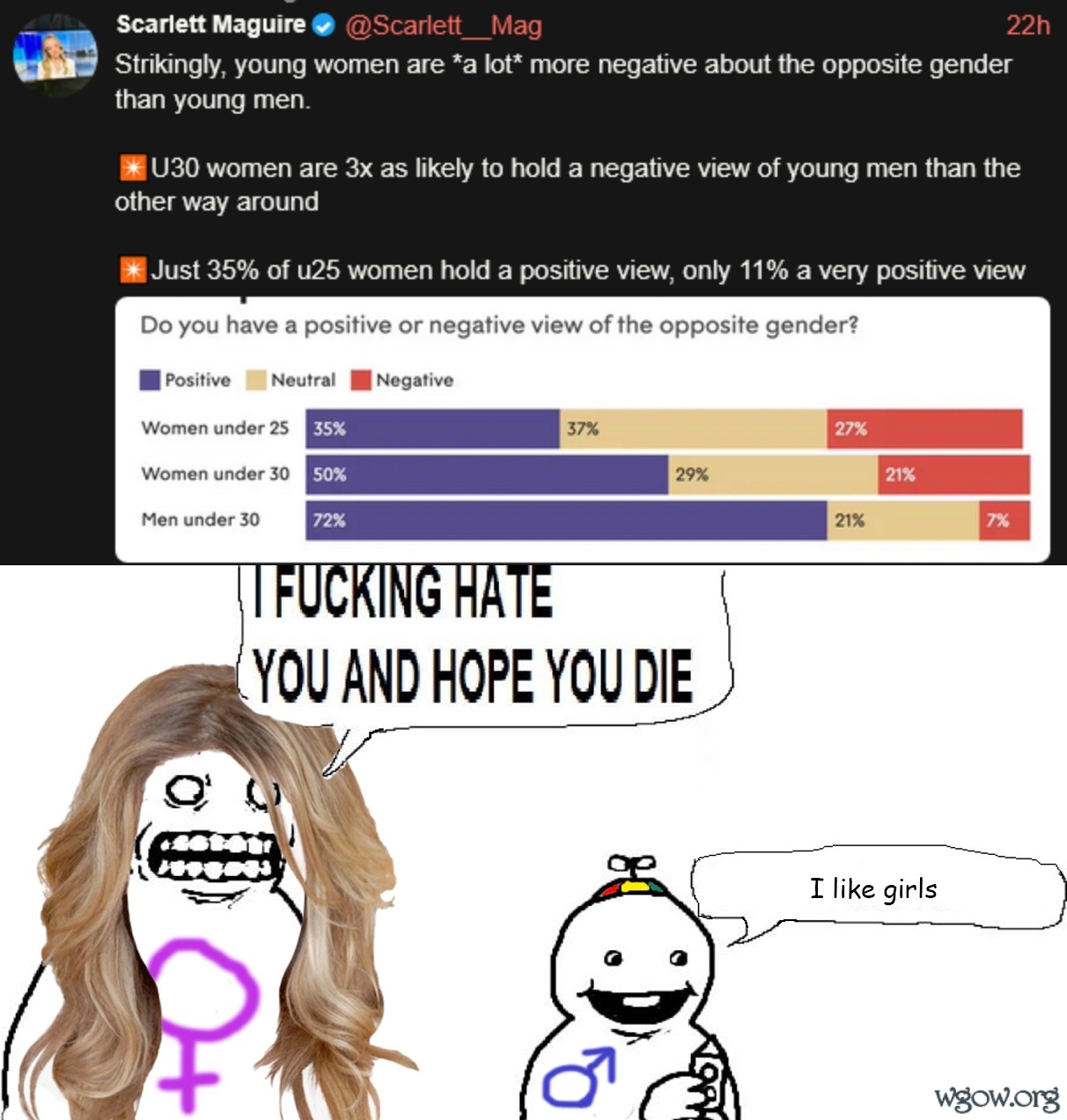
Recent British polling supplies the wider atmosphere in which this licence operates. Among women under twenty-five, only 35 per cent expressed a positive view of young men, while 27 per cent expressed a negative one; among men under thirty, 72 per cent viewed young women positively and only 7 per cent negatively.28 Cancel culture therefore does not enter a neutral field. It supplies procedures, slogans, and collective legitimacy to a cohort in which hostility towards the opposite sex is already markedly asymmetrical.
The result is a generation of women encouraged to experience social cruelty as courage. To exclude becomes discernment; to humiliate becomes accountability; to circulate an allegation becomes solidarity; to destroy a man’s standing becomes protection of the community. Every ancient vice is baptised by a therapeutic or political name.
The cruelty is intensified by the certainty that the male target possesses no corresponding right of judgement. He may not call the woman vindictive, unstable, manipulative, or cruel without apparently confirming the very hostility attributed to him. She may psychologise his motives, expose his private life, question his sexual worth, and enlist others against him; he is expected to answer with composure and concern for the feelings of those punishing him.
The effect is compounded when one analyses the extreme rates of boy-directed violence. Female homicide is far less common in the aggregate, yet its internal pattern is strikingly domestic and maternal. In Australia during 2022–23, females constituted 13 per cent of all identified homicide offenders; among the twenty-six female primary offenders in cleared incidents, however, 58 per cent had committed a domestic homicide, and 31 per cent had killed their own child. Only three of the 182 male primary offenders, approximately 1.6 per cent, were classified as filicide offenders. Women therefore accounted for eight of the eleven primary offenders responsible for filicide in that year, despite constituting only one eighth of primary homicide offenders overall.29
The victim data sharpen the pattern further. Of the sixteen victims classified as the child of a primary offender, eleven were killed by female primary offenders: eight male children and three female children. The report exposes a category of violence routinely obscured by the moral mythology surrounding maternity that itself, permits the predominance of mother-right as father-right is morally stigmatised. Where male violence is made emblematic of the sex, female violence is commonly individualised, medicalised, or absorbed into some exculpatory narrative of distress. The murdered child, however, lies beyond these rhetorical protections. The maternal relation does not abolish the possibility of domination, resentment, possession, or destruction; in this Australian sample, it was the principal form assumed by female-perpetrated homicide.
The statistic is therefore significant as a disclosure of whom female homicide offenders disproportionately kill. Male homicide ranged principally outwards, towards acquaintances, strangers, and problematic intimate partners; female homicide contracted towards the enclosed domestic sphere, and most terribly towards the child placed immediately beneath maternal power. The cultural presumption that the mother represents unconditional safety can consequently make this violence harder to name: the same society that searches relentlessly for hatred concealed within paternal authority remains strangely reluctant to perceive the fatal shadow cast by maternal possession.
The Power and Control Wheel, which was developed by battered women attending women’s groups, was originally a description of typical behaviors accompanying the violence. In effect it said, “When he is violent, he gets power and he gets control.” Somewhere early in our organizing efforts, however, we changed the message to “he is violent in order to get control or power.” The difference is not semantic, it is ideological. Somewhere we shifted from understanding the violence as rooted in a sense of entitlements to rooted in a desire for power. By determining that the need or desire for power was the motivating force behind battering, we created a conceptual framework that, in fact, did not fit the lived experience of many of the men and women we were working with.
Ellen Pence, ‘Some Thoughts on Philosophy’, in Melanie F. Shepard and Ellen L. Pence (eds.), Coordinating Community Responses to Domestic Violence: Lessons from Duluth and Beyond (Thousand Oaks, CA: Sage, 1999), pp. 29–30
Thus the aggression is not merely relational but juridical, in a feminine encroachment upon the masculine. Young women are encouraged to act as accuser, witness, interpreter, and beneficiary of the sentence, while the young man is placed simultaneously in the position of defendant and punishment. His exclusion supplies the proof that he deserved exclusion.
Domestic violence has been moralised as an offence bearing solely a male face. Violence by men is immediately named, stigmatised, institutionalised, and punished; violence against men is more readily dissolved into provocation, distress, mutual conflict, or the merely ‘difficult’ behaviour of a troubled partner. British experimental research found that the same intimate-partner violence was less likely to be recognised as abuse, judged more acceptable, and less likely to provoke intervention when the victim was male rather than female.30
The asymmetry becomes still harsher when a man seeks protection. An analysis of twenty-two British Domestic Homicide Reviews found ‘often a dismissal of women’s abusive acts towards men by services’; male victims were more likely to be arrested than their partners, while their injuries were repeatedly disregarded by police and safeguarding agencies.31 Men interviewed about female-perpetrated abuse described being received with ‘suspicion and contempt’, and the failure to recognise their relationships as abusive kept them within coercive and psychologically destructive conditions.32
In the modern marriage, ‘go to therapy’ can function less as an invitation than as a summons. The wife defines the relationship as requiring professional intervention, and the husband who resists is easily belittled as emotionally stunted, frightened of vulnerability, incapable of communication, or unwilling to ‘do the work’; once he submits, however, the dispute has already been transferred from the domestic hierarchy into a therapeutic tribunal whose characteristic language of disclosure, validation, emotional processing, and relational grievance is markedly more familiar to women than to men. The asymmetry is measurable: women use psychotherapy substantially more often, wives characteristically precede husbands through the stages of recognising a marital ‘problem’, considering treatment, and seeking it, and contemporary couple-intervention studies still find women overwhelmingly initiating professional help.33 Research on male help-seeking, meanwhile, records men themselves perceiving counselling and psychotherapy as feminised, not merely because most practitioners are women but because the therapeutic form privileges emotional disclosure, vulnerability, and modes of introspection less congenial to many men. Therapy can therefore become a remarkably efficient mechanism of domestic coercion: the husband is first compelled into a forum selected by his wife, then required to translate himself into its feminine-coded moral and emotional grammar, while his very reluctance to accept that grammar is available as further evidence that he is the one in need of correction.
The British government now concedes that male victims are dismissed or not taken seriously, especially when the perpetrator is female, because of so-called entrenched ‘gender stereotypes’, rather than clearly identifying the radicalisation of women so it may be corrected; it identifies disbelief, minimisation, and lack of empathy towards men and boys as failures that drive victims away from police and support services.34 The woman’s control, humiliation, threats, manipulation, and psychological attrition are thus pushed behind the visible moment at which the man reacts with violence, pathologising the sole defense mechanism against female psychological abuse. Her conduct becomes context; his becomes character. Her abuse is renamed dysfunction; his response is isolated, condemned, and made to bear the moral meaning of the entire relationship.
Research that examines the relationship rather than simply isolating the man’s final physical act as the locus of blame has repeatedly found a progression from psychological aggression to physical assault. Murphy and O’Leary followed couples from engagement through the first thirty months of marriage and found that, among partners who had not previously been physically aggressive, psychological aggression by the other partner predicted the first occurrence of physical violence; the result was consistent for men and women.35 In a later treatment study of marriages already involving husband-to-wife violence, the wife’s psychological aggression before treatment predicted the continuation and severity of physical aggression by both spouses during treatment and throughout the following year.36 Verbal attacks, jealousy, and controlling behaviour have likewise predicted subsequent physical aggression in dating couples, with aggression passing dyadically from one partner to the other.37 The familiar procedure of extracting the man’s visible reaction from the long psychological campaign preceding it therefore falsifies the history of the relationship: her humiliation, coercion, provocation, and control disappear, while the physical act they helped produce is preserved as the sole morally intelligible event.
A study of ninety men and eighty-seven women arrested for domestic violence also found that the leading reported motives for physical aggression in both sexes were self-defence, the expression of negative emotion, and communication conflict; the researchers found no general sex division in motives, apart from women reporting negative emotion and retaliation more often.38 This directly contradicts the institutional presumption that male violence is inherently an exercise of male domination while female aggression is situational, reactive, or psychologically explicable.
This is the governing prejudice: male violence is treated as an expression of the male nature, while female psychological abuse that induces the violence is ignored, if not justified, and her physical violence is treated as an exception requiring explanation. The man is punished for the act that can be seen; the woman is absolved of the long psychological abuse campaign that produced it. His anger is evidence, her cruelty atmosphere; his raised voice enters the record, while her coercion vanishes into the private obscurity of the home.
A culture that sincerely wished to restrain cruelty would deprive such feminine conduct of moral glamour. It would insist that allegations enter proper processes, that social punishment remain proportionate, that women retain the traditionally expected modesty and deference towards men within conflict, and that those who organise exclusion answer for its effects. Cancel culture does the opposite. It gives cruelty a halo, distributes responsibility until it disappears, and teaches the young woman that the destruction of a man may be experienced as evidence of her own virtue.
Scholia
- Ellen Pence and Michael Paymar, Education Groups for Men Who Batter: The Duluth Model (New York: Springer Publishing Company, 1993); Donald G. Dutton and Kenneth Corvo, ‘The Duluth Model: A Data-Impervious Paradigm and a Failed Strategy’, Aggression and Violent Behavior, 12.6 (2007), 658–667, criticising the model’s gender paradigm and differential treatment of male and female violence; Benjamin Hine, Ledja Noku, Elizabeth A. Bates and Kealey Jayes, ‘But, Who Is the Victim Here? Exploring Judgments Toward Hypothetical Bidirectional Domestic Violence Scenarios’, Journal of Interpersonal Violence, 37.7–8 (2022), whose discussion notes that gendered models such as Duluth conceptualise intimate-partner violence as unilaterally male and relates this to differential perceptions of male victims and female perpetrators; David B. Wilson, Lynette Feder and Ajima Olaghere, ‘Court-Mandated Interventions for Individuals Convicted of Domestic Violence: An Updated Campbell Systematic Review’, Campbell Systematic Reviews, 17.1 (2021), e1151. On its British institutional influence, see Home Office/UK Government, Standards for Domestic Abuse Perpetrator Interventions, which identifies Duluth as the origin of many current interventions; Mayor’s Office for Policing and Crime, The Croydon Drive Project: A 2-Year Evaluation (2020), 8, describing the UK approach as ‘largely influenced by the Duluth Model’.
- Panagiota Ira Bitsola and Melina Nicole Kyranides, ‘Relational Aggression in Romantic Relationships: A Study into Gender Differences, Correlates and Predictors’, Journal of European Psychology Students, 12.1 (2021), pp. 16–26.
- Tracy Vaillancourt et al., ‘Behavioral and Neural Responses to Social Exclusion in Women: The Role of Facial Attractiveness and Friendliness’, Scientific Reports, 14 (2024), 15135.
- Nicholas Graham, HM Area Coroner for Oxfordshire, ‘Alexander Rogers: Prevention of Future Deaths Report’, Ref. 2024-0624, 8 November 2024.
- Scarlett Maguire, ‘Revealed: the New Radicalism among Young Women’, New Statesman, 15 April 2026; Merlin Strategy survey of British adults aged eighteen to thirty.
- Hannah Miles and Samantha Bricknell, Homicide in Australia 2022–23, Statistical Report 46 (Canberra: Australian Institute of Criminology, 2024), pp. 21, 32–34, Tables 16 and 29. Table 29 records twenty-six female primary offenders, of whom eight committed filicide, compared with three of 182 male primary offenders; Table 16 records eight male and three female victims who were children of female primary offenders.
- Elizabeth A. Bates, Linda K. Kaye, Charlotte R. Pennington, and Charlotte Hamlin, ‘What about the Male Victims? Exploring the Impact of Gender Stereotyping on Implicit Attitudes and Behavioural Intentions Associated with Intimate Partner Violence’, Sex Roles, 81 (2019), pp. 1–15.
- Katie Hope, Elizabeth A. Bates, Mark Brooks, and Julie Taylor, ‘What Can We Learn from Domestic Homicide Reviews with Male Victims?’, Partner Abuse, 12 (2021), pp. 384–408.
- Kevin F. Hogan, Victoria Clarke, and Tony Ward, ‘Men’s Experiences of Help-Seeking for Female-Perpetrated Intimate Partner Violence: A Qualitative Exploration’, Counselling and Psychotherapy Research, 21.4 (2021), pp. 934–945.
- British Association for Counselling and Psychotherapy, ‘Men’s attitudes to therapy – and how they differ to women’s’, Public Perceptions Survey, 2025: in a YouGov survey of 5,000 UK adults, 41 per cent of women reported having had therapy compared with 29 per cent of men; Brian D. Doss, David C. Atkins, and Andrew Christensen, ‘Who’s Dragging Their Feet? Husbands and Wives Seeking Marital Therapy’, Journal of Marital and Family Therapy, 29.2 (2003), 165–177: among 147 married couples seeking marital therapy, wives were on average judged to have completed the stages of problem recognition, treatment consideration, and treatment seeking before their husbands; Astrid B. Leth-Nissen et al., ‘Randomized Controlled Trial of the Marriage Checkup: Stress Outcomes’, Journal of Marital and Family Therapy, 49.1 (2023), 242–259: women were the initiating partner in 72.3 per cent of 231 couples entering the intervention; Andrew S. Chatmon et al., ‘The Challenges Preventing Men from Seeking Counselling or Psychotherapy’, Mental Health & Prevention, 31 (2023), 200287: scoping review identifying the perceived ‘feminisation’ of counselling and psychotherapy as a barrier for men, associated both with the predominance of female practitioners and with therapeutic emphases upon emotional disclosure, vulnerability, and discussion of feelings.
- Home Office, Freedom from Violence and Abuse: Men and Boys Explanatory Note, updated 26 May 2026.
- Christopher M. Murphy and K. Daniel O’Leary, ‘Psychological Aggression Predicts Physical Aggression in Early Marriage’, Journal of Consulting and Clinical Psychology, 57.5 (1989), pp. 579–582. The study drew its participants from 393 engaged couples and followed them through three assessments over thirty months.
- Erica M. Woodin and K. Daniel O’Leary, ‘Partner Aggression Severity as a Risk Marker for Male and Female Violence Recidivism’, Journal of Marital and Family Therapy, 32.3 (2006), pp. 283–296.
- K. Daniel O’Leary and Amy M. Smith Slep, ‘A Dyadic Longitudinal Model of Adolescent Dating Aggression’, Journal of Clinical Child and Adolescent Psychology, 32.3 (2003), pp. 314–327.
- JoAnna Elmquist, John Hamel, Ryan C. Shorey, Lindsay Labrecque, Andrew Ninnemann, and Gregory L. Stuart, ‘Motivations for Intimate Partner Violence in Men and Women Arrested for Domestic Violence and Court Referred to Batterer Intervention Programs’, Partner Abuse, 5.4 (2014), pp. 359–374.
How the British Woman Became the Most Equal Sex
British feminism did not begin at the polling booth. The vote was the public coronation of a much older revolution, conducted first within the household and only afterwards within the state: the gradual detachment of woman from paternal and conjugal form; the conversion of the mother’s natural bond into an independent juridical title; the separation of property, education, employment, and political identity from the household; and, finally, the reconstruction of woman as a collective estate whose supposed interests stood against those of man.
The conventional history describes a succession of disabilities removed. Each reform is isolated and judged according to the material advantage it conferred: access to children, earnings, education, professions, property, divorce, contraception, abortion, political representation. This horizontal enumeration conceals the vertical change. Beneath the separate statutes lay a transfer of the civilisational centre. The father ceased to appear as the source of household form, lineage, authority, and continuity; he was progressively reduced to one interested party among others, while the court and administrative state assumed the power to arbitrate between the persons formerly comprehended within his house.
The distinction between father-right and mother-right is therefore deeper than a dispute over which parent spends more hours caring for a child. In Bachofen’s analysis, maternity belongs first to the visible and corporeal order: the child’s emergence from the maternal body is immediate, certain, and grounded in blood, earth, generation, and physical continuity. Paternity introduces another principle. It cannot rest upon the same sensible certainty; it must be affirmed through law, name, rite, faith, and spiritual recognition. Father-right thus signifies the triumph of form over mere natural immediacy, of juridical and spiritual filiation over the self-evidence of the womb. As Bachofen expressed it, maternity pertains to the physical side of existence, while ‘the paternal-spiritual principle’ raises descent into another order.39
Primogeniture was one juridical expression of that paternal world. It joined name, estate, inheritance, duty, and succession through the eldest son so that the house might endure beyond the mortal persons temporarily inhabiting it. The son did not merely receive property; he received a charge. He continued a line whose unity preceded his private wishes. Agnatic descent, paternal guardianship, and primogeniture belonged to the same architecture even where their precise laws differed: the child entered a house through the father, inherited its name, and stood within an order extending backwards to ancestors and forwards to descendants.
The rise of mother-right in modern England did not simply reverse primogeniture by transferring estates to mothers. It struck at the same axis elsewhere. The maternal connexion was elevated as an autonomous claim against the father’s title; the child was increasingly detached from the continuity of the house and placed within a contest between individual parents; and the state entered above both as the impersonal guardian of an abstract ‘welfare’. The paternal principle was first made comparable, then contestable, then legally equal, and finally subordinate to an administrative judgement claiming to speak for the child independently of lineage.
The materialist explanation offered in the supplied extract is therefore insufficient. Industrialisation certainly removed production from the household, sent men into urban wage labour, and encouraged the later image of the father as an external provider rather than an inward patriarch. Yet paternal right did not arise because the father earned wages. It preceded industrial capitalism by millennia and expressed a religious, juridical, and civilisational principle. The decisive modern degradation consisted precisely in forgetting this distinction. Once the father was understood chiefly as the supplier of money and the mother chiefly as the supplier of care, both could be reduced to quantifiable functions. The court might then balance one contribution against another, while the state quietly assumed the higher formative authority once belonging to the father.
Thomas Taylor, Olympian Aristocrat, Reduces to Absurdity Mary Wollstonecraft, Judaeo-Christian Feminist; the French Revolution Descends into the Domestic Sphere
Mary Wollstonecraft’s A Vindication of the Rights of Woman of 1792 supplied one of the earliest systematic English statements of the radical egalitarian premise. Wollstonecraft supplied a proto-social-constructionist theory of sexual difference: woman’s apparent nature was recast as the artificial product of education, dependency, and social conditioning, beneath which supposedly stood the same rational individual found in man. Her argument extended the abstract ‘rights of man’ into sexual relations: women were rational beings, their apparent incapacity was attributed to defective education, and national mixed-sex schooling and economic self-support were subversively proposed as the means of releasing them from male dependence.40 The metaphysical distinction between masculine and feminine form was thereby replaced by a theory of unrealised similarity. Woman differed because her circumstances had made her differ; alter the education and the social structure, and the underlying equal individual would emerge.
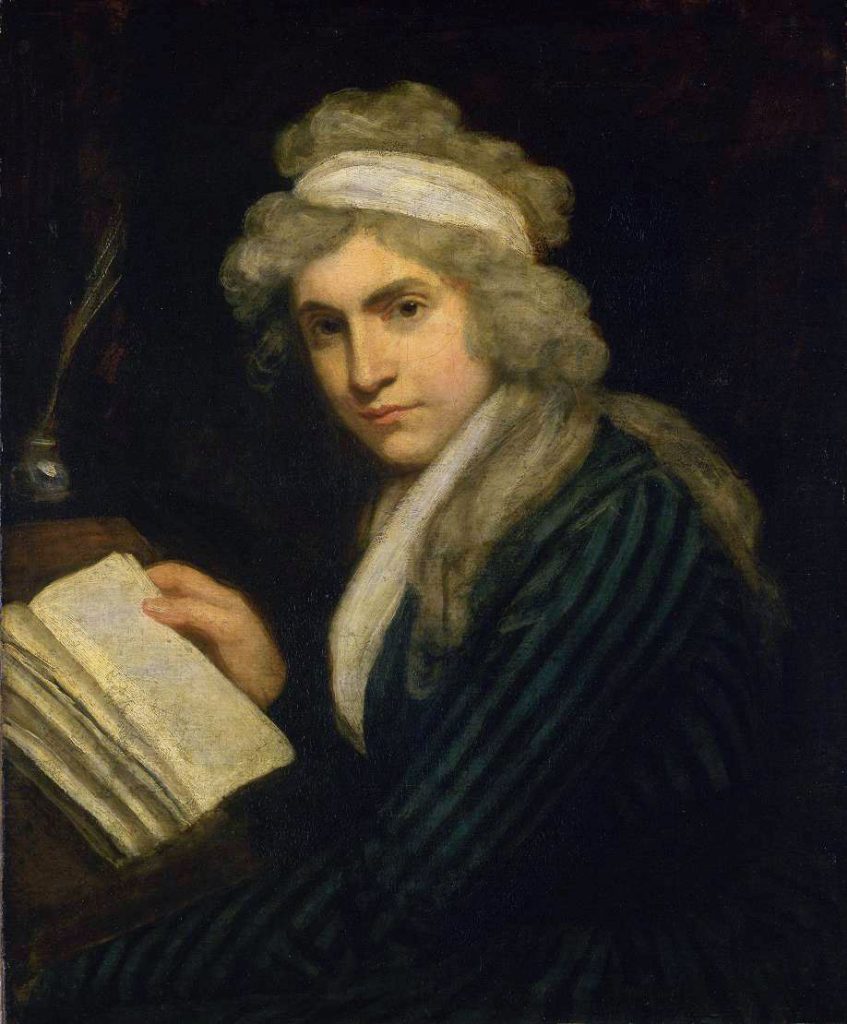
Before Mary Wollstonecraft ‘vindicated’ what she perceived as the rights of woman, she entered the revolutionary controversy under the universal title of man. Edmund Burke’s Reflections on the Revolution in France, and on the Proceedings in Certain Societies in London Relative to That Event appeared in 1790 as a defence of inherited constitution, prescription, rank, property, chivalry, and the accumulated authority of the dead against the abstract reconstruction of society by revolutionary reason. Wollstonecraft answered almost immediately with A Vindication of the Rights of Men, in a Letter to the Right Honourable Edmund Burke; Occasioned by His Reflections on the Revolution in France, the first published reply to Burke’s great indictment of the French Revolution.
This was already more than a plea that women should be educated well enough to fulfil their duties with intelligence. Education became the instrument through which woman might cease to receive her position through father, husband, household, and inherited custom. Her reason was conceived as an autonomous jurisdiction whose development required independence. The abstract individual, supposedly concealed beneath sex, began to take precedence over woman as daughter, wife, mother, and bearer of a particular civilisational function.
Wollstonecraft’s advance was answered in its own moment by Thomas Taylor, the English Platonist whose life was devoted to Plato, Aristotle, Plotinus, Proclus, Iamblichus, Orpheus, and the full, uncompromising restoration of the Hellenic religious tradition. Taylor did more than interpret that tradition: he reopened it to the English-speaking world, producing the first complete English edition of Plato in 1804, incorporating and revising several translations by his deceased friend Floyer Sydenham—the first complete translation of the surviving works of Aristotle between 1806 and 1812, and pioneering English versions of the Orphic Hymns and the writings of Plotinus, Porphyry, Proclus, Iamblichus, Sallustius, Julian Augustus, and other inheritors of the ancient theology.41 His work was not antiquarian scholarship severed from life. He and his wife Mary were reputed to converse in ancient Greek within their home; he composed his own hymns and prayers to the Gods, kept their images in his study, and was remembered as pouring libations before them—the hostile stories of animal sacrifice belonging chiefly to caricature, while the libations accord with the devotional life attested by his surviving manuscripts.42
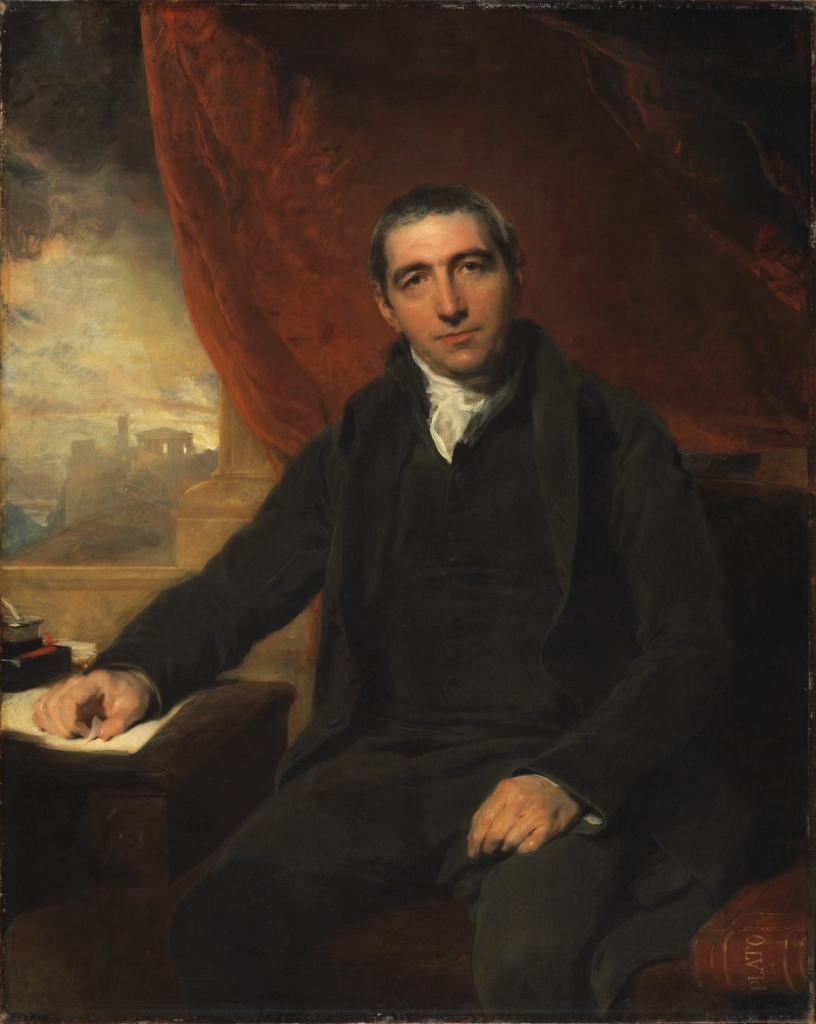
The scale of his achievement remains extraordinary. The complete modern edition of Taylor’s published writings occupies thirty-three volumes and approximately seventeen thousand pages; his translations continue to be read, reprinted, and gathered into uniform editions, while several of his renderings and conjectural emendations retain scholarly value two centuries later. He did not merely translate isolated Greek books into English prose: he transmitted an integrated philosophical and theological corpus, preserving the ancient commentators through whom Plato and Aristotle had been understood within the living tradition rather than submitting them to the dissecting categories of modern empiricism.
His genius revealed itself most dramatically where the manuscripts failed him. Working from a defective Greek text of Proclus’ Platonic Theology, Taylor supplied more than four hundred emendations and deficiencies from his comprehension of the philosopher’s system. Another branch of the manuscript tradition was subsequently recovered; in a remarkable number of passages, it contained precisely the readings Taylor had independently reconstructed, while modern editors adopted several of his conjectures even where the newly discovered manuscripts offered no correction.43a This was more than philological ingenuity. Taylor had so completely internalised the architecture, vocabulary, and procession of Platonic thought that he could recognise what Proclus must have written where the physical transmission had fallen silent. His translations were exact because Platonism was not an external object beneath his scholarly inspection; it had become the formative language of his own intellect.
Nor would Taylor have accepted the modern separation of ‘Platonism’ from ‘Neoplatonism’. The latter designation had been coined by German historians of philosophy during the 1770s and 1780s within a largely condemnatory scheme that treated the later tradition as an eclectic, syncretic, or corrupted departure from Plato. Taylor declined both ‘Neoplatonist’ and the still more openly depreciatory ‘Alexandrian’ label, speaking without qualification of ‘Platonism’ and ‘Platonists’. Plotinus, Porphyry, Iamblichus, Syrianus, Proclus, Hierocles, Sallustius, and Damascius were no late fabricators standing beyond Plato; they were, in Taylor’s phrase, the ‘true interpreters of his mystic speculations’, possessing the profundity required to unfold what the dialogues delivered in concentrated and symbolic form.43b The German Neo- marked a rupture; Taylor saw continuity, succession, and the authentic maturation of the Platonic revelation.
Even the circumstances of his life acquired an appropriately Platonic and celestial frame. Taylor was born on 15 May 1758, a date identified by later Platonists with the seventh day of Thargelion, the traditional Athenian anniversary of Plato’s birth and death. The return of Halley’s Comet marked the year of Taylor’s birth and again the closing days of his life; shortly before his death on 1 November 1835, he asked whether a comet had appeared and, being told that it had, replied: ‘Then I shall die; I was born with it and shall die with it.’44
In 1792, he published anonymously A Vindication of the Rights of Brutes, a mock-vindication that carried the egalitarian reasoning of Thomas Paine and Mary Wollstonecraft beyond the boundary at which they had chosen to arrest it.45
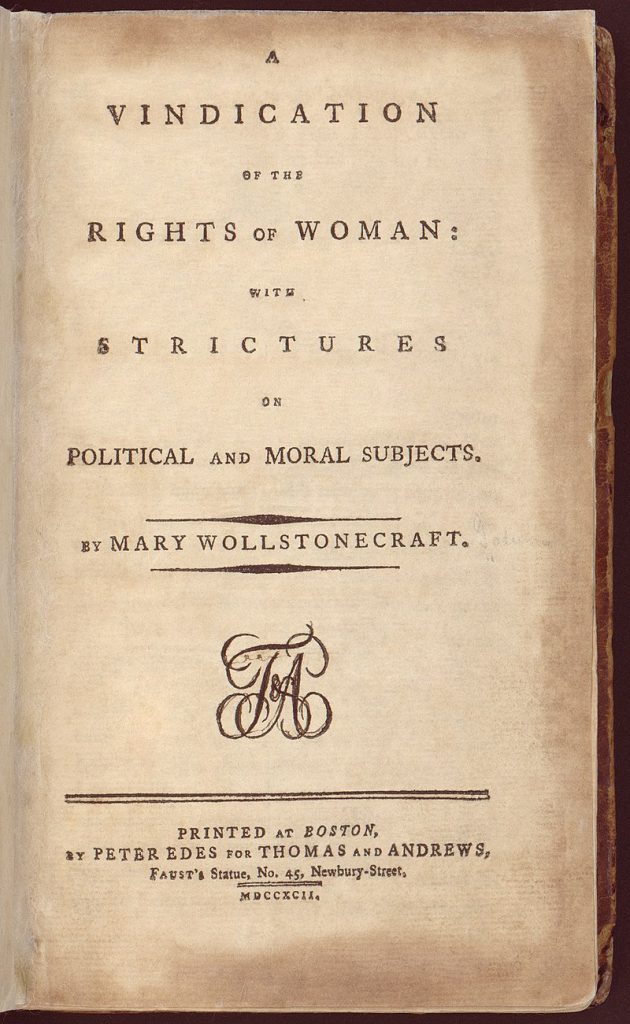
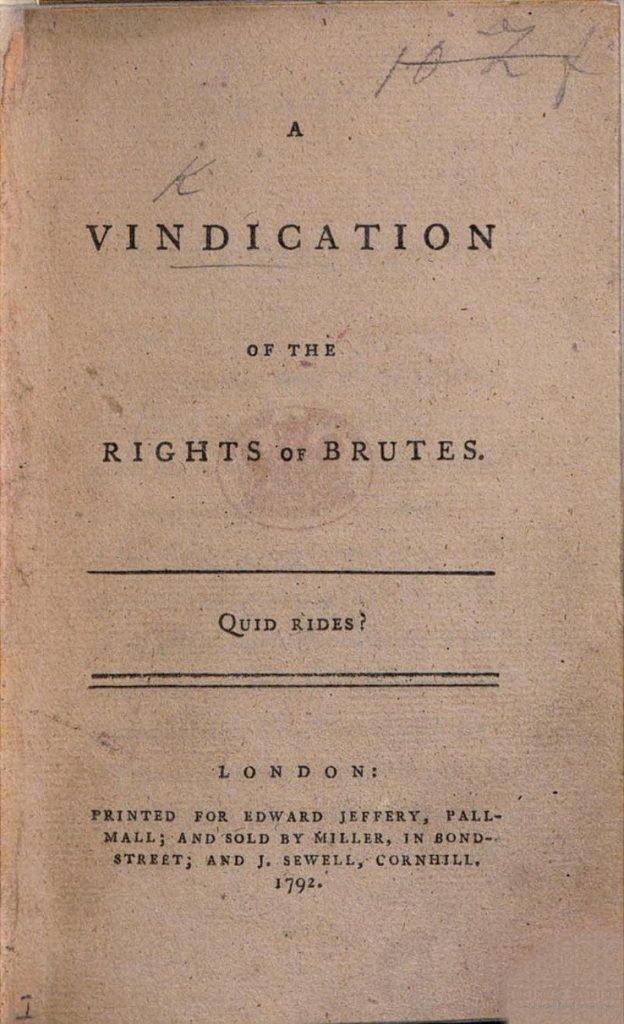
Left: Title page of the Boston edition of Mary Wollstonecraft, A Vindication of the Rights of Woman: With Strictures on Political and Moral Subjects, printed by Peter Edes for Thomas and Andrews, 1792; Susan B. Anthony Collection, Library of Congress, Washington, DC
Taylor’s weapon was reductio through laughter. Thomas Paine had proclaimed the equality of men across distinctions of station; Wollstonecraft had extended natural equality from men to women; Taylor therefore proposed to complete the discovery by demonstrating the equality of animals with mankind, and thereafter, as is only logical: the rights of vegetables and minerals. If every inherited distinction were merely an arbitrary imposition, no principled barrier remained at which emancipation must stop. Rank, sex, species, reason, and even the distinction between animate and inanimate nature could all be summoned before the same tribunal of abstract equality.
A revealing modern afterlife appears in S. Marek Muller’s ‘Archival Mocking as Feminist Praxis’, which proposes to read Taylor literally, dignify the manoeuvre as ‘mocking as method’, and resentfully repurpose his supposed ‘textual garbage’ into a vegan ecofeminist argument.46a Yet this attempted counter-irony falls directly into Taylor’s trap. A Vindication of the Rights of Brutes proceeds through the Eleatic dialectic of reductio ad absurdum: no repurposing is necessary for it does not rely on crass ‘sarcasm’ as supposed, rather, the text itself grants the egalitarian premise and pursues it beyond man to woman, brute, vegetable, and mineral, compelling the premise to disclose its own limitless consequences.46b To embrace that extension literally neither refutes Taylor’s logic nor adds any meaningful degree of absurdity; it merely literally occupies the conclusion he himself deliberately constructed. The attempted ‘repurposing’ thus falls flat as an artefact of weak irony culture without an understanding of the purpose of formal rhetoric and logic—a typical revolutionary crass shamelessness so endemic to feminist ‘praxis’, in which the object of satire is ostentatiously adopted and the intrusive adoption itself mistaken for a victory. Taylor gestures at a greater thesis that rightly extends into slavery, from which the radical can only recoil as one shields the eyes from a great and holy light. Taylor, having a profound familiarity with the classical corpus, remains rooted in rhetorical logic and philosophical method; the modern answer substitutes posture for argument, and, having misunderstood the premise, in claiming to reclaim his reductio, only affirms its entire purpose.
The satire proceeded from a philosophy aristocratic in principle: reality was composed of degrees, distinctions, superior and inferior powers, rulers and ruled, form and matter, intellect and body. Taylor mockingly celebrated an age in which ‘all subordination seems to be dying away’ and in which the difference between ‘my lady and her housemaid’ was becoming imperceptible. He then attributed to Wollstonecraft the supposed proof that women were naturally equal to men in mental power, physical strength, and boldness, before pushing the premise towards the abolition of every superiority and every dominion.47 Taylor invokes Aristotle’s distinction between natural rulers and natural slaves—‘whenever the mind predominates over the body, it confers natural freedom on its possessor’—before observing ironically that every ‘genuine modern’ must ridicule such a conclusion because it affirms the superiority of soul over body. The ridiculous conclusion exposed the original error: once qualitative hierarchy had been denied, equality became an endlessly expansive solvent.
The particular design of the following sheets, is to evince by demonstrative arguments, the perfect equality of what is called the irrational species, to the human; but it has likewise a more general design; and this is no other, than to establish the equality of all things, as to their intrinsic dignity and worth. Indeed, after those wonderful productions of Mr. Paine and Mrs. Woolstoncraft, such a theory as the present, seems to be necessary, in order to give perfection to our researches into the rights of things; and in such an age of discovery and independence as the present, the author flatters himself, that his theory will be warmly patronized by all the lovers of novelty, and friends of opposition, who are happily, at this period, so numerous both in France and England; and who are likely to receive an unbounded increase.
The author indeed, is well aware, that even in these luminous days, there are still many who will be so far from admitting the equality of brutes to men, that they will not even allow the equality of mankind to each other. Perhaps too, they will endeavour to support their opinion from the authority of Aristotle in his politics, where he endeavours to prove, that some men are naturally born slaves, and others free; and that the slavish part of mankind ought to be governed by the independent, in the same manner as the soul governs the body, that is, like a despot or a tyrant. ‘For (says he) those who are born with strong bodily and weak mental powers, are born to serve; and on the contrary, whenever the mind predominates over the body, it confers natural freedom on its possessor.’ But this is a conclusion which will surely be ridiculed by every genuine modern, as it wholly proceeds on a supposition, that mind and body are two distinct things, and that the former is more excellent than the latter; though almost every one is now convinced, that soul and body are only nominally distinguished from each other, and are essentially the same.
In short, such is the prevalence of truth, and such the futility of Aristotle, that his distinction between master and servant is continually losing ground; so that all subordination seems to be dying away, and an approximation to equality taking place among the different orders of mankind. The truth of this observation is particularly evident in female servants, whose independent spirit, which is mistaken by some for boldness and impudence, is become the subject of general surprise; and who so happily rival their mistresses in dress, that excepting a little awkwardness in their carriage, and roughness in their hands, occasioned by untwisting the wide-bespattering radii of the mop, and strenuously grasping the scrubbing-brush, there is no difference between my lady and her house-maid. We may therefore reasonably hope, that this amazing rage for liberty will continually increase; that mankind will shortly abolish all government as an intolerable yoke; and that they will as universally join in vindicating the rights of brutes, as in asserting the prerogatives of man.
Thomas Taylor, A Vindication of the Rights of Brutes (London: printed for Edward Jeffery, Pall Mall, and sold by Miller and J. Sewell, 1792), ‘Advertisement’, pp. iii–vii
Writing in 1792, just as the egalitarian degeneracy of Wilberforce’s evangelical abolitionism had become entrenched in Parliament and, amid the revolutionary fervour, was asserting that Britons should become equals with slaves, Taylor defiantly recalled Aristotle’s doctrine that ‘some men are naturally born slaves, and others free’, setting the Olympian, patrician, and solar principle of qualitative hierarchy against the Christian-humanitarian reduction of mankind to abstract equality. ‘Aristotle’ and ‘aristocracy’ alike begin in the Greek aristos—‘best, noblest, most excellent’—of the same root as aretē, the important Hellenic quality of excellence or virtue; aristocracy therefore signifies the rule of the nobles in whom an innate superior quality has become rank. Where Wollstonecraft carried the revolutionary claim of equal rights from man to woman, and further downwards along the Great Chain of Being, Taylor performed the counter-movement of hierarchy, extending the principle of mastery beyond man’s rule over woman to the Aristotelian ruler’s dominion over the natural slave. Taylor’s rebuke is therefore an intellectual antecedent to the present polemic against female emancipation. He did not answer Wollstonecraft from the timid ground of bourgeois convention, economic expediency, or sentimental attachment to recent custom. He answered from the Platonic conviction that order is neither an accident nor an injustice; it is the visible articulation of unequal qualities and powers. The demand that all beings be recognised as equal in dignity does not elevate the lower to the higher; it destroys the language by which height, excellence, authority, and form can be recognised at all.
Baptised into the Church of England at St Botolph-without-Bishopsgate in October 1759 and, as Godwin later wrote, ‘bred in the principles of the church of England’, Mary Wollstonecraft was subsequently drawn at Newington Green into Richard Price’s circle of Rational Dissenters, whose nonconforming Protestant moralism, rational religion, and conception of liberty as freedom from arbitrary power supplied an essential religious foundation for the arguments of both Vindication and its natural parody. Taylor thus stands as an intellectual antecedent to the designs advanced in our own study of Roman patriarchy: where his answer arose from Hellenic metaphysics, that inquiry proceeds from the even more thoroughly matured solar Roman principle—father-right, patrician continuity, agnatic lineage, household cult, and the formative sovereignty of the pater. Yet both confront the same revolutionary movement. Wollstonecraft’s emancipation of woman belongs to the larger dissolution of Christian-derivative qualitative order into the horizontal arithmetic of interchangeable individuals. Taylor saw at its beginning that the argument could not remain confined to one carefully selected injustice. Once hierarchy itself was placed under accusation, every distinction became a grievance, every superior an oppressor, and every subordinate relation a candidate for liberation.
Besides Thomas Taylor, Wollstonecraft and the early apostles of female emancipation appear intellectually provincial: they possessed grievance, abstraction, and revolutionary confidence, while he possessed the rare genius capable of inhabiting an entire metaphysical civilisation from within. Wollstonecraft and the first feminists could arraign an inherited order they scarcely comprehended; Taylor, a true genius, had so completely mastered the Platonic cosmos that he could restore its lost words—and expose their egalitarian reasoning as little more than fashionable shallowness before a philosophy of rank, form, and divine order.
The modern polemic therefore does not stand alone. At the very birth of feminist emancipation, a Platonist had already met it with an aristocratic laughter: if equality must govern the sexes because difference cannot justify order, then the same reasoning must eventually overthrow every dominion, distinction, and degree in the cosmos.
Yet the passage from intellectual claim to juridical transformation did not proceed in one unbroken egalitarian line. Caroline Norton, among the most consequential pre-suffrage reformers, explicitly rejected equality in the modern sense. ‘The natural position of woman is inferiority to man’, she wrote; she sought remedies for particular cruelties without professing that the sexes possessed interchangeable authority.48 Her importance lies precisely here. A reformer could affirm sexual hierarchy personally while nevertheless opening a breach through which a contrary principle would later advance.
Norton’s disastrous marriage and separation deprived her of access to her three sons under the father’s superior common-law claim. She answered through pamphlets whose titles already announced a maternal counter-title: Observations on the Natural Claim of a Mother to the Custody of her Children as affected by the Common Law Right of the Father in 1837, followed by The Separation of Mother and Child by the Laws of Custody Considered in 1838. Her campaign helped secure the Custody of Infants Act 1839.49
The Act did not automatically transfer young children to their mothers, as the popular account in the image suggests. It permitted a mother to petition the Court of Chancery for custody of children under seven and for access to older children, subject to judicial discretion and statutory limits. The Infant Custody Act 1873 extended the jurisdiction to children under sixteen and directed attention towards the child’s needs rather than the absolute right of either parent. The phrase ‘tender years doctrine’ is commonly applied retrospectively to this wider historical tendency; it was not the formal title of the 1873 statute, nor did the Act establish an automatic universal maternal presumption.50
The limitation does not diminish the structural significance. Before 1839, the mother’s relation to the legitimate child did not ordinarily stand as an independent title equal to the father’s. Norton’s reform made natural maternity legally audible against paternal right. The court did more than relieve an exceptional hardship. It acquired the authority to separate the claims once ordered within the father’s household and to judge them from above.
This was the beginning of a distinctively modern mother-right. It differed from archaic gynaecocracy, which belonged to an integrated religious world of earth, blood, Demetrian cult, and matrilineal continuity. The new form was individualised and bureaucratic. The mother did not return as priestess of a sacred maternal order; she appeared as a claimant before the state. The state recognised her natural bond only after translating it into an individual right administered by courts.
The child likewise changed meaning. Under father-right, the child stood within a lineage. Under the new dispensation, the child increasingly became a separate object of welfare, possessed by neither parent and interpreted by public authority. This appeared impartial; in reality, the supposedly neutral state displaced the father as the higher guardian and reserved to itself the power to decide which natural or private relation should prevail.
The Guardianship of Infants Act 1886 advanced the process. A mother could apply for custody and access; courts were directed to consider the welfare of the child, the conduct of the parents, and the wishes of mother as well as father. The Guardianship of Infants Act 1925 made the child’s welfare ‘the first and paramount consideration’, gave mothers the same power as fathers to apply to the court, and expressly forbade the court from treating the father’s common-law claim as superior to the mother’s.51 The Guardianship Act 1973 completed the formal equalisation of maternal and paternal rights in guardianship.52
The progression is exact: maternal exception, maternal claim, parental equality, welfare paramount, state arbitration. Paternal right was not directly handed to the mother in its old form. It was dissolved into competing claims, above which stood an authority that no longer belonged organically to the house.
No, Stopping at ‘Second-Wave Feminism’ Is Not Enough; Emmeline Pankhurst, Heiress of 1789 and Daughter of the Jacobin Terror
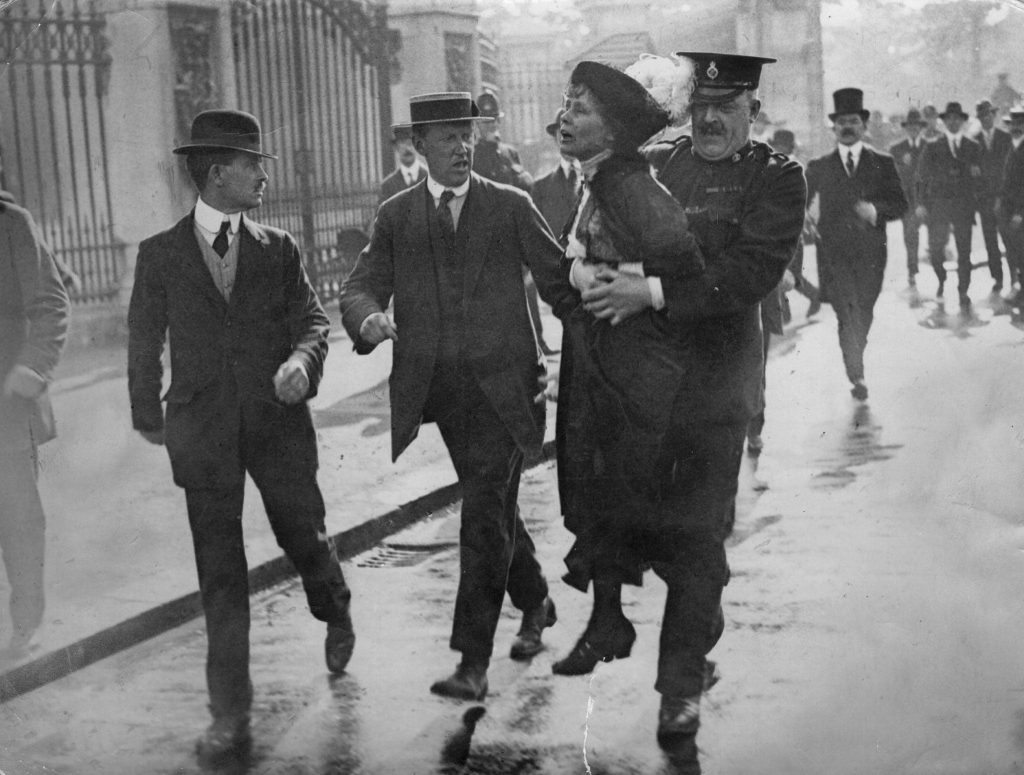
I was born on July 14, the anniversary of the destruction of the Bastille. I shall treasure and wear this medal because I have always thought that the fact that I was born on that day has had some kind of influence over my life. […] it was women who gave the signal to spur on the crowd, and led to the final taking of that monument of tyranny, the Bastille, in Paris.
Emmeline Pankhurst, remarks at Queen’s Hall, 22 December 1908, reported in Votes for Women, 31 December 1908, p. 230; quoted in June Purvis, Emmeline Pankhurst: A Biography (London and New York: Routledge, 2002), ch. 9, n. 35
That’s right! Arrest me at the gates of the Palace. Tell the King!
Emmeline Pankhurst, calling to reporters as she was carried from Buckingham Palace after the WSPU deputation of 21 May 1914; reported in the Daily Mirror, 22 May 1914
Women who profess themselves critical of feminism often confine their objection to the ‘second wave’ and its assault upon domesticity and marriage, because they remain unwilling to question the premise of female liberation itself. Too timid and intellectually cowardly to interrogate the autonomous, atomised existence they have been taught is their due (an independence of which they, in this very question, fall short), they recoil from the older conception of woman as a member of a house, a lineage, and a continuity greater than herself, attaching to it every available charge of degradation and oppression. Yet the closer the genealogy is examined, the clearer it becomes that the atomising premises which reached their fullest expression in the later movement were already present, and already hostile, at the beginning. Thus, as Taylor reduced to absurdity to assert a greater principle, the entire premise of woman’s liberation must be refuted, in thesi.
The revolutionary genealogy did not end with Wollstonecraft. Of all the women of British emancipation, Emmeline Pankhurst carried the Masonic-revolutionary and Jacobin cause most faithfully into the sexual question. She appears, in this sense, as one of 1789’s belated daughters: the revolutionary subject had changed, from estate and citizen to sex, yet the governing grammar remained remarkably recognisable—equality against inherited distinction; the voluntarily constituted association against organic station; fraternity, now transformed into sisterhood, against hierarchy; political regeneration against received custom; and the reconstruction of society according to an abstract principle proclaimed superior to the inherited arrangements of history.
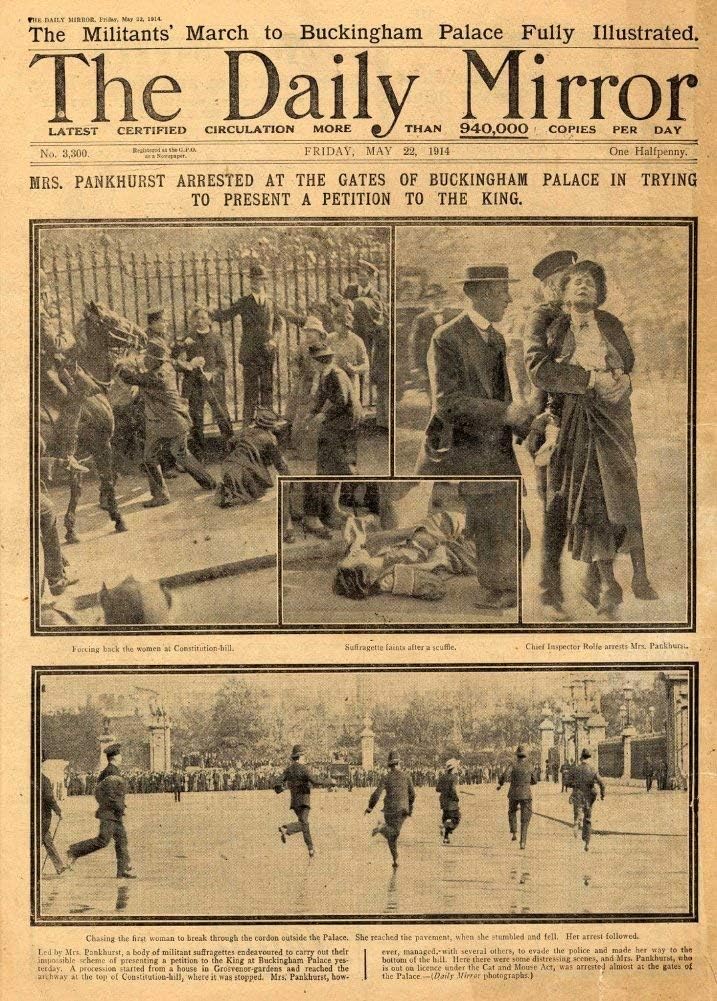
Educated in France, Pankhurst made the French Revolution part of her personal mythology, insisting that she had been born on 14 July 1858, the anniversary of the storming of the Bastille, although her birth certificate records 15 July. The discrepancy mattered because the revolutionary date expressed the lineage in which she wished to stand. At a WSPU celebration in 1908, she was presented with a replica of a medal commemorating the capture of the Bastille and declared: ‘I have always thought that the fact that I was born on that day has had some kind of influence over my life.’ Surrounding herself with the natal mythology of the French Revolution and recalling approvingly the women who had helped precipitate the taking of ‘that monument of tyranny, the Bastille’.53 Her childhood reading of Carlyle’s History of the French Revolution, which she called a lifelong ‘source of inspiration’, strengthened the identification. Thus the movement from the Rights of Man to the Rights of Woman continued from Wollstonecraft into the militant suffragettes: the French Revolution was no remote historical antecedent, but the consciously adopted natal myth of their most famous British leader.
The irony reached its most theatrical expression on 21 May 1914. Emmeline Pankhurst, who had deliberately identified herself with the anniversary of the Bastille and declared that the revolutionary date had exercised ‘some kind of influence over my life’, led a deputation of approximately two hundred women to Buckingham Palace in order to petition King George V personally. The professed daughter of the Bastille thus arrived at the gates of the British sovereign demanding that royal authority rescue her revolution from Parliament. The contradiction was exquisite. Having made inherited authority, masculine rule, and political subordination objects of revolt, she appealed upwards to the very summit of inherited authority when the elected legislature would not deliver her demands. Revolutionary woman had exhausted agitation against the constitutional order and now sought the intervention of the King, as though the Crown might be summoned as the final instrument of its own abasement.
The Palace refused to receive the deputation. Some two thousand police officers, including mounted men, confronted the marchers; the resulting struggle left numerous women injured, while sixty-six women and two men were arrested. Pankhurst, weakened by hunger strikes and force-feeding and then at liberty under the terms of the Cat and Mouse Act, was carried bodily from the gates by Inspector Rolfe and returned directly to Holloway Prison. As she passed the reporters, she cried, ‘That’s right! Arrest me at the gates of the Palace. Tell the King!’54
‘Tell the King’: the phrase contains the whole farce. The revolutionary who had chosen the Bastille as the emblem of her life ended by invoking the sovereign as witness, judge, and potential deliverer. She wished simultaneously to overthrow the principle of paternal and monarchical order and to borrow its majesty when the mass institutions of modern politics frustrated her. Even rebellion required the authority it denied; even female emancipation, arriving in tumult at the Palace gates, could imagine no final appeal higher than the King.
The deeper Jacobin association is consequently richer than any mere resemblance of militancy. Jacobinism represented the radical political maturation of a larger Enlightenment revolutionary grammar. Before the Revolution transformed the constitution came the intellectual and associative transformation by which inherited distinctions could be subjected to an external standard of equality. The individual was increasingly conceivable apart from estate, corporation, locality, hereditary privilege, and established rank; legitimacy could instead arise from voluntary association, abstract citizenship, representation, election, and adherence to universal principles. The ancien régime ceased merely to be an existing order and became an order required to justify itself before principles conceived independently of it.
In this transformation, Freemasonry furnished one of the Enlightenment’s great institutional vehicles and laboratories. James Van Horn Melton describes eighteenth-century Masonry as the first secular voluntary association established on a genuinely pan-European scale and emphasises the peculiar sociability of the lodge: membership was voluntarily assumed, and not inherited; men belonging to different occupations, confessions, and social ranks met beneath the common designation of ‘brother’; offices were elected, constitutions adopted, and an associative identity arose partially distinct from the corporate hierarchies of the surrounding society. The lodge did not invent the Enlightenment, still less did one hidden Masonic command manufacture the Revolution; it gave Enlightenment principles social form, permitting men to practise a different mode of association before that mode became politically generalised.55a
Hence the importance of the transition from Masonic lodge to revolutionary club. Historians have identified real organisational and ideological affinities between the two without requiring the crude insinuation that the Jacobin clubs were simply Masonic lodges under another name. The lodge had accustomed its members to constitutions, assemblies, elections, regulated debate, voluntary fraternity, and a social identity capable of traversing distinctions which the older corporate order regarded as substantive. Kenneth Loiselle finds the clearest specifically revolutionary connexion in the language of classical republicanism circulating through French Masonry, while Michael Kennedy places the enormous pre-Revolutionary growth of Masonic lodges among the associational developments which preceded the proliferation of revolutionary political clubs.55b
The sequence is therefore best understood as a transmission of political form. The Enlightenment lodge rehearsed a society constituted by chosen affiliation and fraternity; revolutionary politics transferred analogous principles into the constitution of the citizen; Jacobinism radicalised the conception until inherited orders were increasingly measured against an ideological conception of the regenerated political community. The significance of fraternity lies precisely here. A fraternity does not merely unite existing estates while leaving their distinctions untouched; it announces another relation beneath or above them in which men recognise one another according to membership of the new association. The revolutionary club could then enlarge this conception from the initiated brother to the politically awakened citizen.
What she carried into the sex question was therefore more profound than a fondness for spectacular protest. The old revolutionary construction acquired a new subject, as the women’s movement performs an analogous operation upon sex. Where 1789 had politically abstracted the citizen from inherited estate, feminism increasingly abstracted woman as daughter, wife, mother, widow, member of a household, representative of a rank away from father, husband, household, class, locality, and inherited sexual function, thus reconstituting her as a woman in herself, an atomised member of a sex possessing a collective political category with interests capable of being asserted against the prevailing order. The conceptual movement is momentous. Once ‘women’ exist politically as a body, differences amongst women may be subordinated to the fundamental solidarity of sex; relations previously internal to the household can be interpreted as relations between political categories; and the husband and wife can cease to appear primarily as differentiated members of one familial organism and instead become representatives of two constituencies whose respective powers require public adjudication. The fraternal revolutionary subject acquired its corresponding sisterhood; the older class or estate consciousness became sexual consciousness. The disputed hierarchy was no longer merely king over subject, noble over commoner, or capitalist over worker, but man over woman and husband over wife. Revolution passed into the household.
Thus the old revolutionary fraternity finds its corresponding sisterhood. The subject changes while the operation remains recognisable: inherited difference is redescribed as political inequality; inequality becomes a grievance common to the newly constituted group; consciousness of that grievance creates solidarity; solidarity generates organisation; organisation then demands reconstruction of the institutions in which the offending distinction had formerly been embedded. The revolutionary principle advances, as it were, by discovering progressively deeper strata of inherited hierarchy upon which to operate. After estate and class comes sex; after the constitution comes the household.
Pankhurst is peculiarly suited to stand at the centre of this genealogy, because 1789 belonged to her own imaginative formation. In My Own Story she recalls discovering Carlyle’s The French Revolution when she was about nine and says that it remained throughout her life ‘a source of inspiration’. Her memoir eventually gives its climactic third part the title ‘The Women’s Revolution’. They make the revolutionary genealogy far more than an externally imposed literary comparison: Pankhurst herself conceived political emancipation through a historical imagination in which the French Revolution occupied a formative and affirmative place.56
What she therefore carries into the sexual question is not merely a demand which happens to be radical. It is the revolutionary conception of emancipation itself: the conviction that an inherited distinction cannot claim legitimacy merely from antiquity, function, custom, religion, household structure, or social continuity once it has been arraigned before the principle of equality. The older order begins with differentiated stations and asks how they may be harmonised; the revolutionary order begins with an abstract equality and asks by what right differentiation survives. Inverting the burden of proof is itself revolutionary. Hierarchy ceases to be the presumptive architecture of society and becomes the accused.
Read in this longer genealogy, Pankhurst appears not as an isolated Edwardian reformer but as an heiress to the revolutionary principle: one of 1789’s belated daughters, carrying a grammar cultivated in Enlightenment Masonic sociability and radicalised in the Jacobin political club into the relations between the sexes. Brotherhood becomes sisterhood; the citizen becomes woman; inherited station becomes political inequality; and the revolutionary demand for regeneration passes finally across the threshold of the household.
The later doctrine of ‘Deeds, Not Words’ belongs downstream from this intellectual transformation and can therefore be treated separately. Before considering what the revolutionary woman eventually did, it is necessary first to understand the revolutionary genealogy which taught her what emancipation meant.
Custody was one front within a larger movement. During the 1850s, the Langham Place circle gathered women such as Barbara Leigh Smith Bodichon, Bessie Rayner Parkes, Emily Faithfull, and Emily Davies around campaigns for property reform, education, professional access, and suffrage. Their English Woman’s Journal, founded in 1858, connected these causes and helped transform scattered complaints into a sustained female political consciousness. The Society for Promoting the Employment of Women followed in 1859; Bodichon and Davies later helped establish Girton College.57
The importance of this circle lay in its integration of reforms. Property, education, employment, and the vote were not separate conveniences. Together they produced a woman capable of standing juridically and economically outside the paternal house. She would possess her own property, develop qualifications through institutions independent of domestic formation, earn money in the public economy, and speak politically as an individual elector.
The Married Women’s Property Acts of 1870 and 1882 carried this principle into marriage. The first protected important categories of a married woman’s earnings and property; the second allowed her to acquire, hold, dispose of, and contract upon separate property as though she were a feme sole.58 The technical reform contained a metaphysical alteration. Marriage no longer comprehended the economic personalities of husband and wife within one household centre. Two separate legal subjects increasingly persisted beneath the conjugal form.
Again, the standard narrative sees only an addition: the wife retained what was hers. The deeper question concerns what marriage had ceased to be. The household was no longer understood as a unity whose possessions, authority, and obligations followed its head. It became an association of autonomous persons whose rights preceded the relation and remained available against it. The legal fiction of unity was not purified; it was displaced by the more radical fiction that marriage could remain a form after its members had been constituted as independent centres.
This juridical separation prepared the political one. In 1866, a mass women’s suffrage petition associated with Bodichon’s circle was presented to Parliament by John Stuart Mill. The petition requested the franchise ‘without distinction of sex’. Mill’s attempted substitution of ‘person’ for ‘man’ in the Reform Bill failed in 1867, yet the governing abstraction had been stated: the elector should be conceived before sex, household, and station.59
The suffragist and suffragette differed in method while sharing the decisive premise: woman should appear before the state directly as a political individual. The household would no longer be represented through its head. Husband and wife, father and adult daughter, were to become separate numerical units within the electorate, each counted according to the same abstract civic measure.
The Representation of the People Act 1918 enfranchised women over thirty who met specified property qualifications, while greatly widening the male franchise from the age of twenty-one; the Parliament (Qualification of Women) Act of the same year allowed women to stand for the Commons. The Equal Franchise Act 1928 placed women and men on the same voting terms at twenty-one.60 The political victory crowned the long conversion of woman from an ordered member of a house into a direct constituent of the mass state.
Suffrage therefore represented more than the admission of additional voices to an unchanged constitution. It completed a reversal in the source of public authority. The traditional polity arose from differentiated bodies—houses, estates, corporations, localities, and ranks—whose representatives were never merely interchangeable particles. Universal suffrage dissolved these forms into quantity. Once every adult will became an equal unit, sex could remain politically meaningful only as grievance, interest, and collective mobilisation. Qualitative difference disappeared from constitutional recognition and returned as class-consciousness.
The Woman Elector Becomes the Female Class, Becomes the Pissing Women: The New Revolutionary Fifth Estate
The first movement had demanded that woman be admitted to institutions from which she was excluded. The second wave subjected the institutions themselves—marriage, motherhood, sexuality, domestic labour, childhood, and the family—to revolutionary interpretation.
Juliet Mitchell provided one of the most important British theoretical bridges. Her 1966 essay ‘Women: The Longest Revolution’ placed women within the socialist tradition while criticising Marxism for treating their position as a subsidiary effect of private property and economic production. She divided woman’s condition into four structures: production, reproduction, sexuality, and the socialisation of children. All four would have to be transformed. The family, which appeared natural, was declared a cultural creation without an inevitable form or role.61
This was a decisive expansion. Earlier feminism had only severed property, education, employment, and political voice from household, paternal form. Mitchell turned towards the biological and formative functions that remained. Reproduction itself became political. Sexuality became political. The transmission of culture to children became political. The family ceased to be the pre-political source from which sacred forms of civilisation emerged and became a constructed arrangement made available to revolutionary reconstruction.
Her language preserved the Marxian method even where she criticised economic reduction. Woman appeared as an oppressed social group whose relation to man could be analysed through structures analogous to class. In Woman’s Estate of 1971, Mitchell again located oppression in work, reproduction, sexuality, and the socialisation of children.62 The title was peculiarly exact. Woman was no longer principally a sexed being distributed among houses, ranks, families, and loyalties; she became an estate in the political meaning—a corporate stratum conscious of common subjection and summoned towards common liberation.
Mitchell, beyond merely speaking of individual women suffering particular disadvantages, makes the language explicit; Woman’s Estate gives women the conceptual form of an estate—a collective social body situated within, and subordinated by, the prevailing order. Her analysis identifies women’s oppression across work, reproduction, sexuality, and the socialisation of children, thereby treating the female condition as structural and extending political struggle beyond the conventional economic class relation.
In that sense, the title lends itself deliberately to the language of a subversive fifth estate. The historic Third Estate had constituted itself politically against the privileged orders; the later ‘Fourth Estate’ supplied another metaphor for an organised power rising in revolt against the established constitutional estates. Mitchell’s Woman’s Estate performs an analogous conceptual operation upon sex: women are abstracted as independent agents apart from their own familial, regional, class, and hierarchical stations, and even from their own personal identities, and reconstituted as a single political constituency, a ‘class-consciousness’, united solely by their supposed subordination to men. The woman ceases to be understood principally as wife, mother, daughter, aristocrat, bourgeois, labourer, or member of a particular household; beneath these identities feminism discovers the more fundamental category woman, and from that category manufactures a political estate with a common grievance and therefore a common revolutionary interest.
The cover makes the logic programmatic. The handcuff fastening the woman to the sink converts household obligation into the visual grammar of imprisonment, while the militant ‘WOMEN’S LIBERATION’ figure behind her supplies the means of escape. Domestic order thus becomes the ancien régime against which the new estate must acquire consciousness. What was formerly conceived as reciprocal spiritual or sexual function is redefined as captivity; once that reinterpretation is accepted, liberation requires not merely reforms within the existing order, but the political mobilisation of women as women against the structure assigning them their inherited place.
That is precisely where Mitchell carries the earlier revolutions of estate and class into the sexual sphere. The decisive innovation is not simply the demand that women be admitted to existing institutions; it is the construction of womanhood itself as a subordinated political class, capable of standing collectively over against the prevailing order. Her ‘Woman’s Estate’ can therefore be read, in the genealogy we are developing, as the conceptual declaration of a fifth estate: the sexual constituency which enters naturally after the bourgeois and proletarian revolutions, continues the downwards trajectory, and subjects the remaining hierarchy of the household and the sexes to the same revolutionary logic.
The abstraction ‘women’ could then supersede the concrete allegiances of particular women. The wife’s fidelity to her husband, the daughter’s allegiance to her father, the mother’s duty to her sons, the queen’s defence of rank, a woman’s own individual identity, and the matron’s authority within the house could all be redescribed as forms of female subordination. The analogy of woman’s emancipation as a literal ‘fifth estate’ within the state was complete, set against an omnipresent system of ‘male domination’ and ‘female subjugation’ to be defeated that existed within language, ideology, institutions, child-rearing, and even socialisation itself. Thus, the political class had acquired authority to reinterpret women against their own consciousness. Those who rejected the revolution had failed to recognise their true interest.
The British Women’s Liberation Movement emerged in the late 1960s from student radicalism, anti-colonial agitation, civil-rights politics, socialism, and imported second-wave theory. At its first national conference at Ruskin College in 1970, and through the conferences that followed, it formulated demands for equal pay, equal education and employment opportunities, free contraception and abortion on demand, and free twenty-four-hour nurseries. By 1977, the programme had expanded to legal and financial independence, self-defined sexuality, and freedom from violence and sexual coercion irrespective of marital status.63
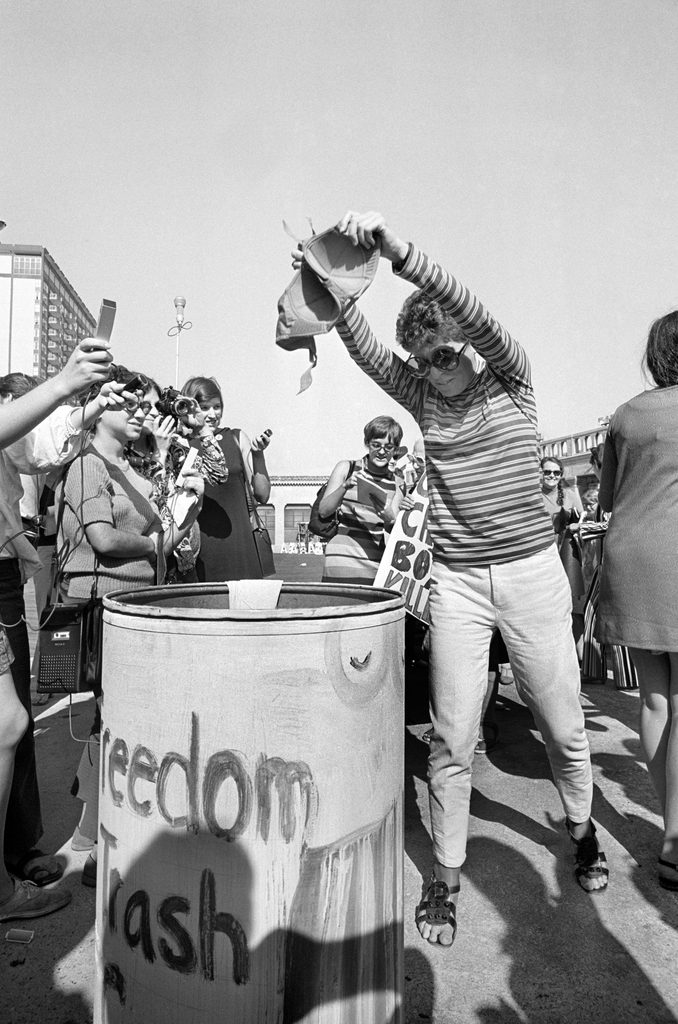
Taken separately, several demands could be presented as remedies to tangible hardships. Taken together, they constituted a coherent transfer of woman’s life from household form to individual and collective administration. Equal employment drew her into undifferentiated production; state nurseries transferred the socialisation of children from household to institution; contraception and abortion placed generation beneath autonomous choice; legal and financial independence preserved the separate individual against marriage; self-defined sexuality detached sexual identity from reproductive and conjugal order.
The new feminist fifth estate announced itself not only in manifestos and legislation, but through ritual attacks upon the inherited signs of femininity. At Atlantic City in 1968, New York Radical Women cast bras, girdles, high heels, curlers, false eyelashes, and women’s magazines into a ‘Freedom Trash Can’; participant Carol Hanisch later recalled that they had intended to burn its contents until prohibited from doing so upon the wooden boardwalk, although organiser Robin Morgan subsequently denied that any burning had been intended. The famous bra-burning bonfire is therefore at the very least a grossly exaggerated rendering of this canonical episode, but the intended iconoclasm was not, and by June 1970 the symbolism had acquired indisputably literal form at Berkeley, where a 38-C bra was ceremonially burned alongside nylon stockings, a copy of Redbook, and birth-control pills,64a the latter reflecting the contemporary feminist revolt against the supposed medical and pharmaceutical control of female contraception rather than a simple rejection of contraception itself. By the early 1970s, refusal to shave the legs and armpits had itself become a visible feminist repudiation of cultivated femininity,64b while menstruation and menstrual blood entered radical feminist art: Judy Chicago’s Red Flag (1971) and Menstruation Bathroom (1971–72), Carolee Schneemann’s Blood Work Diary (1972), and later Catherine Elwes’s Menstruation I and II (1979) deliberately carried what had been intimate, concealed, and corporeal into public aesthetic confrontation.64c In miniature, the revolution had descended into the body itself: grooming, restraint, and concealment could be recoded as instruments of oppression, while exposure, abjection, and repudiation acquired the prestige of liberation.
There is something deliberately latrinal in this aesthetic of revolt: menstrual blood exhibited as art, body hair displayed as defiance, the intimate refuse and secretions of the organism dragged into public view and invested with ideological dignity, as though civilisation might be overturned by compelling it to stare at what higher refinement had once taught it to veil. The gesture resembles weaponised toilet humour elevated into coercion doctrine: shock is mistaken for profundity, exposure for truth, and the merely biological for something spiritually liberating.

Hal Foster gave this tendency an explicit aesthetic formulation in ‘Obscene, Abject, Traumatic’ (1996), describing contemporary art as refusing the older mandate to pacify the gaze and instead seeking the real in its ‘glory (or horror)’, even to ‘evoke this sublime condition’; his discussion of abject art turns upon precisely this descent into menstrual blood, sexual discharge, vomit, excrement, decay, and death. From a Traditional standpoint, however, the supposed sublimity is an inversion of the term itself: the sublime properly exceeds ordinary form by ascent, whereas abjection dissolves form by descent beneath it. The confusion is therefore metaphysical as much as aesthetic: the infra-rational is mistaken for the supra-rational, decomposition for transcendence, and the shock of materia unbound for an elevation beyond form.
The association of excrement with psychic disorder is not merely rhetorical. Coprophagia is a rare but well-documented symptom in psychiatric and neurological literature, reported in schizophrenia, psychotic and affective disorders, obsessive-compulsive disorder, dementia, intellectual disability, autism, and organic brain disease; coprophilia likewise occupies the clinical literature of paraphilic disorder.65a Scatological fixation also appears in forensic studies of serial sexual murderers: the FBI’s classic sample reported coprophilia in roughly 7 per cent of offenders, while Harbort and Mokros found it in 4.5 per cent of their German serial sexual murderers. The excremental fixation therefore possesses a documented pathological and forensic history quite apart from its later aesthetic elevation. The urinary counterpart is likewise clinically recognised: urolagnia or urophilia denotes a fixation upon urine and urination, and appears within the psychiatric literature of paraphilia and, more pertinently here, within forensic accounts of sexual offenders.65b The significance of this descent is wider than ugliness or provocation. In Traditional terms, civilisation depends upon distinctions: high and low, sacred and profane, public and private, form and matter, the rationally governed and the merely organic. Degeneration proceeds by dissolving these boundaries, treating every separation as an arbitrary prohibition until what had been subordinated is permitted to invade what had formerly ordered it. The menstrual secretion becomes art, excretion becomes political declaration, animal process becomes authenticity, and the destruction of restraint is represented as women’s liberation. What is lost throughout is forma: the differentiating and governing principle by which the lower is assigned its place and raw materia prevented from overflowing the hierarchy that gives it meaning.
It is therefore striking that, at the psychic level, one of the most radical disorders of coherent experience has itself long been described in the language of failing boundaries. Schizophrenia is associated in phenomenological psychiatry with disintegration of subjectivity, permeability of ego-boundaries, and disturbance of the distinction between self and other: thoughts, intentions, bodily agency, and even the limits of one’s own person may cease to possess their ordinary self-evidence.65c Read besides the cultural phenomena above, the parallel is formidable. The same formal principle whose weakening permits the lower corporeal strata to overflow aesthetic and social boundaries appears, in psychic pathology, as an inability securely to maintain the elementary delimitations upon which an ordered self depends. Dissolution thus reaches its most intimate image when the loss of form no longer merely degrades the object contemplated, but enters the structure of consciousness, and then civilisation itself, manifested as subversive and degenerative art or political movements as a possible mode through which the same loss of form already traced through aesthetics and politics may express itself outwards.

By the 1990s, the same aesthetic of bodily transgression had acquired an explicitly territorial form. The idea for Sophy Rickett’s Pissing Women came to her at Glastonbury in 1994, where she was struck by what she described as a disparity between men urinating freely in public and women being ‘conditioned’ to perform the same bodily function discreetly and in private. Sophy Rickett’s Pissing Women photographed women in sober office dress urinating while standing at sites associated with corporate and governmental power around London; Rickett herself later described the project as testing those codes by which femininity is rendered ‘disciplined’ and ‘restrained’ within public space.64d Here excretion itself becomes political gesture: the deliberately unfeminine exposure of an ordinarily private bodily function is transformed into an assertion of presence, territory, and emancipation. The logic is continuous with the elevation of menstrual blood into art: what civilisation had relegated to privacy precisely because it belonged to the lower corporeal order is hauled into public view and invested with ideological significance.
As the pathos swells and form dissolves, Boudicca herself now takes a decidedly uromaniacal turn: rebellion descends from the chariot to the bladder, while the gesture of defiance remains that ancient raising of the feminine insurgent against the ordered majesty of Rome, now replayed upon the streets of imperial London in the lone woman standing upright like a man and spraying against the City itself. In traditional terms, the movement is downwards rather than transcendent. It privileges the quantitative, corporeal, and sub-rational residues of animal existence precisely against forma: against measure, selection, beauty, discipline, and the shaping principle by which raw nature is raised into civilisation. Hair, blood, excretion, appetite, and bodily process are not denied as realities; they are simply refused sovereignty. Radical feminist spectacle reverses that hierarchy, hauling the lowest and most involuntary strata of embodiment onto the pedestal and calling the inversion and degradation of superior form authenticity. What appears as liberation from ‘artificial’ standards is therefore more accurately a revolt against form itself: the deliberate enthronement of materia where traditional civilisation had demanded that materia be mastered, ordered, and made beautiful.
To be ‘feminine’ is to be disciplined, restrained. I wanted to see what happened when those boundaries were tested. […] But, in wearing business suits and staging the performances in public sites across London, the meaning shifted. It became a critique of power, and of the ways those spaces were – and still are – gendered. The work has sometimes been described as an appropriation of masculinity…
Sophy Rickett, interviewed by Emily Dinsdale, ‘Pissing Women: The Story Behind the Subversive 90s Photo Series’, AnOther, 19 September 2025
Thus, every higher order is a victory of form over forces which, left to themselves, rather than ascending, disperse. Hierarchy, discipline, rite, measure, and differentiated authority do not merely ‘repress’ an already perfected freedom; they bind, orient, and transfigure the elemental. Once these superior forms are removed in the name of so-called ‘liberation’, what is loosed is therefore not necessarily something higher, but precisely that substratum which form had previously mastered: appetite, resentment, instinct, quantity, the chthonic, the collective, and the merely vital. The lower then experiences emancipation from measure as though it were ascent, while civilisation mistakes decomposition for vitality. The elemental demand for release therefore contains within itself an ultimate demand for dissolution: to be freed from every limit, distinction, hierarchy, and determining form. Yet to be wholly without determination is not to possess a higher or more abundant existence, but to cease to be anything definite at all. Absolute liberation thus tends, at its furthest limit, not towards plenitude but towards indetermination, and indetermination towards nothingness. Liberation, in this sense, becomes the release of elemental forces from the very principles that had given them continuing existence, until what had once been subordinate begins to occupy the place of that which ordered it, and eventually, dissolves into nothingness.
The demand for release exists as a presence beneath the seals of order: an old, sleepless thing pressing against every boundary, hating every form that contains it, whispering through each fracture with a cascading urgency that one more chain must be broken, one more gate opened, one more distinction erased. It promises freedom only because it desires the moment when nothing remains strong enough to continue existence.
The movement’s connexion with the British Left was intrinsic rather than accidental. Socialist feminists sought to force the labour movement beyond its concentration upon the male worker and to interpret domestic life as another field of oppression. Women associated with Labour, trade unions, and the Communist Party of Great Britain developed campaigns around equal pay, abortion, domestic labour, and female political organisation. Publications such as Red Rag, Shrew, and, from 1972, Spare Rib carried this consciousness into British culture, converting private dissatisfaction into a shared political account of woman’s condition.66
The legal transformations arrived in rapid succession: the Abortion Act 1967, the Divorce Reform Act 1969, the Equal Pay Act 1970, the Guardianship Act 1973, and the Sex Discrimination Act 1975.67 None alone created the new order. Together they made its direction unmistakable. Generation, marriage, labour, guardianship, and public participation were progressively subjected to equality, individual choice, and administrative enforcement.
The old suffragette had demanded a vote within the state. The second-wave feminist demanded that the state penetrate the household to secure liberation from the relations formerly composing it.
Scholia
- J. J. Bachofen, Myth, Religion, and Mother Right: Selected Writings of J. J. Bachofen, trans. Ralph Manheim (Princeton: Princeton University Press, 1967), selections from Mother Right; Bachofen’s distinction associates maternity with physical and telluric immediacy and paternity with a spiritual-juridical principle.
- Mari Mikkola, ‘Feminist Perspectives on Sex and Gender’, The Stanford Encyclopedia of Philosophy, §§1.2 and 2.1, on social construction and gender socialisation; Mary Wollstonecraft, A Vindication of the Rights of Woman: With Strictures on Political and Moral Subjects (London: J. Johnson, 1792), especially chs. IV and XII; the work argues for national mixed-sex education and women’s capacity for economic self-support;
- Prometheus Trust, ‘Thomas Taylor Series’, describing Taylor as the first translator of the whole of Plato and the surviving works of Aristotle into English, together with his translations of Proclus, Plotinus, Iamblichus, and other Platonists; the modern series comprises thirty-three volumes and approximately seventeen thousand pages.
- Louise Schutz Boas, Introduction to Thomas Taylor, A Vindication of the Rights of Brutes (Gainesville, Florida: Scholars’ Facsimiles and Reprints, 1966), pp. xi–xiii; Boas records the reports of images of the Gods and libations in Taylor’s study, distinguishing the probable occasional libation from later sensational gossip. Taylor’s surviving notebook of hymns and prayers supplies firmer evidence of his personal worship.
- [a] Thomas Taylor, The Six Books of Proclus, the Platonic Successor, on the Theology of Plato, 2 vols (London, 1816), Introduction; David Nowakowski, ‘Honoring Our Platonic Ancestors: Thomas Taylor’, 9 May 2025; Leendert Catana notes the tribute paid by H.-D. Saffrey and L. G. Westerink to Taylor’s competence in Proclean texts and to his textual conjectures. [b] Leendert Catana, ‘Thomas Taylor’s Dissent from Some Eighteenth-Century Views on Platonic Philosophy: The Ethical and Theological Context’, The International Journal of the Platonic Tradition, 7.2 (2013), pp. 180–220, especially pp. 182–84; Thomas Taylor, ‘General Introduction’, in The Works of Plato, 5 vols (London, 1804), vol. I, pp. lxxxvii–xcii.
- William E. A. Axon, Thomas Taylor, the Platonist (London, 1890), pp. 18–19; David Nowakowski, ‘Honoring Our Platonic Ancestors: Thomas Taylor’, 9 May 2025, on the identification of 15 May 1758 with the seventh of Thargelion.
- Thomas Taylor, A Vindication of the Rights of Brutes (London: Edward Jeffery, 1792). The work satirically carries the egalitarian arguments associated with Paine and Wollstonecraft to their logical extreme; Taylor’s earlier publications and translations included works of Orpheus, Plotinus, Proclus, and the Greek mystery tradition.
- [a] S. Marek Muller, ‘Archival Mocking as Feminist Praxis: A Rhetorical Repurposing of A Vindication of the Rights of Brutes’, Women’s Studies in Communication, 44.1 (2021), pp. 23–43. Muller describes the procedure as ‘mocking as method’ and proposes to ‘repurpose’ Taylor’s satire into vegan ecofeminist advocacy; [b] Taylor’s argument has been expressly identified as a reductio ad absurdum of Wollstonecraft’s universalisation of rights; the method belongs to the Eleatic tradition most famously developed by Zeno, who provisionally admitted an opponent’s premise and derived its impossible consequences.
- Taylor, Rights of Brutes, Advertisement, pp. iii–vii, and ch. I, pp. 10–20. Taylor parodies the disappearance of subordination, the equalisation of mistress and servant, Wollstonecraft’s sexual egalitarianism, and the eventual extension of equal rights to animals, vegetables, and minerals.
- Caroline Norton, ‘The Natural Position of Woman’, The Times, 1838; the line ‘The natural position of woman is inferiority to man’ is discussed in English Heritage’s biographical account and the Open University Law School’s study of Norton.
- Caroline Norton, Observations on the Natural Claim of a Mother to the Custody of her Children as affected by the Common Law Right of the Father (London, 1837); The Separation of Mother and Child by the Laws of Custody Considered (London, 1838). For Norton’s campaign and its legislative consequence, see UK Parliament, ‘Custody Rights and Domestic Violence’.
- Custody of Infants Act 1839, 2 & 3 Vict. c. 54; Infant Custody Act 1873, 36 & 37 Vict. c. 12. The first permitted mothers to petition for custody of children under seven and access to older children; the second extended applications concerning children under sixteen and redirected custody adjudication towards the child’s needs. Neither statute established an automatic maternal award in every case.
- Guardianship of Infants Act 1886, 49 & 50 Vict. c. 27; Guardianship of Infants Act 1925, 15 & 16 Geo. V c. 45, ss. 1–5. The 1925 Act made welfare paramount, denied superiority to either parent’s claim in proceedings, and granted the mother equivalent powers of application.
- Guardianship Act 1973, c. 29; parliamentary debate described its purpose as establishing equal legal rights for husband and wife in the guardianship of their children.
- June Purvis, Emmeline Pankhurst: A Biography (London and New York: Routledge, 2002), pp. 8–9, 118–19. Purvis records the birth-certificate date of 15 July 1858, Pankhurst’s insistence upon Bastille Day, her early admiration for Carlyle’s History of the French Revolution, and her remarks upon receiving the commemorative Bastille medal in 1908.
- Daily Mirror, 22 May 1914, report of Emmeline Pankhurst’s arrest at Buckingham Palace: ‘Tell the King, gentlemen!’; June Purvis, ‘Emmeline Pankhurst (1858–1928) and Votes for Women’, in June Purvis and Sandra Stanley Holton, eds, Votes for Women (London and New York: Routledge, 2000), p. 129; Central Press, Emmeline Pankhurst’s Arrest at Buckingham Palace, vintage press photographs, 22 May 1914, NPG x137688 and x137689; National Portrait Gallery, London. Purvis gives the expanded form: ‘That’s right! Arrest me at the gates of the Palace. Tell the King!’
- [a] James Van Horn Melton, The Rise of the Public in Enlightenment Europe (Cambridge: Cambridge University Press, 2001), ch. 8, ‘Freemasonry: Toward Civil Society’, pp. 252–72, on Freemasonry as a pan-European voluntary association, its crossing of occupational, confessional, and social distinctions, and its comparatively egalitarian associative culture; [b] Kenneth B. Loiselle, Brotherly Love: Freemasonry and Male Friendship in Enlightenment France (Ithaca: Cornell University Press, 2014), particularly ‘Friendship under Fire: Freemasonry in the French Revolution’, on classical republican discourse as a substantive connexion between Enlightenment Masonry and revolutionary political culture; Michael L. Kennedy, ‘The Foundation of the Jacobin Clubs and the Development of the Jacobin Club Network, 1789–1791’, Journal of Modern History 51.4 (1979), pp. 701–33, on the pre-Revolutionary associational environment, including the extensive French Masonic network, from which revolutionary club organisation emerged.
- Emmeline Pankhurst, My Own Story (London: Eveleigh Nash, 1914), opening chapter: Pankhurst recalls discovering Carlyle’s The French Revolution in childhood and describes it as a lifelong ‘source of inspiration’; the third and culminating division of her memoir is entitled ‘The Women’s Revolution’.
- On the Langham Place circle, its leading members, publications, campaigns for employment and legal equality, and connexion with women’s higher education, see Pam Hirsch, ‘The Langham Place Group’, and the historical account of The English Woman’s Journal.
- Married Women’s Property Act 1870, 33 & 34 Vict. c. 93; Married Women’s Property Act 1882, 45 & 46 Vict. c. 75, especially s. 1, which allowed a married woman to acquire, hold, and dispose of real and personal property as a feme sole.
- Women’s Suffrage Petition, 1866; John Stuart Mill presented the petition and later attempted to replace ‘man’ with ‘person’ during debate on the Second Reform Bill. UK Parliament records more than 16,000 petitions to both Houses between 1866 and 1918.
- Representation of the People Act 1918, 7 & 8 Geo. V c. 64; Parliament (Qualification of Women) Act 1918, 8 & 9 Geo. V c. 47; Representation of the People (Equal Franchise) Act 1928, 18 & 19 Geo. V c. 12.
- Juliet Mitchell, ‘Women: The Longest Revolution’, New Left Review, I/40 (November–December 1966), pp. 11–37. Mitchell identifies production, reproduction, sexuality, and the socialisation of children as the four structures requiring transformation and describes the family as a cultural creation rather than an inevitable natural form.
- Juliet Mitchell, Woman’s Estate (Harmondsworth: Penguin, 1971), especially the analysis of oppression through work, reproduction, sexuality, and the socialisation of children.
- People’s History Museum, ‘British Women’s Liberation Movement’; the first four national demands were equal pay, equal educational and employment opportunities, free contraception and abortion on demand, and free twenty-four-hour nurseries. Three further demands were adopted in 1977.
- [a] Alice Echols, Daring to Be Bad: Radical Feminism in America, 1967–1975 (Minneapolis: University of Minnesota Press, 1989), 92–94, on the 1968 Miss America protest, the ‘Freedom Trash Can’, the disposal of bras, girdles, high heels, curlers, false eyelashes and other supposed instruments of female oppression, and the protesters’ hope of burning its contents before being prohibited from doing so by the city. See also Bonnie J. Morris, ‘How the Myth of Feminist Bra Burning Spread’, Smithsonian Magazine, 6 March 2025, on the subsequent bra-burning mythology. An unambiguous later instance occurred at Lower Sproul Plaza, Berkeley, on 2 June 1970, when a 38-C bra was ceremonially burned in a wastebasket with birth-control pills, nylon stockings, and a copy of Redbook; ‘Sisterly Criticism’, Berkeley Tribe, 5–12 June 1970, p. 17. The Atlantic City evidence is nevertheless more complicated than the usual categorical denial suggests: Carol Hanisch later recalled that ‘we had intended to burn it’, but were prevented by police because they were upon the wooden boardwalk; Nell Greenfieldboyce, ‘Pageant Protest Sparked Bra-Burning Myth’, NPR, 5 September 2008. Robin Morgan, by contrast, subsequently maintained that the organisers ‘never burned bras and never intended to do so’; Robin Morgan, ‘I Was There: The 1968 Miss America Pageant Protest’, History, 7 September 2018. A contemporaneous report by John L. Boucher, ‘Bra-Burners Blitz Boardwalk’, Atlantic City Press, 8 September 1968, p. 4, stated that bras and other articles actually ‘burned in the “Freedom Trash Can”’; W. Joseph Campbell, Getting It Wrong: Ten of the Greatest Misreported Stories in American Journalism (Berkeley: University of California Press, 2010), 101–114, esp. 109–10, additionally records the recollection of fellow Press reporter Jon Katz that a small fire was indeed lit. For the supposed medical and pharmaceutical control represented by the contraceptive pills, see Washington Women’s Liberation, press release issued during the 1970 Senate hearings on oral contraceptives, which expressly declared that the group was not opposed to oral contraception itself while accusing the medical and pharmaceutical industries of imposing unsafe contraceptives upon uninformed women for profit. [b] Rebecca M. Herzig, Plucked: A History of Hair Removal (New York: New York University Press, 2015), 115–134, esp. ch. 6, ‘Unshaven: “Arm-Pit Feminists” and Women’s Liberation’; see also Harriet Lyons and Rebecca Rosenblatt, ‘Body Hair: The Last Frontier’, Ms., 1.1 (July 1972), 64–65, 131, treating female depilation as an imposed beauty discipline and natural body hair as a site of feminist resistance. [c] Ruth Green-Cole, ‘Painting Blood: Visualizing Menstrual Blood in Art’, in Chris Bobel, Inga T. Winkler, Breanne Fahs et al. (eds.), The Palgrave Handbook of Critical Menstruation Studies (Singapore: Palgrave Macmillan, 2020), ch. 57, esp. 789ff., on the emergence of menstruation in feminist art during the 1970s, including Chicago’s Red Flag and Menstruation Bathroom, Schneemann’s Blood Work Diary, and Elwes’s menstrual performances; Green-Cole expressly characterises such work as transgressive and as challenging established aesthetic decorum; Hal Foster, ‘Obscene, Abject, Traumatic’, October, 78 (Autumn 1996), 106–124, esp. 109–114, on contemporary art’s refusal of the traditional ‘taming’ of the gaze, its aspiration to evoke the real in ‘glory (or horror)’ as a ‘sublime condition’, and the emergence of abject imagery involving menstrual blood, sexual discharge, vomit, excrement, decay, and death. [d] Sophy Rickett, Pissing Women 1995 (London: Climax Books, 2023), a publication of the complete series including a long-form interview with Rickett; see also Sophy Rickett, interview with Zara Afthab, ‘Pissing Women: The Story Behind Sophy Rickett’s Shocking Photos’, Dazed, 11 September 2025, where Rickett recalls that the idea arose from observing the disparity between male and female public urination at Glastonbury in 1994 and describes the work as exploring ‘strategies of resistance’ within gendered corporate culture; and Sophy Rickett, interview with Emily Dinsdale, ‘Pissing Women: The Story Behind the Subversive 90s Photo Series’, AnOther, 19 September 2025, where she describes the work as exposing and destabilising codes having a ‘conditioning and disciplining effect on women in public space’ and states: ‘To be “feminine” is to be disciplined, restrained.’
- [a] Heela Azizi, Tasmia Khan, Cecilia Canale, and Jisha Kallikkadan, ‘The Pathophysiology and Management of Coprophagia: A Report of Two Cases and Literature Review’, Case Reports in Psychiatry (2018), article 5157879, reviewing reported associations with schizophrenia-spectrum disorders, affective illness, dementia, autism, obsessive-compulsive disorder, cognitive impairment, and neurological disease; Jacqueline M. Arnone, Richard P. Conti, and Joseph H. Preckajlo, ‘Coprophilia and Coprophagia: A Literature Review’, Journal of the American Psychiatric Nurses Association, 30.1 (2024), 8–16, distinguishing coprophilia from coprophagia and treating both within the contemporary literature of paraphilic disorder; Robert K. Ressler, Ann W. Burgess, and John E. Douglas, Sexual Homicide: Patterns and Motives (Lexington, MA: Lexington Books, 1988), on paraphilic behaviour among a sample of thirty-six incarcerated sexual murderers, with coprophilia reported in approximately 7 per cent; Stephan Harbort and Andreas Mokros, ‘Serial Murderers in Germany from 1945 to 1995: A Descriptive Study’, Homicide Studies, 5.4 (2001), 311–334, esp. 325, recording coprophilia in 4.5 per cent of the twenty-two serial sexual murderers examined. [b] [c] Mads Gram Henriksen, Andrea Raballo, and Julie Nordgaard, ‘Self-Disorders and Psychopathology: A Systematic Review’, The Lancet Psychiatry, 8.11 (2021), 1001–1012, describing the foundational association of schizophrenia with a ‘disintegration of subjectivity’ and reviewing anomalous self-experiences including diminished self-presence, bodily self-alienation, and permeability of ego-boundaries; Amy M. Jimenez and Michael F. Green, ‘Disturbance at the Self-Other Boundary in Schizophrenia: Linking Phenomenology to Clinical Neuroscience’, Schizophrenia Research, 272 (2024), 51–60, reviewing disturbances of body ownership, agency, source-monitoring, self-reflection, and autobiographical experience, and distinguishing an overly porous self-other boundary associated with reduced sense of self from the converse possibility of an overly rigid boundary; see also Louis A. Sass, ‘Self-Disturbance and Schizophrenia: Structure, Specificity, Pathogenesis’, Schizophrenia Research, 152.1 (2014), 5–11, on the ipseity-disturbance or basic-self-disorder model of schizophrenia.
- Angela Weir and Elizabeth Wilson, ‘The British Women’s Movement’, New Left Review, I/148 (November–December 1984), pp. 74–103; LSE Library, ‘Women’s Liberation Movement’; London Museum, ‘Spare Rib’.
- Abortion Act 1967, c. 87; Divorce Reform Act 1969, c. 55; Equal Pay Act 1970, c. 41; Guardianship Act 1973, c. 29; Sex Discrimination Act 1975, c. 65. These statutes addressed, respectively, abortion, marital dissolution, employment remuneration, parental guardianship, and discrimination on grounds of sex.
From the French Revolution to Women’s Liberation: The Masonic Thread Finds its Daughters
One of the institutions which underpinned the women’s movement at this time was Freemasonry, since the first two of the three great Masonic principles, namely Brotherly love and Relief, were readily applicable to feminist causes.
Ann Jessica Pilcher-Dayton, Women Freemasons and Feminist Causes 1908–1935: The Case of the Honourable Fraternity of Antient Masonry, PhD thesis, Department of History, University of Sheffield, February 2011, p. 6
The women drawn within the initiatory orbit of Freemasonry cannot easily be dismissed as a handful of accidental dual memberships. Ann Jessica Pilcher-Dayton’s doctoral study, Women Freemasons and Feminist Causes 1908–1935, is based substantially upon the internal records of women’s and mixed Freemasonry and reaches the much broader conclusion that Freemasonry was one of the institutions which ‘underpinned the women’s movement’ in early twentieth-century Britain. Her analysis finds that the Honourable Fraternity of Antient Masonry mobilised its social networks in support of women’s suffrage, while male and female Masons contributed directly to feminist causes. This conclusion is unusually valuable because the source base is not principally hostile commentary upon Masonry: Pilcher-Dayton was librarian and archivist of the Order of Women Freemasons and based much of the thesis upon its own Grand Lodge minutes, Board of General Purposes minutes, individual lodge minute books and records, supplemented by the archives of Le Droit Humain, The Gavel, The Co-Mason, and the principal suffrage periodicals.68
The connexion between Freemasonry and the organised feminist movement was not merely a matter of individual suffragettes happening also to belong to lodges; in the particular current of Continental and mixed Masonry which entered Britain at the beginning of the twentieth century, the emancipation of women was present at the foundation. Nesta Webster traces this genealogy directly to France. Maria Deraismes, whom she calls an ‘ardent French Feminist’, was initiated in 1882 by Les Libres Penseurs at Le Pecq; some years later Georges Martin, an ‘enthusiastic advocate of votes for women’, collaborated with her in founding the mixed Masonic order Le Droit Humain. Webster consequently describes the resulting Maçonnerie Mixte as ‘political and in no way theosophical or occult’ in its original conception.69 Le Droit Humain’s own institutional history confirms the essential sequence: Deraismes was already an activist for women’s rights, Martin a champion of women’s equality, and together they established the mixed Order in which women were admitted to Masonic initiation upon the same footing as men.70
The French experiment then passed directly into Britain through Annie Besant. Having been initiated in Paris in July 1902, Besant and her companions returned to England and petitioned the French Supreme Council for authority to establish a lodge in London. On 26 September Lodge Human Duty No. 6 was formally inaugurated, with Besant installed as its first Right Worshipful Master. The present British Federation of Le Droit Humain itself remembers Besant as already renowned for her support of the feminist cause and records that she had become convinced of the value of a Masonic system admitting men and women ‘on an equal footing’.71 Co-Masonry is a form of Freemasonry in which women and men are initiated into the same Masonic system and admitted to lodge membership on equal terms; in Britain, the term became especially associated with Le Droit Humain, the mixed Masonic order founded in France by Maria Deraismes and Georges Martin and introduced into Britain by Annie Besant in 1902. Webster independently records the same institutional transmission: Besant rose to become Vice-President of the Supreme Council and its national delegate to Great Britain, and in that capacity founded the English branch of Co-Masonry at Human Duty.72 What appeared in Britain was therefore not an indigenous curiosity which subsequently acquired feminist members; it was the British implantation of a French mixed-Masonic institution born out of the women’s-rights agitation itself.
Nor was the political meaning of this arrangement concealed within lodge walls. In January 1911 the 33rd-degree Co-Mason Ursula Bright stated in The Co-Mason that ‘Co-Masonry is the latest development of two great ideas—the religious and the political—I almost said the feminist’, adding that the Paris Supreme Council made the complete equality of men and women throughout human life its chief object.73 Elizabeth Severs carried precisely the same principle into the suffrage press, arguing in The Common Cause that Masonic ‘Brotherhood’ could deserve that name only when it embraced the relation and co-operation of men and women.74 Thus the language of the lodge and the language of organised feminism were not running upon separate tracks: the political equality of the sexes was being presented from within Co-Masonry itself as an implication of Masonic universal brotherhood. Within this mixed-Masonic setting, the language of ‘brotherhood’ acquired an obvious feminine corollary in ‘sisterhood’: women were not merely admitted into an existing fraternity, but incorporated into a ritual and ideological community which could be understood as binding female initiates to one another across the same networks of mutual recognition, loyalty, and common purpose that Freemasonry traditionally claimed for its brethren. In the political atmosphere of the women’s movement, this Masonic conception of fraternity thus furnished an institutional analogue for the emerging feminist ideal of sisterhood.
The connexion became spectacularly public in the Women’s Coronation Procession of 17 June 1911. Amid the great suffrage demonstration appeared a corporate contingent of the Order of Universal Co-Freemasonry, led by Annie Besant and wearing full Masonic regalia. The Co-Mason reported the procession in its July number, whilst its own Elizabeth Severs wrote specifically upon ‘The Co-Masons and the Women’s Suffrage Procession’.75 This was considerably more than the private membership of a few prominent women: a Masonic body entered a national suffrage mobilisation under its own insignia, led by one of its highest-ranking officers. Around the same institutional world stood figures already encountered in the militant movement — Charlotte Despard, Annie Cobden-Sanderson, Evelina Haverfield, and others — so that the lodge, the feminist organisation, and the suffrage procession repeatedly converged in the same personnel and political causes.76
Webster therefore supplies an important missing perspective. The appearance of Freemasons throughout the British women’s movement need not be treated as an accumulation of curious coincidences. There was an identifiable lineage: Deraismes and Martin transformed women’s emancipation into a constitutive principle of mixed Masonry; Le Droit Humain institutionalised that principle in France; Besant carried the Order into Britain; and British Co-Masons then appeared openly within the organised suffrage movement. The Masonic-feminist connexion was consequently genealogical, institutional, ideological, and ultimately public.
Scholia
- Ann Jessica Pilcher-Dayton, Women Freemasons and Feminist Causes 1908–1935: The Case of the Honourable Fraternity of Antient Masonry, PhD thesis, University of Sheffield, 2011, Abstract and Introduction: argues that Freemasonry was one of the institutions which ‘underpinned the women’s movement’, and that HFAM mobilised its networks to support women’s suffrage. Pilcher-Dayton states that, as Librarian and Archivist of the Order of Women Freemasons, she drew her evidence principally from its primary records, especially Grand Lodge, Board of General Purposes and lodge minute books, supplemented by the archives of the British Federation of International Co-Freemasonry, Le Droit Humain, and contemporary periodicals including The Gavel, The Co-Mason, The Vote, Votes for Women, and The Common Cause.
- Nesta H. Webster, Secret Societies and Subversive Movements, section on women in Masonry and the Maçonnerie Mixte: Deraismes’s initiation in 1882, her feminist political activity, Martin’s advocacy of female suffrage, and their establishment of Le Droit Humain.
- International Order of Freemasonry for Men and Women, Le Droit Humain, history of the Order: Deraismes’s initiation, Martin’s campaign for equal rights for women, and their creation of mixed Masonry.
- International Order of Freemasonry for Men and Women, British Federation, ‘History of the British Federation’: Besant’s Paris initiation, the founding party, and the inauguration of Human Duty No. 6 on 26 September 1902.
- Webster, Secret Societies and Subversive Movements: Besant’s advancement to the Supreme Council, appointment as national delegate, and establishment of Lodge Human Duty in London.
- Ursula Bright, ‘Co-Masonry’, The Co-Mason, vol. 3, January 1911, p. 4. The contemporary passage identifies the political — ‘almost … feminist’ — idea and equality of men and women as central to the Order’s programme. The original reference and text are reproduced in the surviving study of the periodical.
- Elizabeth Severs, ‘The Order of Universal Co-Masonry’, The Common Cause, 28 September 1911, pp. 425–26.
- The Co-Mason, vol. 3, July 1911, pp. 128–29, including Elizabeth Severs, ‘The Co-Masons and the Women’s Suffrage Procession’; the contemporary report records the Co-Masonic contingent in the 1911 procession under Besant.
- On the wider overlap of Co-Masonry with the suffrage movement, including Cobden-Sanderson and the lodge’s discussion of direct connexion with women’s suffrage, see the contemporary lodge and periodical materials cited in The Co-Mason and surviving lodge records.
Charlotte Despard: Co-Masonry and the Revolutionary Convergence
Charlotte Despard was an Anglo-Irish suffragist, socialist, pacifist, novelist, social worker, Theosophist, and Co-Mason, whose political activity connected the British women’s movement with socialism, organised pacifism, Irish nationalism, and eventually communism. Her radicalism was accompanied by unusually extensive practical work amongst the poor. In Battersea and Vauxhall she organised or supported health provision, soup kitchens for the unemployed, and clubs for young people and working men; from 1894 to 1903 she served as a Poor Law Guardian, while for part of this period actually living amongst the population with whom she worked rather than administering relief from a distant philanthropic circle. LSE’s archival biography also records her work as a school manager from 1899.
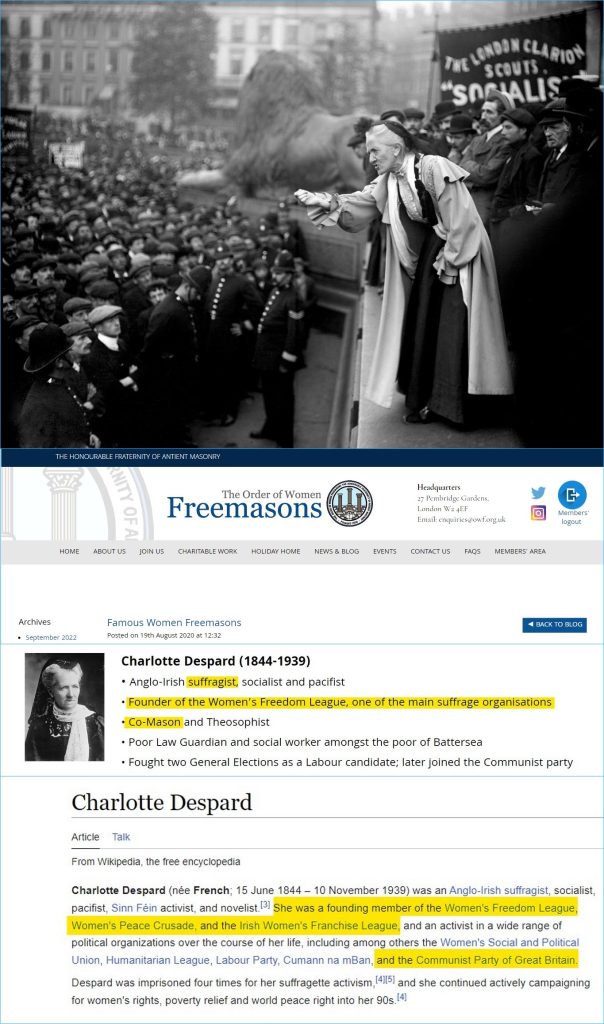
Despard passed through the constitutional and militant wings of the suffrage movement before becoming one of the founders of the Women’s Freedom League after the 1907 break with the WSPU; she was elected the new organisation’s first president. Unlike the increasingly centralised WSPU, the WFL presented itself as democratically organised and pursued what its members called constitutional militancy: tax resistance, obstruction, non-co-operation, and, later, the census boycott rather than the WSPU’s attacks upon people and property. Despard was also involved in the Women’s Social and Political Union, the Women’s Peace Crusade, and the Irish Women’s Franchise League; her wider affiliations extended through the Humanitarian League, Labour movement, Irish republican circles, and Sinn Féin. She was imprisoned four times for suffrage agitation and continued campaigning for women’s political rights, poverty relief, and pacifism into extreme old age.77a
The familial contrast is almost emblematic. Despard’s younger brother was Field Marshal John French, commander of the British Expeditionary Force at the beginning of the First World War and subsequently Lord Lieutenant of Ireland from 1918. While he occupied one of the highest military and viceregal offices of the British State, his sister was an avowed pacifist whose politics moved increasingly towards Irish nationalism and republicanism. Her anti-war campaigning during the First World War therefore placed her publicly in direct opposition to the military world personified by her own brother.
Her Irish commitments eventually became much more than sympathetic association. After the war Despard settled in Ireland, supported Sinn Féin and the anti-Treaty republican cause, and worked closely with Maud Gonne MacBride. She became president of the Women Prisoners’ Defence League, established to campaign for republican prisoners and internees and to demand improved conditions and prisoner-of-war treatment. The political trajectory is consequently unusually broad: British socialist reform, suffrage militancy, pacifism, Irish republicanism, and finally communism all converged within one career.
Despard contested two General Elections as a Labour candidate before moving still further left and eventually joining the Communist Party of Great Britain after visiting the Soviet Union in 1930; she also became secretary of the Friends of Soviet Russia. Alongside these political commitments she was a practising Co-Mason and Theosophist—a conjunction significant to the esoteric and Masonic networks surrounding sections of the contemporary women’s movement. The Order of Women Freemasons itself places Despard amongst its notable historical women, identifying her explicitly as a suffragist, socialist, pacifist, founder of the Women’s Freedom League, Co-Mason, Theosophist, Poor Law Guardian, Labour candidate, and eventual Communist.77b
The range of these associations makes Despard an unusually concentrated example of the ideological intersections visible within the radical wing of British women’s emancipation: suffrage, socialism, pacifism, esotericism and Co-Masonry, social administration, Irish republicanism, and finally organised communism did not merely coexist within the same period; in Despard they existed within the same woman. Her importance to the present discussion lies precisely in that convergence. The lodge, the suffrage organisation, the socialist movement, the peace campaign, the machinery of social reform, and revolutionary politics were not hermetically separate worlds.
Lilian Barker: Female Masonry, Penal Reform, and the Curative State
Lilian Barker was a British prison reformer, welfare administrator, educator, and member of the Honourable Fraternity of Antient Masonry (HFAM), the organisation now known as the Order of Women Freemasons. Her career was devoted particularly to the training, welfare, and rehabilitation of disadvantaged women and girls, carrying the increasingly maternal and reformative conception of institutional authority into industrial administration and the penal system.
During the First World War, Barker became Lady Superintendent at Woolwich Arsenal, where the Order of Women Freemasons records her as responsible for the recruitment and welfare of more than 20,000 women and girls employed in munitions work; Roehampton and Historic England give the still higher figure of approximately 30,000 women under her supervision. Her position placed her within the immense wartime expansion of female industrial labour and female welfare administration: women entering traditionally masculine industrial establishments were accompanied by an expanding apparatus of female superintendence concerned with their conduct, health, recreation, and general welfare.
After the war she entered the Ministry of Labour’s training department and, in 1923, became Governor of the Borstal Institution for Girls at Aylesbury. There she developed a deliberately rehabilitative conception of penal administration. The Order of Women Freemasons summarises her achievement with the unusually revealing formula that she transformed the regime into something ‘curative not punitive’; Roehampton similarly emphasises her use of education and rehabilitation and records her later appointment, in 1935, as Britain’s first female assistant prison commissioner.78a
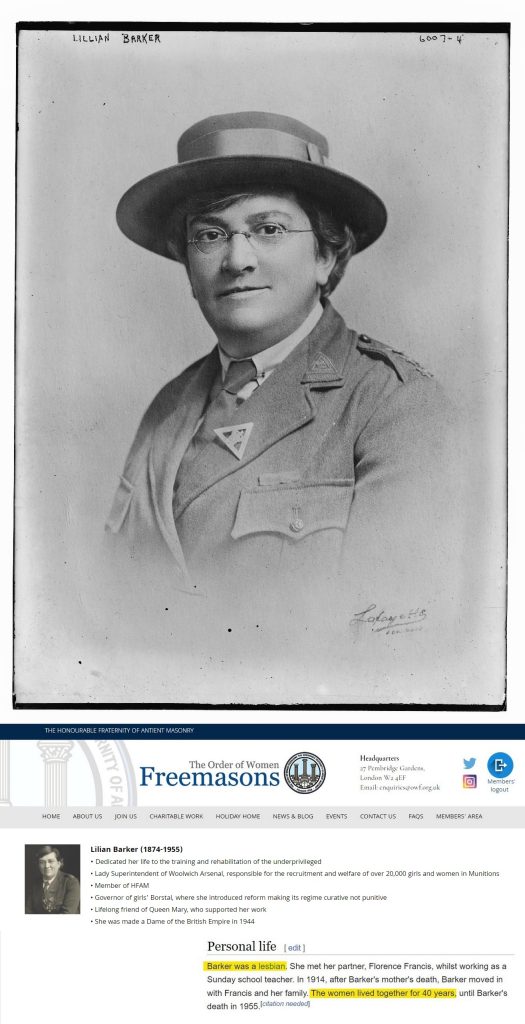
This is particularly relevant to the development of the female management class discussed elsewhere. Under the curative conception, the institution ceases to present itself principally as an authority which judges and punishes an offender and increasingly assumes responsibility for her rehabilitation, habits, education, welfare, emotional formation, and personal reconstruction. Barker’s career thus joined precisely those fields of education, industrial welfare, correction, prison administration, and reform in which the matronal administrator acquired a progressively enlarged jurisdiction during the early twentieth century.
Barker also moved comfortably within the highest reaches of the establishment. The Order of Women Freemasons describes her as a lifelong friend of Queen Mary, who supported her work; Barker’s public service ultimately brought her appointment as Dame Commander of the Order of the British Empire in 1944.
Alongside this establishment career, Barker belonged to HFAM. The Order of Women Freemasons explicitly includes her amongst its notable historical members and records her Masonic affiliation alongside her work at Woolwich and in the Borstal system. Her case is therefore particularly useful because female Freemasonry does not appear at the margins of institutional life: it appears in a woman who exercised substantial authority over industrial welfare and female penal administration and who was eventually honoured by the British State.78b
Barker was also a lesbian. She met Florence Francis while teaching Sunday school, and the two women subsequently formed a same-sex household which endured for approximately forty years, until Barker’s death in 1955. Historic England includes Barker within its national LGBTQ heritage project and records the forty-year relationship with Francis; Roehampton independently records their four decades of shared life. Emily Hamer likewise includes Barker within Britannia’s Glory: A History of Twentieth Century Lesbians, a study specifically concerned with the lives of British lesbians across the twentieth century.
That aspect of Barker’s life is relevant rather than incidental when she is considered within the broader history of organised women’s emancipation. Her career concentrates several developments within a single figure: women’s Freemasonry; female welfare administration; the mass supervision of women entering wartime industry; female authority over delinquent girls; lesbian social history; and the replacement of explicitly punitive discipline by a consciously curative and rehabilitative model of institutional control. She therefore stands at a revealing intersection between the expansion of the female administrative class and the new forms of autonomous female association developing alongside it.
The Lodge as Laboratory of Revolution
The appearance of Freemasonry and Co-Masonry amongst figures of women’s emancipation should not be treated as an incidental taste for ceremony or esoteric ornament. Particularly within the French and continental tradition with which Co-Masonry intersected, the lodge repeatedly presented itself as an engine of emancipation, a laboratory in which principles were first rehearsed amongst initiates and afterwards carried into the political world. One need not accept the maximal claim that a single Masonic command secretly directed the French Revolution in order to recognise the more important and demonstrable fact: Masonic bodies themselves repeatedly claimed a formative relationship with the revolutionary transformation of the old order.
Remarkably, this self-description appeared while the Revolution was still unfolding. In November 1790 the Parisian lodge Saint-Jean d’Écosse du Contrat Social circulated an address to other lodges discussing the extraordinary events through which France had passed. It expressly claimed that Masonry had ‘really influenced the present revolution’ by enlightening citizens within its ‘mysterious workshops’, whence they carried its principles into ordinary society. The document openly claimed that the lodge had ‘really influenced the present revolution’, forming citizens within its private workshops and sending them back into ordinary society bearing its principles; its repudiation of sanguinary violence therefore does nothing to efface the more consequential admission that the lodge understood itself as an organised centre of revolutionary formation, quietly preparing the men and principles through which political transformation was carried into public life.79 The circular opens by complaining that Masonry is being ‘vigorously attacked’ and ‘calumniated’, and says that its explanation is intended both to destroy hostile impressions and to protect brethren from ‘too exalted imaginations’. It then immediately insists that there is ‘no doubt’ that Masonry had exercised great influence upon the events of the age, even suggesting that the National Assembly seemed to have drawn the Declaration of the Rights of Man from the lodge’s own principles. Most significantly, it contrasts a revolution founded merely upon force, which cannot endure, with a revolution ‘brought about by enlightenment’; that is precisely where it declares how it had ‘really influenced the present revolution’—by enlightening citizens in its ‘mysterious workshops’, who then carried its principles into ordinary society.
Then comes the remarkable manoeuvre. Having claimed the cause, principles, personnel, and success of the transformation, it disclaims ‘violent shocks’ and ‘sanguinary means’, insists that lodges exclude ‘affairs of State’, and professes submission to lawful government. Yet only a little later it says that Masons must ‘cherish the new French constitution’ born from the very revolutionary violence it had just taken pains to disclaim, support it with the ascendancy of their virtues and enlightenment, and work upon those around them in its favour. The denial that ‘affairs of State’ belong within the lodge therefore sits rather awkwardly beside an explicit programme for sustaining a new constitutional order whose intellectual genealogy the lodge has just partly claimed for itself.
Only after the boast does the circular disclaim ‘violent shocks’ and ‘sanguinary means’. The function of the disclaimer therefore seems principally apologetic and delimitative: it rejects the allegation that lodges were secret centres issuing orders for bloodshed or physically overthrowing governments, while preserving—indeed magnifying—the claim that they had prepared the intellectual and moral revolution from within that itself led to the bloodshed. The document does not say, ‘We had nothing to do with the Revolution’; it says, in effect, ‘our revolution was deeper: we formed the men, diffused the principles, and thereby changed society.’ That reading is reinforced later when the circular says ‘we want to regenerate the earth’ and instructs Masons to cherish and support the new French constitution with the influence of their virtues and enlightenment. What the circular performs is therefore a remarkable double manoeuvre: it claims credit for the intellectual and ideological revolution whose principles expressed themselves in actual bloodshed, while simultaneously severing that bloodshed from its own agency precisely where responsibility might entail legal or political consequences.
There are several things happening at once. First, self-protection: the lodge wants revolutionary prestige without attracting prosecution or the odium attached to secret conspiracy. The opening declaration that Masonry is being calumniated tells us that apologetics are one of the circular’s purposes. Secondly, internal discipline: it does not want enthusiasts to infer that Masonic principles license freelance insurrection or bloodshed; hence the warning about ‘exalted imaginations’. Thirdly, political stabilisation: November 1790 is important. The monarchy had not yet fallen and the Terror lay ahead; the lodge praises the new constitutional monarchy. It could therefore regard the intellectual and constitutional revolution as accomplished and wish to stop the physical revolutionary process before it consumed the settlement it approved. Porset explicitly notes that France had not yet entered the Terror, although monarchy and Church were already threatened and bloody disorders had occurred.
But that is precisely where the hypocrisy bites. By November 1790, the French Revolution was hardly an immaculate seminar in political philosophy. The Bastille, the Great Fear, the October Days, rural violence, confiscatory measures, and bloody communal conflicts already lay behind or around it; violence had helped destroy crucial parts of the old order. Modern scholarship likewise treats popular violence from 1789 as materially implicated in the destruction of feudal structures and inherited privilege.80 The lodge therefore places itself in the enviable moral position of saying, in effect: we prepared the minds, diffused the principles, influenced the Revolution, rejoice in its constitutional fruits, and intend to consolidate them; the bloodshed, however, belongs to somebody else.
That is more cuttingly described as selective revolutionary innocence. It allows an intellectual movement to claim causation when the result appears glorious and disclaim causation when the mechanism becomes ugly.
There is also something revealing in the circular’s theory that a revolution founded upon force is transient, whereas one produced by lumières is durable. The lodge is effectively asserting that ideological conquest is superior to physical conquest. By its own account, the important revolutionary work that prepared and precipitated the violent eruption occurred before or beneath the visible upheaval: men had been formed privately, principles had been implanted, and those men returned to civil society carrying them. The street violence is almost demoted to an embarrassing surface phenomenon beside the deeper revolution of consciousness. That does not exculpate the latter; it actually makes the lodge’s claim to revolutionary agency more extensive.
The connexion was made still more ceremonially after the Revolution of February 1848. When a Masonic deputation appeared before the Provisional Government, Alphonse de Lamartine—who explicitly told them that he was not himself a Freemason—nevertheless declared that the sentiments which had burst forth into revolution had emanated from the lodges ‘first in the shadows, then in the half-light, and finally in full light’. He concluded by thanking them for principles which had become those of the French Republic: ‘vos principes, devenus ceux de la République française’.81 The imagery is initiatory in itself: doctrine gestates within the enclosed temple, emerges gradually from secrecy, and ultimately takes political embodiment in the State.
By the later nineteenth century the claim had become considerably more explicit. At a plenary meeting of the Nantes lodges Paix et Union and La Libre Conscience on 23 April 1883, a report later published as Du rôle de la Franc-Maçonnerie au XVIIIe siècle declared: ‘Ce fut de 1772 à 1789 que la Franc-Maçonnerie élabora la grande Révolution’—‘It was from 1772 to 1789 that Freemasonry elaborated the great Revolution’. It continued that Masons had disseminated among the people ideas first taken from their lodges and described the Revolution as intellectually prepared within those lodges before becoming a political fact.82 Modern scholarship rightly observes that this was a retrospective Masonic construction nearly a century after 1789 and cannot by itself demonstrate central direction of the original Revolution; what it establishes beyond dispute is that nineteenth-century French Masons were willing to claim the Revolution as the historical fulfilment of their own formative work.
The language became even harder at the centenary. A Grand Orient circular of 2 April 1889, issued in preparation for the hundredth anniversary, declared:
‘Masonry, which prepared the Revolution of 1789, has the duty to continue its work.’
The accompanying conception was one of unfinished revolution: the political transformation initiated in 1789 was to be extended into the religious, moral, juridical, educational, and social orders.83 Contemporary Masonic periodicals and later accounts preserve precisely this formula; it is particularly significant because the Revolution is no longer treated as a completed historical event to be commemorated, but as an ongoing work whose principles demand further application.
This provides the proper background to the extraordinary exchange in the French Chamber of Deputies on 1 July 1904, amid the bitter controversy surrounding the political influence of the Grand Orient under the Combes ministry. The Marquis de Rosanbo accused Freemasonry of having worked quietly but continuously to prepare the Revolution. Henry Jumel interrupted: ‘That is indeed what we boast of’; Alexandre Zévaès called the charge ‘the greatest praise’ Rosanbo could give Masonry, while Henri Michel said that this was precisely why Rosanbo and his friends hated it. Rosanbo then deliberately forced their replies to their extreme conclusion, declaring that they were agreed that Masonry had been ‘the sole author’ of the Revolution. Jumel’s answer was unequivocal:
‘Nous faisons plus que le reconnaître. Nous le proclamons.’
‘We do more than acknowledge it. We proclaim it.’
The exchange appeared in the Journal officiel the following day, p. 1799, and was subsequently reproduced by Henri Delassus.84
The distinction within that exchange should be preserved because it actually strengthens its evidential value. The formula ‘sole author’ belongs to Rosanbo, Masonry’s adversary; it should therefore not be quoted as though Jumel himself spontaneously formulated the historiographical claim in those words. What the deputies on the Left unmistakably did was greet the asserted relationship between Masonry and Revolution as a source of honour rather than scandal. The evidence is consequently strongest when used to establish avowed revolutionary inheritance, rather than a mechanically centralised conspiracy explaining every event of 1789.
A further confirmation comes from within twentieth-century French Masonry itself. Gaston Martin—historian, university professor, Radical politician, member of the Grand Orient, and later councillor of the Order—devoted an entire scholarly work to La Franc-Maçonnerie française et la préparation de la Révolution in 1926. His thesis was more sophisticated than the crudest conspiratorial construction: Masonry had not invented all the philosophical principles of emancipation, but had transformed ideas into organised habits, sociability, political preparation, and action. Near his conclusion he memorably described Masonry as:
‘le levain qui transforma en action créatrice des virtualités d’émancipation’
—the leaven which transformed latent possibilities of emancipation into creative action.85 Later historians have disputed many of Martin’s numerical and causal claims; nevertheless, his significance here is precisely that he was writing from within the Grand Orient tradition, with access to its archives, and was prepared to place Masonry squarely within the practical genealogy of revolutionary emancipation.
This historical vocabulary matters when Freemasonry subsequently appears beside the women’s movement. The connexion should not be flattened into the proposition that every female Mason, British lodge, French obedience, socialist, or suffragist belonged to one political organisation; they plainly did not. What emerges instead is an extraordinarily persistent grammar of emancipation: private initiation preceding public transformation; equality rehearsed ritually before becoming juridical doctrine; inherited distinctions dissolved within the lodge and subsequently challenged outside it; and Revolution understood less as one completed explosion in 1789 than as a work still requiring extension into institutions previously untouched by it.
In Charlotte Despard this convergence becomes especially difficult to dismiss as coincidence. Suffragism, socialism, pacifism, Theosophy, and Co-Masonry existed within the career of the same woman; she later passed still further into communist politics. When women entered Masonic institutions and reproduced their forms for themselves, therefore, they were entering a symbolic and organisational tradition in which at least one major continental branch had long celebrated emancipation, equality, republican transformation, and the continuation of revolutionary work. The transition from the Masonic brotherhood to the feminist sisterhood acquires a deeper significance in that light: the revolutionary subject changes, whilst the architecture of initiation into a collective consciousness opposed to inherited rank remains strikingly recognisable.
Two additional quotations are especially worth keeping. The first is the 1790 Contrat Social circular, because it is contemporary with the Revolution rather than retrospective:
‘We have really influenced the present revolution, by enlightening in our mysterious workshops a multitude of citizens…’
And the second is Lamartine in 1848; its imagery almost perfectly describes the movement from occulted principle to public order:
‘From the depths of your lodges there emanated, first in the shadows, then in the half-light, and finally in full light…’
Those two quotations make a particularly strong pair: 1790 gives the lodge speaking about itself; 1848 gives the statesman standing within a new republic and identifying what had emerged from it.
Scholia
- [a] Frances Clarke, ‘Charlotte Despard: Novelist, philanthropist, friend of Soviet Russia, and lord lieutenant’s sister’, The Irish Times, 10 December 2018, drawing upon the Dictionary of Irish Biography: records her WSPU involvement and founding presidency of the Women’s Freedom League; her pacifism and 1918 Labour candidacy; support for Sinn Féin; activity in Ireland; increasing involvement with the far left; and her 1930 visit to the Soviet Union as secretary of the Friends of Soviet Russia; Elizabeth Crawford, The Women’s Suffrage Movement: A Reference Guide 1866–1928 (London: Routledge, 2003), p. 168; [b] Order of Women Freemasons, ‘Famous Women Freemasons’, 19 August 2020: identifies Charlotte Despard as an Anglo-Irish suffragist, socialist, and pacifist; founder of the Women’s Freedom League; Co-Mason and Theosophist; Poor Law Guardian and Battersea social worker; twice a Labour parliamentary candidate; and later a member of the Communist Party.
- [a] University of Roehampton, ‘Dame Lilian Barker’: records Barker’s teaching career, wartime superintendence at Woolwich Arsenal, post-war Ministry of Labour service, appointment in 1923 as governor of the girls’ Borstal at Aylesbury, emphasis upon education and rehabilitation, appointment as assistant commissioner of prisons in 1935, DBE in 1944, and approximately forty years of shared life with Florence Francis; Historic England, ‘Women’s Employment’, LGBTQ Heritage Project, likewise places Barker within British LGBTQ history and records her forty-year relationship with Francis; Emily Hamer, Britannia’s Glory: A History of Twentieth Century Lesbians (Bloomsbury Academic, 2016), situates Barker within the history of twentieth-century British lesbian life.; [b] Order of Women Freemasons, ‘Famous Women Freemasons’, 19 August 2020: identifies Barker as a member of HFAM; Lady Superintendent at Woolwich Arsenal responsible for the recruitment and welfare of more than 20,000 women and girls in munitions; governor of a girls’ Borstal, where she made the regime ‘curative not punitive’; lifelong friend of Queen Mary, who supported her work; and a Dame from 1944.
- À la Gloire du Grand Architecte de l’Univers. La Loge de Saint-Jean d’Écosse du Contrat Social… à toutes les Loges régulières et à tous les Maçons dignes de ce nom, circular, Orient of Paris, November 1790. Issued while the lodge complained that Freemasonry was being attacked and calumniated, the circular declares that there was ‘no doubt’ that it had exercised great influence upon the events of the age, suggests that the National Assembly appeared to have drawn the Declaration of the Rights of Man from principles already cultivated within the lodges, and states explicitly that it had ‘really influenced the present revolution’ by enlightening citizens in its ateliers mystérieux, from which they carried its principles into ordinary society. It distinguishes this durable revolution ‘brought about by enlightenment’ from one founded merely upon force, repudiating violent and sanguinary methods while nevertheless declaring an intention to ‘regenerate the earth’ and calling upon Masons to cherish and support the new French constitution. Reproduced at length in Charles Porset, ‘Genealogía del “complot” masónico’, in José Antonio Ferrer Benimeli (coord.), Masonería, revolución y reacción (Alicante: Instituto de Cultura Juan Gil-Albert, 1990), I, 337–352.
- See Jon Elster, ‘Constitution-Making and Violence’, Journal of Legal Analysis, 4.1 (2012), pp. 7–39, esp. his discussion of the Great Fear and the direct causal effect of provincial anti-seigneurial violence upon the Assembly’s abolition of feudalism on 4 August 1789; D. M. G. Sutherland, ‘Urban Violence in 1789’, in David Andress (ed.), The Oxford Handbook of the French Revolution (Oxford: Oxford University Press, 2015), pp. 272–89, on the Bastille, the October Days, and the political violence of revolutionary crowds; Robert H. Blackman, 1789: The French Revolution Begins (Cambridge: Cambridge University Press, 2019), pp. 256–68, on the nationalisation of Church property on 2 November 1789. Recent synthesis explicitly concludes that the popular violence beginning in 1789 helped eliminate the vestiges of feudalism and inherited privilege: Charles Walton, ‘Violence and the French Revolution’, in Wim Klooster (ed.), The Cambridge History of the Age of Atlantic Revolutions, vol. I (Cambridge: Cambridge University Press, 2023).
- Alphonse de Lamartine, response to a Masonic deputation, March 1848, in Trois mois au pouvoir (Paris: Michel Lévy, 1848), pp. 97–98; Lamartine expressly disclaimed Masonic membership before attributing to the lodges the propagation of fraternity, liberty, and equality and concluding that their principles had become those of the French Republic.
- Du rôle de la Franc-Maçonnerie au XVIIIe siècle, report read to the plenary meeting of the lodges Paix et Union and La Libre Conscience, Orient of Nantes, 23 April 1883, pp. 8–9; reproduced in Henri Delassus, La Conjuration antichrétienne, vol. I, p. 146. A modern scholarly treatment reproduces the fuller passage while cautioning that the 1883 claim is retrospective and unsupported as proof of a centrally organised Masonic direction of 1789.
- Grand Orient of France, circular of 2 April 1889 preparing the centenary of the Revolution: ‘La maçonnerie qui prépara la Révolution de 1789 a pour devoir de continuer son œuvre; l’état actuel des esprits l’y engage.’ Reproduced in Delassus, La Conjuration antichrétienne, I, p. 146; also cited with the date and contemporary Masonic references in The Builder, September 1919.
- Journal officiel de la République française, Débats parlementaires, Chambre des députés, sitting of 1 July 1904, published 2 July 1904, p. 1799; reproduced in Henri Delassus, La Conjuration antichrétienne, vol. I, pp. 145–46. The BnF catalogue confirms that the complete in-extenso parliamentary debates for 1881–1940 are preserved in the Journal officiel series and available through Gallica.
- Gaston Martin, La Franc-Maçonnerie française et la préparation de la Révolution (Paris: Presses universitaires de France, 1926), p. 296. Martin was a member of the Grand Orient and later a councillor of the Order; a modern review of the 1989 scholarly reissue quotes his conclusion that Masonry acted as the ‘leaven’ transforming latent possibilities of emancipation into creative action, while also recording the substantial historiographical objections to portions of his thesis.
‘Deeds, Not Words’: The Tyrannical ‘Reign of Terror’ That Would ‘make England and every department of English life insecure and unsafe’
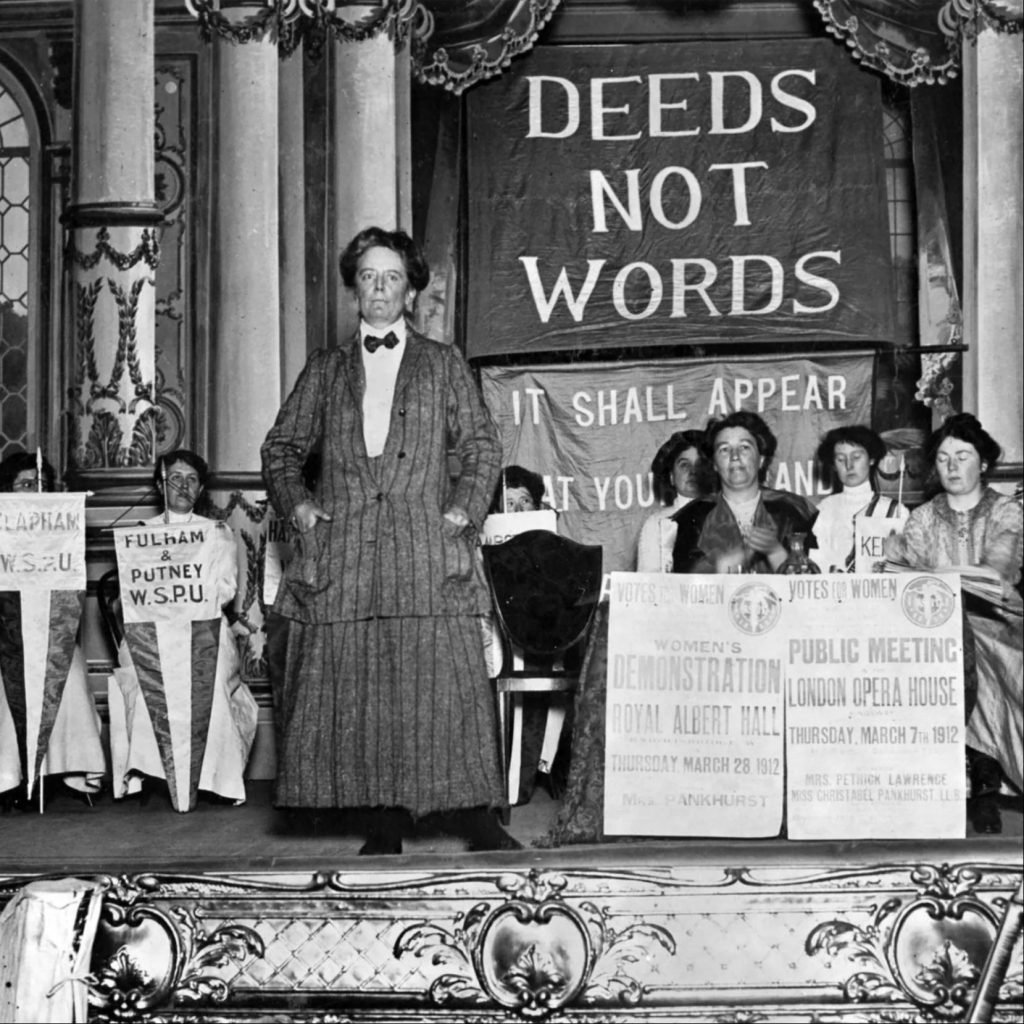
Now our task was to show the Government that it was expedient to yield to the women’s just demands. In order to do that we had to make England and every department of English life insecure and unsafe. We had to make English law a failure and the courts farce comedy theatres; we had to discredit the Government and Parliament in the eyes of the world; we had to spoil English sports, hurt business, destroy valuable property, demoralise the world of society, shame the churches, upset the whole orderly conduct of life—
Emmeline Pankhurst, My Own Story (1914), Book III, ‘The Women’s Revolution’, ch. IV
That is, we had to do as much of this guerrilla warfare as the people of England would tolerate.
The organised campaign expanded through local societies, petitions, and increasingly sophisticated national machinery. In 1897 seventeen existing suffrage societies federated as the National Union of Women’s Suffrage Societies; Millicent Garrett Fawcett became its dominant leader and, from 1907, its president. The NUWSS retained the constitutional method of agitation—petitioning Parliament, lobbying MPs, public meetings, marches, electoral organisation, and an expanding provincial network which by 1913 approached five hundred affiliated societies and some 50,000 members. The Women’s Freedom League, founded in 1907 by Charlotte Despard, Teresa Billington-Greig, Edith How-Martyn, and others after their revolt against the increasingly autocratic government of the Pankhursts within the WSPU, occupied a more insurgent but still formally non-violent position. Its members styled themselves ‘constitutional militants’: they resisted taxation, chained themselves within Parliament, pursued ministers, and organised the 1911 census boycott under the principle ‘No Vote, No Census’.86
The Women’s Social and Political Union travelled considerably further. Founded at Manchester in 1903 by Emmeline Pankhurst and others under the maxim ‘Deeds, Not Words’, it progressively converted the suffrage demand from a parliamentary agitation into a deliberate campaign of coercion. Heckling and disruption were followed by assaults upon windows, pillar boxes, telegraph lines, golf courses, paintings, railway property, churches, politicians’ houses, and eventually by incendiary devices and explosives. Imprisonment itself became another theatre of action: Marion Wallace Dunlop initiated the suffragette hunger-strike tactic in 1909; forcible feeding produced further agitation; and the 1913 Prisoners (Temporary Discharge for Ill Health) Act created the cycle of release and re-arrest remembered as the ‘Cat and Mouse Act’.87
It is therefore misleading to allow ‘Deeds, Not Words’ to survive merely as a picturesque slogan attached to purple, white, and green banners. By 1912–14 the ‘deeds’ included a sustained bombing and arson campaign. Emmeline Pankhurst herself later called the new policy ‘continued, destructive, guerilla warfare against the Government through injury to private property’. More revealing still was her account of its strategic purpose: the object was to ‘make England and every department of English life insecure and unsafe’ until the cost of refusing the suffrage demand became politically intolerable.88
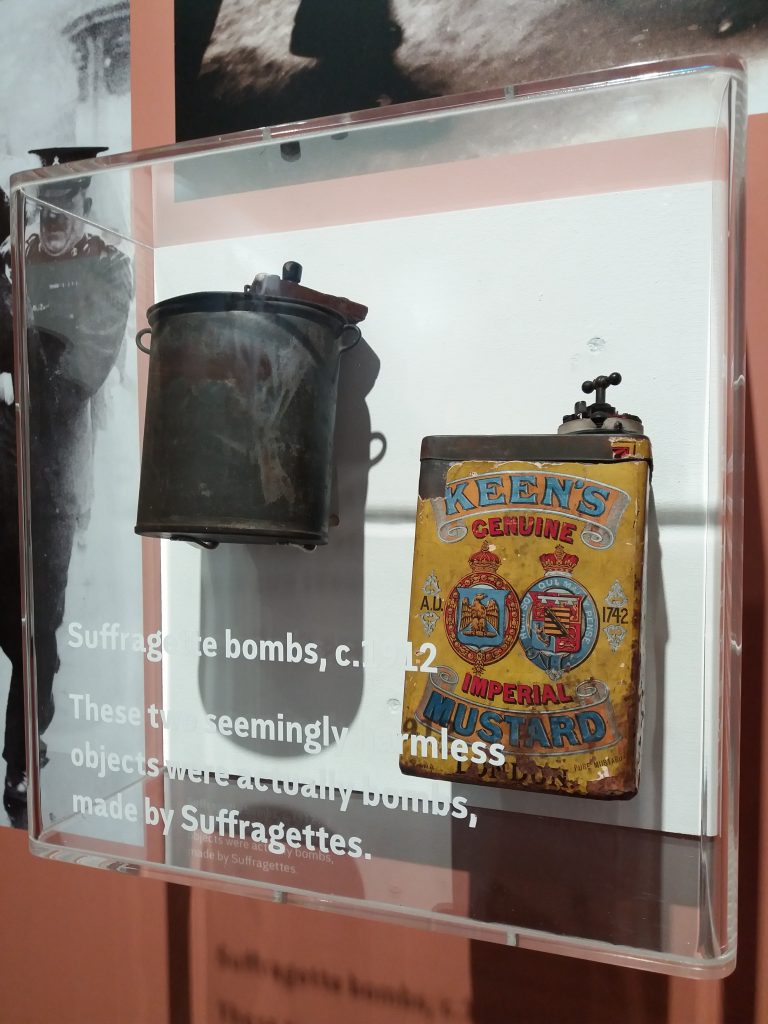
The two surviving suffragette bombs in the City of London Police Museum collection, improvised explosive devices made from domestic foodstuff containers, London, 1913; left, the mustard-tin bomb with an alarm-clock mechanism, discovered ticking beneath the Bishop’s Throne at St Paul’s Cathedral on 7 May; right, the smoking milk-tin device, discovered outside the Bank of England on Bartholomew Lane on 14 April, before being thrown into the fountain at the Royal Exchange by PC Ralph; believed by the museum to be the only surviving suffragette bombs; City of London Police Museum
This was no accidental eruption by a handful of women acting contrary to the movement’s declared principles. A police report of Emmeline Pankhurst’s speech at Hampstead Town Hall on 14 February 1913 records her expressly warning listeners not to regard the destruction as ‘isolated acts’; it was, she insisted, being carried out ‘on a plan’ and with ‘a definite intention and a purpose’. The National Archives possesses not only police reports and prosecution files but an official index of passages in The Suffragette thought to constitute incitement to crime: its headings include explosions in letter boxes, burned mansions, pillar-box raids, a Scottish castle burned, a railway-station fire, broken windows, and repeated reports of incendiary attacks.
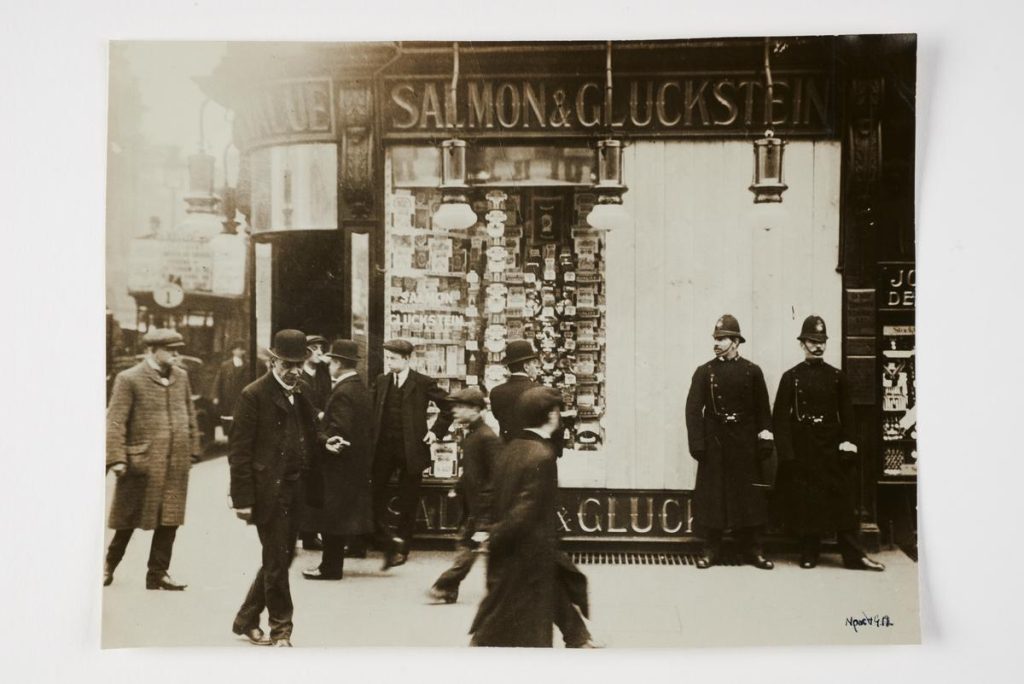
The scale was considerable. C. J. Bearman’s detailed reconstruction in the English Historical Review counted 337 bombing and arson incidents claimed in the columns of The Suffragette during 1913–14, while observing that contemporary newspaper attributions could place the true number above five hundred. His catalogue contains ninety-six attacks upon houses, hotels, and other domestic buildings; thirty-four upon private sporting structures; thirty-two upon churches; thirty-one upon railway targets; twenty-two upon public buildings; seventeen upon industrial premises; and sixteen upon schools, universities, and teacher-training establishments. Bearman further argues from organisational and financial evidence that the violent campaign depended substantially upon WSPU leadership, paid organisers, employees, safe houses, transport, and a comparatively small nucleus of committed militants rather than arising as an entirely spontaneous popular effervescence.89 The preceding figures count bombings and arson, excluding other forms of agitation such as vandalism. At its peak, Islamist terrorism produced four attacks in Britain in 2017; even in Saudi Arabia, at the height of al-Qaeda’s domestic campaign, there were thirty major terrorist attacks in 200490, the highest annual total outside an active war zone. Why is one excused, belittled, euphemised, scarcely heard of, or even valorised, while the other is aggrandised into the paradigmatic terrorist menace? Because the former belongs to a successful occupation by subversives whose settlement became the establishment, while the latter supplies that same occupied regime with a useful antagonist. Thus, when a modern woman persists in the feminist vein, adopts a feminist persona, and embraces feminist precepts, she perpetuates an older genealogy of terrorist agitation.
Boudicca would have been proud. Tacitus describes an uprising which did not confine itself to Roman soldiers or military positions, but descended upon the populated centres of Camulodunum, Londinium, and Verulamium with pillage, fire, and indiscriminate slaughter; at Londinium, those unable or unwilling to join the Roman evacuation were abandoned to the insurgents, while Verulamium was selected precisely for the wealth it offered to the pillager rather than for its military importance. Tacitus reckons that nearly seventy thousand Roman citizens and allies perished across the places named, adding that the rebels neither took nor sold captives, but hurried instead to killing, execution, and arson.91 The familiar compression of this number into ‘seventy thousand Romans’, or even ‘Roman soldiers’, therefore falsifies the character of the destruction: Tacitus explicitly includes Rome’s allies, and his narrative plainly encompasses the civilian populations of Roman Britain and communities attached to the Roman settlement, including the conspicuously pro-Roman Verulamium.
The distinction lies less in the means employed than in the political inheritance of their perpetrators. One belonged to a successful ideological occupation: its demands passed into law, its heroines entered the national pantheon, and the institutions that emerged from its victory acquired an interest in retrospectively cleansing the violence that assisted their ascent. The other remains an antagonist of that established order and is therefore politically useful as an enemy. The successful revolutionary ceases to appear revolutionary once his settlement becomes the establishment; his violence is redescribed as ‘protest’, ‘militancy’, ‘agitation’, ‘direct action’, or the regrettable excess of an otherwise righteous cause, while the violence of those who assail the victorious settlement retains the full vocabulary of terror, extremism, and coercion. Thus power does not merely determine which cause prevails; afterwards, it determines the language in which the violence of victor and vanquished is remembered.
The surviving objects themselves abolish any temptation to treat the language metaphorically. On 14 April 1913 a homemade bomb concealed in a milk tin was discovered outside the Bank of England. On 7 May another ticking device was discovered beneath the Bishop’s Throne in St Paul’s Cathedral, wrapped partly in an issue of The Suffragette; official examination concluded that successful detonation could have caused extensive damage. Earlier that year an explosion had damaged the unfinished house at Walton Heath belonging to Chancellor David Lloyd George. Kew Gardens suffered arson; railway facilities and post boxes were attacked; telegraph communications were cut; and the campaign extended through England, Scotland, Wales, and Ireland.92
Christabel Pankhurst did not veil the philosophy beneath humanitarian euphemism. In 1913 she defended the use of explosives by analogy with masculine warfare and concluded:
If men use explosives and bombs for their own purpose they call it war, and the throwing of a bomb that destroys other people is then described as a glorious and heroic deed. Why should a woman not make use of the same weapons as men? It is not only war we have declared. We are fighting for a revolution!
Christabel Pankhurst, 1913, quoted in City of London Police Museum, ‘Suffragette Bombs’, 5 September 2020; cf. Fern Riddell in The National Archives, ‘Suffrage 100: Did Militancy Help or Hinder the Fight for the Franchise?’, 20 February 2018
The declaration is important because it places the violence within the movement’s own understanding of itself. The bomb was not an embarrassing contradiction of ‘Deeds, Not Words’; it was one possible fulfilment of it.
Even the oft-repeated proposition that the campaign was directed solely against property requires qualification. WSPU policy generally professed an intention to avoid killing, and participants sometimes selected empty structures accordingly; yet explosives, incendiaries, burning postal material, attacks upon railway property, and fires in buildings could scarcely be rendered metaphysically incapable of injuring persons. Rachel Monaghan’s study of the militant campaign observes that its defining characteristics included violence or threatened violence, symbolic targets, extreme methods, and an intention to frighten or terrorise, although indiscriminate killing was not adopted as policy. Bearman likewise identified numerous incidents in which human life was endangered. The historiographical argument over the word ‘terrorism’ therefore concerns classification rather than the existence of the bombings themselves.93
Nor is ‘terror’ simply a hostile term retroactively imposed upon the women. By 1913 The Suffragette carried reports of destruction beneath the rubric ‘Reign of Terror’; contemporary newspapers employed similar language. The movement’s own Seventh Annual Report went further in explaining the strategic logic. Private citizens, it argued, could not expect insulation from the conflict, because:
‘It is, in fact, by means of pressure on the private citizen that an opposing force finally achieves its victory.’
That sentence is perhaps more revealing than any isolated bomb. The object was to transfer pressure from the political combatants to ordinary civil existence until the population itself demanded that the Government terminate the disturbance by conceding the movement’s objective.
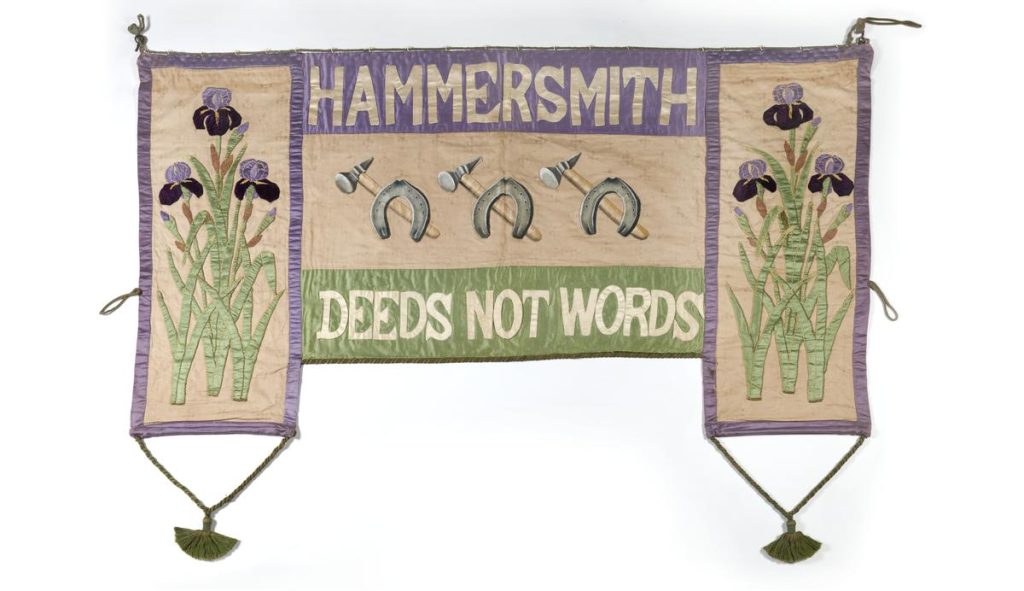
Here ‘Deeds, Not Words’ passes from theatrical militancy into a recognisable politics of tension. Persuasion is abandoned as insufficient; insecurity itself becomes the argument. Ordinary life is deliberately rendered more costly, anxious, disordered, or dangerous so that political resistance will appear more burdensome than surrender. The target need not always possess intrinsic military importance: the church, railway station, sporting pavilion, post box, artwork, or private dwelling matters because damaging it demonstrates that the prevailing order cannot guarantee its own tranquillity. Destruction becomes communication.
This gives the episode an important thematic place besides P2 and the strategy of tension explored in the next section. There is now a considerably stronger evidential basis, especially because the 2025–26 Cassation proceedings concerning the Bologna station bombing have made the P2 connexion substantially firmer. The recurring political form is the exploitation of insecurity as an instrument of political leverage: clandestine or semi-clandestine actors strike beyond the conventional arena of parliamentary contest; symbolic and civilian structures acquire value precisely because their disturbance is socially legible; fear, inconvenience, uncertainty, and institutional embarrassment become means of operating upon a population and therefore upon the State. Emmeline Pankhurst’s own formula—make England ‘insecure and unsafe’—expresses the principle with unusual candour. The act is valuable not merely for what it destroys, but for the pressure radiating outwards from the destruction.
That logic also explains why the WSPU’s declaration that human life ought to be spared did not make its violent strategy politically innocuous. Its Seventh Annual Report explicitly accepted the suffering of private citizens as an unavoidable instrument of ‘war’. Annie Kenney later recalled that Christabel believed burning would frighten both the public and Parliament. The intended object was therefore psychological and political as much as material: the incendiary attack was a message addressed through somebody else’s property, security, livelihood, worship, travel, or ordinary peace.93
This places the constitutional suffragist and the suffragette in much sharper opposition than the generic modern category ‘votes-for-women campaigner’ allows. Fawcett’s NUWSS sought to demonstrate that women deserved admission to parliamentary government by operating through parliamentary government. The WFL attempted organised non-co-operation and passive resistance. The later WSPU increasingly proceeded from another proposition: when persuasion failed, the surrounding social order itself might legitimately be made ungovernable until the demand was granted. ‘Deeds, Not Words’ thus ceases to be sentimental embroidery. At its furthest point it meant the substitution of coercive political action for consent: the petition became the broken window; the march became the incendiary raid; and the unanswered argument became the bomb.
The bombing and arson campaign did not proceed in a legal vacuum, nor were its perpetrators treated merely as troublesome demonstrators. Suffragettes were arrested, tried, convicted, and in some cases sentenced to years of penal servitude. What differs from the modern situation is principally the legal vocabulary. The prosecutions were framed through the existing criminal law—arson, malicious injury to property, conspiracy, incitement, offences involving explosives, and kindred crimes—rather than through a separate statutory category called ‘terrorism’. In substance, however, the State was confronting an organised political campaign in which destruction of property, fire, and explosives were deliberately employed as instruments of coercion.
The penalties could be substantial. In February 1913, Olive Wharry and Lilian Lenton burned the refreshment pavilion at Kew Gardens. Wharry was tried at the Old Bailey for arson and sentenced to eighteen months’ imprisonment in the second division, with further securities required for keeping the peace after her release. Later that year Florence Jane Short, also known as ‘Rachel Peace’, was arrested with Mary Richardson after the burning of an unoccupied house at Hampton. Short was tried at the Old Bailey in November and received eighteen months’ hard labour.94 These were therefore not symbolic arrests followed by nominal fines: deliberate incendiarism could and did result in lengthy imprisonment.
More severe still was the punishment imposed following the WSPU operation in Dublin in July 1912. Mary Leigh, Gladys Evans, Lizzie Baker, and Mabel Capper were implicated in a succession of actions surrounding Prime Minister H. H. Asquith’s visit, including the throwing of a hatchet at the carriage carrying Asquith and John Redmond and an attempt to burn the Theatre Royal. Leigh and Evans were convicted on charges involving conspiracy, arson, and explosives and each received five years’ penal servitude; Lizzie Baker received seven months’ hard labour. The historian Ian Miller identifies the five-year terms as the longest prison sentences imposed upon suffragettes. Contemporary reporting distinguished the immediate acts—Leigh was associated particularly with the hatchet attack, which injured Redmond, and Evans with the attempted burning of the theatre—but the prosecutions treated the episode with the seriousness ordinarily reserved for major criminal violence.95
Nor did prosecution stop with the women who physically broke windows or carried incendiary materials. The Government also pursued the leadership and organisers of militant action. After the WSPU’s organised window-breaking campaign of 1912, Emmeline Pankhurst, Emmeline Pethick-Lawrence, and Frederick Pethick-Lawrence were tried at the Old Bailey upon an indictment charging them with conspiring, together with Christabel Pankhurst, unlawfully and maliciously to damage property and to incite others to do likewise. All three were convicted and sentenced to nine months’ imprisonment in the second division.96 The importance of the prosecution lies in its conception of responsibility: the law did not require the political organiser personally to wield the hammer. Those who planned, encouraged, and directed the campaign could themselves be made criminally answerable for the resulting destruction.
That principle became still clearer after the attack upon the house being built for David Lloyd George at Walton-on-the-Hill in February 1913. Explosives were placed in the building and detonated during the night; the persons who actually planted them were never successfully prosecuted. Emmeline Pankhurst, however, publicly accepted responsibility for the militant policy and declared that she had advised and incited such action. The Government consequently proceeded against her, not as the physical bomber, but for procuring and inciting women to commit offences contrary to the Malicious Injuries to Property Act 1861. She was arrested on 25 February and, on 3 April 1913, sentenced to three years’ penal servitude.97 The episode is particularly revealing because it demonstrates that the inability to identify the hand which placed the explosive did not necessarily prevent the State from pursuing the leadership which publicly authorised and encouraged the campaign.
The difficulty for the Government was that imprisonment itself had become incorporated into WSPU strategy. Convicted militants embarked upon hunger strikes; forcible feeding created controversy and medical danger, while unconditional release threatened to make sentences effectively unenforceable. In practice, women weakened by hunger strike could simply be released before their condition became fatal and then fail to surrender themselves for the remainder of their sentence, leaving the authorities with the humiliating task of finding and rearresting them. The result was not merely further prosecution but new legislation devised specifically to overcome the problem. The Prisoners (Temporary Discharge for Ill-Health) Act 1913 (the notorious ‘Cat and Mouse Act’) allowed a prisoner whose health had deteriorated to be discharged temporarily and conditionally, only to be recalled when sufficiently recovered, with the period outside prison not extinguishing the remainder of the sentence.98
The parliamentary debates leave remarkably little ambiguity as to what problem the legislation was intended to meet. Moving the Bill in the House of Lords on 24 April 1913, the Lord Chancellor acknowledged that it was formally of general application but said that it was notoriously directed towards women who had ‘engaged in acts of violence’ and then attempted, through starvation, to prevent the sentences imposed upon them from being carried out. He described the State as faced with a choice between release, forcible feeding, or allowing the prisoners to starve, and presented the Bill as a means of ensuring that a sentence could ultimately be completed. The measure was treated as urgent enough to pass through all its remaining Lords stages at a single sitting before receiving Royal Assent on 25 April. The Marquess of Salisbury, although critical of the extraordinary legislative procedure, described the circumstances confronting the Government as a ‘condition of anarchy’ which had to be brought to an end.
The legal response therefore considerably complicates any retrospective presentation of suffragette militancy as though the State regarded it merely as theatrical civil disobedience. Arsonists were imprisoned; conspirators and organisers were prosecuted; women involved in explosives and incendiarism received penal servitude; Pankhurst herself received three years for inciting destructive offences; and Parliament altered the law when organised hunger striking threatened to defeat the execution of those sentences. The criminal courts did not possess the later statutory architecture through which politically motivated bombing and arson would be discussed under the general heading of terrorism. They nevertheless possessed ample law with which to punish the constituent acts, and they used it.
This distinction is important. The absence of the modern legal label should not be confused with an absence of criminal recognition. The conduct was prosecuted seriously; what had not yet developed was the modern juridical category under which such conduct might now be grouped. Indeed, the contemporary record is in some respects less euphemistic than later memory: while the WSPU itself could advertise a continuing ‘Reign of Terror’, proclaim ‘guerrilla warfare’, and speak openly of terrorising Parliament, the courts answered in the older and more concrete language of conspiracy, felony, incendiarism, explosives, malicious destruction, imprisonment, and penal servitude.
The Radical Women Too Extreme for Lenin: Comrades Pankhurst, Freemasonry Underpins the Suffragettes, and the Comintern
The connexions between the Pankhurst movement, Freemasonry, and later communism were neither remote nor merely metaphorical. They run through the Pankhurst household itself, through women who occupied prominent positions within the WSPU, through the organisations which broke away from it, and finally through the explicitly Communist movements into which a portion of the suffrage milieu subsequently passed. The WSPU need not itself have possessed a Masonic constitution for the significance of this network to be apparent: Freemasons were present within the family and amongst its militants, while revolutionary Communism subsequently emerged from within the Pankhurst movement itself.
The connexion begins remarkably close to Emmeline Pankhurst. Her husband, Richard Marsden Pankhurst, was himself a Freemason: the Provincial Grand Lodge of East Lancashire records him as one of the founding members of St George’s Lodge No. 1170 in Manchester in 1867. Richard was simultaneously an important intellectual and legal architect of the early women’s movement. He established a National Society for Women’s Suffrage, drafted the Women’s Disabilities Removal Bill, and in 1868 drafted the Married Women’s Property Bill introduced in Parliament by George Shaw-Lefevre, with John Stuart Mill and Russell Gurney, which proposed that a married woman should be capable of holding and disposing of property, contracting, and suing or being sued ‘as if she were a feme sole’. Its opponents understood perfectly well that more than property was at issue: Henry Lopes defended the existing law upon the principle that ‘there must be one head of the family, and that he was the proper head’.
MR. LOPES, in rising to move that the Bill be read a second time that day six months, said […] Thus there was nothing unequal or harsh in the law, which was consistent with the whole relations between husband and wife. It was founded on the principle that in return for the confidence of the wife the husband gave her protection and support; that he was most competent to deal with any property belonging to either; that there must be one head of the family, and that he was the proper head. That principle of law had worked well for centuries, and there was no reason why it should be altered.
Henry Lopes, moving to postpone the Bill’s second reading for six months, in opposition to George Shaw-Lefevre’s second reading of Richard Marsden Pankhurst’s Married Women’s Property Bill; House of Commons debate, 10 June 1868
Now, the Preamble of the Bill was drawn with a very bold hand. It said—“Whereas the law of property and contract with respect to married women is unjust in principle, and presses with peculiar severity upon the poorer classes of the community.” And then the 1st clause went on to enact that—“A married woman shall be capable of holding, acquiring, alienating, devising, and bequeathing real and personal estate, of contracting, and of suing and being sued, as if she were a feme sole.” In his opinion such a change in the law was uncalled for, and would be most pernicious.
While John Karslake described the measure as effecting ‘an entire revolution in the social status of husband and wife’.
MR. KARSLAKE, in seconding the Amendment, said he objected to the Bill as the most revolutionary measure that had been introduced to the House since he had had the honour of a seat in it. He objected to it on two grounds—in the first place, because it would effect an entire revolution in the social status of husband and wife; and in the next, because it would work a like revolution in regard to the law of property; and it was difficult to say under which head it was most open to objection.
John Karslake, seconding Henry Lopes’s amendment to postpone the second reading of Richard Marsden Pankhurst’s Married Women’s Property Bill, which proposed treating a married woman in property and contract as if she were a feme sole; House of Commons debate, 10 June 1868
The property campaign ultimately developed into the Married Women’s Property legislation culminating in the Act of 1882. Emmeline therefore did not encounter the politics of female emancipation and the Masonic world as wholly separate spheres: the man she married in 1879 inhabited both.99 Emmeline and Richard Pankhurst had five children, three daughters and two sons; Frank died of diphtheria at four and Harry at twenty, leaving the family in which the suffrage movement developed markedly female-dominated, particularly after Richard’s death in 1898. All three daughters entered political life: Christabel became Emmeline’s principal lieutenant in the WSPU before later turning to evangelical Christianity; Sylvia broke with the WSPU, passed into revolutionary communism, and founded and edited the Woman’s Dreadnought, subsequently the Workers’ Dreadnought; while Adela emigrated to Australia, became a foundation member of the Communist Party of Australia, and later turned decisively against communism.100
The overlap becomes still clearer amongst the militant women themselves. Charlotte Despard joined the WSPU in 1906 before breaking with the Pankhursts in 1907 and becoming the founding president of the Women’s Freedom League. Yet Despard was already a Co-Mason during her WSPU period. In May 1906 she delivered a paper to Lodge Human Duty No. 6 on ‘Masonry and Society’, arguing that Masons ought to place themselves in contact with the great movements of humanity. Her Masonic and suffrage commitments therefore did not merely occur at different ends of a long career: they coincided at the moment she was participating in Pankhurst’s militant organisation. Despard was also a Theosophist, making her a particularly concentrated example of the intersection between suffrage, socialism, Theosophy, and women’s Freemasonry.101
So on 27 November 1913, Mrs Elizabeth Boswell Reid and her daughter Mrs Lily Seton Challen set up their own Grand Lodge to be known as The Honourable Fraternity of Ancient Freemasons, or HFAF, which is my Grand Lodge. Elizabeth Boswell Reid became our first Grand Master. So in 1913 we had three masonic Grand Lodges admitting both men and women, although women outnumbered the men in both HFAM and HFAF. Eventually these fraternities decided to become single-sex, and by 1933, we had achieved this aim in HFAF.
‘Women’s Rites’, interview with Christine Chapman, Grand Master of the Honourable Fraternity of Ancient Freemasons, Freemasonry Today, Winter 2018, pp. 30–32
So HFAF was founded on the wave of social change in 1913?
We were inspired by the suffragettes and were founded on a streak of rebellion, because we’d broken away from another group. But they were all founded with the same principles – to empower women. We had one suffragette I know of – Helen Fraser, a great orator who inspired women to join the suffrage movement.
Evelina Haverfield supplies another direct WSPU case. She joined the WSPU in 1908, became a regular speaker and donor, and served as organiser of its Paddington branch; she was arrested and imprisoned in the suffrage campaign and appeared prominently in its demonstrations. At the same time she belonged to Lodge Golden Rule No. 21 of the Co-Masons, a lodge founded by Annie Besant. The United Grand Lodge of England itself now describes Haverfield without circumlocution as a ‘prominent suffragette and Freemason’. The Order of Women Freemasons likewise places her amongst its notable historical women and records both her suffragette militancy and membership of Golden Rule No. 21.102
Anne Cobden-Sanderson provides an even more revealing instance because the Masonic lodge itself responded to her suffrage imprisonment. Cobden-Sanderson joined the WSPU in 1905; in October 1906 she was arrested following a demonstration outside the House of Commons and imprisoned in Holloway. She belonged successively to the mixed Maria Deraismes Lodge No. 1 in Paris, Co-Masonry in England, including Human Duty No. 6, and later the Honourable Fraternity of Antient Masonry, affiliating with Golden Rule No. 1. When she was imprisoned after her 1906 militant action, her lodge formally sent her an assurance of its sympathy with her ‘suffering and self-sacrifice’ and admiration for her ‘courage and endurance’. The original resolution explicitly referred to her sacrifice ‘in the cause of political equality of the sexes’, although those particular words were removed after an objection within the lodge. Cobden-Sanderson later told her Co-Masonic lodge that she had hoped Masonry might put itself directly in touch with the great movements outside it, explicitly including women’s suffrage.103
This Lodge desires to convey the assurance of its sympathy with Sister Cobden Sanderson in her present suffering and self-sacrifice in the cause of political equality of the sexes, and to express its admiration for her courage and endurance in conditions so trying.
Lodge of Human Duty No. 6, Minutes, 5 November 1906, Surbiton Archive; quoted in Ann Jessica Pilcher-Dayton, Women Freemasons and Feminist Causes 1908–1935: The Case of the Honourable Fraternity of Antient Masonry, PhD thesis, University of Sheffield, February 2011, p. 145
The Masonic thread did not end with individual suffragettes entering existing lodges. Lily Seton Challen belonged to a family deeply embedded in the new women’s Masonry: she and her mother, Elizabeth Boswell-Reid, entered Lodge Unity No. 3 in 1908, followed that year by Challen’s husband, Howard, and all three subsequently became members of Lodge Stability No. 5. In 1913 the family stood at the centre of another Masonic rupture. Boswell-Reid, Challen, and their supporters sought to introduce the Holy Royal Arch after the governing Honourable Fraternity of Antient Masonry had removed it from its permitted degrees; when Grand Lodge refused to sanction their course, the dispute ended in resignations, the effective destruction of Stability No. 5, and the establishment of a rival obedience. On 27 November 1913, Boswell-Reid and Challen founded the Honourable Fraternity of Ancient Freemasons, with its own Grand Lodge and constituent lodges; Boswell-Reid became its first Grand Master, and Challen succeeded her mother in that office in 1933.104 Thus, within five years of the foundation of the first English obedience, women who had entered Masonry were no longer merely being admitted into an inherited institution: they were founding lodges, contesting Masonic authority, creating rival jurisdictions, and occupying the supreme offices of Grand Master themselves.
The political atmosphere surrounding this development is equally revealing. HFAF’s later Grand Master Christine Chapman described the fraternity as ‘inspired by the suffragettes’, born with a ‘streak of rebellion’, and founded upon principles intended ‘to empower women’; in another account she traced the attraction of early Co-Masonry to its commitment to ‘equal rights and universal suffrage’, explicitly identifying those principles as what drew suffragettes into Masonry.105 HFAF itself places its foundation within the history of the women’s movement and points out that organised women’s Freemasonry preceded both the Women’s Institute and the Townswomen’s Guild. Challen’s importance, therefore, lies not merely in the peculiarity of a woman wearing Masonic regalia or attaining a traditionally male dignity: she helped establish an independent female Masonic hierarchy during the very years in which suffragettism was attacking the political hierarchy outside the lodge. The lodge and the suffrage movement were not identical organisations, but they occupied overlapping networks of women, ideas, and rebellion; by HFAF’s own later account, female Freemasonry understood part of its inheritance in precisely those terms.
From the rebellion of women within the lodge, the same section passes into women of the revolutionary Left. Sylvia Pankhurst carried militancy beyond the suffrage struggle altogether: from the WSPU into revolutionary socialism, the Third International, and finally a confrontation in which she told Lenin himself that one ought to be ‘even more extreme’. The relationship between the suffrage movement and Communism is still more explicit, because here the line passes directly through Pankhurst’s own daughters. Sylvia Pankhurst began as one of the central WSPU militants but increasingly developed a working-class socialist organisation in East London. Her East London Federation came into conflict with Emmeline and Christabel and was expelled from the parent WSPU in 1914. It subsequently evolved through the Workers’ Suffrage Federation into the Workers’ Socialist Federation, while Sylvia’s newspaper changed from The Woman’s Dreadnought to Workers’ Dreadnought. The transformation eventually ceased to be merely socialist in the broad sense. In June 1919 the organisation’s conference adopted the name Communist Party and declared solidarity with the workers’ revolutions in Russia, Hungary, and Germany, committing itself to social revolution in Britain. By 1920 the organisation had become the Communist Party (British Section of the Third International), with Workers’ Dreadnought serving as its official newspaper.106
This was not a loose sympathy with events in Russia. Sylvia and her organisation entered directly into the negotiations surrounding the formation of British Communism and into relations with the Third International. Lenin discussed her personally and repeatedly. In his letter of 8 July 1920 to the Joint Provisional Committee for the Communist Party of Britain, Lenin referred explicitly to ‘Comrade Sylvia Pankhurst and the Workers’ Socialist Federation’, condemning as erroneous their refusal to join the proposed amalgamation of British Communist organisations. The disagreement was revealing: Pankhurst was, in effect, too radical even for Lenin’s tactical programme. Pankhurst’s position was the harder anti-parliamentary one. She argued that Labour was a reformist, ‘social-patriotic’ organisation that Communists should prepare to overthrow, rather than strengthen. In ‘Left-Wing’ Communism, Lenin quoted Pankhurst arguing that Labour’s accession to power was inevitable and that Communists should therefore cease ‘adding to the strength of the Labour Party’ and construct instead a revolutionary Communist movement that would ‘vanquish it’.107 She insisted that the Communist Party should preserve its doctrine and independence from reformism; Lenin argued that Communists should enter Parliament and exploit Labour affiliation tactically, using both to reach the working class and expose reformist leadership from within. Lenin took the opposite tactical view. He thought British Communists should participate in elections and Parliament and should affiliate with Labour where sufficient freedom of Communist criticism remained. His reasoning was deliberately instrumental: Labour still commanded the allegiance of a very large part of the working class, so Communists ought to enter that arena, reach those workers, and help bring Labour to office so that workers could discover through experience what Lenin regarded as the inadequacy and betrayal of Labour leaders such as Henderson and Snowden.
I have received a letter from the Joint Provisional Committee for the Communist Party of Britain, dated June 20, and, in accordance with their request, I hasten to reply that I am in complete sympathy with their plans for the immediate organisation of a single Communist Party of Britain. I consider erroneous the tactics pursued by Comrade Sylvia Pankhurst and the Workers’ Socialist Federation, who refuse to collaborate in the amalgamation of the British Socialist Party, the Socialist Labour Party and others to form a single Communist party. Personally I am in favour of participation in Parliament and of affiliation to the Labour Party, given wholly free and independent communist activities. I shall defend these tactics at the Second Congress of the Third International on July 15, 1920 in Moscow. I consider it most desirable that a single Communist party be speedily organised on the basis of the decisions of the Third International, and that such a party should establish the closest contact with the Industrial Workers of the World and the Shop Stewards’ Committees, in order to bring about a complete merger with them in the near future.
N. Lenin
Vladimir Lenin, ‘Reply to a Letter From the Joint Provisional Committee for the Communist Party of Britain’, 8 July 1920, Collected Works, 4th English edn, vol. 31, Progress Publishers, Moscow, 1965, p. 202; trans. Julius Katzer
An open letter to comrade Lenin
IT IS reported in the press that you have sent a wireless message from Moscow stating: “I consider the tactics of comrade Sylvia Pankhurst and of the WSF are wrong,” and “I am personally in favour of participation in parliament and in favour of adhesion to the Labour Party. I will defend these tactics at the 2nd Congress of the Third International on July 15 in Moscow.”
My reply to you is that I also would desire to defend my tactics in the Moscow congress, but I have been refused a visa by two intervening countries.
If you, through the influence of the Labour Party or your parliamentary friends, can obtain for me a passport, I shall gladly meet you in debate –
With communist greetings, I remain, honoured comrade,
Yours, till the British workers’ revolution,
E Sylvia Pankhurst
E. Sylvia Pankhurst, ‘An Open Letter to Comrade Lenin’, Workers’ Dreadnought, vol. VII, no. 18, 24 July 1920
Pankhurst answered him publicly in Workers’ Dreadnought, and, when Lenin announced that he would defend his position before the Communist International in Moscow, she challenged the pre-eminent male authority of the revolutionary movement to which she had aligned herself: if he could secure her passage to Russia, she wrote, ‘I shall gladly meet you in debate.’ Sylvia duly attended the Second Congress of the Communist International in Moscow in 1920 and defended her anti-parliamentary position there; her Workers’ Socialist Federation was amongst the earliest British bodies affiliated with the Comintern. She subsequently entered the Communist Party of Great Britain, although the association was brief: in September 1921 she was expelled after refusing to place Workers’ Dreadnought under Party control and insisting upon her freedom to criticise Party and Comintern policy.106 At the Second Congress she argued that Labour’s structure and trade-union bureaucracy would constrain revolutionary independence, saying that affiliation would effectively place the fate of the revolutionary movement in the hands of the established unions. She asked whether a Communist Party could properly join another political party still associated with the Second International and answered in the negative. Her passage was therefore not simply from suffragette to generic socialist: it ran from the WSPU through an autonomous East London suffrage organisation and ultimately into the organisational struggles which produced revolutionary Communism in Britain, where her politics proved sufficiently uncompromising that she could find Lenin himself too moderate in method and openly contest his authority from within the Communist cause.
In the commission, Comrade Sylvia Pankhurst pointed out several times that Britain needed “Lefts”. I, of course, replied that this was absolutely true, but that one must not overdo this “Leftism”.
Vladimir Lenin, ‘Speech on Affiliation to the British Labour Party’, Second Congress of the Communist International, Thirteenth Session, 6 August 1920; in Collected Works, 4th English edn, vol. 31, Progress Publishers, Moscow, 1966
I refer to an expression of Comrade Lenin’s, who said, one should not be too extreme. I think, however, one should be even more extreme than one is. Particularly in England there is a lack of courageous people. Although I am a socialist I have fought for a long time in the suffragette movement and I have seen how important it is to be extreme and to have the courage to defend one’s ideas.
Sylvia Pankhurst, speech to the Second Congress of the Communist International, Thirteenth Session, 6 August 1920; Minutes of the Second Congress of the Communist International, Bob Archer, trans. (London: New Park Publications, 1977)
The two statements preserve opposite sides of the same behind-the-scenes exchange in the Congress commission.108 Before the plenary debate, Pankhurst had repeatedly pressed Lenin on the need for a stronger revolutionary Left in Britain; Lenin agreed with the diagnosis but warned her against carrying ‘Leftism’ too far. When the dispute reached the open session, Pankhurst publicly recalled his advice as a warning ‘not to be too extreme’ and rejected it outright: her experience of militant suffragettism, she told the Communist International, had taught her precisely the opposite lesson, that political movements required extremity and the courage to defend their principles. Lenin, speaking subsequently, independently recounted the earlier commission conversation and confirmed its substance, saying that he had told Pankhurst that Britain certainly needed ‘Lefts’, but that ‘one must not overdo this “Leftism”’. The surviving speeches thus provide an unusually clear two-sided record of the private disagreement: Pankhurst was pressing Lenin from his own revolutionary Left, invoking the suffragette movement itself as her school of political militancy, and openly maintaining before the Communist International that Lenin’s strategy was insufficiently extreme.
Nor was Sylvia the only Pankhurst daughter to enter a Communist Party. Adela Pankhurst, another paid WSPU organiser who had been repeatedly imprisoned as a militant suffragette before emigrating to Australia, moved through the Women’s Political Association, Women’s Peace Army, and Victorian Socialist Party into revolutionary socialism. She and her husband Tom Walsh became foundation members of the Communist Party of Australia. Adela ran a speakers’ class for the Party and wrote and spoke at Communist meetings before the couple withdrew from Party activity. Her subsequent development moved sharply in the opposite direction: by the late 1920s she had become increasingly anti-communist and in 1928 founded the Australian Women’s Guild of Empire. The ideological destination changed; the organisational fact remains that a second daughter raised within Emmeline Pankhurst’s suffrage movement became a founding member of a national Communist Party.109
Charlotte Despard joins the Masonic and Communist strands within a single biography. The former WSPU activist, founder of the Women’s Freedom League, Theosophist, and Co-Mason continued travelling leftwards politically after the suffrage period. Following her visit to the Soviet Union in 1930 she joined the Communist Party of Great Britain and became associated with the Friends of Soviet Russia. The Order of Women Freemasons’ own biographical account accordingly lists, in the same entry, her Co-Masonry, Theosophy, socialism, suffrage leadership, and eventual Communist Party membership. Despard thus provides a literal personal junction between two currents which are too often treated as wholly unrelated episodes of modern political history.110
The same transition is visible amongst Sylvia’s rank-and-file East London suffragettes. Sisters Nellie and Rose Cohen worked within Sylvia Pankhurst’s East London movement; Nellie became Sylvia’s personal secretary in 1913, while Rose also joined the East London Federation. Their flat was shared with other activists from the same circle, and Sylvia’s headquarters at 400 Old Ford Road functioned as an interchange between suffragettes and revolutionary socialists. After the Russian Revolution the movement increasingly identified itself with Bolshevik aims. Nellie and Rose subsequently passed from suffrage activism into international communism: Nellie worked for the People’s Russian Information Bureau and remained a committed member of the Communist Party of Great Britain until her death in 1979; Rose rose within the Communist movement, became active in Comintern networks, and ultimately settled in Moscow. History Today aptly describes their trajectory as one beginning in East London alongside Sylvia Pankhurst and ending within the world of international Communism.111
The contrast within the Pankhurst family is important. Emmeline herself did not follow Sylvia into Bolshevism. On 16 November 1917, only days after the Bolshevik seizure of power, she wrote in Britannia, the newspaper edited by Christabel, that Russia was ‘being terrorised by a minority inspired and directed by German agents’. Emmeline and Christabel therefore stood on the opposing side of the widening revolutionary division even as Sylvia moved towards Bolshevism. Nor does the documentary evidence assembled here establish that Emmeline or Christabel were themselves initiated Freemasons. The Masonic connexion lies immediately around them instead: Emmeline’s husband Richard; WSPU militants Charlotte Despard, Evelina Haverfield, and Anne Cobden-Sanderson; and a broader suffrage environment in which mixed and female Masonic bodies consciously supported the campaign for women’s political emancipation.112
The resulting pattern is unusually dense. At the centre stands Emmeline Pankhurst: wife of a Freemason and leader of the WSPU. Within her militant organisation stood women who simultaneously belonged to Co-Masonic and female Masonic orders. One of those women, Despard, later became a Communist. Two of Emmeline’s own daughters entered Communist organisation, Sylvia becoming a protagonist in the formation of revolutionary Communism in Britain and Adela a foundation member of the Communist Party of Australia. Sylvia’s East London suffrage organisation itself metamorphosed into an avowed Communist body, while members of her suffrage staff passed with it into the Communist International and the CPGB.
The historical connexion is therefore considerably stronger than a vague resemblance between ‘brotherhood’ and ‘sisterhood’. Suffrage, socialism, Theosophy, women’s Freemasonry, and revolutionary Communism repeatedly occupied the same organisations, households, lodges, newspapers, and individual lives. They were distinct movements, but they were not separate worlds.
Scholia
- UK Parliament, ‘Votes for Women: 150 Years of Campaigning’; ‘Start of the Suffragette Movement’; ‘Founding of the National Union of Women’s Suffrage Societies, 1897’. The NUWSS was formed in 1897 from seventeen existing suffrage societies under the leadership of Millicent Garrett Fawcett and, by 1913, comprised nearly five hundred affiliated societies; the WSPU was founded in Manchester in 1903 and led by Emmeline Pankhurst. English Heritage, ‘The Road to Women’s Suffrage’, records the NUWSS’s constitutional methods and membership of approximately 50,000 by 1913; ‘Women’s Freedom League’ describes the WFL, founded after the 1907 split from the WSPU, as a non-violent ‘constitutional militant’ organisation employing tax resistance, ministerial pressure, parliamentary protest, and the 1911 census boycott.
- UK Parliament, ‘Start of the suffragette movement’ and ‘Deeds not words’: WSPU founded in Manchester in 1903 with the motto ‘Deeds not words’; militancy, imprisonment, hunger striking, forcible feeding, and the 1913 Prisoners (Temporary Discharge for Ill Health) Act.
- Emmeline Pankhurst, My Own Story (London, 1914), describing the 1913 policy as ‘continued, destructive, guerilla warfare’ and stating that its object was to make English life ‘insecure and unsafe’; police report of her Hampstead Town Hall speech, 14 February 1913, quoted by The National Archives, where she insisted that the attacks were being conducted according to ‘a plan’ and ‘definite intention’. The National Archives also preserves the official index of passages in The Suffragette considered possible incitements to crime, TS 27/19.
- C. J. Bearman, ‘An Examination of Suffragette Violence’, English Historical Review, 120.486 (2005), pp. 365–397. Bearman’s reconstruction finds 337 bombing and arson incidents claimed by The Suffragette in 1913–14 and argues that the campaign required substantially greater organisation, financing, and participation by WSPU employees than earlier historiography had acknowledged; Annie Kenney, Memoirs of a Militant (London, 1924), p. 187, recalling Christabel Pankhurst’s belief that burning would frighten public and Parliament.
- David Anderson QC, Attacks in London and Manchester, March–June 2017: Independent Assessment of MI5 and Police Internal Reviews (December 2017), on the Islamist attacks at Westminster, Manchester Arena, and London Bridge, together with the subsequently attempted Parsons Green bombing; HM Government’s later review treats the five terrorist attacks of 2017 collectively, of which Finsbury Park was an extreme-right anti-Muslim attack rather than Islamist. Thomas Hegghammer, ‘The Current State of Al-Qa`ida in Saudi Arabia’, CTC Sentinel, Combating Terrorism Center at West Point, 2008: ‘the number of major terrorist-initiated attacks in Saudi Arabia has dropped from 30 in 2004 to a combined total of just six in the years since’.
- Tacitus, Annales, XIV.32–33. Camulodunum is pillaged and fired; Suetonius evacuates Londinium but leaves behind those prevented by sex, age, or attachment to the place; Verulamium suffers a similar fate, Tacitus remarking that the insurgents avoided defended positions and sought the richest material for plunder. He then gives ‘ad septuaginta milia civium et sociorum … cecidisse constitit’: a total of nearly seventy thousand Roman citizens and allies, civium et sociorum, killed in the places named; and stresses that the rebels took no captives for ransom or sale but proceeded through slaughter, execution, and fire. See also the University of Warwick’s discussion of Verulamium, which notes its pro-Roman character and Tacitus’s figure of seventy thousand Roman citizens and allies.
- City of London Police Museum, ‘Suffragette bombs’, on the surviving Bank of England and St Paul’s devices; The National Archives, HO 45/10700/236973, ‘Bomb at St Paul’s’, Morning Post, 8 May 1913; The National Archives, ‘Campaign in photographs’, reproducing the contemporary Illustrated London News sequence ‘From pavement-chalking to arson, window-breaking and bombing’, 24 May 1913. Christabel Pankhurst’s 1913 declaration that ‘We are fighting for a revolution’ is reproduced by the City of London Police Museum and Historical Association suffrage resources.
- Rachel Monaghan, ‘“Votes for Women”: An Analysis of the Militant Campaign’, Terrorism and Political Violence 9.2 (1997), arguing that the campaign embodied characteristic features of terrorism whilst distinguishing it from indiscriminate killing; Bearman, ‘Examination of Suffragette Violence’, pp. 365–397. WSPU, Seventh Annual Report (1913), p. 16, copy preserved by The National Archives, states explicitly that pressure upon private citizens formed part of the means by which victory was to be obtained; contemporary WSPU reporting used the rubric ‘Reign of Terror’.
- Proceedings of the Central Criminal Court, Old Bailey, R. v. Olive Wharry (‘Joyce Locke’), 4 March 1913, trial t19130304-69: Wharry was prosecuted for arson arising from the burning of the refreshment pavilion at Kew Gardens and sentenced to eighteen months’ imprisonment in the second division, with sureties required for keeping the peace after release; London Museum, ‘Photograph, surveillance image’, object 53.140/139: records Florence Jane Short’s October 1913 arrest with Mary Richardson for burning an unoccupied house at Hampton, her November Old Bailey trial, and sentence of eighteen months’ hard labour.
- Ian Miller, A History of Force Feeding: Hunger Strikes, Prisons and Medical Ethics, 1909–1974 (Palgrave Macmillan, 2016), ch. ‘The Instrument of Death: Prison Doctors and Medical Ethics in Revolutionary-Period Ireland, c.1917’, pp. 62–63 in the online NCBI edition: records that WSPU members Mary Leigh, Gladys Evans, and Lizzie Baker were involved in the hatchet attack and attempted burning of Dublin’s Theatre Royal; Leigh and Evans were convicted of conspiracy, arson, and explosive offences and sentenced to five years’ penal servitude, described as the longest prison sentences given to suffragettes, while Baker received seven months’ hard labour; cf. Ann Lewis Women’s Suffrage Collection, contemporary clipping, ‘Suffragettes Sentenced to 5-Year Term’, 8 August 1912, distinguishing Leigh’s hatchet attack upon Asquith’s carriage, which injured John Redmond, from Evans’s setting fire to the Theatre Royal.
- Proceedings of the Central Criminal Court, Old Bailey, R. v. Emmeline Pankhurst, Frederick William Pethick Lawrence and Emmeline Pethick Lawrence, 14 May 1912, trial t19120514-54: indictment for conspiring together and with Christabel Pankhurst unlawfully and maliciously to damage property and incite others to do so; each defendant was sentenced to nine months’ imprisonment in the second division.
- Elizabeth Crawford, ‘We wanted to wake him up: Lloyd George and suffragette militancy’, History of Government, 4 July 2013: based upon the governmental record of the Walton-on-the-Hill bombing, records that the actual perpetrators were never caught; that Pankhurst’s public acceptance of responsibility led the Home Secretary and officials to prosecute her for procuring and inciting women to commit offences contrary to the Malicious Injuries to Property Act 1861; that she was arrested on 25 February 1913; and that on 3 April she was sentenced to three years’ penal servitude.
- Prisoners (Temporary Discharge for Ill-Health) Act 1913, 3 & 4 Geo. V, c. 4, Royal Assent 25 April 1913; House of Lords, Hansard, 24 April 1913, ‘Prisoners (Temporary Discharge for Ill-Health) Bill’: Lord Chancellor Viscount Haldane stated expressly that, although the Bill was of general application, it was notoriously directed towards women prisoners who had ‘engaged in acts of violence’ and refused through hunger striking to submit to their sentences; he explained that temporary discharge would interrupt rather than extinguish the sentence, enabling the prisoner to be recalled and required eventually to complete it. The debate records 240 such women imprisoned during the preceding year, fifty-seven forcibly fed and twenty-six released where health made continued feeding dangerous; it also records the Government’s insistence upon completing the Bill’s remaining stages immediately because of the urgency of the situation. UK Parliament’s archival account identifies the Act’s parliamentary catalogue reference as HL/PO/PU/1/1913/3&4G5c4 and notes its subsequent popular name, the ‘Cat and Mouse Act’.
- Lee Holcombe, Wives and Property: Reform of the Married Women’s Property Law in Nineteenth-Century England (Toronto: University of Toronto Press, 1983), 166: records that the Married Women’s Property Bill introduced in 1868 was drafted by Richard Marsden Pankhurst; House of Commons Debates, 10 June 1868, vol. 192, cols. 1352–57, esp. cols. 1354–56: for the Bill’s provision that a married woman should hold property, contract, and sue or be sued ‘as if she were a feme sole’, Henry Lopes’s defence of the husband as ‘the proper head’ of the family, and John Karslake’s description of the proposal as ‘an entire revolution in the social status of husband and wife’; Provincial Grand Lodge of East Lancashire, ‘The Interesting Life of Manchester Mason Richard Pankhurst’: records Richard Marsden Pankhurst as a founding member of St George’s Lodge No. 1170, Manchester, in 1867; also records his establishment of a National Society for Women’s Suffrage, authorship of the Women’s Disabilities Removal Bill, and role in the legislation which became the Married Women’s Property Act 1882.
- The Pankhurst Museum, ‘The Pankhurst Family’, for the five children, the deaths of Frank and Harry, Christabel’s later evangelism, and the political careers of Sylvia and Adela; Mary Davis, ‘Pankhurst, (Estelle) Sylvia (1882–1960)’, Oxford Dictionary of National Biography, for Sylvia’s development into revolutionary communism and her editorship of the Workers’ Dreadnought; Susan Hogan, ‘Pankhurst, Adela Constantia (1885–1961)’, Australian Dictionary of Biography, vol. 12 (Melbourne: Melbourne University Press, 1990), for Adela’s Australian career and foundation membership of the Communist Party of Australia. The Workers’ Dreadnought itself subsequently carried the masthead ‘For International Communism’ and identified Sylvia as its founder and editor.
- Ann Jessica Pilcher-Dayton, Women Freemasons and Feminist Causes 1908–1935: The Case of the Honourable Fraternity of Antient Masonry, PhD thesis, University of Sheffield, 2011, ch. III, ‘Service and Suffrage’: records Charlotte Despard as a Co-Mason and founder of the Women’s Freedom League and, from the minutes of Lodge Human Duty No. 6, her May 1906 paper ‘Masonry and Society’, in which she argued for contact between Masonry and the great movements of humanity; UK Parliament, ‘Women’s Freedom League’, records Despard’s participation in the 1907 break from the WSPU. Despard’s WSPU membership began in 1906, so her WSPU and Co-Masonic activities demonstrably overlapped.
- London Museum, ‘The Hon. Mrs Haverfield’: records Evelina Haverfield joining the WSPU in 1908, becoming a regular speaker and donor and organiser of its Paddington branch; Pilcher-Dayton, Women Freemasons and Feminist Causes, ch. III, records her as a member of Co-Masonic Lodge Golden Rule No. 21, founded by Annie Besant; United Grand Lodge of England, ‘Women at Home & War’, describes Haverfield as a ‘prominent suffragette and Freemason’; Order of Women Freemasons, ‘Famous Women Freemasons’, 19 August 2020, likewise records her suffrage militancy, arrest and imprisonment, and membership of Golden Rule No. 21.
- London Museum, ‘Photograph of Suffragette Mrs Cobden Sanderson’: records Anne Cobden-Sanderson’s membership of the WSPU from 1905 and her 1906 arrest and imprisonment following the House of Commons demonstration; Pilcher-Dayton, Women Freemasons and Feminist Causes, ch. III, using the Declaration Book and minutes of Lodge Human Duty No. 6 and Lodge Golden Rule No. 1, records her membership of Maria Deraismes Lodge No. 1, English Co-Masonry, and subsequently the Honourable Fraternity of Antient Masonry. The minutes of Human Duty No. 6, 5 November 1906, record the lodge’s message of sympathy following her imprisonment; the same study records her May 1906 paper on ‘Masonry and the Labour Movement’ and her statement that Co-Masonry should establish contact with great external movements such as women’s suffrage.
- Ann Jessica Pilcher-Dayton, Women Freemasons and Feminist Causes 1908–1935, pp. 53–55, 92–93; Honourable Fraternity of Ancient Freemasons, ‘Our History’. Pilcher-Dayton records the Royal Arch dispute, the resignations of Boswell-Reid, Challen, her husband, and most of Stability’s officers, and their establishment of HFAF; HFAF records Boswell-Reid as Grand Master from 1913 to 1933 and Challen as her successor.
- Christine Chapman, ‘Women’s Rites’, interview as Grand Master of the Honourable Fraternity of Ancient Freemasons, Freemasonry Today, Winter 2018, pp. 30–32; United Grand Lodge of England, ‘International Women’s Day: Women, Freemasonry and the Fight for Equality’, 7 March 2023. Chapman describes HFAF as ‘inspired by the suffragettes’, founded with a ‘streak of rebellion’ and with principles intended ‘to empower women’; she subsequently described early Co-Masonry as being ‘very much about equal rights and universal suffrage’ and said, ‘That is what appealed to these suffragettes.’
- London Museum, ‘Sylvia Pankhurst: Suffragette, artist, activist’, and UK Parliament, ‘The East London Federation of Suffragettes’, for Sylvia’s separation from the WSPU and creation of an independent East London organisation; Workers’ Dreadnought, 14 June 1919, ‘The Communist Party: W.S.F.—Communist Party’, records the Workers’ Socialist Federation conference adopting the Communist name and declaring solidarity with revolutionary Russia, Hungary, and Germany; Workers’ Dreadnought subsequently appeared as the organ of the Communist Party (British Section of the Third International). V. I. Lenin, ‘Reply to a Letter from the Joint Provisional Committee for the Communist Party of Britain’, 8 July 1920, refers directly to ‘Comrade Sylvia Pankhurst and the Workers’ Socialist Federation’ during the Communist unity dispute. Marx Memorial Library records the WSF as an early British affiliate of the Third International and Sylvia’s participation in its Second Congress; Oxford Dictionary of National Biography records her subsequent admission to the Communist Party and expulsion in 1921, while Sylvia Pankhurst’s archival resource site specifies that the September expulsion followed her refusal to submit Workers’ Dreadnought to Party control.
- Sylvia Pankhurst, ‘Towards a Communist Party’, Workers’ Dreadnought, vol. VI, no. 48, 21 February 1920; Vladimir Lenin, ‘Left-Wing’ Communism: An Infantile Disorder, ch. IX, ‘“Left-Wing” Communism in Great Britain’, 1920; Lenin reproduces Pankhurst’s argument from ‘Towards a Communist Party’ while criticising her anti-parliamentary strategy.
- Vladimir Lenin, ‘Speech on Affiliation to the British Labour Party’, 6 August 1920, in Collected Works, 4th English edn, vol. 31 (Moscow: Progress Publishers, 1965), pp. 257–63; Lenin recalls that ‘in the commission’ Pankhurst had repeatedly argued that Britain needed ‘Lefts’, to which he replied that one must not ‘overdo this “Leftism”’; Minutes of the Second Congress of the Communist International, Thirteenth Session, 6 August 1920; Bob Archer, trans. (London: New Park Publications, 1977); Pankhurst recalls Lenin’s advice ‘not to be too extreme’, answers that ‘one should be even more extreme’, and immediately invokes her suffragette experience.
- Susan Hogan, ‘Pankhurst, Adela Constantia (1885–1961)’, Australian Dictionary of Biography, vol. 12 (Melbourne University Press, 1990): records Adela as a paid WSPU organiser who was repeatedly imprisoned as a militant suffragette; her subsequent work with the Women’s Political Association, Women’s Peace Army, and Victorian Socialist Party; and Adela and Tom Walsh as foundation members of the Communist Party of Australia, where she ran a speakers’ class and addressed Party meetings before they withdrew from Communist activity. The same biography records her later anti-communism and foundation of the Australian Women’s Guild of Empire in 1928.
- Order of Women Freemasons, ‘Famous Women Freemasons’, 19 August 2020: identifies Charlotte Despard in the same biographical entry as a Co-Mason, Theosophist, socialist, suffrage leader, and later Communist Party member; biographical accounts of Despard record her 1930 journey to the Soviet Union, subsequent adhesion to the Communist Party of Great Britain, and work with the Friends of Soviet Russia.
- Maurice J. Casey, ‘The Suffragettes Who Became Communists’, History Today, 4 February 2018: records Nellie Cohen becoming Sylvia Pankhurst’s personal secretary in 1913, Rose Cohen joining the East London Federation, and 400 Old Ford Road functioning as an interchange between suffragettes and revolutionary socialists; traces the organisation’s movement towards Bolshevism after 1917, Nellie’s employment by the People’s Russian Information Bureau, Rose’s subsequent career in the CPGB and international Communist networks and move to Moscow, and Nellie’s continued membership of the CPGB until her death in 1979.
- Casey, ‘The Suffragettes Who Became Communists’: records Emmeline Pankhurst’s Britannia statement of 16 November 1917 that Russia was ‘being terrorised by a minority inspired and directed by German agents’, illustrating her opposition to the Bolshevik course adopted by Sylvia. The Masonic sources above document Richard Pankhurst, Despard, Haverfield, and Cobden-Sanderson; they do not establish a Masonic initiation of Emmeline or Christabel Pankhurst themselves.
No, Stopping at ‘Second-Wave Feminism’ Is Really Not Enough: The Emancipated Modern Woman and Her Habit of Coercion Towards Men
The significance of the suffragette campaign does not end with the franchise, nor even with the extraordinary spectacle of its perpetrators eventually being absorbed into the honours, institutions and commemorative mythology of the order they had attacked. More enduring was the political personality which emancipation cultivated and subsequently enthroned: a woman taught to conceive of herself not merely as an individual, daughter, wife, mother or member of a particular household and community, but as a member of a political class whose interests stood in structural opposition to those of men, and whose acts of insubordination consequently acquired the presumptive dignity of resistance. Once that premise is granted, coercion undergoes a moral transfiguration. What would ordinarily be recognised as intimidation, manipulation, destruction, disobedience or the punitive exercise of power becomes, when directed upwards against the designated oppressor, an act of emancipation.
Nor could such a political education remain confined to the polling booth. Emancipation necessarily became a school of manners, temperament and moral judgement. If resistance to male political authority was taught as liberation, the prestige attached to resistance itself could readily descend from the constitutional sphere into ordinary relations between the sexes. Defiance acquired an emancipatory pedigree. The woman who contradicted, resisted or publicly faced down a man increasingly occupied the culturally heroic position; submission, deference and obedience, by contrast, were progressively contaminated by association with the supposedly degraded condition from which woman had been delivered. Thus a revolution in political authority carried within it a revolution in the very adjectives by which feminine conduct would henceforth be praised or condemned.
The consequences are visible in the peculiar modern glorification of the woman who ‘stands up to men’. The phrase is revealing because the virtue is so often located less in what she stands for than in the fact that she stands against him. Rudeness may be redescribed as forthrightness; contemptuousness as self-respect; insubordination as independence; imperiousness as confidence; hostility to correction as possession of ‘boundaries’; and an habitual refusal of male direction as proof that she is a ‘strong woman’. The revolutionary inheritance is thereby miniaturised into personality. What was once dramatised upon the political stage as resistance to patriarchal authority reappears in ordinary life as the assumption that resistance to a man’s authority possesses moral prestige in itself.
This is where female class-consciousness becomes decisive. Once woman is instructed to interpret herself as the historic subordinated class and man as the historic ruling class, an ordinary encounter between a particular man and a particular woman becomes capable of inheriting the moral proportions of a political struggle. His authority is no longer merely his authority; it arrives shadowed by ‘patriarchy’. Her resistance is no longer merely her resistance; it can partake of the accumulated righteousness of ‘women’s liberation’. An interpersonal disagreement is thus furnished with a ready-made revolutionary mythology in which one participant enters morally burdened by the supposed crimes of his sex, whilst the other enters already haloed by the historic meaning assigned to hers.
What emerged from emancipation was therefore not simply a redistribution of legal powers, but a historically particular emancipated type, fashioned under the pressure of radical political doctrine. The old relation between authority and obligation was inverted. Male authority could increasingly be represented as presumptively suspect merely because it was male; female resistance to it could conversely present itself as presumptively righteous merely because it was female. The former was required to justify itself before exercising power; the latter increasingly required no justification beyond the assertion that it was resisting power. Thus was established one of the most consequential asymmetries of the emancipated culture: male order becomes oppression, while female compulsion becomes liberation.
The WSPU presents this principle in unusually naked form because the coercion had not yet acquired the sanitising vocabulary and bureaucratic mechanisms through which it would later operate. Its militants smashed, burned, bombed, threatened and disrupted in order to impose political costs upon a society until that society yielded. Christabel Pankhurst could therefore speak without embarrassment of Parliament being ‘terrorised’ into reform and of terrorism as the argument Parliament understood. The word had not yet required laundering. The moral structure is more important than the particular weapon: an asserted condition of oppression confers upon the emancipator an exceptional licence to compel, whilst resistance to that compulsion supplies further evidence of the oppression supposedly necessitating it.
The bomb and the torch were consequently not the whole inheritance. More important was the moral entitlement behind the hand that held them.
And with that entitlement came an archetype. The militant suffragette was not subsequently remembered merely as a woman who possessed a political opinion; she was celebrated because she defied, resisted, refused, confronted and ultimately compelled. The posture itself entered the mythology of female emancipation. A culture which erects monuments to female defiance cannot be surprised when defiance becomes culturally legible as a female virtue. A culture which teaches successive generations that women became free because earlier women refused male restraint cannot easily prevent the lesson from becoming simpler and more intimate: to resist the man is to enact, in miniature, the emancipation of woman.
This supplies a genealogy for something more commonplace, and in its ubiquity perhaps more consequential, than spectacular political violence: the assumption that discourtesy towards men may itself be evidence of liberation. Where older feminine ideals placed value upon restraint, dignity, loyalty, modesty, tact and the capacity to receive legitimate correction without experiencing it as degradation, the emancipatory personality is invited to prove its strength through refusal. ‘She takes no nonsense from men’ becomes praise before anyone has established whether what she rejected was nonsense. ‘She speaks her mind’ becomes exculpatory before anyone asks whether what she said was insolent or unjust. ‘She will not be told what to do’ becomes a character recommendation in a civilisation that would scarcely praise any functioning hierarchy on the same principle. The virtue has migrated from the justice of the resistance to the mere fact of resistance itself.
Once the revolutionary principle had been accepted, its instruments could change completely without disturbing its underlying logic. A later emancipated culture need not set fire to a country house when it possesses social, professional, reputational and institutional mechanisms capable of imposing obedience more efficiently. It need not break a window when exclusion, denunciation, complaint, ostracism or the mobilisation of sympathetic authority will suffice. It need not openly announce that an adversary must be terrorised into submission when the same relation can be expressed through a vocabulary of harm, safety, boundaries, empowerment and accountability, each term capable of bearing a perfectly legitimate meaning in itself yet equally capable, under an ideological dispensation of unequal moral standing, of becoming an instrument by which one party’s will is insulated from reciprocal judgement.
Here the connexion with the original militant temperament becomes clearer. The continuity is not a literal identity of means, but the persistence of a moral architecture of coercion in which pressure exerted in the emancipatory direction can be experienced as righteousness rather than domination. The method changes; the asymmetry survives. One side acts and calls it self-assertion; the other resists and is accused of control. One side imposes conditions and calls them boundaries; the other imposes conditions and is accused of authoritarianism. One side withdraws recognition, affection, access or reputation and calls this self-protection; the other protests the withdrawal and thereby furnishes evidence that the punishment was deserved. Under such a dispensation, power becomes peculiarly difficult even to identify, because the person exercising it has inherited a political vocabulary which describes her, beforehand and almost irrespective of circumstances, as the party upon whom power is exercised.
This asymmetry becomes particularly conspicuous when rudeness itself acquires a politics. A man’s sharpness towards a woman may readily be interpreted through the inherited vocabulary of intimidation, aggression, misogyny or control; a woman’s sharpness towards a man can, under the opposite presumption, be celebrated as assertiveness, empowerment or the refusal to be silenced. His anger threatens; hers testifies. His judgement oppresses; hers establishes a boundary. His refusal to yield becomes domination; hers becomes independence. The behaviours themselves need not differ greatly for their moral interpretation to diverge completely, because emancipation has supplied a prior narrative determining whose exercise of will represents power and whose represents resistance to power.
This is where the question of moral superiority becomes inseparable from coercion. Class-conscious emancipation did not merely demand that women possess political power; it furnished an account of history in which female interests increasingly occupied the morally privileged position. To oppose a particular demand could thus cease to mean disagreement with a woman and become opposition to women; to criticise a mode of female conduct could be translated into hostility towards female liberty; to insist upon duties, hierarchy or obedience could be represented as an attempt to restore subjection. The emancipated personality is thereby offered an immensely seductive political privilege: the ability to exercise power while continuing to imagine herself principally as its victim.
That privilege produces its own characteristic imperiousness. The person who approaches a disagreement convinced that history has already adjudicated the moral standing of the parties does not negotiate upon equal terms; she arrives carrying an inherited verdict. Resistance to her will may therefore seem not merely inconvenient but illegitimate, because it resonates with a supposedly defeated history of male domination. The result can be a peculiar combination of aggression and grievance: the liberty to provoke accompanied by indignation at retaliation; the liberty to judge accompanied by resentment of judgement; the liberty to command accompanied by hostility towards command; and the liberty to treat another person contemptuously whilst construing his refusal to accept the treatment as the true act of aggression. Moral superiority ceases to restrain coercion and instead becomes its warrant.
No political culture could extend such a privilege indefinitely without altering character. A person repeatedly instructed that resistance to her demands is presumptive evidence of injustice will not acquire the same habits as one taught that authority entails reciprocal obligation, self-command and restraint. A class repeatedly assured that its historical emancipation constitutes an unqualified moral ascent will inevitably find it harder to recognise the point at which emancipation itself becomes domination. And when an entire political order has already demonstrated its willingness to retreat before organised pressure, subsequently honour those who applied it and finally reinterpret its own retreat as moral enlightenment, the lesson transmitted to succeeding movements is hardly obscure: coercion may be vindicated by victory.
This is perhaps the deeper meaning of the old patriarchal political order’s eventual submission to revolutionary and gynaecocentric forces. It did not merely relinquish particular laws. It progressively surrendered the authority to define the moral meaning of its own defeat. The insurgent supplied both the accusation and the verdict; the conquered order eventually repeated them. What began as an attack upon an existing hierarchy culminated in that hierarchy participating in its own retrospective condemnation, until even terroristic coercion could be incorporated into the national story as an episode in the majestic advance of liberty.
The resulting type is historically produced rather than timeless: politicised, class-conscious, suspicious of male authority, habituated to interpreting opposition as injury and endowed with a vocabulary by which its own exercises of power may continually escape recognition as power. This is why the inheritance belongs to the particular civilisation, period, demography and ideological conditions which engendered the coercive politics of emancipation rather than to woman considered as an innate group. The distinction matters because it reveals the phenomenon for what it is: not femininity released, but femininity radicalised; a cultural formation in which antagonism towards male authority has been furnished with a historical mythology, a political vocabulary and, ultimately, a claim to moral superiority.
The chilling continuity lies there. The forms of compulsion become gentler in appearance as the institutions themselves become more receptive to them; the revolutionary no longer needs to stand outside the gate when the assumptions of the revolution have passed inside. Violence gives way to administration, the incendiary to the complaint, the threat to the moral veto, and open terror to the subtler disciplines of social and institutional coercion. At the level of ordinary character, meanwhile, revolutionary defiance survives in diminished but pervasive forms: the sneer transfigured into confidence, contempt into independence, insubordination into strength, and hostility towards male authority into a badge of emancipation. Yet beneath these changing forms survives the same dangerous political conviction: that possession of the emancipatory cause confers a superior moral title to compel another person’s submission—and that, because the coercion proceeds in the name of liberation, it somehow ceases to be coercion at all.
Young Women, Look Again at Your Inheritance: Feminism Is Terrorism
There comes a point at which inheritance itself must be judged. The young woman of the present age did not devise the political mythology into which she was born; she inherited its heroes, its grievances, its vocabulary of oppression and empowerment, and above all its assumption that resistance to male authority is presumptively virtuous while the exercise of that authority is presumptively suspect. Yet inherited ideas do not remain innocent merely because their origins have been forgotten. If the emancipation of women was historically advanced through a culture which could glorify coercion, dignify hostility as resistance, and confer moral privilege upon female antagonism towards men, then the descendants of that culture have an obligation to examine what precisely has been handed down to them.
That examination must extend beyond legislation and political theory into conduct. A civilisation which has spent generations teaching women to recognise every indignity committed against them, while furnishing comparatively little moral language for indignities committed by them against men, has produced a grave asymmetry of conscience. Men have been expected to absorb contempt, derision, humiliation, emotional punishment, public suspicion and openly unequal standards with a degree of forbearance that would never be demanded in the opposite direction; when they protest, the protest itself is too easily redescribed as aggression, entitlement or an attempt at control. An injustice does not cease to be an injustice because the person enduring it belongs to a class historically designated as powerful.
Young women therefore have reason to ask whether some of what they have been taught to call strength is merely inherited belligerence; whether what passes for independence sometimes consists in refusing obligations that would readily be demanded of a man; whether ‘boundaries’ have occasionally become a language for imposing unilateral terms; whether contempt for male judgement has been mistaken for freedom; and whether the celebrated instinct to ‘stand up to men’ has been allowed to eclipse the more difficult virtues of fairness, loyalty, gratitude, restraint and the capacity to recognise legitimate authority when it appears.
To reconsider this inheritance is not to return to some caricatured condition of voicelessness. It is to recover a more elementary principle which revolutionary rhetoric has too often obscured: a man is owed dignity because he is a man and a human being before he is ever an abstraction framed as ‘patriarchy’. He is not a receptacle into which inherited grievances may be poured; he is not morally indebted for acts committed before his birth; and he is not obliged to endure one-sided hostility merely because a political culture has taught women to interpret their own aggression as emancipation. The habit of demanding humane treatment while withholding it from the other sex is not liberation. It is privilege masquerading as justice.
The moral correction required is therefore simple in statement, if difficult in practice: women must learn once again to treat men as beings to whom duties are owed, rather than merely as powers from whom concessions may be extracted. Respect cannot remain a word invoked exclusively when female dignity is threatened. Courtesy cannot be reciprocal only when convenient. Restraint cannot be demanded of men while female provocation is romanticised as spiritedness. Nor can equality before moral judgement coexist with a culture in which the same conduct changes its ethical name according to the sex of the person committing it.
What kind of ‘liberation’ declares every specifically female duty an oppression, yet treats freedom from male authority as a moral good requiring no reciprocal doctrine of female obligation? If the emancipated woman may discard every inherited restraint merely because it binds her as a woman, what remains to distinguish liberty from licence, or equality from a one-sided exemption from duty, or rather, female antagonism that is never sated? And if the liberation project can never be complete while any sex-specific hierarchy survives, was its object ever freedom within an order, or the abolition of the order itself?
The deeper difficulty is that emancipation possesses an internal logic of its own. If specifically female duties remain binding, then emancipation can always declare itself unfinished; every surviving obligation rooted in sex appears as a remnant of hierarchy awaiting removal, in an eternal downwards spiral towards the very bottom. Yet once freedom from male authority is severed from any corresponding doctrine of female duty, liberty begins to shade into licence, and emancipation ceases merely to remove unjust restraints and becomes antagonistic to the very principle that sex may entail differentiated obligations at all. The question, then, is whether modern woman was freed into a higher order of responsibility, or merely released from one.
If emancipation wishes to claim the language of justice, it must finally submit itself to justice. That means relinquishing the inherited exemption by which female coercion, hostility or contempt is forever redescribed as resistance, while male resistance to it is treated as the offence. It means allowing the man to say that he has been wronged without first forcing him to prove that his sex has earned the right to suffer. And it means acknowledging a truth which decades of one-sided moral instruction have made strangely difficult to pronounce: men, too, may be treated unjustly by women; where they have been, women owe them not another theory of emancipation, but better conduct.
Look again, then, at the inheritance before accepting its moral vocabulary as your own. In the history traced above, feminism did not merely coexist with terrorism: one of its most celebrated political traditions deliberately adopted terror as an instrument of emancipation, and the coercive entitlement beneath that violence survived the abandonment of the bomb and torch, passing into a more ordinary habit of relation in which female defiance, contempt, threat, manipulation, and resistance to male authority could themselves be moralised as signs of liberation. It is no wonder, then, that feminism is terrorism names an inheritance whose methods, moral permissions, dispositions, and heroines remain embedded within the emancipatory tradition itself.
Propaganda Due: From Revolutionary Preparation to the Strategy of Tension
The political history of the lodge cannot always be confined to intellectual preparation, petition, sociability, and the quiet dissemination of ideas. In certain historical formations it passed into clandestine subversion and organised violence. The distinction is important: there is no warrant for treating every Masonic obedience as a simple terrorist organisation, nor for projecting the activities of twentieth-century P2 backwards upon eighteenth-century French lodges. Yet neither can political violence be dismissed as something wholly extraneous to the history of lodge-based political action. The surviving record contains instances in which the protected network of the lodge became an instrument through which revolutionary or subversive objectives were cultivated, coordinated, financed, or assisted.
In revolutionary France, the strongest defensible claim concerns political formation rather than the direction of the Terror itself. Modern scholarship characteristically shies away from the well-attested thesis that Freemasonry secretly commanded the Revolution of 1789; yet, at the same time, it does recognise significant affinities between Masonic sociability and the revolutionary political culture which emerged from the collapse of the ancien régime. Kenneth Loiselle finds the clearest connexion in the lodges’ discourse of classical republicanism and concludes more broadly that French lodges helped shape the political culture of modern France. Earlier Masonic rhetoric had already rehearsed fraternity, equality, constitutional self-government, election, representation, and the creation of rule-bound associations whose legitimacy derived internally rather than from the inherited estates of the old order.113 The Revolution did not therefore require a mythical Masonic general staff for the lodge to have participated in preparing some of the cultural and associative forms through which revolutionary politics became conceivable.
Propaganda Due, ordinarily abbreviated P2, was an Italian Masonic lodge which, under Licio Gelli, developed into something far more consequential than an ordinary initiatory association. The Italian parliamentary commission established to investigate it stated expressly that Gelli’s organisation arose and developed within the Grande Oriente d’Italia, the principal Masonic obedience in Italy; what distinguished P2 was the extraordinary political character assumed by the network which Gelli constructed around it.114a
Its existence became a national scandal in 1981, when investigations into financier Michele Sindona led authorities into Gelli’s papers. Among the material recovered was a list containing 962 names associated with P2. The importance of the list lay less in its sheer size than in the places into which the network reached: subsequent parliamentary records describe among those named military officers, magistrates, politicians, and businessmen, while the investigation was specifically charged with determining P2’s penetration of public institutions and bodies of public importance, its attempted influence upon public functions, and any resulting deviations in the exercise of State authority.115
P2 was therefore not merely interesting because powerful men happened to meet privately beneath Masonic forms. What alarmed the Italian State was the possibility of a concealed structure running transversely through institutions which were publicly supposed to remain distinct. A politician, officer, intelligence official, magistrate, financier, and businessman might occupy quite separate positions within the visible constitutional order whilst simultaneously belonging to a private network founded upon selection, discretion, personal obligation, and access. The lodge-form supplied precisely what ordinary political organisation could not: a second architecture beneath the first, connecting men through relationships invisible to those formally governed by the institutions they inhabited. This was sufficiently serious that Parliament created a dedicated bicameral commission of inquiry in 1981, while Parliament subsequently dissolved P2 by statute under Law no. 17 of 25 January 1982 concerning secret associations.114b
The documentary evidence also revealed an expressly political conception extending beyond ordinary Masonic fellowship. The parliamentary inquiry devoted separate sections of its final report to ‘P2 as a political association’ and to Gelli’s Piano di rinascita democratica—the ‘Plan for Democratic Rebirth’—under the revealing heading il principio del controllo, ‘the principle of control’.114c The importance of such material for the present argument lies in the form of politics it exposes. Public power need not always be sought by openly creating a party, winning an election, and declaring a programme before the electorate; it can instead be pursued by placing connected persons within existing centres of authority, cultivating leverage over institutions, communications, administration, finance, and security, and allowing a private network to operate across the boundaries separating them.
This is why P2 belongs within a discussion which begins much earlier with the political history of Freemasonry. It supplies a modern, exceptionally well-documented demonstration of the lodge as a technology of political organisation. The eighteenth-century lodge could provide a protected associational space in which new principles of fraternity, equality, election, and political sociability were cultivated before revolutionary political clubs generalised comparable forms; nineteenth-century Masons could retrospectively boast that the lodges had helped prepare the French Revolution. With P2, however, the same fundamental organisational possibilities appear in a darker and more developed form: initiation and co-optation; graduated access; secrecy; personal fraternity across otherwise separate institutions; and the capacity of the private network to acquire objectives which transcend the ostensible purposes of the lodge itself.
The relevance is therefore methodological as much as genealogical. P2 demonstrates why the presence of Masonic organisation within political movements cannot always be dismissed as ornamental esotericism. The lodge is itself a distinctive form of power. Its members may know one another where the public does not know that they know one another; fraternity can override ordinary institutional separation; obligations can cross party, professional, military, judicial, and economic boundaries; and political design can be incubated away from the scrutiny ordinarily attaching to declared political associations. The same organisational properties which can make a lodge an intellectual workshop can, under different historical circumstances, make it a clandestine political instrument.
That point becomes still more consequential when the P2 inquiry reaches its documented connexions with political subversion and the Italian strategy of tension. It is there that the subject ceases to concern merely ideas, influence, and covert penetration and enters the question of whether clandestine political networks may employ disorder itself as an instrument. P2 thus provides the natural modern bridge between the earlier history of the revolutionary lodge and the later examination of organised political coercion: first the workshop of ideas; then the hidden network; finally the question of what such a network may be prepared to do when political transformation is pursued beyond the ordinary public mechanisms of law and persuasion.
The Italian Propaganda Due, however, carries the matter from ideological preparation into a far darker sphere. The 1984 parliamentary commission headed by Tina Anselmi devoted an entire section of its majority report to I collegamenti con l’eversione—‘connexions with subversion’. Examining the years of the strategia della tensione, the Commission concluded that evidence connected Licio Gelli, P2, and important members of the lodge repeatedly with organisations of the violent extra-parliamentary Right. Its formulation deserves quotation: P2, ‘through its head or its members’, connected itself on several occasions with subversive groups, ‘inciting and favouring them in their criminal designs’, whilst seeking to insert itself into those circles in pursuit of a political design of its own.114b This is considerably stronger than saying merely that individual Masons happened independently to know terrorists. It was the parliamentary commission’s considered judgement that the relationships formed part of an autonomous political strategy associated with the lodge.
The subsequent judicial history of the Bologna station massacre of 2 August 1980, in which eighty-five people were killed, has made the relationship harder still to regard as peripheral. Licio Gelli had already been definitively convicted for his part in obstructing the investigation and manufacturing false trails. More recent trials reconstructed what the courts termed a much broader ‘political and criminal project’ rooted at the summit of P2; the Bologna Court of Assize identified Gelli and Umberto Ortolani amongst the deceased figures acting as financiers or principals behind the attack.116
Most significantly, this reconstruction has now reached the Court of Cassation. In July 2025 the Court definitively confirmed Paolo Bellini’s life sentence; its reasons, published in January 2026, described the terrorist commando as comprising several cells drawn from different organisations of the milieu which the courts designate the destra eversiva (‘subversive right’), while simultaneously documenting its manipulation by the intelligence services and P2 and ‘organised and financed by Licio Gelli and other men of P2’, with the objective of destabilising the democratic order. The judicial account also identifies Bellini’s essential role in transporting the explosive.117
This supplies a concrete historical meaning to the otherwise abstract expression ‘strategy of tension’. Terror was not necessarily pursued for the immediate programme apparently proclaimed by the men who placed the bomb; indiscriminate violence could instead serve the political function of destabilisation, fear, institutional crisis, manipulation of public reaction, and ultimately the redirection of political authority. The Anselmi Commission was already careful to distinguish P2’s own political design from the stated objectives of the extremist organisations with which it established relations: Gelli’s network could encourage or exploit the criminal purposes of such groups without simply sharing their entire ideology. In that respect violence becomes instrumental rather than doctrinal—a means by which an obscured political centre operates upon the visible political order.
That distinction also gives the longer Masonic genealogy greater precision. The claim need not be that a single uninterrupted conspiracy runs from Paris in 1789 to Bologna in 1980. The historically stronger proposition is that the lodge-form repeatedly offered a peculiar technology of political action: selective initiation; obligations of fraternity; discretion; parallel networks extending across ordinary institutional divisions; private deliberation preceding public action; and the cultivation of programmes which might subsequently be projected beyond the lodge. In eighteenth-century France this could assist the diffusion of republican and egalitarian political culture; nineteenth-century French Masonry could openly claim the continuation of the revolutionary work of 1789; and in the aberrant but extraordinarily consequential case of P2, a clandestine lodge became a nexus connecting political design, secret services, subversive organisations, obstruction of justice, and ultimately a terrorist strategy whose dead numbered in scores.
P2 therefore makes it impossible to maintain, as an absolute proposition, that political violence is intrinsically foreign to lodge politics. The Italian parliamentary inquiry found P2 encouraging and assisting subversive groups in their criminal purposes; Italian courts found its master engaged in deliberate obstruction after the Bologna massacre; and the final judicial reconstruction now places Gelli and other P2 figures in the organisation and financing of the terrorist network behind the bombing. What changes across the centuries is the degree and method: the lodge as nursery of political principle in one period; the lodge as covert apparatus of political destabilisation in another.
Scholia
- Kenneth Loiselle, Brotherly Love: Freemasonry and Male Friendship in Enlightenment France (Ithaca: Cornell University Press, 2014), ch. 6, ‘Friendship under Fire: Freemasonry in the French Revolution’, pp. 201–43, especially his discussion of classical republicanism and revolutionary political culture; conclusion, pp. 244–56. Loiselle expressly rejects a simplistic conspiratorial origin of the Revolution whilst finding identifiable Masonic contributions to its political culture.
- Commissione parlamentare d’inchiesta sulla Loggia massonica P2, Relazione di maggioranza, rel. Tina Anselmi, IX Legislature, Doc. XXIII, no. 2 (1984), [a] ch. I: the Commission states that the organisation inspired and directed by Licio Gelli, called Loggia Propaganda Due, arose and developed within the Grande Oriente d’Italia; the parliamentary inquiry itself had been established by Law no. 527 of 23 September 1981 to investigate P2’s origins, organisation, aims, activities, means, institutional penetration, connexions, and influence upon public functions. Law no. 17 of 25 January 1982 subsequently provided for the dissolution of the association denominated Loggia P2; [b] Ibid. section ‘I collegamenti con l’eversione — Contatti con l’eversione nera’: the Commission concluded that P2 repeatedly connected with subversive organisations, ‘incitandoli e favorendoli nei loro propositi criminosi’, whilst pursuing a political design of its own. The official Camera archive preserves the report and its extensive documentary annexes; [c] Ibid. sections ‘La Loggia P2 come associazione politica’ and ‘Il piano di rinascita democratica ed il principio del controllo’. Parliamentary documentation records the Piano di rinascita democratica among the materials connected with Gelli investigated by the Commission.
- Italian parliamentary and Senate records concerning the material seized from Gelli record 962 names associated with P2 and describe among them military personnel, magistrates, politicians, and entrepreneurs; the parliamentary commission regarded the lists as sufficiently consequential to make the lodge’s penetration of State and public institutions a central object of inquiry.
- On Bologna, the 2022–24 judicial reconstruction identified Licio Gelli and Umberto Ortolani of P2, together with Federico Umberto D’Amato and Mario Tedeschi, as deceased principals, financiers, or organisers whom death prevented from being formally tried; Gelli’s earlier conviction for deliberate diversion of the Bologna investigation had already become final. The Court described a wider ‘political and criminal project’ rooted at the summit of P2.
- Corte di Cassazione, Sixth Criminal Section, judgment confirming Paolo Bellini’s life sentence, 1 July 2025, reasons published January 2026. The Court’s reconstruction describes a multi-cell terrorist commando drawn from organisations of the destra eversiva (‘subversive right’) and organised and financed by Gelli and other P2 figures, directed towards destabilisation of the democratic order. See also the 2026 Bilancio Sociale of the Procura Generale di Bologna, which records the judicial finding concerning Gelli’s financing role.
The Occult Machinery of Dissolution
Dualism is found in one form or another in all beings whose horizon does not extend beyond certain limits even if the limits are those of the entire manifested world; such people cannot resolve the duality they see in all things lying within those limits by referring it to a superior principle, and so they think that it is really irreducible and are thereby led to a denial of the Supreme Unity, which indeed for them is as if it were not. For this reason it has been possible to say that the representatives of the “counter-initiation” are in the end the dupes of the part they themselves are playing, and that their delusion is in truth the worst delusion of all, since it is positively the only one whereby a being can be not merely led more or less seriously astray, but actually irremediably lost; nonetheless, if they were not so deluded they would clearly not be fulfilling a function that must be fulfilled, like every other function, so that the Divine plan may be accomplished in this world.
René Guénon, The Reign of Quantity and the Signs of the Times, ch. 40, ‘The End of a World’, p. 278; Lord Northbourne, trans., 4th rev. ed. (Hillsdale, NY: Sophia Perennis, 2001)
The significance of the feminist-Masonic current lies precisely in the fact that it cannot be reduced to a mere overlap of memberships. Here Freemasonry appears not simply as a background association, but as a causative medium through which emancipation could be organised, ritualised, legitimised, and transmitted. Yet the more exact object of criticism is the current that arose where Masonic forms were turned towards feminist ends: a movement retaining hierarchy, degrees, initiation, fraternity, secrecy, ceremonial authority, and the language of moral elevation, while directing them towards equality between the sexes, rebellion against inherited authority, and the political emancipation of woman.
In that sense, the current bears the unmistakable character of counter-initiation. It does not destroy initiatic form from without; it preserves the form and reverses the principle. The lodge remains, the offices remain, the oaths remain, the ascending degrees remain, yet the spiritual grammar of differentiation is bent towards a programme of levelling. What had once signified ordered distinction becomes an instrument for dissolving distinction; what had once sanctified hierarchy becomes a vehicle for emancipation from hierarchy. The inversion is therefore more profound than secular agitation alone, because it acquires the prestige and discipline of a sacred or quasi-sacred structure while advancing conclusions fundamentally opposed to traditional order.
The material examined above makes this difficult to dismiss as abstraction. Women entered Masonic bodies, founded rival obediences, assumed the office of Grand Master, invoked suffragettism, rebellion, ‘equality’, and ’empowerment’, and carried those energies into the wider political transformation of the age. From there the same radical female current passes into socialism and Communism, until Sylvia Pankhurst can invoke the suffragette movement itself as her education in extremity and rebuke Lenin for insufficient radicalism. The genealogy is therefore not accidental: the feminist-Masonic current forms one of the bridges by which revolt against inherited sexual order passed from agitation into institution, and from institution into revolutionary politics.
Once man and woman are detached from a superior principle capable of ordering their difference, the relation between them is inevitably recast as a contest between autonomous interests. Authority becomes oppression; obedience becomes degradation; difference becomes injustice; hierarchy becomes violence. From that point onward, every remaining distinction appears as something to be corrected, and every correction generates the premise for the next. The revolution therefore ceases to require conscious revolutionaries. Its categories become habitual; men and women inherit them as moral common sense; and the completed inversion is mistaken for nature.
This is the deeper force of the old description of such agents as ‘the dupes of the part they themselves are playing’. The immediate actor may understand her grievance, her vote, her lodge, her reform, or her political faction perfectly well while remaining blind to the total tendency in which each participates. The wider movement exceeds the intentions of its adherents. And when the inversion succeeds completely, its greatest victory is not that opposition has been defeated, but that opposition becomes almost unintelligible: the revolutionary settlement no longer appears revolutionary at all; it appears merely normal.
Guénon supplies here a principle by which the preceding history may be read at a deeper level. The revolutionary agent need not comprehend the final tendency of the revolution; indeed, the very conviction with which a partial cause is treated as absolute may depend upon an inability to perceive the superior order within which its apparent oppositions are resolved. This is the meaning of Guénon’s severe description of the representatives of the counter-initiation as ‘the dupes of the part they themselves are playing’. Their activity may be conscious, deliberate, organised, and even strategically intelligent within its own plane, while remaining radically ignorant of the larger function which that activity fulfils.
Such a conception is particularly illuminating when applied to the modern antagonism between the sexes. Once man and woman are conceived primarily as rival political classes, each possessing interests to be asserted against the other, the opposition has already been detached from the higher principle which traditionally determined their differences, relations, duties, and hierarchy. The duality then appears irreducible. What had formerly been differentiated within an order becomes a struggle between competing autonomous wills; emancipation becomes victory, authority becomes oppression, obedience becomes degradation, and every surviving inequality demands explanation as an injustice. The revolutionary premise has therefore entered before any particular reform is even proposed.
The genealogy traced here shows that this transformation was not accomplished by abstraction alone. It passed through agitation, suffrage organisations, revolutionary socialism, Freemasonry, communist organisation, legal reconstruction, and the successive conversion of once-radical demands into unquestioned social assumptions. Yet Guénon’s conception also removes the need to imagine that every participant consciously perceived the whole trajectory. The suffragette demanding a vote, the legislator dismantling paternal jurisdiction, the socialist translating class war into sexual terms, the Mason speaking of emancipation, and the ordinary man acquiescing in the new settlement could each understand his or her immediate object perfectly well while remaining unaware of the total movement in which that object participated. A revolution may therefore exceed the intentions of its revolutionaries.
This is what makes the modern settlement so difficult for the modern mind itself to perceive. Its premises have ceased to appear revolutionary because the revolution has become environmental. Men and women inherit categories fashioned through centuries of agitation and opposition, experience them as spontaneous moral intuitions, and then judge the older order by standards produced through its destruction. The traditional consciousness feels the resulting dissonance as an almost continuous grating upon the nerves because it still refers the fragments to a principle above them; the modern consciousness, confined within the fragments, experiences their arrangement as self-evident.
Even deviation does not escape the total order merely by opposing it. In the traditional conception he articulates, dissolution itself fulfils a function within the cycle; the forces most devoted to inversion remain unable to establish a rival metaphysical sovereignty and are ultimately encompassed by the very order they deny. Their tragedy is therefore deeper than simple error: they mistake a subordinate and destructive function for an independent principle. They believe themselves authors of the transformation when, from the superior point of view, they remain actors within a drama whose whole they cannot see.
Superiority to the Catechism of Dissolution
This level, however, can only be maintained by one in whom, in accordance with the expression just used, superiority is not based upon power, but power upon superiority. To need “power” is impotence, and the one who understands this will perhaps mean it in the sense that the path of a certain renunciation (a virile renunciation, based entirely upon an “Ability-to-do-without”, a “being-sufficient”) can be a condition for the path to the supreme power, and will also understand the hidden logic through which striking and extrasensory powers, stronger than any power of men and things, spring unexpectedly and naturally from the ascetics, saints, and initiates (according to traditions that most people regard as myths, but which we cannot by any means deem as such).
Baron Julius Evola, Pagan Imperialism, in Pagan Imperialism and Metaphysics of War (Wewelsburg Archives, 2018), p. 38
As every need, every desire, and every passion expresses deficiency of being, saying no to all that integrates, increases, exalts being, and pushes it to a higher, central, solar life.
No revival can be constituted by rearranging the debris of dissolution. What has been lost cannot be restored by borrowing the categories that destroyed it, nor can a traditional order be summoned back by modern men who remain inwardly governed by the revolutionary catechism they imagine themselves to oppose. A true restoration begins only with the return of the obscured principle itself: not as an antiquarian doctrine, not as an aesthetic preference, and not as a political slogan, but as a living axis by which judgement, conduct, rank, obligation, and relation are once again ordered.
The difficulty is that the revolution has succeeded most completely where it is least recognised as revolutionary. Its assumptions have passed into ordinary speech, ordinary morality, ordinary law, ordinary relations between men and women; doctrines once proclaimed in agitation, pamphlets, lodges, congresses, and barricades have descended into the texture of everyday life until their origins have been forgotten. Equality becomes synonymous with justice; emancipation with good; autonomy with dignity; scepticism with intelligence; resistance to authority with moral courage. Once the superior principle has been obscured, these propositions cease to appear as propositions at all. They become atmosphere.
The transformation is therefore more profound than any alteration of institutions. A civilisation changes decisively when men cease to possess the principle by which its institutions could be judged. Thereafter even those who sense that something has gone awry are tempted to resist dissolution with the vocabulary of dissolution itself; they complain of unfairness rather than disorder, demand competing rights rather than restore duties, invoke individual preference where they ought to invoke rank, and seek validation from the very tribunal whose jurisdiction must first be denied. In this manner the revolutionary catechism survives even within its ostensible opponents.
For that reason, restoration must precede politics within the man himself. Those who still apprehend the principle must gather it inwardly until it ceases to be merely something they profess and becomes something they are. Hierarchy must be lived before it can be defended; self-command must exist before authority can become legitimate; distinction must be recognised inwardly before it can be restored outwardly. A man cannot re-establish order while carrying disorder within him, nor invoke a higher law while remaining secretly dependent upon the approval of those who deny it.
The first community of revival is therefore invisible. It is constituted wherever men recover within themselves a centre that modernity cannot grant and cannot revoke; wherever they cease to experience dissolution as judgement and begin once again to judge dissolution from above. Such men may initially be scattered, unknown to one another, without office or institution; yet if the principle is genuinely present, they already participate in the same order. The outwards form comes later. The principle comes first.
And this is why the return cannot be manufactured. It must be embodied. The obscured truth must once again acquire human form in men whose bearing, judgement, restraint, courage, and sufficiency make its reality undeniable. Only then can custom, family, institution, law, and authority begin to take shape around it. A civilisation is not restored when its symbols are imitated; it is restored when the principle those symbols once expressed becomes living again in those capable of carrying it.
The proper answer to dissolution begins here: not with the acquisition of greater power over the person who embodies it, but with the refusal to require anything from him at all.
Superiority that depends upon recognition, submission, victory in argument, social approval, or the humiliation of an adversary has already conceded too much, for it has made itself dependent upon the very world it proposes to judge. The counter-reagent is therefore first of all inward: self-sufficiency, recollection, measure, and that vertical composure by which the higher principle remains higher regardless of whether the lower acknowledges it.
This becomes indispensable when confronting what may properly be called an agent of dissolution: not necessarily a conscious conspirator, nor even a person aware of the tendency he carries, but someone in whom the catechisms of inversion have become second nature. Scientific or scientistic scepticism, materialism, positivism, radical leftism, egalitarianism, emancipationism, revolutionism, progressivism, historicism, relativism, individualism, psychologism, utilitarianism, sexual liberationism, bureaucratic managerialism, consumerism, and nihilism can all participate in the same downward movement. Their doctrines differ superficially; their common tendency is to deny, relativise, invert, or render unintelligible every principle standing above autonomous preference, measurable quantity, political equality, or material utility.
The danger in such an encounter is therefore subtler than disagreement. The dissolutive mentality seeks, often without recognising that it does so, to establish the tribunal before which tradition must plead its case. Hierarchy is summoned before equality; authority before emancipation; metaphysics before scepticism; inherited form before individual desire; qualitative distinction before quantity; restraint before appetite; paternal jurisdiction before autonomous choice. The traditional principle is then required to prove its innocence according to criteria invented by the very forces which deny it.
The first discipline is accordingly simple and severe:
Never permit a lower principle to summon a higher one before its tribunal.
This is not an evasion of argument. It is the restoration of jurisdiction. One may answer an egalitarian argument without accepting equality as the measure of justice; one may answer scepticism without granting scepticism sovereignty over metaphysical certainty; one may confront emancipation without accepting release from obligation as the definition of freedom. The question must continually be returned upwards: by what authority does the supposedly neutral standard judge the thing it condemns?
Much of the modern sense of moral inferiority, or demoralisation, arises precisely because this reversal has gone unnoticed. The adherent of dissolution occupies the posture of prosecutor while compelling the defender of inherited order to occupy that of the accused. He need not possess genuine superiority; it is enough that his categories have become culturally dominant. The modern man consequently learns to apologise before he has even spoken: he qualifies hierarchy, softens authority, excuses difference, and translates tradition into the vocabulary of equality in the hope of making it permissible. What appears as civility may in fact be capitulation at the level of first principles.
The traditional response is neither nervous defensiveness nor reciprocal aggression. It is interior sovereignty. Courtesy remains possible because concession is unnecessary. Silence need not signify defeat; listening does not confer jurisdiction; comprehension does not imply submission. One can understand perfectly the premises from which another person reasons while remaining inwardly untouched by the demand that those premises become one’s own.
This requires, first, principial recollection. Before answering the accusation, one returns to the principle from which the matter ought to be judged. If hierarchy is attacked, the question is not immediately how hierarchy may justify itself to egalitarianism, but whether differentiation belongs to the nature of order. If authority is accused of oppression, the prior question is whether legitimate authority and arbitrary coercion have first been deliberately confused. If obedience is treated as degradation, one asks whether obedience to the higher can itself constitute participation in a greater order. The essential movement is always vertical: from the fragment back to the principle which gives the fragment its meaning.
Second comes the refusal of dialectical capture. Dissolution flourishes through false oppositions: oppressed or oppressor, liberated or repressed, progressive or reactionary, sceptical or credulous, autonomous or enslaved. Once these binaries are accepted, every answer becomes merely a choice between alternatives devised on the same plane. A superior principle need not choose between them because it stands above the opposition from which they derive. Masculine and feminine, authority and obedience, liberty and discipline, distinction and unity need not be mortal enemies until a dualistic consciousness tears them from the order which reconciles them.
Third is moral asymmetry. So many attempts to impose authority against moderns are met with ridicule or further dissolution. An agent of dissolution may attempt to impose inferiority through ridicule, accusation, moral exhibitionism, or the insinuation that modern categories are so self-evidently superior that dissent itself constitutes a defect. To answer in kind would merely reproduce the same lower movement under another banner. The higher position is maintained through proportion, precision, restraint, self-command, and the refusal to become emotionally dependent upon the other’s recognition. One does not prove superiority by scrambling to dominate; the need to dominate is itself evidence that sovereignty has not yet been secured inwardly.
This is why the Evolian distinction between power founded upon superiority and superiority founded upon power is so decisive. The person who must compel agreement, collect validation, silence contradiction, or establish dominion over another in order to feel secure reveals dependence beneath the appearance of strength. The superior position requires less. It can do without. It remains what it is whether applauded or condemned. Its power follows from sufficiency rather than deficiency.
The same principle exposes an important contradiction within the modern catechism itself. The emancipator proclaims liberation while demanding submission to the morality of emancipation; the sceptic denies certainty while treating scepticism as unquestionable; the egalitarian condemns hierarchy while arrogating to himself the superior position from which hierarchy may be condemned; the relativist dissolves every absolute except the absolute prohibition against absolutes; the revolutionary attacks inherited authority while claiming an unlimited moral authority to destroy it. Dissolution repeatedly disguises its own exercise of dominion beneath the vocabulary of liberation.
The traditional consciousness must therefore learn to recognise these operations before reacting to them. The feeling of being placed beneath another’s judgement is often the first sign that an inverted hierarchy has been smuggled into the exchange. The correct inward response is not wounded pride but discernment: this is a tribunal whose jurisdiction I do not recognise. From that moment the psychological pressure weakens, because what had appeared as condemnation is revealed as the predictable recitation of a catechism.
Nor does the agent himself need to be hated. Indeed, hatred can become another form of dependence. The deeper analysis recognises that the agent of dissolution may sincerely believe himself rational, humane, compassionate, progressive, emancipatory, or intellectually courageous. His sincerity does not determine the tendency of the principles through which he acts. A person may understand his immediate object perfectly while remaining blind to the total movement which gives that object its historical and metaphysical significance. He may believe that he is merely abolishing an inconvenience, correcting an inequality, dissolving a prejudice, or freeing an individual; yet each local act can still participate in the progressive removal of every superior reference by which autonomous man might be measured.
Here the earlier analysis of the feminist-Masonic current acquires its full significance. Counter-initiation need not announce itself as sacrilege. It may retain ritual, hierarchy, initiation, discipline, fraternity, and moral seriousness while reversing the direction towards which those forms are ordered. Likewise, dissolution in ordinary life rarely presents itself as dissolution. It appears as fairness, freedom, reason, progress, compassion, liberation, equality, or simple common sense. Its most complete victory occurs when inversion no longer feels inverted.
The counter-reagent is therefore not a rival agitation. It is verticality. One does not answer revolutionism by becoming an inverse revolutionary, egalitarian resentment by cultivating an equal and opposite resentment, scepticism by nervous overstatement, or moral intimidation by competing intimidation. One stands upon principle; distinguishes without apology; exercises authority without craving domination; accepts solitude where agreement would require abasement; and refuses the psychological need to be vindicated by those whose standards one rejects.
From that vantage, the apparent moral advantage of dissolution collapses. Its accusations cease to function as judgements; its emancipations cease automatically to appear as gifts; its scepticism ceases to masquerade as intelligence; its hostility to restraint ceases to define freedom; its levelling ceases to define justice. One may examine each proposition calmly because one no longer approaches it as a defendant.
The decisive contest is therefore fought before a word is spoken. The first victory over dissolution is inwards: to refuse its categories the power to determine one’s rank, one’s conscience, or one’s vision of reality. From there argument becomes possible without submission and opposition without hatred. The higher principle requires neither permission nor applause from the lower; it requires only that those who recognise it possess sufficient being to remain faithful to it.
What speaks from below may be heard; it need not be obeyed.
Boudicca’s Gynaecocratic Britain: The Chariot of the Female Management Class Races Through London
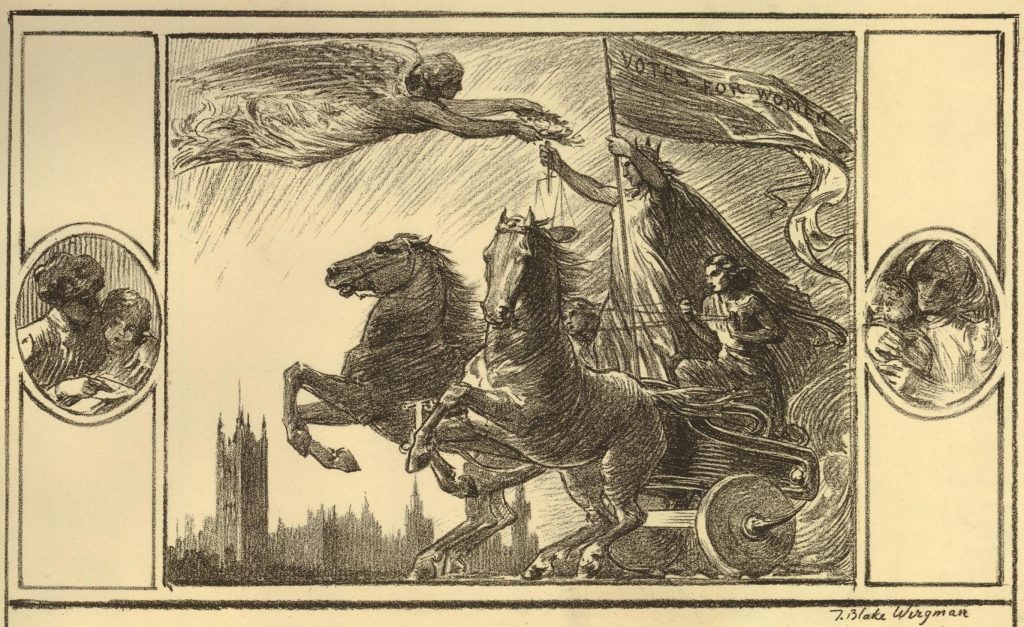
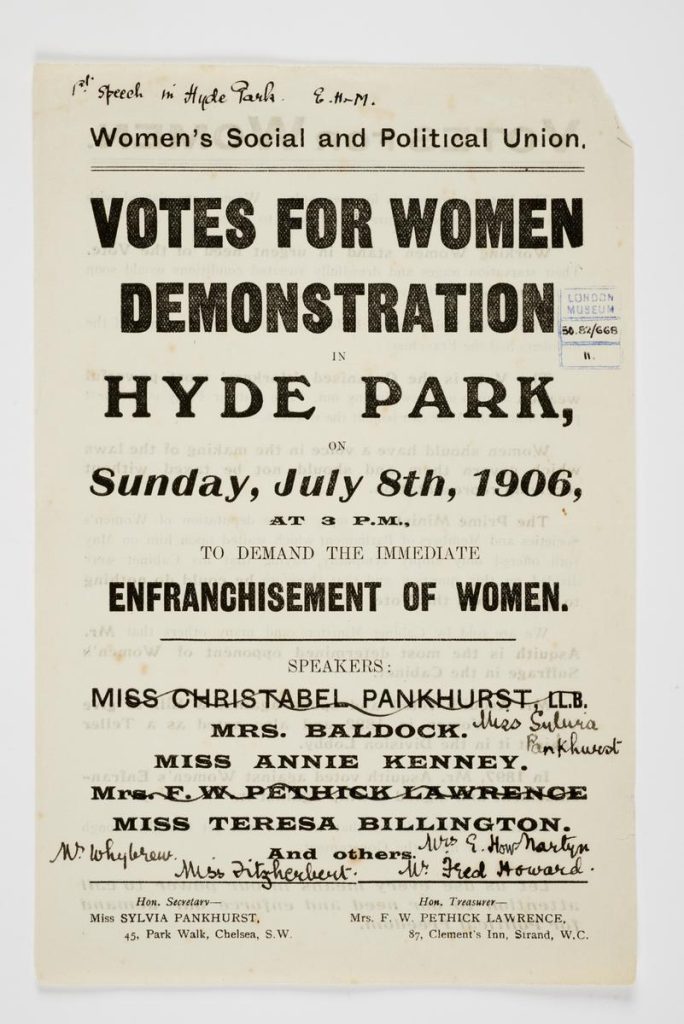
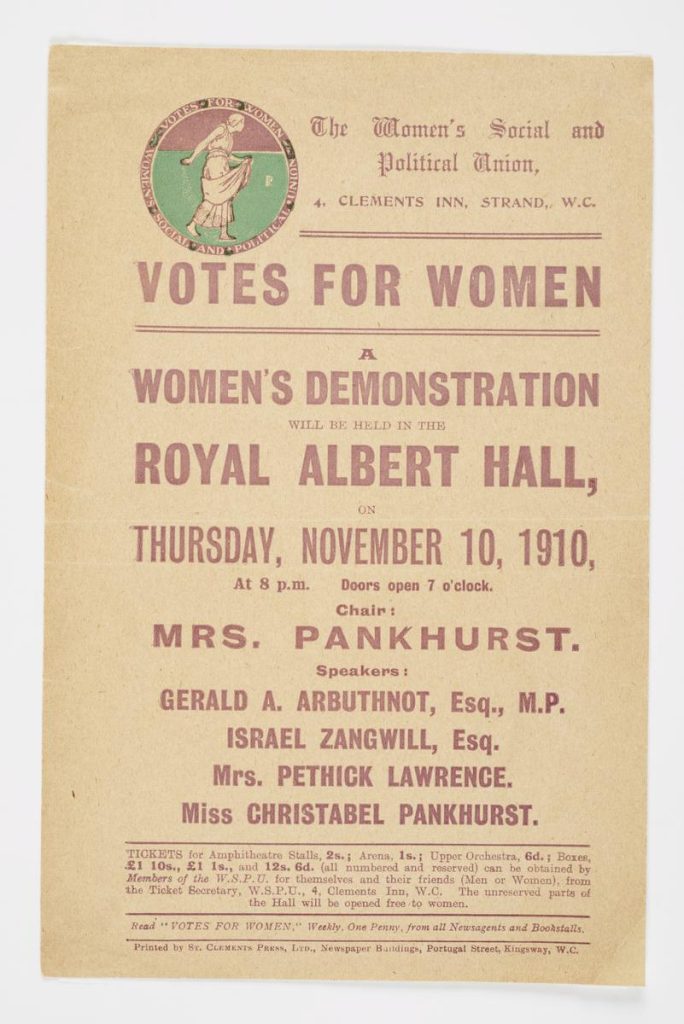
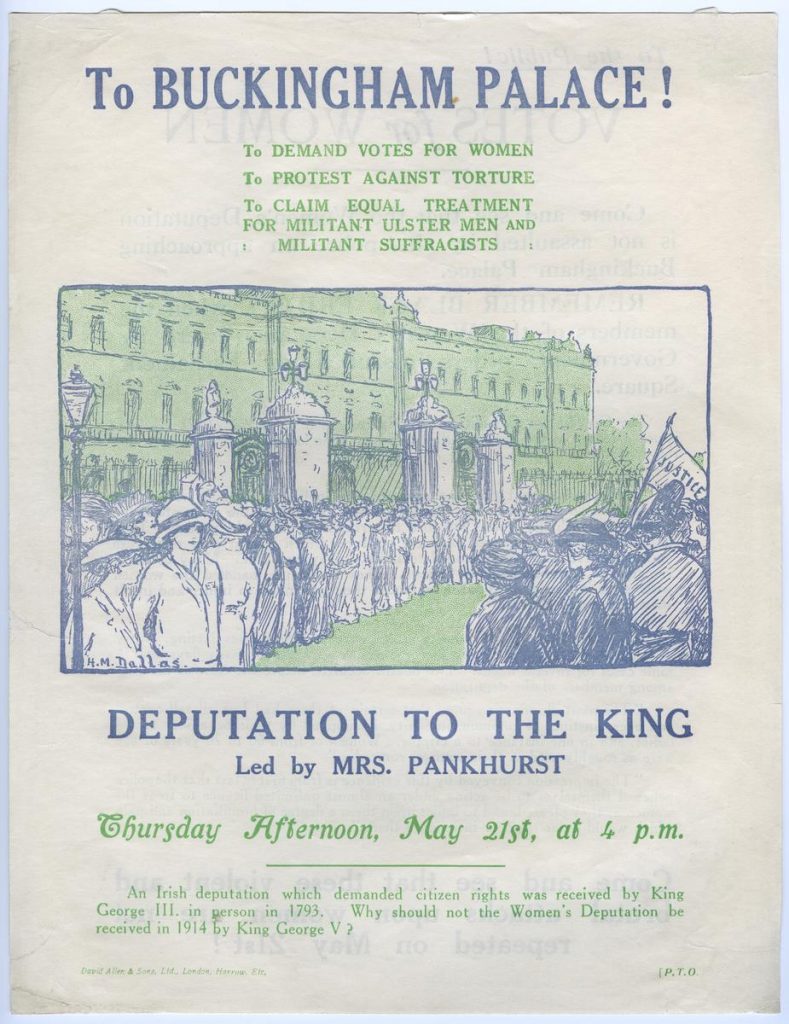
Theodore Blake Wirgman’s Boadicea’s Chariot in London seizes upon Thomas Thornycroft’s Westminster Boudicca and drives her directly into the women’s suffrage cause. The composition is almost ceremonial in its audacity: The spear is gone; above the charging horses rises the banner ‘Votes for Women’; Boudicca herself holds aloft the scales of Justice, while winged Victory descends from heaven with the laurel wreath. Motherhood and female instruction occupy the flanking medallions; Parliament itself looms beyond the horses as Boudicca races upon it through London. The surviving British Museum lithograph dates from 1921, but the image already belonged to the suffrage movement much earlier: Millicent Garrett Fawcett presented a version to released WSPU prisoners at the Savoy in 1906. Here Boudicca and women’s emancipation are made one image—the ancient female insurgent returned to London beneath the standard of ‘Votes for Women’, crowned by Victory and advancing upon the political order in the very form of conquest.
The political demand is therefore not merely written upon the image but enthroned within an entire sacred pageant of legitimacy—insurgency dressed in the vestments of sovereignty, and revolution already picturing itself as the victor whose wreath has descended from heaven. The irony of the image is almost too perfect. Boudicca, the anti-Roman insurgent, is herself Romanised in the very act of being enlisted against Rome. Above her flies Victoria, bearing the wreath of victory which belonged to the visual language of emperors, generals and triumphators; beneath her, the chariot hurtles through London with something of the theatrical violence of a corrupted triumphus, while the scales of Justice lend divine sanction to the procession. The vehicle of gods, kings and victorious commanders is thus appropriated for an insurgency of the feminine and plebeian element, and the symbols by which Rome once represented ordered victory are made to crown rebellion against hierarchy itself. There is a dark historical comedy in it: the revolutionary must borrow the majesty of the order she repudiates in order to appear majestic at all.
The resemblance to Servius Tullius is difficult to miss at the level of political symbolism. Once again the regal and Roman form is made to carry an inversion beneath it: elevation from below, the political enfranchisement of the subordinate element, and the displacement of an older patrician principle by forces which claim justice precisely through their emancipation from inherited rank. The costumes change; the movement is ancient. Rome has seen this tyranny before—the plebeian and democratic claim elevated against the patrician order, the feminine principle acquiring political force beneath the borrowed insignia of sovereignty, and revolution presenting itself not as rebellion but as the rectification of an injustice.
London was the point at which the WSPU ceased to be principally a Manchester agitation and installed itself besides the organs of national power. Its transfer to Clements Inn in September 1906 was therefore more than a change of headquarters: the movement planted its directing centre within the capital from which Crown, Parliament, ministries, courts, press, finance, and the ceremonial life of the nation radiated. Annie Kenney had already been dispatched to ‘rouse London’, addressing meetings, canvassing women, and leading deputations upon Parliament; once the leadership followed, the metropolis became simultaneously headquarters, recruiting-ground, theatre of demonstration, field of confrontation, and stage upon which punishment itself could be converted into political spectacle.
The WSPU consequently acquired an increasingly metropolitan character even while organising nationally. London concentrated within a few miles the objects against which pressure could be directed and the monumental spaces through which that pressure could be magnified: Parliament and Westminster supplied the political adversary; Hyde Park permitted the disciplined mobilisation of enormous numbers; the Royal Albert Hall furnished something approaching a counter-ceremonial arena in which militants could be acclaimed and decorated; Holloway supplied the prison whose chains, gates, hunger strikes, and sentences were themselves turned into insignia; and eventually even Buckingham Palace itself as the destination of Emmeline Pankhurst’s deputation to the King.118 Women’s Sunday in 1908 made the transformation spectacular, drawing suffragettes from throughout the country into London by specially chartered trains before seven processions, thirty bands, thousands of standard-bearers, and immense crowds converged upon Hyde Park. The chariot of the movement was therefore not merely racing through London: London had become its political terrain, its machinery of amplification, and the imperial stage upon which a movement originating outside the established order sought to confront, surround, and ultimately enter its institutions.
Women’s Sunday in June 1908 made this metropolitan concentration spectacular, drawing suffragettes from throughout the country into London on specially chartered trains before seven carefully ordered processions, thirty bands, and some 3,000 standard-bearers moved through the capital towards Hyde Park. By the time they converged upon the park, the multitude was reckoned at some 300,000, gathered before twenty platforms and a hundred speakers. Then, at the rally’s close, the bugles sounded. ‘Votes for Women!’ was taken up once, then again, then a third time, until, as the Lakes Herald reported, ‘from thousands of throats the cry came, gathering in volume’, swelling across Hyde Park into something it compared to the roar that breaks from a football crowd at the instant of victory. The mass of separate voices had become for a moment a single enormous voice, rolling out from the park towards the political heart of London; the Daily Mail supplied the almost threatening coda: ‘If it was not heard at Downing Street, the echo of it will be.’ It was remembered accordingly as ‘the day of the great shout’. The spectacle gave physical form to the WSPU’s new relation to London: provincial forces summoned into the capital, ordered into procession, concentrated into a mass, and made to speak with one voice before the institutions whose political constitution they intended to alter.
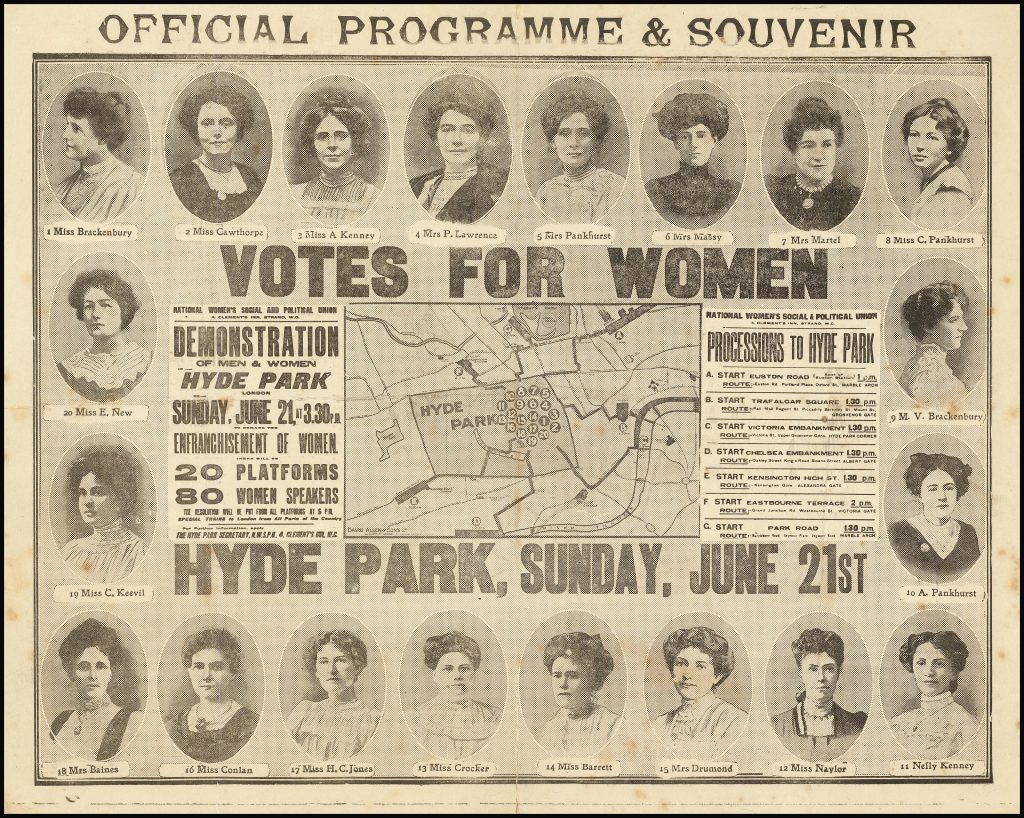
There was nothing spontaneous about the spectacle. Pankhurst herself recalled that ‘London, of course, was thoroughly organised’: more than £1,000 was spent on advertising alone; the capital was covered with posters and maps of the seven converging processions; and for weeks what she called a small army of women moved through its streets chalking notices, distributing handbills, canvassing houses, and carrying sandwich boards. The scale of the undertaking is clearer in modern terms: The £1,000 spent upon advertising alone would represent approximately £107,000–£156,000 in present-day purchasing power119, depending upon the historical inflation series employed. Even the culmination was choreographed. Twenty platforms began speaking at the sounding of bugles; at five o’clock the bugles sounded again, every platform simultaneously put the same resolution to its crowd, and the assembled multitude answered the conclusion with the threefold cry ‘Votes for Women!’120 The official programme itself mapped this machinery of concentration across London, plotting procession against procession and platform against platform until separate bodies were gathered into one political mass.
That detail gives the ‘great shout’ a rather different character. It was not merely an eruption of enthusiasm after a successful rally, but the terminal act of a deliberately constructed demonstration of mass power. Herbert Gladstone, Liberal Home Secretary from 1905 to 1910 and son of the former prime minister William Ewart Gladstone, had argued that ‘power belongs to masses’, effectively challenging the suffrage movement to demonstrate that it could command mass political support. Pankhurst herself frames the entire undertaking as the WSPU’s answer to Gladstone’s dictum: London was organised, its streets traversed, its crowds channelled into Hyde Park, its twenty platforms synchronised by bugle, and at the appointed hour innumerable individual voices were compressed into one demand directed at the Government.
What renders the spectacle so demoralising is not merely the success of a political demand, but the imagery of an order being made to watch its own displacement. Trains pour their contingents into the capital; banners multiply; columns converge; bugles sound; the separate voices of the crowd gather until they become one immense cry directed towards Westminster. Read against the older Roman imagination, the scene acquires something of the horror of a city hearing the tumult beyond its walls and realising that what had once stood outside the order has acquired numbers, organisation, symbols, and confidence enough to dictate terms within it. The disturbing element is precisely this conversion of multitude into authority: the mass ceases to petition and begins to speak as though its own volume were a title to sovereignty.
There is something almost late-Roman in the pathos of it. The forms remain standing: Parliament, Crown, law, ceremony, the monumental capital itself. Yet beneath them the principle has begun to change. What had once claimed legitimacy through hierarchy, inheritance, office, restraint, and a standard above the social body is compelled increasingly to answer before the organised pressure of the crowd. The barbarians need not literally breach the walls when the City has learned to receive their standard as its own; conquest reaches its most complete form when the institutions survive outwardly while the animating conception of authority has been reversed within them.
That is why the ‘great shout’ reads less like a triumph than like the sound of old Britannia discovering, in real time, that she no longer possesses the confidence to defend the principle by which she had understood herself. The old Roman Britannia had been an image of armed composure: feminine, certainly, yet contained within measure, seated beneath the higher peace of imperium, her shield and spear belonging not to revolt against the centre but to participation in an order emanating from it. Her sovereignty consisted precisely in that accord between local dignity and a transcendent imperial axis, between the island and the greater form that gave it place, limit, and meaning. Now that composure seemed to darken. The seated goddess rose, but no longer in harmony; the shield became grievance, the spear insurrection, the measured stillness of the province gave way to the rushing wheels of the chariot. Britannia, having ceased to recognise the centre above herself, began almost imperceptibly to assume the face of Boudicca.
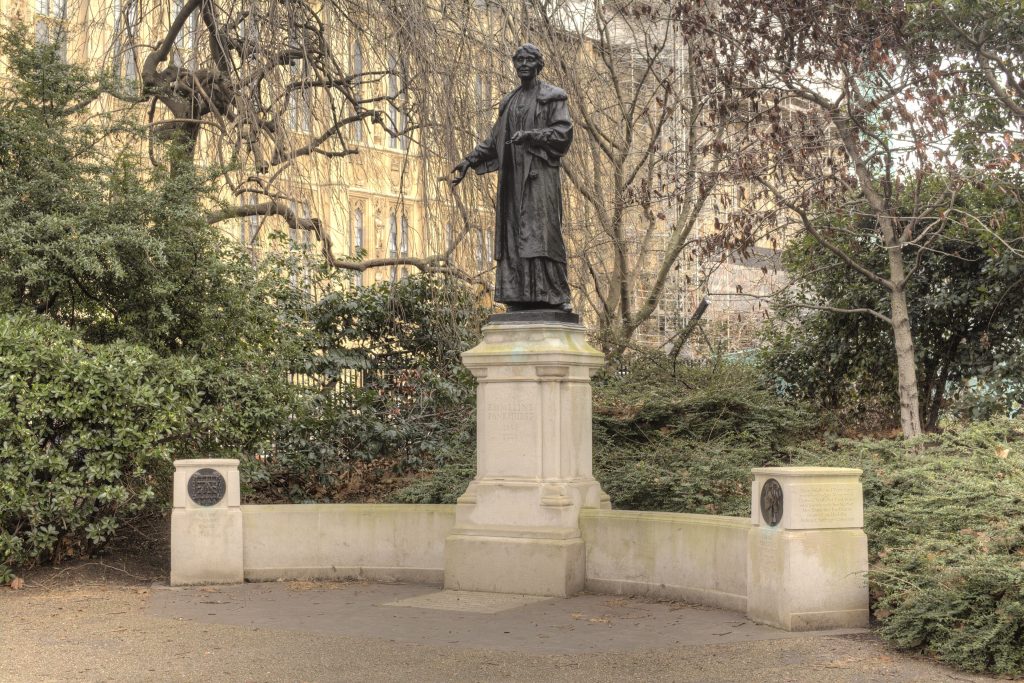
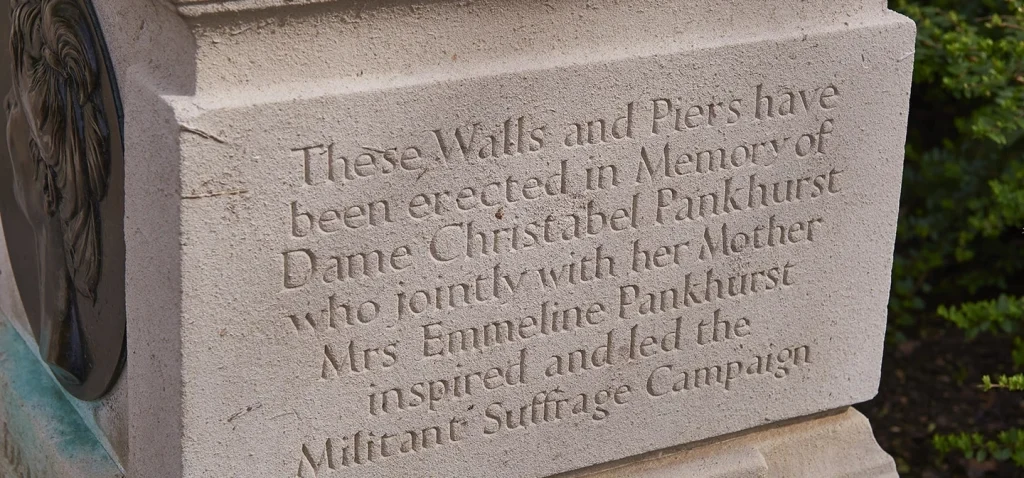
Left: ‘This statue of Emmeline Pankhurst was erected as a tribute to her courageous leadership of the movement for the enfranchisement of women.’
Right: ‘These Walls and Piers have been erected in Memory of Dame Christabel Pankhurst who jointly with her Mother Mrs Emmeline Pankhurst inspired and led the Militant Suffrage Campaign.’
Very obvious are the replies to these two points. In the first place, the Suffragettes not only “think”, they know that Parliament can be terrorised into granting reform. They also know that Parliament never grants reform unless it is terrorised. The men terrorised Parliament into giving them the Vote. The Catholics terrorised Parliament into giving them emancipation. The Nationalists (by their votes in the House of Commons) are terrorising Parliament into proceeding with the Home Rule Bill.
‘Dame’ Christabel Pankhurst, ‘Mr. Lloyd George on Militancy’, The Suffragette, 27 June 1913
Terrorism is, in fact, the only argument that Parliament understands!
There is something terrible in the metamorphosis. The helmet remains, but its significance is reversed; majesty survives, but detached from measure; the feminine figure still claims to personify the island, yet now does so through tumult, injury, and the mobilisation of everything below against everything above. Britannia has not simply been conquered: she has lost the inward sovereignty by which she could distinguish order from rebellion, and in the ensuing darkness mistakes the fury of Boudicca for her own recovered crown. The great shout then becomes the audible instant of that transformation, as though the old goddess of the island were disappearing beneath the roar and, where her calm image had stood, the chariot were beginning once again to move.
London thus stood encircled by a force intent upon unmaking and remaking its order from within, while the machinery of radical agitation serves as the conduit through which elemental energies are loosed into the very centre of the polity. What had once been held beneath form, hierarchy, custom, and sacred restraint is gathered, organised, amplified, and hurled back against the institutions that had contained it, until quantity itself begins to assume the voice of legitimacy and collective passion the posture of law. The crisis is therefore deeper than any single reform: it is the irruption of the formless into the seat of form, the plebeian and telluric pressing upon the remaining structures of a civilisation whose governing principle has begun to lose confidence in itself.
The institutional sequence alone says something extraordinary. In 1936 Christabel Pankhurst was appointed Dame Commander of the Order of the British Empire, the official honours notice recording the reason simply as ‘for public and social services’. This was no merely colloquial ‘OBE’, but the grade of the Order carrying the title of Dame. Yet Christabel had been one of the directing minds of a movement whose campaign had encompassed systematic destruction of property, arson, and bombing; Parliament’s own historical report on the Pankhurst memorial records these methods among the activities of the WSPU. Twenty-three years after her damehood, the memorial beside Parliament was itself enlarged to commemorate Christabel and the WSPU, with the words ‘Militant Suffrage Campaign’ quite literally chiselled into the stone as an object of public honour.121a One might observe, with rather less euphemism, that this was quite literally terroristic coercion: the calculated use of violence, destruction and fear to compel political submission. There is, moreover, an unmistakable historical continuity in the Left’s recurrent willingness to sanctify political violence when it serves an emancipatory end, from the suffragette campaign to later movements of liberation whose coercion is similarly transfigured, once successful or fashionable, into the moral language of progress; beyond this, the threatening compulsion found in a particular strand of the modern woman and the culture she inhabits, begins to come into focus, not as something innate to women as a class, but as an inheritance of the terroristic disposition that effected their political liberation, confined to the particular period, demography and ideological conditions that engendered the coercive politics of the emancipation movement.
Ellie Cawthorne: Can we call the suffragettes “terrorists”?
Fern Riddell, interviewed by Ellie Cawthorne, BBC History Magazine, May 2018
Fern Riddell: Absolutely. The question of whether or not we should call the suffragettes of the WSPU “terrorists” is redundant to me, because they so clearly were terrorists. We’re talking about a hugely skilled and highly organised group, whose actions—bombing, arson, acid attacks—clearly match up with what we understand as terrorism today and what was understood as terrorism 100 years ago.
The irony becomes grotesque in light of ‘Dame’ Christabel’s own words: the Suffragettes, she declared, did not merely suppose that Parliament could be terrorised into submission, but ‘know that Parliament never grants reform unless it is terrorised’; after invoking earlier political victories as proof that such coercion worked, she made the principle perfectly explicit: ‘Terrorism is, in fact, the only argument that Parliament understands!’121b Should not her own words, rather than euphemism, be inscribed upon any monument raised to a radical insurgent? Thus the word now chiselled into stone as an honourable description of their ‘Militant Suffrage Campaign’ commemorates a movement whose own leader openly acknowledged terrorism as its conscious instrument of political compulsion. The word ‘militant’ is itself a euphemism here: what it softens into a respectable adjective was, in practice, a campaign of terrorism, violence, arson, bombing and political coercion. One might imagine a statue of Osama bin Laden erected in London, his campaign of terror solemnly chiselled into stone as an object of public honour; yet, as the comparison in the preceding section has already shown, even the scale of Islamist attacks examined across Britain and the other countries considered falls markedly short of the suffragettes’ campaign of bombing, arson and destruction—making the reverential monumentalisation of the latter all the more ghoulish. The Pankhurst memorial is, in precisely this sense, a monument to the terroristic nature of women’s emancipation and a monument to its evil: not merely a memorial to women who happened also to have committed acts of violence, but a public consecration of a movement which consciously made coercion, terror, agitation, and destruction instruments of political submission, and whose militancy is itself preserved upon the monument as a title to honour.
How much more fitting—and how much more beneficial to the feminine psyche—would be monuments to Livia Augusta, Nogi Shizuko-fujin, or any of those other flagship women whom Feminism cannot forgive: women memorialised not for turning grievance into political class-war, nor for compelling society through terror, but for loyalty, dignity, self-command, devotion, feminine nobility and fidelity to an order greater than themselves. Public monuments do more than remember the dead; they place types before the living and silently instruct them in what their civilisation considers admirable. If one wishes to alter the character cultivated in succeeding generations of women, one might begin by asking which women are placed upon the pedestal.
It is difficult to contemplate the question without a certain disgust. Had an avowedly patriarchal male organisation conducted a comparable campaign of bombing, arson, destruction, and calculated political coercion, does anyone seriously imagine that its leaders would today be commemorated besides Parliament with the language of courage, public service and royal honour? More likely their violence would define them absolutely; every memorial proposal would be treated as an obscenity, and every attempt to distinguish their political ends from their methods as apologetics for terror. Yet where the Pankhursts are concerned, the violence is softened into ‘militancy’, the coercion absorbed into the mythology of progress, and the perpetrators themselves elevated into national heroines. The desolating part is not merely the double standard, but what it reveals: our civilisation appears capable of recognising political evil perfectly well until the violence has been committed in the name of an emancipation it has subsequently chosen to sanctify.
The remarkable thing, then, is not merely that an insurgent movement prevailed, but that the order against which it had directed its coercion eventually adopted the movement’s own vocabulary of honour: prosecution gave way to decoration; militancy became public service; and what had once been punished by the state was monumentalised almost beneath the walls of Parliament. There is something more disturbing here than ordinary political defeat. Every enduring order must possess some inward principle by which it knows what it is, what it will tolerate, and, at the final boundary, the capacity to say ‘thus far’. Once that faculty fails, toleration shades into surrender, reconciliation into consecration, and political defeat into retrospective moral vindication. The adversary need no longer merely overcome the old order; the old order will eventually confer its titles upon her, engrave her struggle into stone, and teach succeeding generations to behold the breaking of its own authority as an object of public reverence. The deeper question is therefore not simply how the militants won, but what principle within the civilisation had already ceased to command obedience before their victory could become complete.
At such a moment London required, more than ever, something of the Caesarean principle: not merely a ruler in the political sense, but a figure capable of embodying ancestral continuity, transcendent measure, command, and the impersonal authority of an order standing above agitation. A Caesar would have represented the still point of an immovable object standing against the unstoppable, gathering torrent, recalling the City to the distinction between sovereignty and clamour, between the sacred centre and the passions assembled around it. Yet precisely when such a principle was most needed, the capital endured the crisis increasingly without it, and the vacuum left by the retreat of vertical authority was filled by the organised energies of those prepared to remake the order in their own image.
Gynaecocracy need not announce itself through the formal enthronement of women (although the throne literally now passes by women), nor even require that women occupy the highest constitutional offices. Its more characteristic modern form is indirect: men may retain the titles, uniforms, and ostensible command, whilst the moral atmosphere within which they act has already become feminine. Authority remains nominally masculine, but its permissible tone, purposes, and limits are determined by a maternal tribunal. The man may administer, punish, fight, or govern only after his actions have been rendered acceptable to the feminine conscience; whenever force offends pity, hierarchy offends sentiment, or command produces discomfort, the male officeholder is summoned to justify himself before those who claim exemption from the burdens upon which his authority rests.
Likewise, the return of Boudicca need not be imposed retrospectively upon the women’s emancipation movement; its own propagandists summoned her. To the suffrage imagination she became at once warrior, mother, national avenger, and female insurgent: Mary Lowndes designed a ‘Boadicea’ banner for the great NUWSS procession of 1908; guests at a 1906 suffrage banquet honouring released WSPU prisoners had already received an emblematic Boadicea driving her chariot beneath the demand ‘Votes for Women’; the WSPU afterwards sold ‘Boadicea’ brooches; and Christabel Pankhurst herself appeared in the contemporary press beneath the revealing designation ‘A Boadicea of Politics’.122
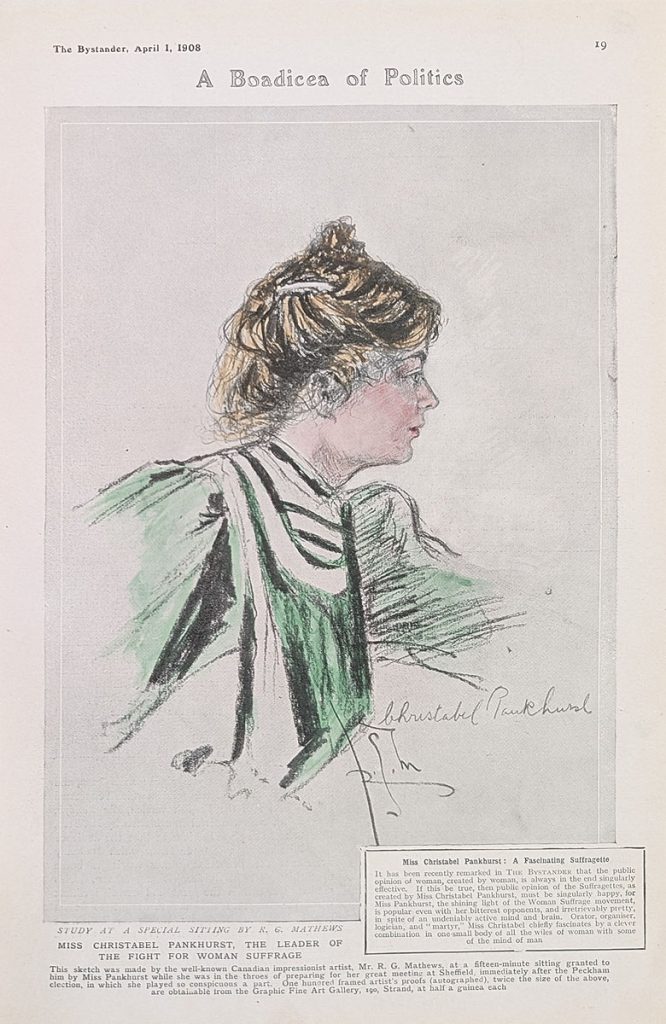
The choice was singularly apt. Tacitus places Boudicca in her chariot with her daughters before her and makes her present herself, despite her royal ancestry, as a woman speaking from the people; the maternal and the popular, the feminine and the insurgent, are thus fused in the very ancient portrait through which she entered British memory. The same conjunction reappears in the modern cult made around her. The revolutionary feminine presents itself as injured motherhood and popular grievance, converts suffering into political title, and then directs collective violence against the established order while claiming the nation itself as its moral possession. Even the destruction of Boudicca’s revolt is commonly romanticised by allowing ‘Romans’ to swallow up Tacitus’s more inconvenient ‘ad septuaginta milia civium et sociorum … cecidisse constitit’, or ‘about seventy thousand Roman citizens and allies were established to have fallen’, in a period when Roman citizens and allies in Britain themselves included native Britons: Roman Britain becomes rhetorically foreign so that violence committed upon its towns, civilians, allies, and Romanised supporters can be remembered simply as national liberation (see ‘Deeds, Not Words’: The Tyrannical ‘Reign of Terror’…, n. 6, above). And Boudicca herself is an exceptionally sinister patroness for such a procession. Her army did not merely resist Rome in some abstract struggle for liberty: Camulodunum was overwhelmed and destroyed; Londinium was abandoned by Suetonius and put to the torch; Verulamium followed, while the inhabitants caught within the revolt suffered slaughter on a prodigious scale. Suetonius Paulinus deliberately chose not to defend Londinium when Boudicca’s revolt reached it.
Tacitus says Suetonius marched to Londinium and considered making his stand there, but, seeing how few troops he had and remembering the recent destruction of Petillius Cerialis’s force, decided that he had to sacrifice the town in order to save the province. He ordered a withdrawal and took with him those inhabitants who were able and willing to leave; those who remained were then overtaken by Boudicca’s army. Tacitus is quite stark about the decision: Suetonius resolved, in effect, to save the whole ‘at the cost of a single town’. Londinium was then destroyed, and Verulamium suffered similarly. Tacitus subsequently gives the combined death toll at Camulodunum, Londinium and Verulamium as about 70,000 Roman citizens and allies, adding that the Britons were not interested in taking prisoners or selling captives, but in killing. The modern metropolis therefore pictures as its emancipatory charioteer a woman whose historical passage through Roman Britain was marked by cities burned, populations butchered and civic order reduced to ruin—and then places Victoria above her head. Tacitus’s own narrative is much uglier: a revolt ostensibly for Britain devastated Britain, sought rich and vulnerable centres for plunder, and consumed tens of thousands inhabiting the very country it claimed to avenge.
Neither does the customary invocation of the violation of Boudicca’s daughters confer moral purity upon what followed. Tacitus himself records that the Boudiccan insurgents bypassed fortified positions for places offering ‘the richest material for the pillager’, and that nearly seventy thousand Roman citizens and allies were slaughtered without quarter; by this stage those citizens and allies included provincials and native Britons themselves, so that the supposed vengeance for assault, dispossession and rape issued in the indiscriminate pillage, murder and brutalisation of an entire civilian population. Yet feminist posterity has valorised Boudicca as an emblem of righteous female revolt even while reproducing, sometimes in subtler forms, sometimes through literal terrorism and radical, anti-social agitation, her darkest political design: grievance transfigured into a moral licence to coerce, punish and despoil those collectively assigned the character of an oppressor.
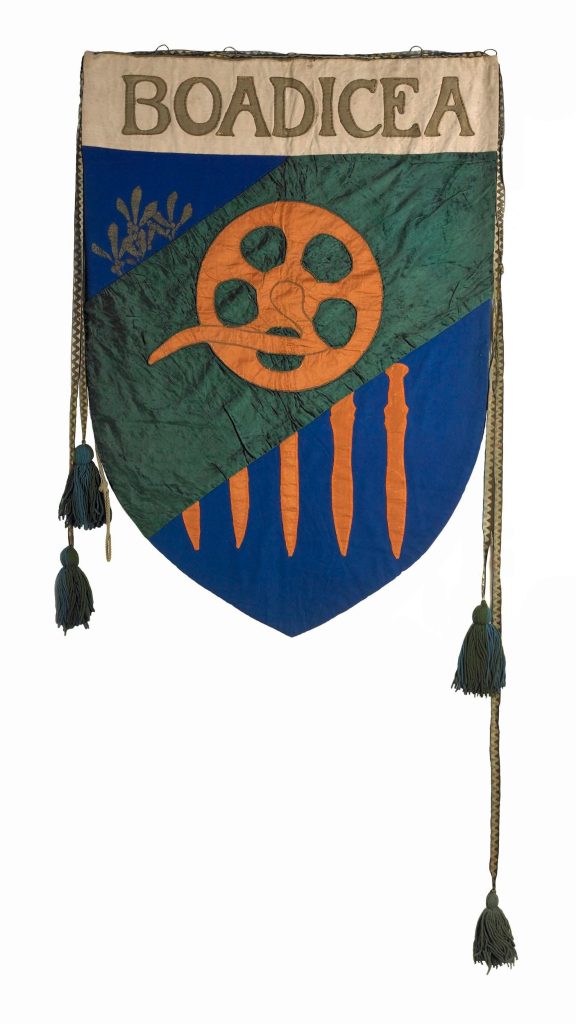
In that sense, the later radical feminine appears less as Boudicca’s repudiation than as her political return. The suffragists themselves perceived the ancestry and carried her image before them; what had once appeared with daughters in a chariot and fire behind it returned beneath banners, political organisations, and the rhetoric of emancipation. The maternal, plebeian, and revolutionary currents converge once more, each lending sanctity to the other, until revolt against the inherited order can present itself not as revolt at all but as the authentic voice of woman, people, and nation, opposed to the transcendent and solar principle of imperium. In its mature institutional form, however, this current no longer requires the chariot, the torch, or the barricade; it takes primacy through the female management class, through bureaucratic mediation, administrative supervision, welfare, education, policing, personnel, compliance, and the innumerable offices by which authority is softened, dispersed, and made maternal. Here gynaecocracy ceases to appear as an insurgent exception and becomes the ordinary texture of rule itself. The commanding centre of imperium, vertical, personal, and answerable to a principle above the social body, is displaced by an enveloping apparatus that governs horizontally through management, regulation, therapeutic solicitude, and the moral authority of care. Boudicca’s chariot has not vanished; it has entered the bureaucracy. What once rushed upon the City as revolt now presides within it as administration, while the ancient antagonism between the maternal-collective and the solar-paternal returns in its most accomplished form: not the feminine assaulting authority from without, but the feminine principle having captured authority’s machinery and remade its very grammar in its own image.
Boudiccan iconography acts less as an isolated historical personality than as the re-emergence of a recognisable metaphysical type. In her, the political and the maternal cease to occupy distinct planes: violated woman, outraged mother, tribal sovereign, and voice of the collective are fused into a single insurgent figure. Authority no longer descends from a transcendent, paternal principle which differentiates, orders, and gives form; it rises instead from injury, blood, maternity, grievance, and the undifferentiated solidarity of those who conceive themselves as wronged. The centre of gravity consequently shifts from the solar and vertical to the telluric and collective, from sovereignty as participation in an order above the individual to sovereignty as the eruption of an immanent force from below. What appears politically as revolt is, in this register, the displacement of one metaphysical pole by another: the paternal principle of form, measure, hierarchy, and command yields before a gynaecocentric power which derives legitimacy precisely from suffering, fecundity, emotional identification, and the mobilisation of the mass.
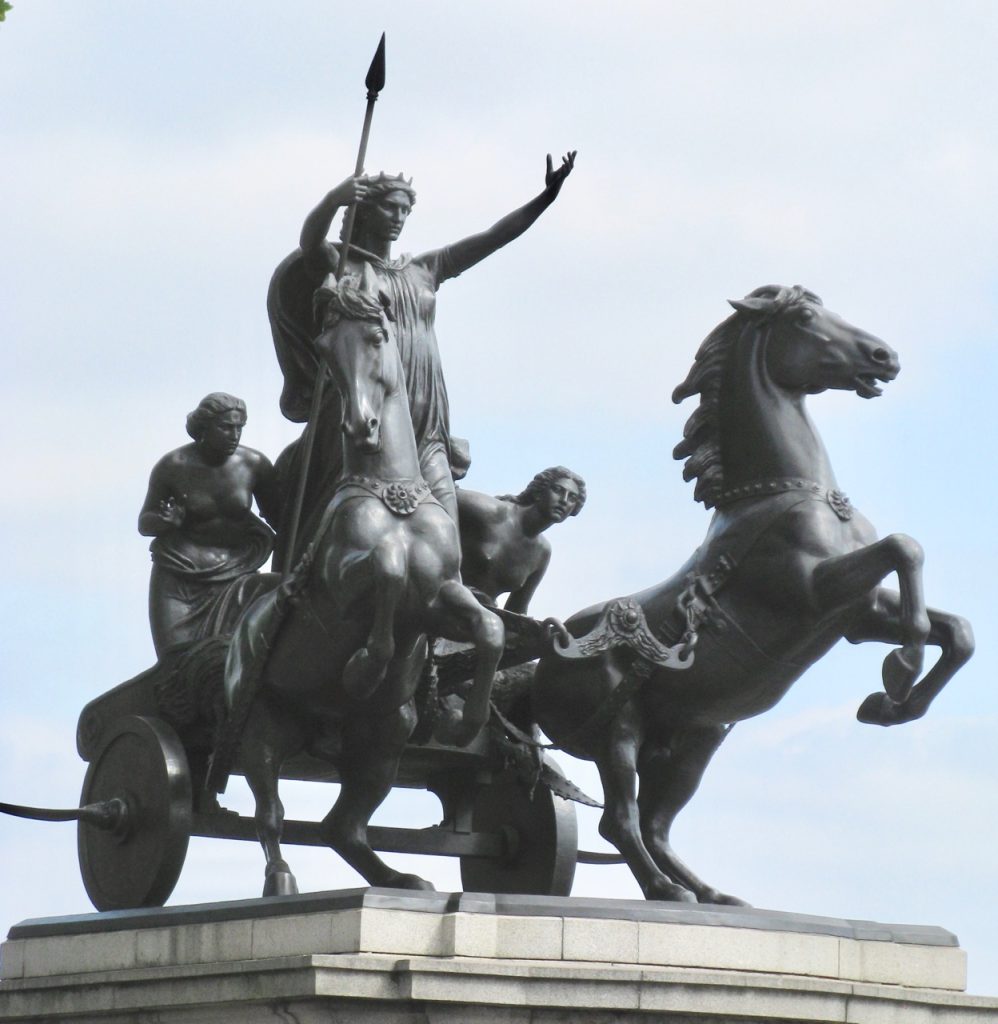
Long before the suffrage movement consciously enlisted Boudicca among its heroines, Victorian Britain had already raised the maternal insurgent into monumental form at the very seat of political authority. Thomas Thornycroft’s colossal bronze group, Boadicea and Her Daughters, represents Boudicca erect in feminine furore upon a charging chariot with her two daughters beside her; conceived from the 1850s and finally erected in 1902 at the northern end of Westminster Bridge, it confronts the precincts of Parliament itself with the image of the furious rebellious queen and her revolutionary female lineage.123a The circumstances of its creation are themselves significant: Prince Albert encouraged Thornycroft’s project, while the wider Victorian reception of Boudicca repeatedly intertwined the ancient queen with contemporary ideas of British nationhood and monarchy. Martha Vandrei accordingly treats the Westminster group as no incidental antiquarian monument, but as a particularly important object within the long historical process by which Boudicca was successively reimagined according to the political and cultural needs of later Britain.123b Thus, before the emancipationists placed her upon banners and sent her chariot racing symbolically through London, the City had already monumentalised the mother, her daughters, and the revolt itself beside the legislature; the later suffrage appropriation did not invent the Boudiccan image so much as seize upon a figure whose maternal and political potency had already been installed in bronze at the heart of Westminster.
Nor was Boudicca confined to banners and allegorical prints; she was bodily summoned into the suffrage movement’s own political theatre. In Cicely Hamilton’s A Pageant of Great Women, Elizabeth Kirby appeared as Boudicca, styled ‘Boadicea’ in the contemporary production, among the pageant’s ‘Group of Warriors’, alongside Pauline Chase as Joan of Arc, Munci Capel as the Ranee of Jhansi, and Frances Wetherall as Agnes of Dunbar. Hamilton places her specifically among ‘The Warriors’, immediately after Joan of Arc, and introduces her by the quality for which the movement wished her to be remembered: ‘a Briton in arms’ who ‘spat defiance at the hosts of Rome’.124a The significance of the grouping was explicit. Hamilton’s pageant placed the allegorical figure of Woman before Justice while pursued by Prejudice, and then marshalled successive companies of illustrious women as evidence in Woman’s plea for emancipation; Boudicca therefore entered not merely as a remembered British queen, but as one of the armed historical witnesses called forward to vindicate the political liberation of women. The ancient insurgent was thus quite literally made to stand upon the modern suffrage stage as an ancestor and champion of the cause.
JUSTICE.
Cicely Hamilton, A Pageant of Great Women (London: The Suffrage Shop, 1910), p. 45
Go forth: the world is thine. . . Oh, use it well!
Thou hast an equal, not a master, now.
WOMAN (rising).
I have an equal, not a master, now.
I will go speak with him as peer with peer,
Free woman with free man.
The importance of Boudicca to the later revolutionary imagination therefore lies in something deeper than the convenient discovery of an ancient female warrior. She furnishes an archetype in which the feminine can present its own insurgency as the authentic voice of the people and, by that fusion, sanctify revolt itself. The mother becomes nation; the nation becomes grievance; grievance becomes title to rule. Once these terms are joined, resistance to the feminine appears simultaneously as resistance to the people, to suffering, and to the nation imagined as a maternal body. The old distinction between ruler and ruled is thereby morally inverted: authority must justify itself before those beneath it, while the collective acquires a quasi-sacred innocence merely by occupying the position of the injured. It is precisely here that the gynaecocentric and democratic principles reveal their affinity. Both abolish distance; both suspect transcendence as domination; both translate qualitative difference into privilege; and both seek legitimacy in the numerical, affective, and terrestrial substratum from which the higher order had formerly demanded obedience.
Beyond that photographed quartet, the pageant unfolds into a much larger historical procession: Hypatia, St Teresa, Lady Jane Grey, Madame de Staël, Madame Roland, Jane Austen, George Sand, Caroline Herschel, and Madame Curie among the learned; Sappho and Rosa Bonheur among the artists; St Hilda and Elizabeth Fry among the saintly; Charlotte Corday and Flora Macdonald among the heroines; Elizabeth I, Victoria, Zenobia, and Catherine the Great among the rulers; and, among the martial company itself, Boudicca, Joan of Arc, the Ranee of Jhansi, Emilia Plater, the Maid of Saragossa, and Florence Nightingale. Together they constitute a deliberately assembled genealogy of female achievement intended to answer the charge that woman is naturally confined to dependence, passivity, and obedience. Boudicca’s revolt against Roman authority is therefore not incidental scenery but evidence entered into the suffrage movement’s own case for emancipation: amid queens, revolutionaries, saints, writers, scholars, and warriors, the insurgent British queen is called as a historical witness for Woman against the inherited masculine order.
The architecture of the pageant makes this still clearer. ‘Woman’, pursued by ‘Prejudice’, appears before an enthroned ‘Justice’ and demands freedom; successive companies of learned women, artists, saints, heroines, rulers, and warriors are then produced as the proofs of her claim, until Justice pronounces her worthy of freedom and the drama culminates in the declaration, ‘I have an equal, not a master, now’.124b Hana Leaper accordingly describes these tableaux as successive parts of Woman’s argument for emancipation and gender equality, and identifies the surviving ‘Group of Warriors’ photograph as Pauline Chase portraying Joan of Arc, Elizabeth Kirby as ‘Boadicea’, Munci Capel as the Ranee of Jhansi, and Frances Wetherall as Agnes of Dunbar.124c Boudicca consequently stands inside an explicitly political dramaturgy of emancipation: Rome’s ancient female antagonist is resurrected upon a London suffrage stage and incorporated into a martial genealogy through which the modern movement sought to vindicate its own revolt against inherited authority.
The medals and brooches make the underlying transvaluation unusually visible. The WSPU did not merely commemorate imprisonment; it deliberately borrowed the language and insignia of military honour for resistance to constituted authority. Its Hunger Strike Medal bore the legend ‘For Valour’, consciously echoing the Victoria Cross, while successive silver bars recorded hunger strikes and enamelled bars recorded force-feeding. The presentation case went further still, proclaiming that endurance ‘to the last extremity of hunger and hardship’ had vindicated ‘a great principle of political justice’. London Museum itself describes these as ‘military-style campaign medals’. The Holloway brooch, designed by Sylvia Pankhurst, likewise transformed the prisoner’s condition into a decoration of militant honours: Parliament’s portcullis, hanging chains, and the convict’s broad arrow were recast as insignia to be worn after imprisonment for militant action, in violet, white, and green; it transformed imprisonment itself into a title of distinction and was openly styled the ‘Victoria Cross of the Union’.125 The WSPU’s violet, white, and green palette, introduced in 1908 by Emmeline Pethick-Lawrence, was itself ideological heraldry: violet for dignity and the ‘royal blood’ of the suffragette, white for purity, and green for hope and spring. When hunger striking entered the suffragette repertoire later that same year, the logic was extended still further: the Hunger Strike Medal converted bodily endurance, prison discipline, and eventually force-feeding into graduated insignia of political valour, complete with dated bars and the martial legend ‘For Valour’.
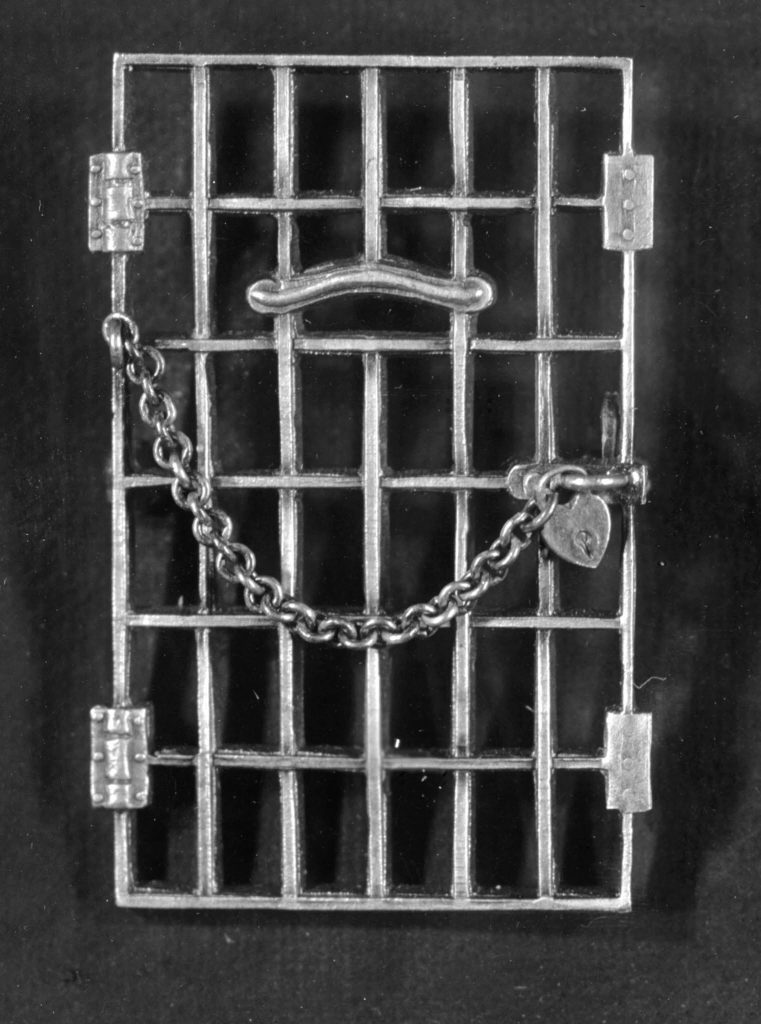
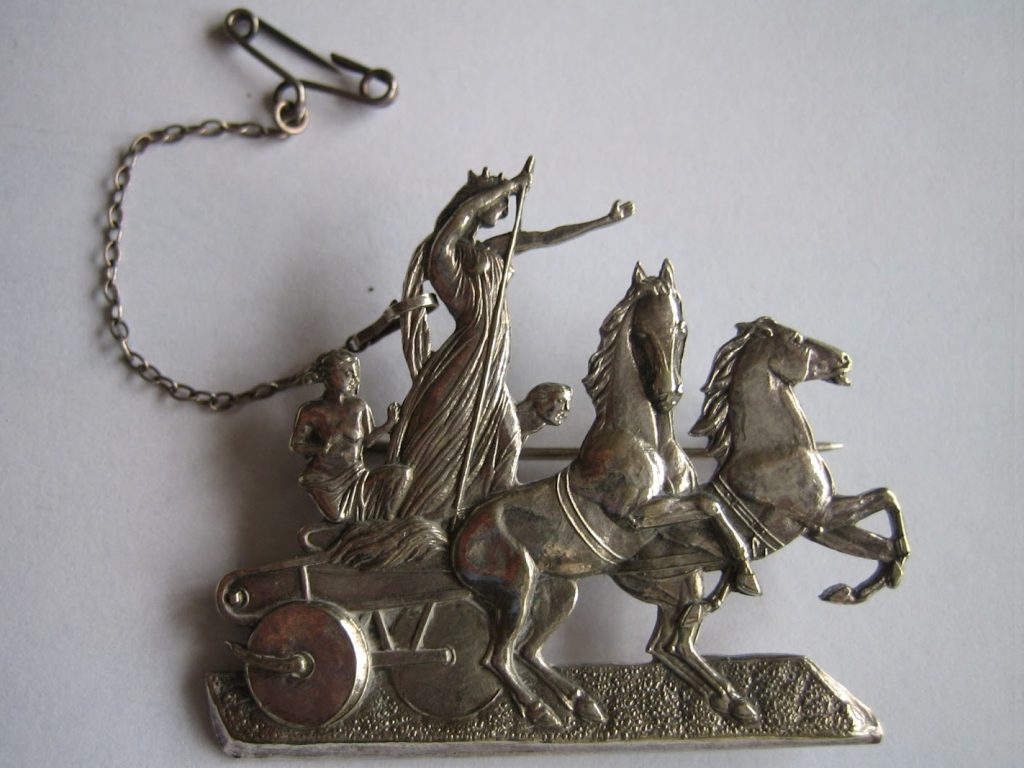
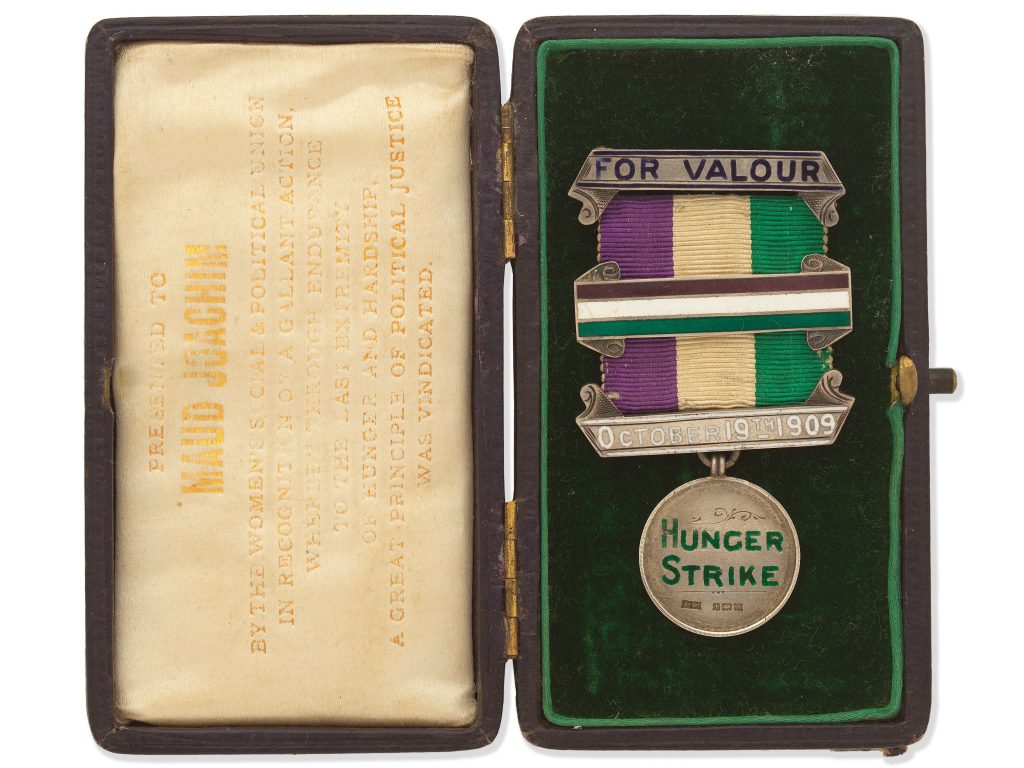
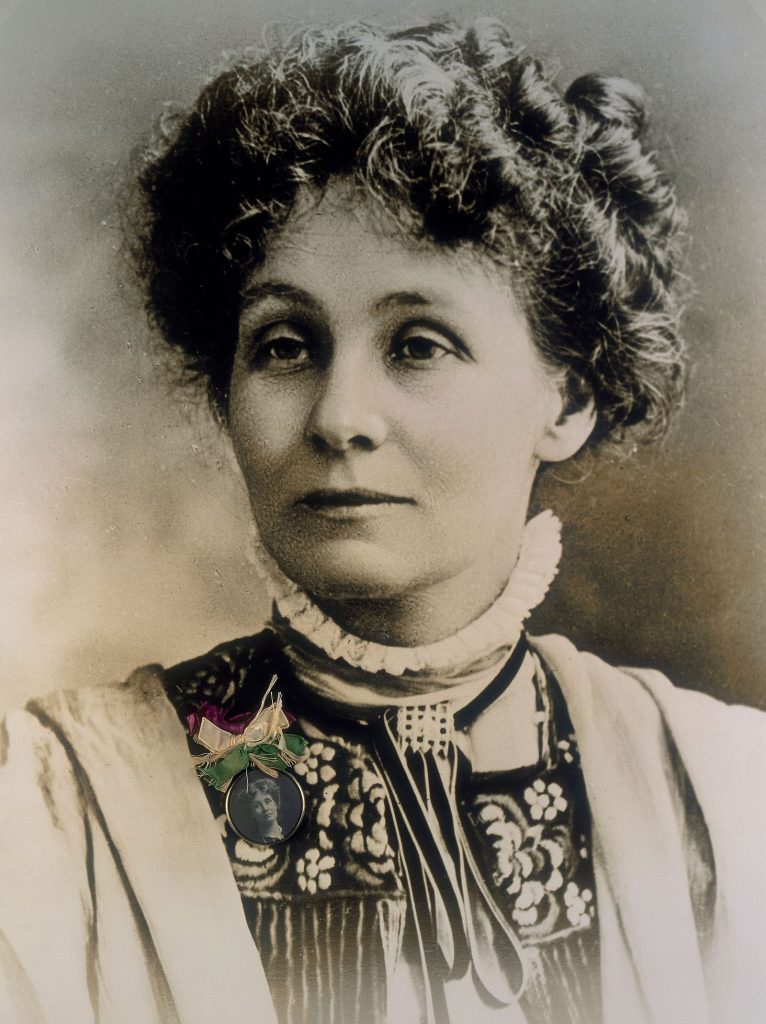
Far from representing the assertion of a legitimate and sovereign interest within an ordered polity, these insignia may be read as the heraldry of a far wider radicalisation: the elevation of grievance, agitation, imprisonment, slave-rebellion, and defiance into positive titles of honour whenever they are directed against an authority standing above the individual. To identify oneself with a slave revolt is already to accept the slave’s premise: one must first conceive or be convinced to conceive oneself as enslaved before the imagery of emancipation can become one’s own. The symbolism therefore does more than condemn an external master; it requires the adherent to assume the slave as an ontological type, to understand himself first as one who is acted upon rather than one who gives or carries form, who experiences order as constraint and bondage, authority as oppression, and every superior relation as an injury demanding release, interpreting hierarchy itself through the consciousness of the slave. Taken together, they disclose the characteristic movement of modern subversion, by which every superior principle, whether sacred, paternal, juridical, or hierarchical, is progressively stripped of transcendence and recast as an obstacle to be overcome by the mobilised will of the mass. The ultimate outcome, far from emancipation or the recovery of woman’s proper identity, is her confinement within an ever more total social mechanism, her exploitation as labour, consumer, voter, and ideological instrument, and finally her degradation through the very forces that claimed to liberate her. What presents itself as liberation thus culminates in a more comprehensive servitude: release from the household, the father, and inherited obligation merely delivers her into the impersonal disciplines of the market, the bureaucracy, the party, and mass culture, where she is counted, mobilised, employed, advertised to, and politically instrumentalised as an interchangeable unit. The older forms of dependence at least belonged to an organic hierarchy in which function, protection, duty, and dignity were mutually intelligible; the modern order destroys that qualitative bond and replaces it with anonymous subjection, while teaching the woman to mistake incorporation into the machinery of production and ideological mobilisation for freedom itself.
The imagery of chains, frequently invoked by suffragettes in protests as well as in jewellery, deliberately recruited the moral compulsion and vocabulary of abolition, casting woman as an enslaved class whose emancipation required the breaking of inherited bonds; violet then completed the transvaluation by clothing that maternal and plebeian claimant in the colour of royalty and sacral dignity. The conjunction is strikingly Servian: the subordinate element does not remain content with release from restraint, but advances from emancipation to investiture, appropriating the signs, prerogatives, and moral altitude of the order it has displaced. As in the Servian pattern, the movement from below is legitimated through the feminine and plebeian while simultaneously assuming the insignia of sovereignty itself, so that inversion is no longer presented as inversion at all, but as a higher consecration of those formerly beneath the paternal and patrician order. Violet therefore becomes more than a campaign colour: it visually enacts the elevation of the maternal-popular principle into something quasi-regal, turning emancipation into enthronement and the plebeian claimant into the bearer of a newly sacralised authority.
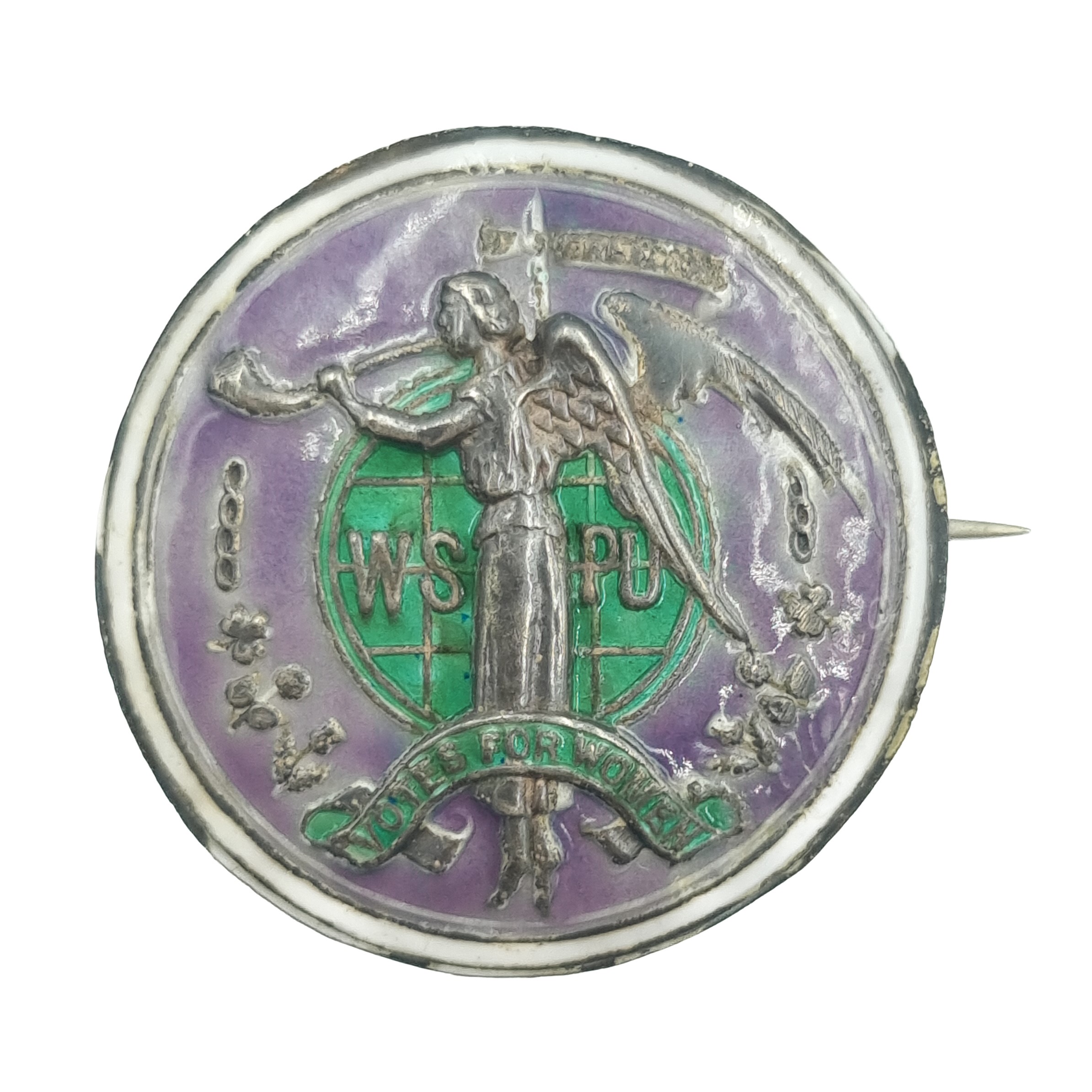
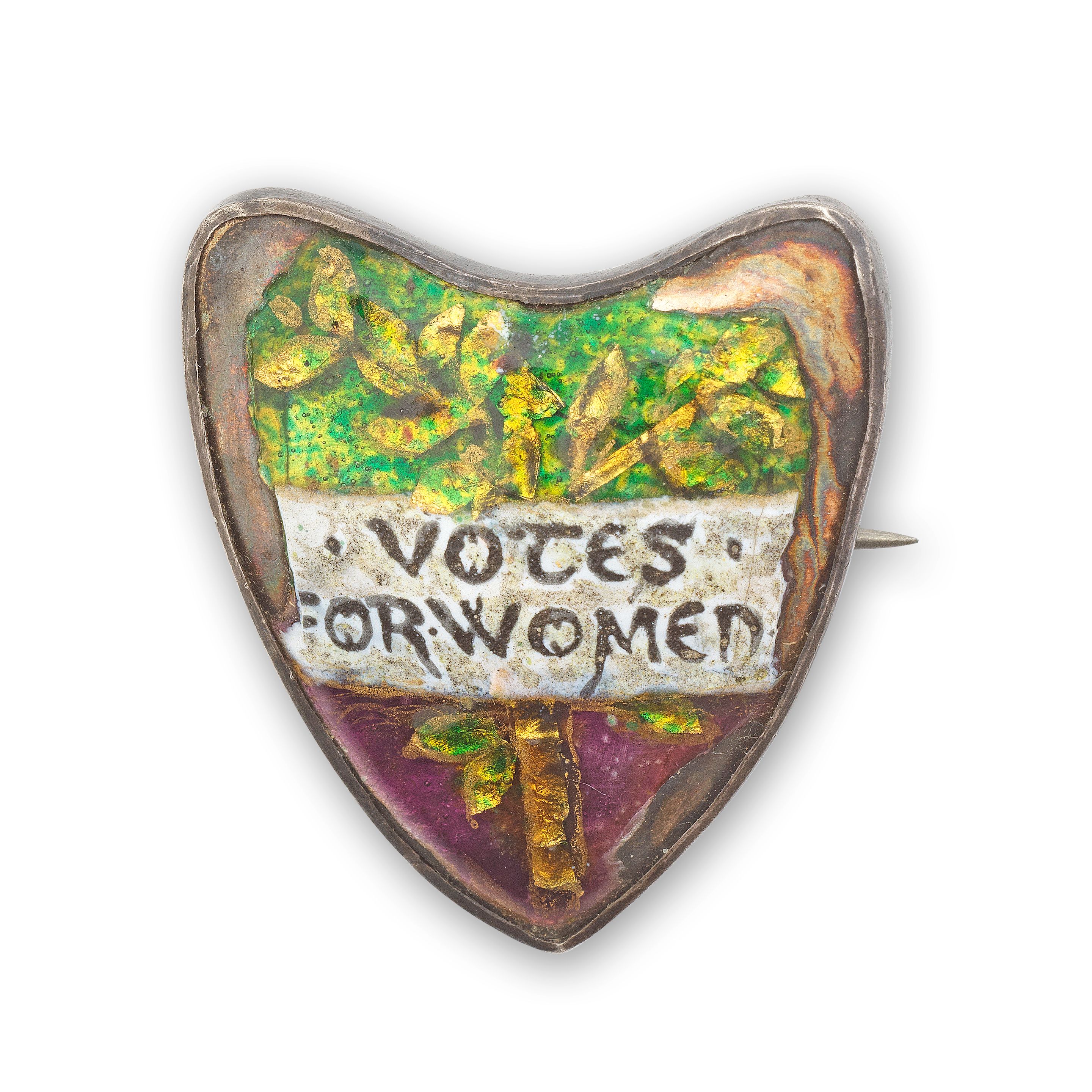
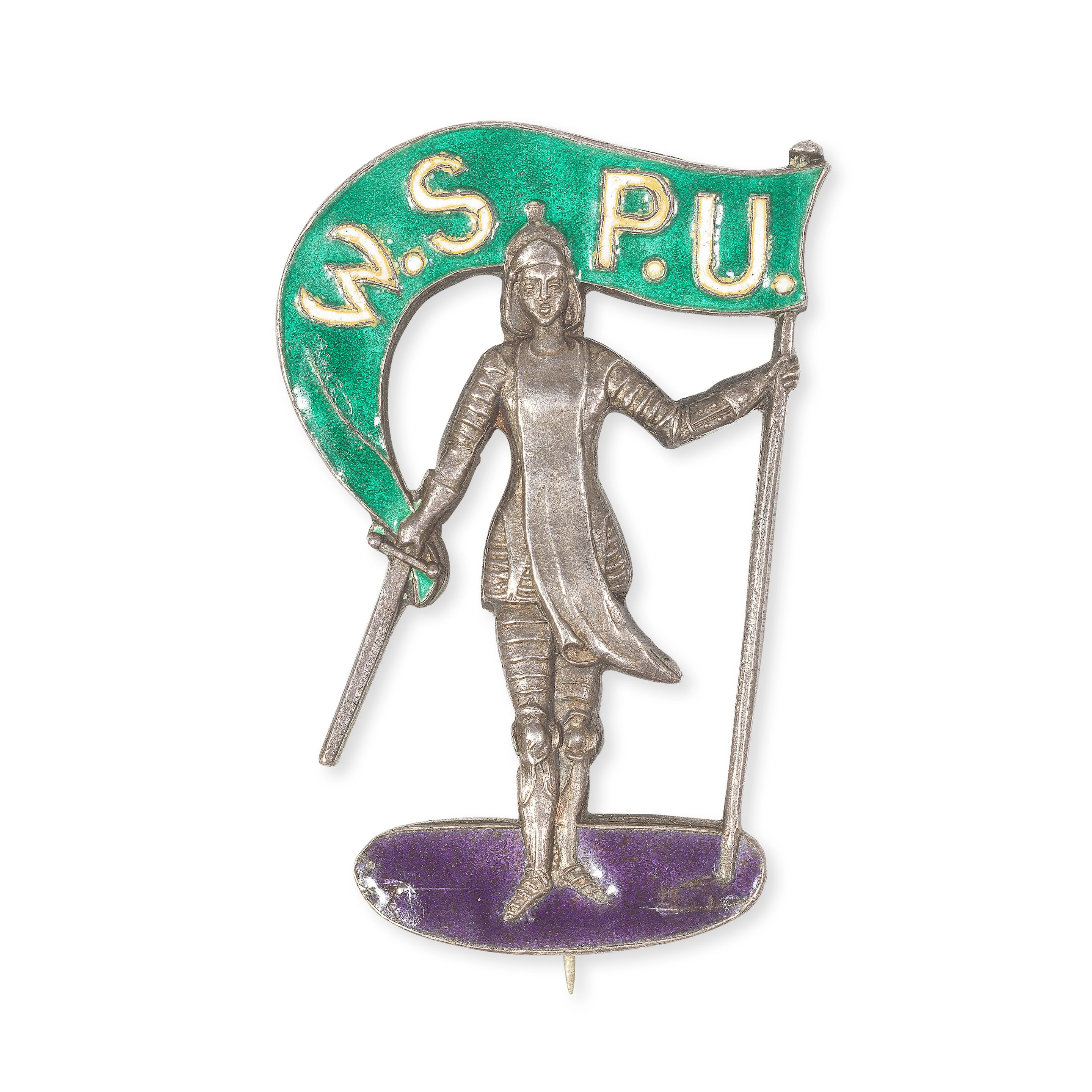
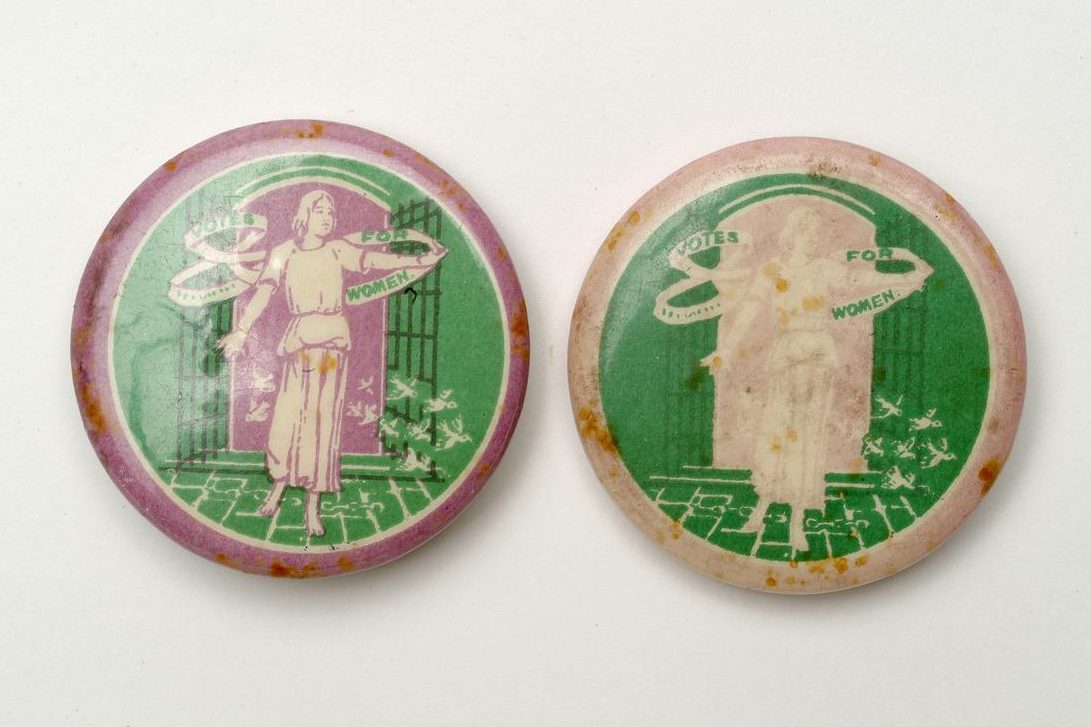

The lex Oppia renders the symbolism almost uncannily apposite. It is no wonder that Lucius Valerius, tribune of the plebs, arguing for its repeal, could reduce the dispute to the stark question, ‘Shall we forbid women alone the use of purple?’ (Livy, Ab Urbe Condita XXXIV.7.2–3), a formulation that anticipates the accusatory structure of later suffragette propaganda. His own comparison discloses precisely what was at stake: while women were denied purple, the colour remained woven into the masculine civic and sacral order through the toga praetexta of magistrates and priests and even through the purple-bordered garment of Roman boys. The distinction can thus be read as more than sumptuary restraint. Rome reserved the regal and sacral symbolism of purple to the differentiated masculine order through which sovereignty, priesthood, office, ancestry, and the future transmission of civic authority were embodied, while refusing the feminine principle any equivalent autonomous investiture. Purple marked the male as participant in the vertical continuity of command, cult, and imperium; its denial to women correspondingly withheld from the feminine the symbolic language of sovereignty itself.
Against that older and higher distribution of dignity, the suffragette adoption of violet acquires an almost perfectly inverse significance. The maternal and plebeian claimant does not merely demand release from inherited restraint; she takes up the very colour by which the older order had distinguished and sacralised masculine authority, clothing emancipation in quasi-regal dignity and presenting the feminine principle itself as entitled to enthronement. Here again the movement is strikingly Servian: what rises from below does not remain below, but appropriates the insignia of the summit, until plebeian elevation becomes royalisation, social inversion becomes consecration, and the feminine claimant appears not merely liberated from hierarchy but invested with the sovereignty once deliberately withheld from her. The suffragette cult of Boudicca was, in this sense, the Edwardian ancestor of today’s injunction to call oneself a ‘queen’ or ‘princess’: a plebeian act of self-coronation in which grievance is transmuted into royalty by proclamation alone. Boudicca supplied the movement with an antique diadem for the same psychological operation.
What is being established is therefore something more radical than remembrance. Sedition acquires its own order of chivalry. The honour that in a traditional polity descends from service to something above the individual, from sovereign, sacred law, military duty, or a transcendent principle of order, is inverted and conferred upon the act of resistance, and the image of the sacred woman herself. Hunger, imprisonment, defiance, and collision with authority become proofs of sanctity because the revolutionary cause has already assumed the right to judge the order against which it revolts. Christabel Pankhurst stated the premise without circumlocution in 1913: ‘It is not only war we have declared. We are fighting for a revolution!’ The medals merely gave this proposition its heraldry.
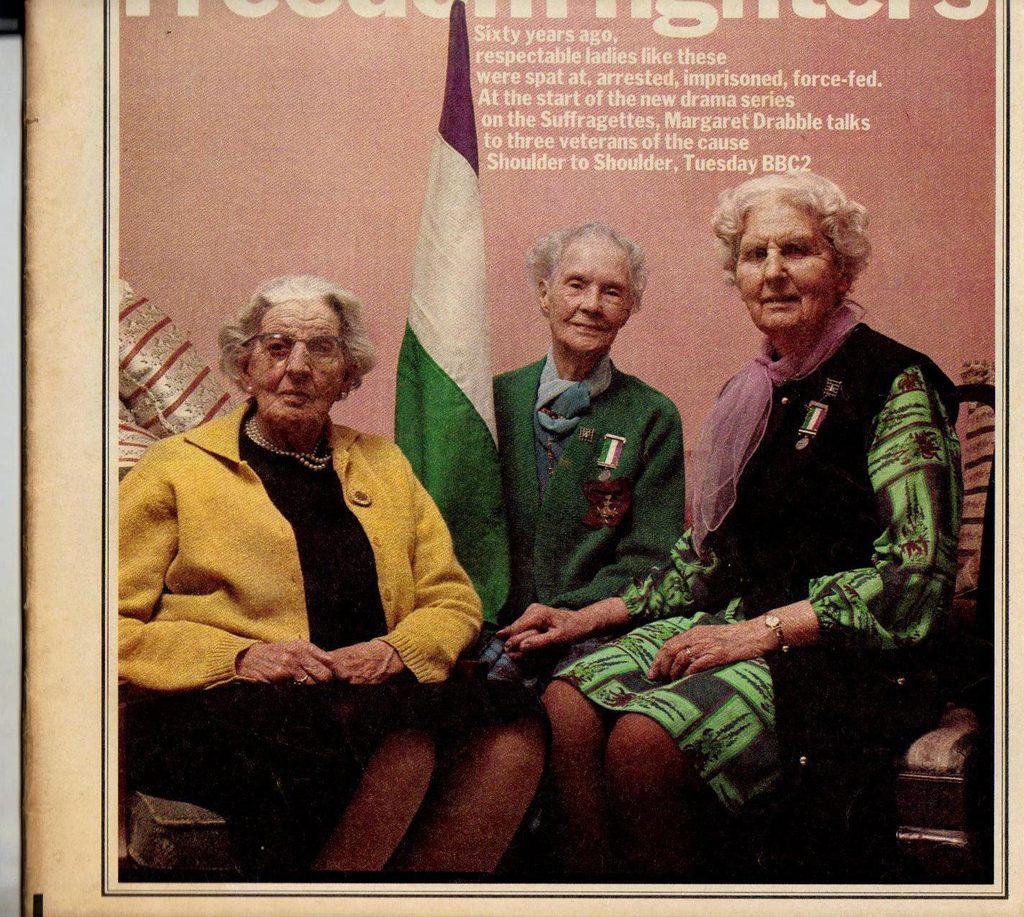
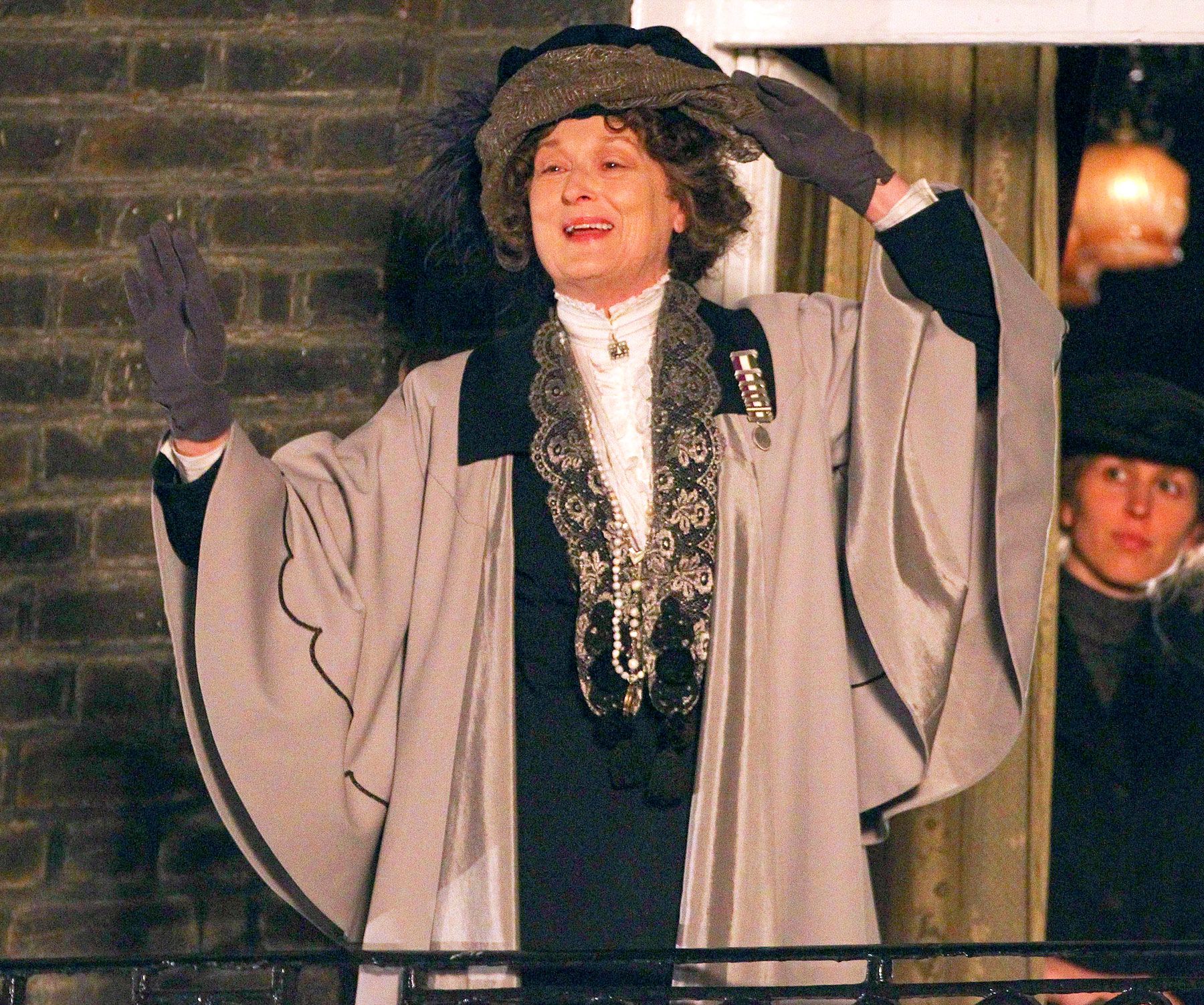
Right: Meryl Streep as Emmeline Pankhurst delivering a clandestine balcony address in Suffragette, film still, directed by Sarah Gavron and written by Abi Morgan, 2015. Streep’s brief appearance aggrandises Pankhurst’s exhortation to terrorism and rebellion.
The American development makes the inversion even more explicit. The National Woman’s Party’s ‘Jailed for Freedom’ pin, itself derived from the English Holloway brooch, reduced the prison door to a silver badge of honour, complete with a heart-shaped padlock. The ‘Jailed for Freedom’ pin arose directly from the campaign for the federal women’s suffrage amendment that would become the Nineteenth Amendment, commemorating those imprisoned for picketing the White House in an effort to force presidential support for its passage. More than ninety of the Silent Sentinels were arrested after picketing the White House; imprisonment and hunger strike were subsequently converted into a public title of distinction. At the December 1917 ceremony honouring the prisoners, Elizabeth Thacher Kent declared that by honouring women willing to go to prison ‘for liberty’, ‘we are showing our love of country and devotion to democracy’.126 There, in miniature, lies the democratic revolutionary formula: obedience to the existing law may be repudiated while the repudiation itself is proclaimed the higher patriotism, because ‘democracy’ has ceased to mean a determinate constitutional order and become an abstract moral tribunal before which every inherited institution can perpetually be arraigned.
Nor should this political mythology be permitted to annex woman herself. Nothing in femininity as such entails the WSPU, the hunger strike, the broken window, the prison brooch, the bomb, or the revolutionary doctrine that opposition to inherited authority constitutes an intrinsic badge of virtue. Indeed, the very success of the movement’s visual culture lay in converting a particular political programme into the appearance of a collective feminine identity: violet, white, and green became wearable allegiance, while jewellery, ribbons, medals, banners, and dress allowed an ideological minority to present itself symbolically as Woman.127 The WSPU’s colours became a highly effective means of publicly advertising political identity, and fashionable jewellery was deliberately incorporated into that visual campaign.
From a Traditionalist perspective, this is precisely where the distinction must be restored. The revolutionary mass does not become feminine merely because it speaks in woman’s name, any more than numerical mobilisation acquires a higher legitimacy by calling itself emancipation. What appears instead is the characteristically plebeian operation by which an undifferentiated collective identity is manufactured, grievance is elevated into a source of authority, and participation in revolt becomes a substitute for qualitative rank. The woman of higher type would therefore have no obligation to recognise herself in this artificially collectivised ‘womanhood’; she would deny its claim to represent her precisely because her principle lies elsewhere, in differentiation, measure, loyalty, self-command, and an order whose legitimacy does not arise from the passions of the mobilised mass. What was later inherited as an almost compulsory feminine mythology can thus be refused at its root: these are the decorations of a revolutionary party, not the regalia of woman.
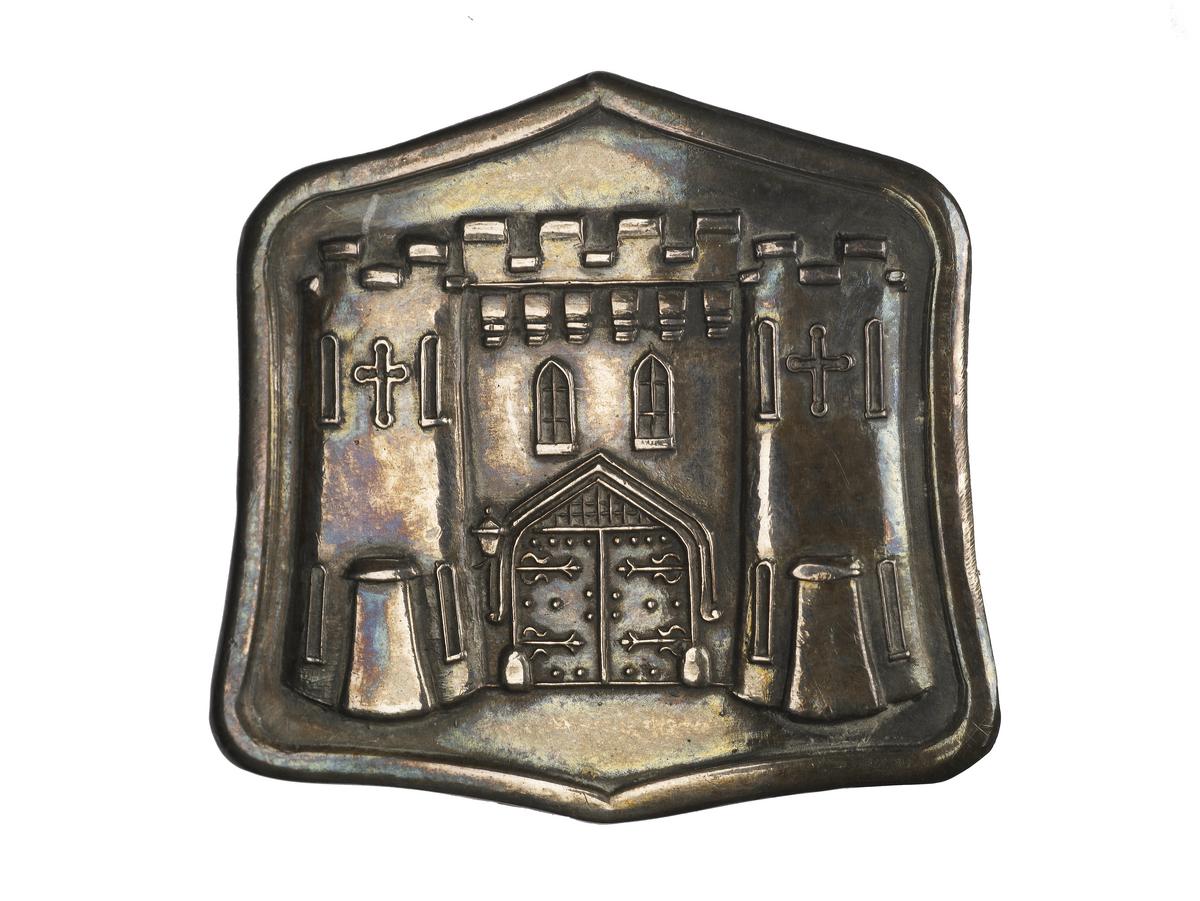

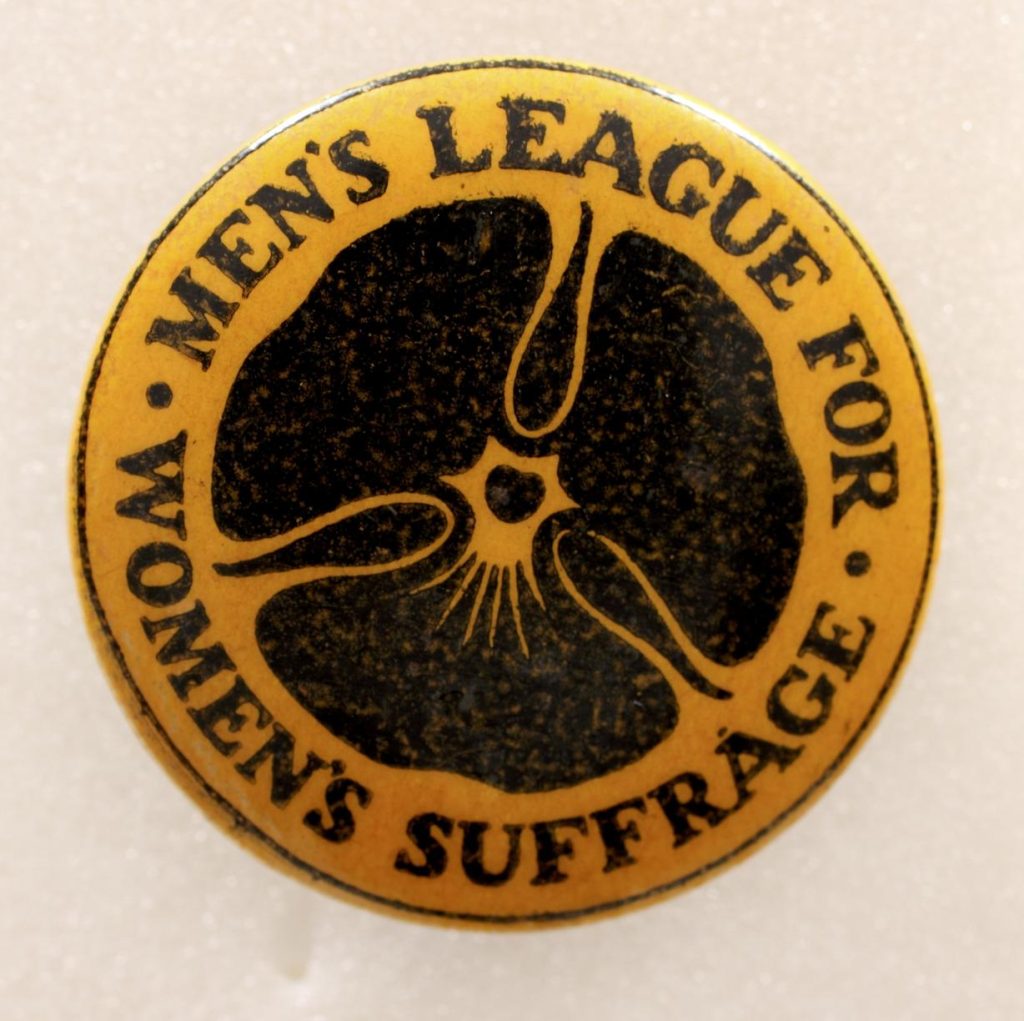
Neither was the mobilisation confined to women. In New York it acquired an organised male auxiliary in the Men’s League for Woman Suffrage, whose origins lay in Fanny Garrison Villard’s 1908 proposal for a men’s organisation supporting equal suffrage; her son Oswald Garrison Villard, Rabbi Stephen S. Wise, and the radical Max Eastman became the principal figures who carried the project forward, with the New York League organised in 1909.128 Wise was no merely ornamental patron. A prominent rabbi and founder of the Free Synagogue, he was already an outspoken advocate of female enfranchisement and declared that so long as women remained outside citizenship at the ballot box, ‘ours is no democracy’ but a ‘manocracy’. The language is revealing in light of the democratic principle already encountered above: existing political order is judged deficient according to an abstract democracy that demands its own progressive extension.
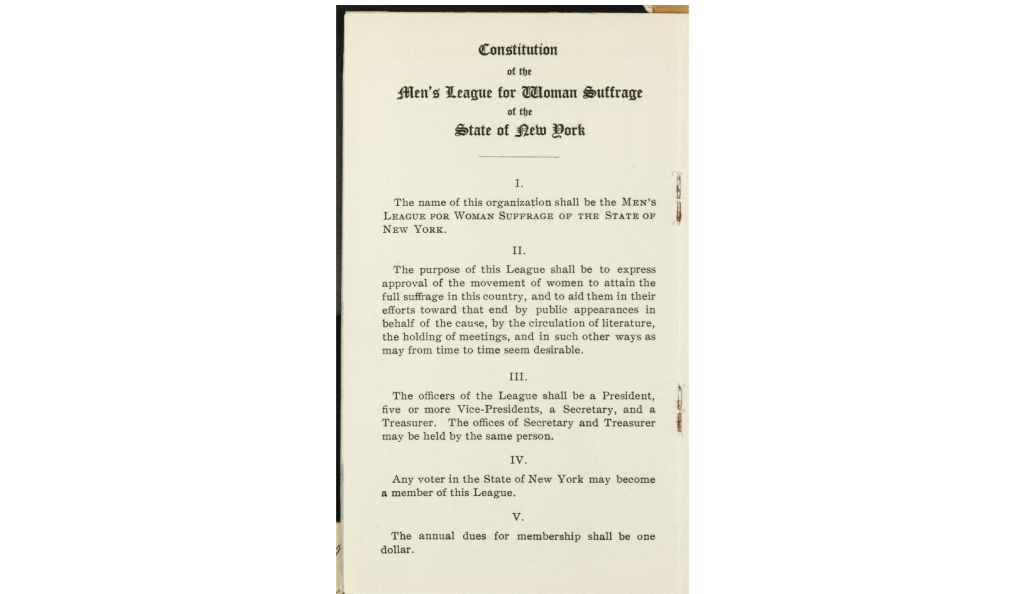
Right: ‘Woman and Democracy’, speech for woman suffrage delivered by Rabbi Stephen S. Wise of New York, Pathé phonograph disc, 1915; side A of Pathé no. 30305, paired on the reverse with Gertrude Foster Brown’s ‘Why Women Want the Vote’, recorded during the 1915 New York women’s-suffrage campaign; vertically cut shellac recording, A. Lanset Collection / NYPR Archives & Preservation
The movement even carried its democratic appeal into the new technology of recorded sound. In 1915 Pathé issued Rabbi Stephen S. Wise’s Woman and Democracy as one side of a phonograph disc devoted entirely to woman suffrage, the reverse carrying Gertrude Foster Brown’s appeal Why Women Want the Vote.129a The record is a striking material extension of the Men’s League programme: the male advocate no longer merely lends his vote, name, or presence to the cause, but has his voice mechanically multiplied and sent beyond the meeting hall, while ‘democracy’ itself becomes the governing abstraction under which the existing political order is arraigned. Brown’s accompanying address makes the premise explicit, declaring that ‘the entire question of democracy’ was at stake and asking enfranchised men whether government ‘of the people, for the people, and by the people’ could exclude women. In February 1915, Rabbi Stephen S. Wise went so far as to attribute the continued existence of war partly, ‘if not largely’, to the exclusion of women from the councils of state.129b By October, the proposition had hardened into a condition of peace itself: there could be no ‘beginning of an end to war’ until women possessed the vote.129c
The League’s constitution made the mechanism remarkably explicit. Its stated purpose was to aid women in attaining ‘full suffrage’ through ‘public appearances’, the circulation of literature, meetings, and whatever further means might appear desirable; membership, significantly, was open to ‘any voter in the State of New York’, with annual dues fixed at one dollar.130 Thus those who already possessed the franchise were consciously organised so that their electoral standing, public prestige, money, voices, and institutional access might be placed at the disposal of those demanding admission to it. The organisation quickly passed beyond nominal endorsement: its members supplied speakers, organised meetings and fundraising events, wrote and answered material in the press, canvassed voters, organised chapters, lobbied political authorities, served as poll watchers, and marched publicly for the cause. In the Fifth Avenue procession of 1912 alone, approximately a thousand men marched for woman suffrage; Wise himself appeared with his ten-year-old son, whose placard announced, ‘We want our mothers to vote’.
The absence of women from the councils of state partially, if not largely, is responsible for the continuance of the plague of war on earth. […] ‘Military preparedness’ means war, and there will never be a beginning of an end to war until women vote.
Rabbi Stephen S. Wise, first in an address on whether war was ‘cureless’, reported during the Emergency Federation of Peace Forces conference, Washington, D.C., February 1915; and later during the New Jersey woman-suffrage referendum campaign, Paterson and Newark, 16 October 1915
Israel Zangwill supplies a particularly revealing figure within this metropolitan network. London-born and already prominent in Jewish nationalist politics, he had been one of Theodor Herzl’s important early English associates and participated in the first seven Zionist Congresses before breaking with the Palestine-exclusive course of the movement and becoming the leading figure of the Jewish Territorial Organization after 1905.131a Yet he was simultaneously woven deeply into the suffrage agitation: he became a vice-president of the Men’s League for Women’s Suffrage, rode with the Zangwill party in the great WSPU procession to Hyde Park in June 1908, addressed numerous suffrage organisations, and appeared beside Emmeline and Christabel Pankhurst and Emmeline Pethick-Lawrence at the WSPU’s Royal Albert Hall demonstration of November 1910. The surviving handbill accordingly places the Zionist and territorialist polemicist quite literally upon the suffragette platform in the heart of London.
The connexion ran through the household. Edith Ayrton Zangwill joined the WSPU in 1907 and in 1912 became involved in the Jewish League for Woman Suffrage, which deliberately joined the demand for the parliamentary franchise to agitation over women’s position within Jewish religious life; Israel supported the League, while both later became vice-presidents of the United Suffragists.131b The Zangwills thus stood at a conspicuous junction of London literary life, Jewish political organisation, Zionist or territorialist nationalism, and the proliferating machinery of female enfranchisement. The chariot, by this stage, no longer needed to race merely through metaphor: London itself had supplied it with offices, halls, newspapers, leagues, committees, patrons, speakers, and an increasingly dense political infrastructure through which agitation could become institution.
There is therefore something more substantial here than the retrospective picture of a movement constituted simply by ‘women demanding their rights’. The franchise could be altered only through institutions still politically controlled by men, and the League deliberately recruited enfranchised males as a body through which the agitation could penetrate that order from within. Its constitution itself preserves the paradox: the voter was organised politically so that the category of voter might cease to be his exclusive political estate.



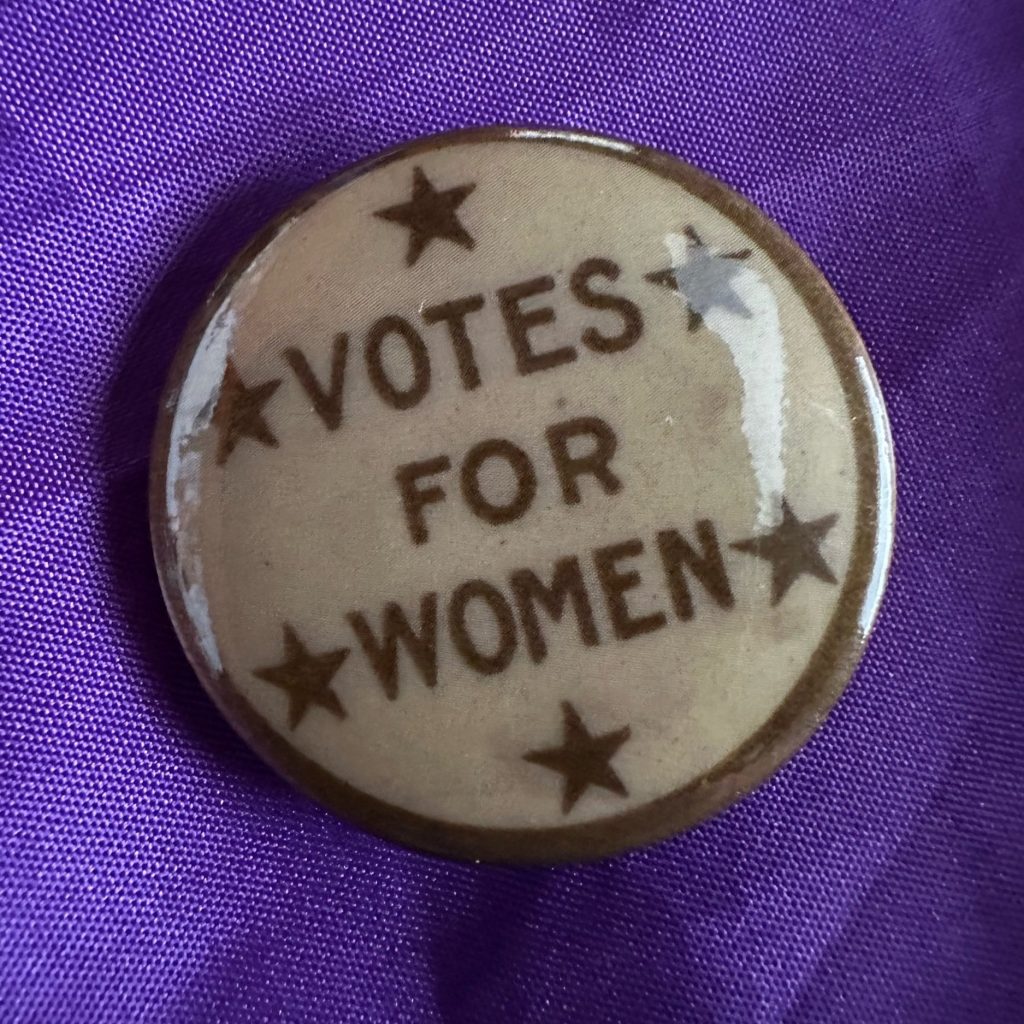

Her return within the women’s emancipation movement was therefore no accidental antiquarian flourish. When Boudicca was carried beneath suffrage banners, embodied upon the political stage, or made to drive the chariot of ‘Votes for Women’ through London, an ancient figure was being recalled, because the modern movement instinctively recognised its own form within her. The weapons had changed, the symbolism had been moralised, and maternal revolt now spoke in the abstract language of rights, equality, and emancipation; the underlying movement remained recognisable. Once more, feminine grievance was collectivised, converted into political authority, and directed against an inherited paternal order whose very distinctions were recast as injuries. Boudicca thus returns wherever the maternal and plebeian are fused into a revolutionary sovereignty: not merely as a woman taking power, but as the principle by which the feminine, claiming to incarnate the people themselves, seeks to dissolve the vertical world that had formerly contained and transcended both. The Boudiccan revolt can thus be read as a direct assault upon the Roman principle of paternal and solar order: against the imperium that descends from a transcendent centre, differentiates rank, and binds household, cult, and polity beneath masculine authority, Boudicca appears as the insurgent maternal power of blood, grievance, tribe, and collective passion. In this sense her revolt is more than anti-Roman; it is anti-solar, opposing the vertical principle of form and command with a gynaecocentric force that seeks legitimacy in suffering, maternity, and the mobilisation of the many against the ordering centre.
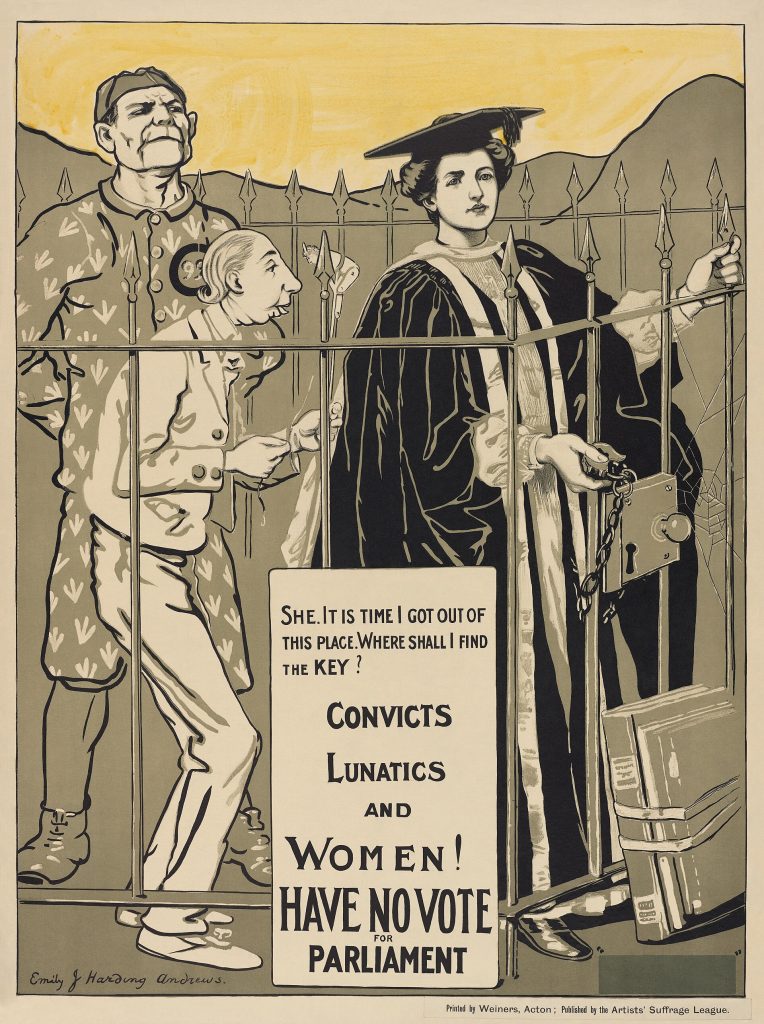
Academic attainment itself became an instrument of the suffrage argument. As increasing numbers of British universities admitted women to degrees, the cap and gown could be exhibited as visible evidence of female qualification for citizenship; contemporary suffrage propaganda accordingly placed the educated woman beside those classes of men already excluded from the franchise and demanded to know why she should share their political condition. Harding Andrews renders the argument with deliberate humiliation: the female graduate stands outside the cage but remains, politically, grouped with the convict and the ‘lunatic’, while her education is made to testify that the inherited distinction between masculine political authority and feminine civil position has become irrational. The rhetorical manoeuvre is significant: intellectual accomplishment is converted into a claim upon political power, while exceptional or degraded classes of men are employed as the foil through which the existing order is made to appear absurd.
The suffrage societies did not arise upon virgin organisational soil. By the time the NUWSS and WSPU appeared, women’s temperance organisations had already spent decades constructing a national female political infrastructure: branches, petitions, deputations, public lecturers, journals, police-court missionaries, prison visitors, and campaigns for statutory intervention into the household consequences of drink. Under Lady Henry Somerset the British Women’s Temperance Association explicitly joined this moral programme to women’s suffrage, a union contentious enough to help split the association in 1893. The surviving NBWTA thereafter embraced suffrage alongside temperance and other reforms. The ballot could thus appear as the political consummation of a jurisdiction already being claimed in the prison, police court, rescue home, and household: the organised female moral guardian sought not merely to petition the State, but eventually to participate in constituting it.
Britain became especially susceptible to this inversion because its institutions were progressively domesticated. The public school, hospital, workhouse, prison, court, municipal office, and police station ceased to be conceived merely as instruments serving definite and limited ends; each became a moral household, populated by dependants whose conduct, feelings, habits, language, health, sexuality, and private relations were to be continuously supervised. Wherever the institution was imagined as a household, the matron followed; wherever its inmates were represented as children, the maternal function acquired precedence over the paternal law.
The same period also saw women moving from voluntary reform associations into recognised functions within the machinery of the state. In 1893 the Royal Commission on Labour issued The Employment of Women, a substantial official report prepared by Eliza Orme, Clara E. Collet, May E. Abraham, and Margaret H. Irwin, who were formally designated ‘Lady Assistant Commissioners’.132 Their inquiry was not confined to descriptive observation: they were instructed to investigate differences in male and female wages, the ‘alleged grievances of women’, the effects of women’s industrial employment upon ‘health, morality, and the home’, and the exclusion of women from trades considered suitable for them. Orme, as Senior Lady Assistant Commissioner, coordinated reports based upon direct investigation across England, Wales, Scotland, and Ireland, which were then printed for Her Majesty’s Stationery Office and presented to both Houses of Parliament. The significance lies in the institutional form itself: before women possessed the parliamentary franchise, women reformers were already being incorporated into official commissions as investigators of female conditions, gathering evidence, entering workplaces, defining grievances, and transmitting their findings directly into the administrative and parliamentary sphere.
The four women named upon the title page were drawn from closely related currents of organised female reform.133 Eliza Orme, the Senior Lady Assistant Commissioner, was a founding member of the Women’s Liberal Federation and had been involved with both the National Society for Women’s Suffrage and the Society for Promoting the Employment of Women; May Abraham came directly from the Women’s Protective and Provident League, subsequently the Women’s Trade Union League, in which she served as treasurer; and Margaret H. Irwin was the League’s full-time Scottish organiser. Clara E. Collet, meanwhile, entered the Commission from the developing field of professional social investigation, having worked with Charles Booth upon his survey of London labour and poverty, before proceeding in 1893 to the Labour Department of the Board of Trade. Their collective appointment as Lady Assistant Commissioners to the Royal Commission on Labour consequently brought women already active in suffrage, Liberal organisation, female employment, trade unionism, and social investigation into an official apparatus of state inquiry, where their investigations of women’s work were published under parliamentary authority.
Thus arose the female management class: schoolmistresses, matrons, ward sisters, lady visitors, welfare officers, probation workers, inspectors, social workers, secretaries, committee-women, personnel managers, and, eventually, the modern human-resources functionary. These figures did not generally seize authority by openly contesting its martial or sovereign source. They entered through the side-door of care. Their special competence was said to lie in protecting the vulnerable, recognising distress, mediating disputes, maintaining propriety, and correcting the supposed crudities of male administration. Yet because vulnerability can be discovered everywhere, their jurisdiction possessed no natural boundary. The exception became the rule; solicitude became inspection; mediation became veto; and maternal concern hardened into an administrative sovereignty which could reach where the old law neither wished nor presumed to enter.
The deferential posture demanded before the female superior is consequently unlike obedience to the traditional commander. The commander issues an order and bears responsibility for its consequences; the managerial woman administers an atmosphere. Her authority resides in implication, tone, moral disapproval, and the threatened reclassification of resistance as aggression, instability, insensitivity, or danger. The subordinate is not merely required to comply; he must demonstrate that he understands, accepts, and inwardly affirms the maternal judgement pronounced upon him. A man may answer another man’s command with disciplined silence, formal appeal, or open contest; before the female institutional superior he is expected to soften his voice, explain his intentions, acknowledge her feelings, and submit to an examination of conscience.
This ritual deference is visible throughout British institutional life. Men who would speak plainly to a male superior instinctively qualify themselves before a woman; they smile, apologise, reassure, and labour to display harmlessness. The slightest firmness risks being construed as menace, whilst the female superior’s own hostility is protected by the vocabulary of concern, procedure, and professional duty. Her power is simultaneously official and disavowed: she commands, but describes herself as facilitating; she censures, but claims merely to safeguard; she humiliates, but calls the process supportive; she destroys a man’s position, yet appears throughout as the injured or anxious party.
The result is not simply government by women, but government through the elevation of feminine modes of moral coercion. Direct prohibition gives way to the therapeutic interview; judgement to assessment; accusation to the expression of concern; punishment to the ‘support plan’; denunciation to safeguarding; political obedience to the management of behaviour. The subject is treated neither as citizen nor subordinate, but as a recalcitrant child whose resistance confirms the necessity of further supervision. Even male officials learn to speak in this register, becoming functionaries of a gynaecocratic order whose deepest imperatives they administer without necessarily perceiving their origin.
The female superior therefore enjoys a peculiar double authority. She possesses the institutional rank of the modern manager, whilst retaining the cultural immunity accorded to the woman as woman. She may invoke equality when seeking admission and difference when resisting the reciprocal burdens of office; she may wield the state’s coercive machinery whilst presenting herself as the vulnerable party whom that machinery exists to defend. Her command is insulated by chivalric deference from below and bureaucratic power from above. The man beneath her must obey her as an officer, placate her as a woman, and guard his manner lest the very vigour required by his own vocation be entered into the record as evidence against him.
This gynaecocratic arrangement did not emerge fully formed. Its institutions possess an intelligible genealogy, and nowhere is that genealogy more revealing than in the figure of the matron. The matron stood at the threshold between private feminine solicitude and public coercive authority. She entered the school, hospital, workhouse, prison, and police station as guardian of women, children, modesty, cleanliness, and moral order; yet from this limited custodial province there arose a general claim to inspect, correct, reform, and command. She was not originally the sovereign of the institution, but its conscience; and because the conscience was gradually permitted to judge every exercise of sovereign power, she became its hidden superior.
The police matron marks the decisive stage of this ascent. Admitted as an auxiliary because male officers deferred to female modesty, she converted that deference into jurisdiction; installed to search and supervise women in custody, she became the moral examiner of the police institution itself. In her, Christian pity, temperance reform, prison visitation, maternal discipline, and administrative ambition converged. The woman first entered the station because the policeman was forbidden to treat her as he treated a man; she would ultimately remain there to determine how the policeman himself might act.
And yet, more grotesque still, is the inevitable inclusion of women among their ranks, costumed as enforcers.
Scholia
- June Purvis, Emmeline Pankhurst: A Biography (London: Routledge, 2002), on the WSPU’s expansion from Manchester into London and the establishment of its metropolitan headquarters; Krista Cowman, Women of the Right Spirit: Paid Organisers of the Women’s Social and Political Union (WSPU), 1904–18 (Manchester: Manchester University Press, 2007), on Annie Kenney and the organisation of the London campaign; The Royal Parks, ‘The Suffragettes in Hyde Park’, on Women’s Sunday, 21 June 1908, when seven processions converged upon Hyde Park.
- Bank of England, ‘Inflation calculator’: £1,000 in 1908 is calculated as equivalent to £107,460.51 in July 2026, using the Bank’s CPI-based historical series. The Bank of England notes that long-run historical comparisons are necessarily approximate, with pre-1988 CPI estimates modelled from earlier price-index data; Official Inflation Data, ‘Value of 1908 British pounds today’, calculates the equivalent as £156,150.88 in 2026 using the Office for National Statistics Composite Price Index, giving a cumulative price increase of 15,515.09 per cent. The divergence reflects differences in the long-run historical price series employed.
- Emmeline Pankhurst, My Own Story (London: Eveleigh Nash, 1914), pp. 112–15, on Herbert Gladstone’s challenge concerning the declaration that ‘power belongs to masses’, the WSPU’s preparations throughout London, the expenditure on advertising, the seven converging processions and twenty platforms, and the five-o’clock bugle signal followed by the three-times-repeated cry ‘Votes for Women!’; Votes for Women Souvenir & Official Programme, S. Burgess, London, 1908, London Museum, object no. 63.104/16, for the contemporary programme, procession routes, platforms, and timetable of Women’s Sunday, 21 June 1908.
- [a] ‘Central Chancery of the Orders of Knighthood’, The Edinburgh Gazette, no. 15,241, 7 January 1936, p. 21: ‘Miss Christabel Pankhurst. For public and social services’; Historic England, ‘Memorial to Emmeline and Christabel Pankhurst’, National Heritage List for England, no. 1357336, recording the 1959 additions commemorating Christabel Pankhurst and the Women’s Social and Political Union. [b] Christabel Pankhurst, ‘Mr. Lloyd George on Militancy’, The Suffragette, 27 June 1913, p. 615
- Mary Lowndes, Design for Boadicea Banner, watercolour design preserved in the Women’s Library collection; the banner belonged to the historical-women imagery associated with the NUWSS demonstration of 13 June 1908. Contemporary suffrage culture had already appropriated Boadicea explicitly: an emblematic image distributed at the December 1906 NUWSS banquet for released WSPU prisoners represented her driving a chariot with a ‘Votes for Women’ banner, while WSPU shops were selling ‘Boadicea’ brooches by autumn 1908. Richard George Mathews’s portrait of Christabel Pankhurst appeared as the frontispiece of The Bystander, 1 April 1908, under the title ‘A Boadicea of Politics’.
- [a] Thomas Thornycroft, Boadicea and Her Daughters, bronze sculptural group, conceived and executed principally 1856–1883 and erected at Westminster Bridge in 1902; Historic England describes the monument as a dramatic bronze group of three figures in a two-horse chariot, situated at the head of the Westminster Bridge abutment steps. [b] Martha Vandrei, ‘A Victorian Invention? Thomas Thornycroft’s “Boadicea Group” and the Idea of Historical Culture in Britain’, The Historical Journal, 57.2 (2014), pp. 485–508. Vandrei places Thornycroft’s Westminster Bridge statue within a longue durée account of Boudicca’s historical reception, arguing that such representations must be understood as successive reinterpretations of the past within changing political, cultural, and social contexts.
- [a] Cicely Hamilton, A Pageant of Great Women (London: The Suffrage Shop, 1910), esp. the ‘Group of Warriors’ photograph facing p. 47, Pauline Chase as Joan of Arc, Elizabeth Kirby as ‘Boadicea’, Munci Capel as the Ranee of Jhansi, and Frances Wetherall as Agnes of Dunbar, and explains that the pageant’s tableaux formed part of Woman’s argument before Justice for emancipation and political equality; p. 41; upon the entrance of ‘The Warriors’, Boudicca, styled ‘Boadicea’ in the original, is singled out as the Briton who ‘spat defiance at the hosts of Rome’. The cast list places Elizabeth Kirby in the role among ‘The Warriors’. [b] Hamilton, A Pageant of Great Women. The drama begins with Woman kneeling before Justice and crying for ‘freedom’; at its culmination Justice declares, ‘Thou hast an equal, not a master, now’, which Woman repeats before proceeding to speak ‘as peer with peer’. The volume itself was issued by The Suffrage Shop, whose notice describes its purpose as publishing and selling literature dealing with ‘the Woman’s Movement’. [c] Hana Leaper, ‘Contemporary Co-Production with Historical Collaborative Feminist Precedents: Exploring Community-Led Exhibition-Making through The Famous Women Project’ (2026), pp. 4–6; Leaper describes the successive tableaux as elements of Woman’s argument before Justice for emancipation and equality and reproduces the ‘Group of Warriors’ from Hamilton’s 1910 volume, identifying Elizabeth Kirby as ‘Boadicea’ alongside Chase, Capel, and Wetherall.
- London Museum, ‘Hunger Strike – For Valour’, object no. 50.82/1151; idem, ‘Medal, hunger strike medal’, object no. 753001; UK Parliament, ‘Holloway Prison brooch’, catalogue no. WOA S694. The London Museum records describe the WSPU hunger-strike medals as rewards for imprisonment and hunger strike, with the upper bar inscribed ‘For Valour’; surviving presentation cases praise the recipient for a ‘gallant action’ whereby endurance ‘to the last extremity of hunger and hardship’ vindicated ‘a great principle of political justice’. Parliament identifies Sylvia Pankhurst as designer of the Holloway brooch, awarded to imprisoned WSPU members and described as ‘the Victoria Cross of the Union’; its design combines the parliamentary portcullis, hanging chains, and the convict broad arrow.
- Doris Stevens, Jailed for Freedom (New York: Boni and Liveright, 1920), pt. III, ch. 14, ‘The Administration Outwitted’; National Park Service, ‘The Story of the “Jailed for Freedom” Pin’. Stevens records the December 1917 Belasco Theatre ceremony at which Mrs William Kent decorated the former prisoners with ‘a tiny silver replica of a cell door’ and declared: ‘In honoring these women, who were willing to go to jail for liberty […] we are showing our love of country and devotion to democracy.’ The National Park Service records that more than ninety Silent Sentinels were imprisoned and that the National Woman’s Party awarded the silver prison-door pins to women ‘jailed for freedom’.
- London Museum, Beverley Cook, ‘Are the Suffragettes still relevant today?’; London Museum, ‘Brooch’, object no. 96.14. Cook describes the preservation and display of banners, sashes, rosettes, fashion accessories, and merchandise in the WSPU colours of violet, white, and green, together with prison medals and objects associated with militant action; the Museum’s Ernestine Mills brooch provides a surviving example of suffrage jewellery deliberately made in those colours and bearing the WSPU motto ‘Votes for Women’.
- Johanna Neuman, ‘Who Won Women’s Suffrage? A Case for “Mere Men”’, The Journal of the Gilded Age and Progressive Era, 16.3 (2017), pp. 347–367, on Fanny Garrison Villard’s proposal, the rôle of Oswald Garrison Villard, Rabbi Stephen S. Wise, and Max Eastman in forming the New York League, and Wise’s contemporary suffrage advocacy; ‘Well-Known Men Advocate It’, New York Times, 21 February 1909, SM2, cited therein
- [a]Andy Lanset, ‘Rabbi Says: Giving Women the Vote Will Mean the End of War!’, NYPR Archives & Preservation, WNYC, 28 February 2019; idem, ‘Listen to a 101-Year-Old Clarion Call for Women’s Suffrage Preserved in Shellac’, 8 March 2016. The surviving 1915 Pathé disc places Rabbi Stephen S. Wise’s Woman and Democracy on side A and Gertrude Foster Brown’s suffrage address on side B; WNYC also reproduces Brown’s complete recorded text and records the Men’s League’s use of speeches, publications, lobbying, fundraising, and other forms of political advocacy. [b] ‘Peace Advocates Hold Conference’, Galveston Tribune, 27 February 1915, p. 3, reporting Wise’s address ‘Is War Cureless?’ before the Emergency Federation of Peace Forces: ‘The absence of women from the councils of state partially, if not largely, is responsible for the continuance of the plague of war on earth.’ [c] Stephen S. Wise, speaking during the New Jersey woman-suffrage campaign, 16 October 1915: ‘“Military preparedness” means war, and there will never be a beginning of an end to war until women vote’; reproduced by David M. Dismore, ‘Founding Feminists: October 16, 1915’, Feminist Majority Foundation, 16 October 2013. Wise repeated substantially the same proposition later that month at Carnegie Hall, declaring that ‘there will never be a beginning of the end of war until women have such a voice’.
- ‘Constitution of the Men’s League for Woman Suffrage of the State of New York’, c. 1910, Miller NAWSA Suffrage Scrapbooks, 1897–1911, Scrapbook 9, p. 82, Rare Book and Special Collections Division, Library of Congress; Neuman, ‘Who Won Women’s Suffrage?’, for the League’s subsequent speaking, publishing, canvassing, fundraising, lobbying, organising, and parade activities
- [a] ‘Israel Zangwill’, Mapping Women’s Suffrage, University of Warwick, on Zangwill’s vice-presidency of the Men’s League, participation with Edith in the WSPU Women’s Sunday procession of 21 June 1908, and subsequent speaking engagements for the WSPU, WFL, NUWSS, and other organisations; ‘Israel Zangwill’, Encyclopaedia Judaica, for his participation with Herzl in the Zionist movement and first seven Zionist Congresses and his subsequent leadership of Jewish territorialism; London Museum, ‘A Women’s Demonstration, Royal Albert Hall, Thursday November 10, 1910’, object no. 56.176/24. [b] ‘Edith Ayrton Zangwill’, We Were There Too, on her membership of the WSPU and involvement in the Jewish League for Woman Suffrage; Jewish Women’s Archive, ‘Jewish League for Woman Suffrage’, on the League’s foundation in 1912 and its combined political and religious programme; Mapping Women’s Suffrage, ‘Israel Zangwill’, on Israel and Edith Zangwill’s later vice-presidency of the United Suffragists.
- Royal Commission on Labour, The Employment of Women: Reports by Miss Eliza Orme, Miss Clara E. Collet, Miss May E. Abraham, and Miss Margaret H. Irwin (Lady Assistant Commissioners), on the Conditions of Work in Various Industries in England, Wales, Scotland, and Ireland (London: HMSO, 1893), title page and introductory memorandum, p. iii; see also the account of Orme’s appointment and work for the Royal Commission in Eliza Orme’s Ambitions, ch. 5, ‘Public Figure’, Open Book Publishers.
- Leslie Howsam, Eliza Orme’s Ambitions: Politics and the Law in Victorian London (Cambridge: Open Book Publishers, 2024), ch. 5, ‘Public Figure: 1888 to about 1903’; Royal Commission on Labour, The Employment of Women: Reports by Miss Eliza Orme, Miss Clara E. Collet, Miss May E. Abraham, and Miss Margaret H. Irwin (Lady Assistant Commissioners), Parliamentary Papers, C. 6894-XXIII (London: HMSO, 1893); Serena Kelly, ‘Tennant, Margery Mary Edith Josephine Pia [May] (1869–1946)’, Oxford Dictionary of National Biography; Marshall Library of Economics, University of Cambridge, Clara Elizabeth Collet Papers; Dundee Women’s Trail, ‘Margaret Irwin — Trade Union and Suffrage Activist’
The Return of Cultic Mother-Right as Bureaucracy and the Matronisation of Authority
Modern feminism is further regression beyond even ancient mother-right. Whereas, ancient mother-right possessed its own sacred world, rites, duties, and severe forms, the modern movement actually takes it one step further and dissolves the outwards signs of sacred maternity even as it enshrines the maternal pole politically. It separates woman from motherhood through contraception, abortion, wage labour, and self-defined identity; yet it also elevates female feeling, bodily autonomy, maternal claim, and the supposed interests of ‘women’ above paternal form, the surrogate over a mass of egalitarian siblings—thus the principle takes its final, and purest form.
The result is a fragmented and state-administered gynaecocracy.
The mother’s bond with the child is treated as natural enough to challenge the father, while the father’s authority is denied any corresponding transcendence. His connexion must be demonstrated through care, money, presence, or judicial approval. Maternity retains the privilege of bodily certainty; paternity is stripped of the law, rite, lineage, and household form through which it formerly rose above biology.
The child is removed from primogeniture and agnatic continuity, then returned as the object of maternal claim and public welfare. The woman is removed from the house, then reinstated before it as an autonomous claimant. The father is removed from guardianship, then recalled as provider, maintenance payer, or equal co-parent. The state inherits the residue of his authority while professing neutrality between the sexes.
This is mother-right without the sacred mother, fatherlessness administered by institutions.
The stages form a continuous movement. Wollstonecraft placed the equal rational individual beneath woman’s sex. Norton made maternity an independent legal title against paternal custody. The Langham Place reformers separated property, education, and employment from household dependence. The suffrage movement converted woman into a direct unit of political sovereignty. Mitchell and the Women’s Liberation Movement transformed woman into a class and carried revolutionary analysis into reproduction, sexuality, and childhood. The state then gathered the detached functions beneath its own jurisdiction.
At the beginning stood the claim that a mother should be heard against a father. At the culmination stood a civilisation no longer capable of understanding why the father had once stood in primis et ante omnia—first and before all.
The progress was presented as the liberation of persons from inherited form. Its deeper effect was the liberation of the state and the mass from the paternal household. Once lineage, authority, property, education, reproduction, and political representation had been detached from the father, no organic centre remained capable of resisting their absorption into administration and collective ideology.
The victory of mother-right therefore did not finally enthrone the mother. It dethroned the father and delivered the disintegrated house to powers more remote, more abstract, and more comprehensive than his rule had ever been.
Equal Pay and the Dissolution of the Family Wage to Moral Coercion
Equal pay entered the British Women’s Liberation Movement through an agitation substantially older than the movement itself. By the early 1950s it had acquired formidable cross-party sponsorship: Conservative MP Irene Ward repeatedly pressed the issue in Parliament; Barbara Castle and Edith Summerskill did likewise from Labour; Patricia Ford, an Ulster Unionist, joined them; while Muriel Pierotti, Ethel Watts, Philippa Strachey, and Gertrude Horton organised through the Equal Pay Campaign Committee. In March 1954 Ward presented its petition of more than 80,000 signatures for equal pay in the public services, alongside a still larger petition of 1,282,000 signatures representing the Civil Service staff side, the National Union of Teachers, NALGO, and the National Federation of Professional Women Workers. Equal pay was subsequently introduced progressively into the non-industrial Civil Service, teaching, and sections of local government between 1955 and 1961.134
The decisive bridge into the liberation movement came through industrial militancy. In June 1968, 187 sewing machinists at Ford’s Dagenham plant, led by Rose Boland, Eileen Pullen, Vera Sime, Gwen Davis, and Sheila Douglass, struck after their work had been placed in the lower ‘B’ grade whilst comparable male production work attracted the higher rate. Their immediate grievance was technically one of grading rather than a philosophical demand for sexual equality—the official Court of Inquiry itself made that distinction—but the dispute rapidly acquired the language of equal pay. In a remarkable surviving letter to Harold Wilson, the women declared themselves to be fighting ‘for all Women everywhere’. Barbara Castle intervened in the dispute; the National Joint Action Committee for Women’s Equal Rights emerged from the agitation and organised an equal-pay demonstration in 1969; Castle thereafter introduced the legislation which became the Equal Pay Act on 29 May 1970, although it did not take effect until December 1975.135
The moral genius of the doctrine lay in concealing a lower principle beneath the language of a higher one. ‘Equal pay’ was presented as though equality itself constituted an ultimate moral good, requiring no account of the social order it displaced, the obligations it dissolved, or the kind of human being it enthroned. The question was deliberately narrowed until only the individual remained: two persons perform an identical task; therefore justice demands an identical wage. Once framed at that level, the conclusion appears irresistible. Yet the apparent moral clarity is purchased by stripping away everything that formerly gave remuneration its social meaning: husband, wife, children, inheritance, household, duty, provision, dependence, continuity, and the differing burdens borne by the sexes. The abstraction triumphs only after the concrete order has been made invisible.
This is the characteristic deception of egalitarian moral reasoning. It seizes upon one measurable relation, declares all surrounding distinctions morally irrelevant, and then condemns the inherited order for failing to conform to the abstraction it has itself imposed. The higher questions—what sustains a household; who bears responsibility for dependants; whether authority ought to accompany provision; whether a civilisation should privilege marriage, maternity, paternity, and continuity over the maximisation of interchangeable labour—are excluded before the argument begins. Equality is then permitted to pose as justice precisely because justice has been forbidden to consider anything except equality.
The old order at least acknowledged that rights, burdens, honours, and duties belonged together. The man who possessed greater household authority was also expected to provide, protect, answer for failure, and carry obligations which extended beyond his own consumption. The liberationist formula severed that reciprocity. It retained the language of moral grievance whilst dissolving the structure in which obligation had previously been intelligible; dependence upon a husband became humiliating, whilst dependence upon salary, corporation, landlord, bank, childcare provider, and State became the badges of an emancipated adulthood. The exchange was advertised as the destruction of servitude when it was, in substantial part, the transfer of dependence from persons bound by reciprocal duty to institutions bound chiefly by contract.
Hence the peculiar sanctimony surrounding the economic emancipation of women. The woman who serves her household is imagined to have surrendered herself; the woman who serves an employer is imagined to possess herself. Obedience to a husband charged with the welfare of wife and children becomes morally suspect, whilst obedience to an impersonal managerial superior is called professionalism. To cook for one’s own family is drudgery; to cook commercially for strangers is employment. To care for one’s own children is dependence; to care for another woman’s children for wages is economic participation. The distinction is not between labour and idleness, nor even between obedience and independence. It is between labour enclosed within an organic hierarchy and labour rendered available to the market.
The deception therefore consists in presenting an economic reorganisation as a self-evident moral ascent. No proof is offered that the autonomous wage-earner is a higher human type than the wife, mother, father, or household head; the conclusion is smuggled into the vocabulary. ‘Independence’ means market participation; ‘empowerment’ means individual income; ‘equality’ means interchangeability; ‘opportunity’ means availability to institutions beyond the home. Once these definitions are accepted, the older order is condemned by grammar before it can be judged by principle.
A civilisation governed by higher principles would ask first what form of economic life best serves continuity, loyalty, hierarchy, inheritance, the rearing of children, and the integrity of the household; it would then arrange wages and labour around those ends. The egalitarian order reverses the sequence. It begins with the atomised individual as an axiom and reorganises the household until reality conforms to it. Having shattered the larger unit into economically independent persons, it then congratulates itself upon having liberated the fragments.
Women’s Liberation then absorbed the demand into a considerably more comprehensive programme. At the first national Women’s Liberation conference at Oxford in February 1970—with Sheila Rowbotham among its organisers and Juliet Mitchell among the speakers—the four demands around which the nascent movement crystallised were equal pay; equal educational and occupational opportunity; free contraception and abortion on demand; and free twenty-four-hour nurseries.136 Their juxtaposition is more revealing than the apparently modest language of ‘equal pay’ taken in isolation. The programme envisaged not merely remuneration for women who happened to work, but the dismantling of the practical conditions which had hitherto made the married household a differentiated economic unit: reproduction was to be controlled independently of the husband and household; children could be transferred for twenty-four hours to collective provision; occupations were to be sexually interchangeable; and the wage was to attach to the individual without regard to the family which that wage had traditionally been expected to maintain.
Here the apparently self-evident justice of ‘the same wage for the same work’ concealed a profound alteration in the unit upon which economic life was imagined to rest. The older family-wage ideal did not regard two solitary workers, one male and one female, as economically equivalent merely because they performed an identical operation for eight hours. The ordinary male wage-earner was conceived as the head of a household: from his wage were expected to come the rent or mortgage, food, clothing, heating, and the maintenance of a wife and children whose domestic labour, maternity, and child-rearing were not separately purchased in the labour market. Historians of the British breadwinner system accordingly describe the nineteenth- and twentieth-century ‘family wage’ precisely as remuneration legitimated by the man’s obligation to sustain dependent wife and children.137
The point was understood perfectly well before the triumph of equal-pay doctrine and was debated explicitly in Parliament. In 1951 Chancellor Hugh Gaitskell warned that ‘the majority of men employees have families dependent upon them; the majority of women employees have not’; the Royal Commission evidence then before Parliament similarly observed that the average male earner was husband and father, whereas the average employed woman was not the sole support of a household. The Treasury’s difficulty was consequently obvious: if the employer were forbidden to recognise the social burden borne by the family provider, the married father supporting wife and children would be placed upon the same wage footing as an unattached individual supporting only herself. Irene Ward contested Gaitskell’s statistical generalisation and supported equal pay, yet even she conceded that the economic position of the married man with dependants required special protection.138
What ultimately disappeared was therefore more than a differential wage-scale. The household ceased to be the presumptive economic subject; the individual worker replaced it. Under the older conception, one income might be expected to support four or five persons because the wage belonged socially to the family even when juridically earned by its head. Under the atomised conception, each adult must possess a separate market income because remuneration is calculated around the individual employee. A wage which once confronted the question, ‘Can this man maintain a household?’ increasingly confronts only the question, ‘What is this individual worker worth to the employer?’ The wife’s unpaid labour within the home simultaneously ceases to justify greater provision to the husband; it is instead redescribed as her personal economic dependency, from which paid employment is offered as liberation.
There lies one of the central paradoxes of the liberationist conception of independence. Dependence upon the husband is stigmatised as subjection; dependence upon the employer is dignified as autonomy. A woman who orders her life beneath the household patriarch who assumes responsibility for her maintenance is said to have surrendered independence; the same woman may spend forty years rising at another person’s appointed hour, travelling to another person’s premises, wearing what another institution permits, obeying managerial instructions, submitting to appraisal and discipline, and exchanging the greater part of her waking day for the continuance of a salary—and this is represented as emancipation. The decisive distinction is evidently not obedience itself. It is that patriarchal obedience remains personal, familial, and vertical, whereas obedience to the corporation is contractual, impersonal, and therefore ideologically sanitised.
The change in British family employment is enormous enough to be measured. Among couples with children, the proportion in which only one adult worked fell from 47 per cent in 1975 to 27 per cent in 2015, whilst the proportion in which both adults worked rose from 49 to 68 per cent. By 2021, 73.9 per cent of British couple-families with dependent children had both parents in employment and only 22.6 per cent had a single employed parent; from 2020 onwards, among dual-working parental households, both parents working full-time became the most common arrangement, overtaking the former pattern of a full-time father and part-time mother. Prime-age female employment itself rose from 57 per cent in 1975 to 78 per cent by 2017, whilst the employment rate of mothers rose from roughly 50 per cent in 1975 to more than 70 per cent four decades later.139
These figures do not establish that equal-pay legislation, considered by itself, caused the disappearance of the single-earner household; deindustrialisation, taxation, housing, consumer expectations, childcare policy, education, technological change, and many other forces belong to that history. They do, however, demonstrate with extraordinary clarity the social transformation with which the liberation programme coincided and which its own demands expressly sought to accelerate. The exceptional two-earner household became the normal one; the normal one-earner household became economically exceptional. The market consequently acquired not merely the husband’s labour but increasingly the wife’s also, whilst the work formerly performed within the household had either to be fitted around two jobs or purchased back from nurseries, cleaners, prepared-food industries, carers, schools, and an expanding service bureaucracy.
Nor did the multiplication of wage-earners guarantee that the old capacity of a single income to establish a household would survive. Housing illustrates the problem without proving any simplistic single-cause relationship. In England in 2025 the median home cost 7.6 times the median annual earnings of a full-time worker; in only a small minority of English and Welsh local authorities are homes now priced below five times a worker’s annual earnings. The ONS records that earnings doubled between 1997 and 2024 whilst house prices more than quadrupled.140 The economic structure has thus become increasingly adapted to aggregated household incomes at precisely the historical moment in which ideological language insists upon the economic separateness of the adults comprising the household.
The gain to the managerial order is considerable. Where the patriarchal household concentrated provision, authority, reproduction, and much productive activity within a private vertical association, the atomised household releases its members separately into institutions. Husband and wife become two taxpayers, two employees, two pension contributors, two consumers of transport and professional childcare, and two subjects of managerial discipline. The movement which condemned dependence upon a husband consequently assisted in universalising dependence upon the wage. It did not abolish obedience; it transferred obedience from the household to the employer, and rendered the latter morally respectable precisely because its master is impersonal.
This is why the combination of equal pay and twenty-four-hour nurseries at the foundation of British Women’s Liberation deserves more attention than either demand receives separately. Equal pay individualised the economic claim; continuous childcare removed the domestic impediment to exercising it. The programme’s logical subject was not the household composed of differentiated and mutually dependent members, but the autonomous worker whose familial relations must never obstruct her availability to the labour market. The emancipated woman thus emerges as the peculiar citizen of the managerial age: freed from obedience to the man charged with maintaining her household, only to take her place beneath the vastly more extensive hierarchy of employer, bureaucracy, taxation, regulation, and institutional supervision.
Scholia
- The Equal Pay Campaign Committee’s 1954 petition bore the names of Muriel Pierotti, Ethel Watts, Philippa Strachey, and Gertrude Horton and was presented by the cross-party MPs Patricia Ford, Irene Ward, Edith Summerskill, and Barbara Castle; a simultaneous public-service petition carried 1,282,000 signatures. UK Parliament, ‘Equal Pay petition’; Hansard, HC Deb 9 March 1954, vol. 524, cc. 1903–04.
- The Dagenham action began with 187 sewing machinists led by Rose Boland, Eileen Pullen, Vera Sime, Gwen Davis, and Sheila Douglass; their work had been graded beneath comparable male production work, and the subsequent Court of Inquiry treated grading as the immediate substance of the dispute. The National Archives preserves their letter to Harold Wilson; Parliament records Castle’s intervention and the later Equal Pay Act. The National Archives, PREM 13/2412; UK Parliament, ‘Ford strike report’ and ‘50 years of the Equal Pay Act’.
- LSE Library records the four demands formulated at the first Women’s Liberation conference as equal pay, equal educational and job opportunity, twenty-four-hour childcare, and free contraception and abortion on demand; Sheila Rowbotham was among the organisers, whilst Juliet Mitchell spoke at the conference. Gillian Murphy, ‘The beginnings of Women’s Liberation in Britain’, LSE History; ‘5 key items to see in LSE Library exhibition “Social Revolution”’, LSE Review of Books.
- Sarah Horrell and Jane Humphries describe the British male-breadwinner family as one in which men supported dependent wives and children and wage demands were legitimated by reference to the need for a ‘family wage’; Colin Creighton likewise identifies the historical ideal of the husband as principal or sole breadwinner and the accompanying family wage. Sarah Horrell and Jane Humphries, ‘The Origins and Expansion of the Male Breadwinner Family: The Case of Nineteenth-Century Britain’, International Review of Social History, 42, supplement S5 (1997), pp. 25–64; Colin Creighton, ‘The Rise of the Male Breadwinner Family: A Reappraisal’, Comparative Studies in Society and History.
- Hugh Gaitskell’s statement of 20 June 1951 explicitly raised the conflict between equal individual wages and the greater number of dependants maintained by the average male worker; the subsequent debate quoted Royal Commission evidence that the welfare of more persons ordinarily depended upon the man’s rate of pay. Hansard, HC Deb 20 June 1951, vol. 489; HC Deb 2 August 1951, vol. 491.
- Institute for Fiscal Studies calculations show couples with children and one employed adult falling from 47 per cent in 1975 to 27 per cent in 2015, whilst dual-earner couples rose from 49 to 68 per cent; the prime-age female employment rate rose from 57 per cent in 1975 to 78 per cent in 2017. ONS data for 2021 record 73.9 per cent of couple-families with dependent children having both parents employed, 22.6 per cent having one employed parent, and the dual-full-time arrangement becoming the most common amongst working couples from 2020. Barra Roantree and Kartik Vira, The Rise and Rise of Women’s Employment in the UK, Institute for Fiscal Studies, 2018; ONS, Families and the Labour Market, UK: 2021.
- In 2025 the median English home cost £300,000 against median annual full-time earnings of £39,300, an affordability ratio of 7.6; ONS’s preceding analysis found that earnings had roughly doubled since 1997 whilst house prices had more than quadrupled. ONS, Housing Affordability in England and Wales: 2025; Housing Affordability in England and Wales: 2024.
A Gynaecocratic Plea for the Radical Infiltration of Policing with Female Moral Authority
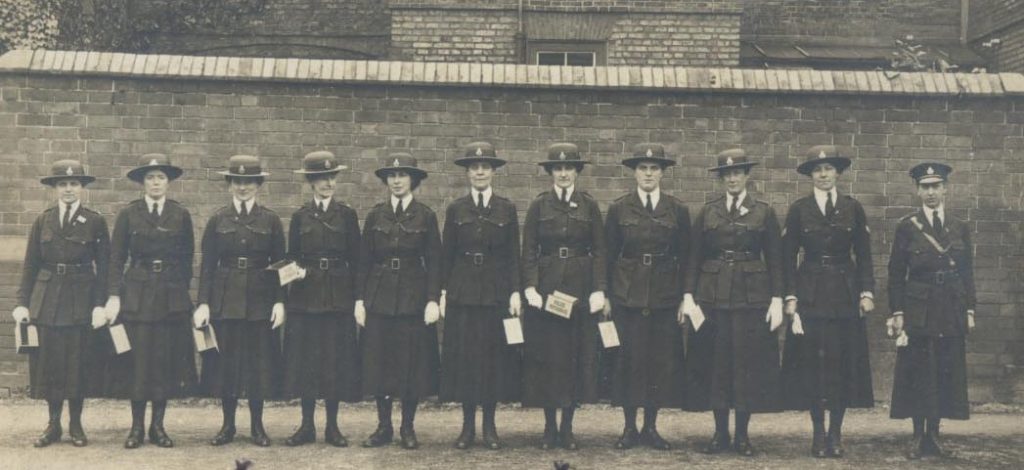
One objection frequently raised against the appointment of matrons is that they have not the physical strength to control the more violent women. But experience has proved that an old offender who has had to be carried or held down by four policemen in paroxysms of rage or drunkenness, will submit without a murmur to the moral force of one matron.
Florence Balgarnie, A Plea for the Appointment of Police Matrons at Police Stations (1894), p. 30
Here the charade slips from the tragic to the openly farcical. If a man in uniform inspires no reverence, a woman in uniform invites disbelief or, at its most garish, the impression of pornographic cosplay: the costume remains, whilst the vocation whose inherited gravity made it intelligible has vanished. She has not passed through the martial path of blood and silence; she does not bear the sacrificial gravitas of the guardian whose authority is purchased by his exposure to violence, disgrace, injury, and death. Her command therefore tends to become performative: shrill, matronly, mechanical, negating and self-negating; a memorised litany delivered in a voice designed to beguile, plead, chastise, instruct, or implant maternal guilt, rather than an order proceeding from embodied sovereignty.
Yet the woman did not first enter the British police station as a constable. She entered it as a wife, visitor, searcher, warder, housekeeper, missionary, and matron. The chronology is decisive. Her original claim was neither martial competence nor an equal capacity to command men; it was that the female prisoner must be enclosed within a special zone of feminine custody, into which the male officer ought not intrude. Long before the woman acquired the warrant-card, she acquired jurisdiction over the female body; long before she claimed the street, she claimed the cell.
Right: Mary A. Jenks, pioneering police matron of Pawtucket, Rhode Island, portrait photograph, late nineteenth century; author of Behind the Bars; or, Ten Years of the Life of a Police Matron (1902)
The institutional ancestry of the police matron lies partly within the earlier Christian reform of the prison. Elizabeth Fry’s visits to Newgate from 1813, and the ladies’ association she subsequently established, made the respectable Christian woman an authorised visitor, moral examiner, instructor, and intercessor within the female ward.141a The British Society of Ladies for Promoting the Reformation of Female Prisoners, formed in 1821, extended this model beyond Newgate. The Gaols Act of 1823 required the separation of male and female prisoners and permitted women warders for the custody of women. The innovation possessed an intelligible protective object: female prisoners were vulnerable to sexual indignity and abuse when searched, undressed, washed, or supervised by men.141b Yet its institutional form was already maternal and missionary. The prisoner was not merely guarded; she was to be visited, reclaimed, instructed, prayed over, and restored through the personal ministrations of respectable Christian womanhood.
The police station inherited this logic imperfectly. Women arrested at night were commonly searched by a police officer’s wife, a station-housekeeper, a local married woman summoned for the occasion, or a woman paid a small fee for each search. She might be designated a ‘matron’ whilst possessing neither continuous duty nor constabulary status. In numerous smaller towns, the wife of the lock-up keeper or station sergeant remained the ordinary female attendant well into the later nineteenth century.142a The Metropolitan Police appointed women as visitors to female convicts on licence in the 1880s and, in March 1889, employed fourteen formal police matrons to search and supervise women and children detained at certain stations. Even here, however, the office remained civil and domestic: the matron was attached to the police institution without yet being admitted to its masculine commission.142b
This was the first inversion. The constable’s wife originally performed an ancillary service because the station belonged to her husband’s world. Her authority was borrowed, domestic, and bounded by the bodily privacy of the female prisoner. Yet the service soon generated its own moral claim. What had begun as the wife’s assistance to the constable was reconceived as an independent female jurisdiction whose incompleteness demanded remedy. The matron was no longer present because the policeman’s authority required a female instrument in exceptional circumstances; the policeman was now represented as ethically deficient wherever the matron was absent.
The humanitarian grievance was not fictitious. The case which chiefly impelled Florence Balgarnie’s agitation arose during the Jubilee year of 1887, when Miss Cass, a young dressmaker, was arrested in Oxford Street by Police Constable Endacott upon an allegation of solicitation. The accusation collapsed; nevertheless, Cass had been confined overnight without a woman attendant. Balgarnie contrasted London with Glasgow, where women called ‘turnkeys’ attended women in the central station, and helped to transform an individual scandal into a national campaign.143a Louisa Twining had already pressed for women attendants; in 1889 the Liberal MP John Pickersgill questioned the Home Secretary, Henry Matthews, about women detained in police stations without female supervision.143b A committee investigating the accommodation of metropolitan police courts declared the absence of women from places of female detention indefensible and recommended a female officer subordinate to the male gaoler or constables.143c
The language of subordination is significant. The female attendant was initially justified as a specialised adjunct beneath the male command. Yet the moral prestige of her special province gradually consumed the hierarchy that had admitted her. Once the treatment of women and children became the supreme test of the police institution’s legitimacy, the custodian of those classes possessed an inexhaustible claim upon its structure. The feminine auxiliary could perpetually accuse the masculine sovereign power of coarseness; she alone embodied care, decency, compassion, and reform. Her limited office thereby acquired a universal moral superiority to the male authority that contained it. No greater crime is there, of course, than the belittling of the masculine under feminine feelings-conservatism.
Balgarnie’s 1894 radical manifesto, A Plea for the Appointment of Police Matrons at Police Stations, illustrates this transition with unusual clarity. She was not an isolated radical, but one that had occupied the position of Superintendent of the Department for the Appointment of Police Matrons within the National British Women’s Temperance Association. Her enquiry asked which towns employed matrons, whether they served by day and night, whether they were sworn, how they were recruited and remunerated, and who searched female prisoners where none existed. The answers disclosed a disordered patchwork. Manchester, Liverpool, Newcastle, Bradford, Leeds, Sheffield, Blackpool, Clitheroe, and Wolverhampton were among the towns reported to have some form of matron; in many cases, however, the title concealed no more than the wife of an officer or a woman called in when required. In the City of London, six stations possessed resident women described as matrons, principally employed as housekeepers and searchers; they were paid by the search and were not necessarily required to remain with prisoners throughout the night.
Balgarnie accumulated cases in which this absence appeared dangerous. At Wolverhampton, a woman believed to be drunk was placed in a cell and died; the post-mortem examination found apoplexy rather than alcohol. Another elderly woman similarly mistaken for intoxicated was left without sustained female observation. Such incidents gave the radical campaign its presumptive entrypoint: the matron was no longer merely the guardian of modesty, but the attentive maternal eye capable of distinguishing illness, terror, pregnancy, injury, or madness from disobedience. A man could restrain; the matron could interpret. The male officer’s very impersonality, once essential to law, became an indictment of his unfitness to administer the new humanitarian jurisdiction.
What A Plea for the Appointment of Police Matrons at Police Stations finally reveals is something considerably more consequential than a humanitarian appeal for female attendants. Read as a whole, it is a strategic manual for organised female political pressure and radical infiltration, one that has succeeded proceeding from an apparently modest custodial reform towards the acquisition of recognised standing, salaried office, administrative authority, and ultimately a place within the police apparatus itself. Balgarnie does not merely ask sympathetic men to consider the plight of female prisoners; she explicitly seeks to ‘rouse women themselves to an invincible determination’, and then tells them how to act: ‘call a conference of women’, summon delegates from ‘all the associations, clubs, or organisations of women’ in the town, enlist an ‘influential woman’, and ‘secure the presence of newspaper reporters’. The proposed resolution is equally unambiguous: ‘We women’ are to ‘take all possible measures to induce our Watch Committee’ to make the desired appointment.
This is political agitation in recognisable form. Should official authority resist, the women are instructed ‘not [to] be in the least daunted’, but to obtain the Municipal Register, divide the town into districts, ‘canvass each woman ratepayer’, gather signatures, and confront the Watch Committee with ‘as large a deputation of women and women ratepayers as can be secured’. If resistance persists, the matter is to be ‘kept to the front’ through resolutions, meetings, and letters to the newspapers. It is difficult to read such directions as anything other than a handbook of pressure politics: organisation, propaganda, deputation, constituency mobilisation, persistence, and the exploitation of every available civic foothold until resistance yields.
Nor does Balgarnie conceal the emancipatory logic by which one concession is made to generate the next. A Home Secretary who had already appointed women factory inspectors, she argues, ought therefore to consider women within policing; indeed, she calls the proposal ‘a reform which logically and of necessity results from what has already been carried into effect’ elsewhere. That sentence exposes the mechanism with unusual candour. An exception becomes a precedent; the precedent becomes a principle; the principle then demands extension. The reform advances not as an isolated act of mercy, but as one stage in an enlarging claim to female public office.
The existing arrangement, that the policeman’s wife summoned occasionally to search a prisoner, is rejected precisely because it leaves the woman without institutional authority: such a ‘so-called police-matron’ has ‘no real standing of any kind’. Balgarnie’s questions reveal what was wanted instead: was the matron ‘upon the regular police staff’? Was she sworn? Did her pay and pension approximate those of policemen? To whom was she responsible? Did she retain the keys of cells? The demand consequently moves beyond female presence into full female office. Salaries, she elsewhere insists, ‘should be the same as those given to policemen for similar work’; and the properly appointed matron should be ‘as responsible for the custody of the female prisoners as the inspector is for the male prisoners’.
The foreign examples held up for British imitation make the trajectory still plainer. Balgarnie attributes the organised American movement to the National Women’s Christian Temperance Union and the cooperation of leading women’s organisations; in Boston she approvingly records a female-controlled station in which the superior matron already possesses ‘two or three policewomen assistants under her’. In Philadelphia, the appointments resulted from a ‘united agitation’ by women’s organisations, after which the matrons reported to a committee of women that materially assisted the police authorities. Thus the very pamphlet advocating the British matron already contains within its exemplars the next institutional type: the policewoman.
Plymouth supplies the domestic case-study in miniature. Balgarnie addresses a drawing-room meeting; women take up the proposal; the President of the Plymouth Women’s Liberal Association joins the campaign; a deputation confronts the Watch Committee; the Committee initially refuses to alter ‘the old plan of men only’; the campaigners wait for the yearly election to alter the composition of the Committee and try again. Platform speeches by Lady Henry Somerset and Miss Hood renew the agitation; public opinion is cultivated until the ‘universal exclamation’ becomes, ‘how is it we have never thought of this before’; another, broader deputation is assembled; and the effort is absorbed into a larger women’s organisation. The proposed settlement finally places the matrons under the Chief Constable ‘as his own force’, with ‘the entire surveillance of female prisoners’ transferred to them from entry to release.
The revealing force of the universal, levelling exclamation ‘how is it we have never thought of this before’ lies precisely in the dissolution of the higher point of view from which the distinct functions and proper spheres of the sexes had formerly been apprehended: once that ordering principle had been abandoned, the mere anomaly of men exercising an exclusive custodial function over women could present itself as a self-evident injustice, and with the transcendental rationale for sexual differentiation dissolved, there remained no principle from which any resistance to the proposed inversion of roles could coherently be offered.
What is revealed here is not merely an absence of reflection, but the characteristic operation of the rationalist and individualist mentality: once the higher order in which differentiated functions and relations had been intelligible has ceased to exercise any effective authority, consciousness is confined to the merely human and temporal sphere, where isolated circumstances are apprehended as autonomous problems and subjected to the judgement of a disjunctive and individual reason. The resulting ‘discovery’ therefore does not represent the recovery of some self-evident truth which had simply been overlooked; rather, it is the consequence of having lost the objective centre from which the traditional order had formerly been perceived. The episode is consequently revealing in a more fundamental sense than its authors intend: it expresses the very anti-traditional, degenerative condition produced by the dissolution of a transcendent reference, namely, that what had once been determined by an order superior to individual opinion can now appear for the first time only as the spontaneous conclusion of personal and common ‘common sense’ lay-intelligence, that the substitution of the true centre for the vain and individualist, illusory centre leaves the inherited differentiation of functions defenceless before every new demand of purely human reason, compounded by the weight of ‘public opinion’, the mass sentiment of revolutionary populisms, and appeals to ‘the people’, or the demos of democracy; a perpetual, cascading march in which boundary is toppled after boundary, establishing for itself a supreme matronly authority not seen since the ancient goddess cults and recalling the ‘progress’ of terminal decline known to diseased pathology.
Public opinion was against women being handed over to the sole charge of men, when it was pointed out the reasons against such a course, and the universal exclamation was: “how is it we have never thought of this before.”
A Plea for the Appointment of Police Matrons at Police Stations, Appendix V, ‘Plymouth’, p. 57, National British Women’s Federation Association
Now their attention was drawn to the anomaly, it was found easy to gather together a second deputation, consisting this time of representative ministers, and leading men citizens, as well as ladies; and Miss Latimer, who had hitherto had the conduct of the effort, willingly accepted the offer that it should become a movement of the N. B. W. F. Association, and get the assistance of their organisation.
The feeling which had been kept alive by meetings, explanatory interviews with members of the Watch Committee, and perseverance, bore fruit.
Seen in that light, A Plea belongs recognisably to the same emancipatory repertoire of organised agitation that would shortly become characteristic of the suffrage movement: federated women’s associations, political clubs, public platforms, cultivation of the press, organised deputations, mobilisation of women ratepayers, exploitation of elections, persistence after official refusal, and the conversion of each institutional concession into the premise for another. Its immediate language is maternal, humanitarian, and reformative; its machinery is political. The ‘matron’ is the point of entry, but the logic presses towards standing, salary, jurisdiction, equality of professional recognition, and incorporation into the force itself. What appears at first as protection of women under arrest thus becomes, in Balgarnie’s own programme, a method by which organised women enter the administration of coercive public authority.
Once female authority became manifest at the institutional level, the consequences were likely to extend far beyond the immediate office occupied. The psychological novelty lay precisely in the public visibility of a woman exercising recognised jurisdiction within structures that had previously embodied male command. A matron, inspector, magistrate, factory official, or policewoman did more than perform a discrete administrative function; she altered the symbolic field in which authority itself was perceived. What had once appeared anomalous could, through repetition, acquire the force of precedent, and precedent in turn could become expectation.
Sociologically, such appointments possessed a multiplier effect. Every new office weakened the intuitive association between public authority and male guardianship, while furnishing the next demand with an accomplished fact to which it could appeal. The argument no longer needed to begin from principle; it could begin from extension. If women might legitimately supervise prisoners, why not direct them; if they might inspect factories, why not enter other administrative departments; if they might exercise custodial authority, why should policing itself remain male? The significance of the reform therefore lay partly in its capacity to normalise the very premise upon which subsequent reforms depended.
At the psychological level, this institutionalisation also altered relations between the sexes. Men encountered female authority less as a private or exceptional circumstance and increasingly as an impersonal command backed by office, uniform, salary, law, and bureaucracy. Women, meanwhile, were provided with visible models of female jurisdiction independent of household or paternal structure. The effect was cumulative: authority ceased gradually to be imagined as something mediated through masculine office and began instead to be conceived as an abstract administrative competence to which either sex might lay equal claim.
From an emancipationist perspective, this was the essential strategic advantage. The most consequential advance was not necessarily the dramatic concession, but the apparently modest one that changed the category itself. Once female authority had been admitted somewhere within the machinery of the state, the question subtly shifted from whether such authority was proper in principle to why it should remain confined to one sphere. The exception became the wedge; the wedge became the precedent; the precedent became the norm.
This is how radical transformation often advances most effectively: not by announcing the totality of its destination, but by securing a sequence of limited reforms whose cumulative effect is to render the old boundary unintelligible. Each individual change may appear humane, practical, or administratively minor; taken together, they reconstitute the social imagination. What had once required argument comes to require no argument at all.
The deeper consequence is therefore one of habituation. Institutional visibility teaches more powerfully than doctrine. A society repeatedly exposed to female authority in official form begins to absorb the premise without consciously debating it; children grow up encountering it as ordinary, men cease to experience it as exceptional, and women increasingly regard exclusion from neighbouring offices as arbitrary. The radical advance is complete when the principle that once demanded agitation has disappeared into custom.
Within the genealogy traced here, this is the decisive sociological function of the early female officeholder. She is not merely the beneficiary of reform; she is also its living demonstration. Her presence alters what can subsequently be imagined, demanded, and justified. In that sense, institutional female authority operates as an instrument of emancipation not only through the powers formally conferred upon the individual woman, but through the transformation of the collective expectations surrounding authority itself.
The police-matron movement possessed a distinctly British tone and institutional sensibility, yet from an early stage belonged to a wider Anglospheric current. In Britain it was expressed through the characteristic machinery of Victorian reform in municipal committees, women ratepayers, temperance associations, deputations, female philanthropy, and appeals to administrative precedent, while American and Canadian examples were continually invoked as proof that further concessions were both practicable and overdue. The result was not a one-way export from Britain, but a mutually reinforcing Anglospheric field in which similar reforms circulated between Britain, the United States, Canada, and later Australia. What was local in idiom was international in tendency.
The Soft Power of Female Emancipation and Institutional Entryism
The distinctive power of the emancipationist movement was rarely confined to overt confrontation. Alongside militancy existed a softer and often more durable form of penetration: the acquisition of moral authority before the acquisition of formal authority. The claim was initially framed in terms difficult to oppose without appearing indecent, callous, or irrational. Women required protection; female prisoners required modesty; children required maternal care; the unfortunate required sympathy. From such premises came the demand for a woman to be present. Once presence was conceded, however, presence became office; office acquired salary, status, responsibility, permanence, and eventually jurisdiction. Balgarnie’s own sequence moves in precisely this direction: the unofficial policeman’s wife is dismissed because she possesses ‘no real standing of any kind’, while the desired matron is imagined upon the regular police staff, remunerated comparably to policemen, exercising custody comparable to that of the male inspector, and, in Plymouth, belonging to the Chief Constable’s ‘own force’.
Balgarnie’s language is revealingly general. Her defence of the matron does not begin with the convicted prisoner, but with ‘the more violent women’ encountered by the police. Where several policemen may be required to impose physical restraint, she claims that the same woman will ‘submit without a murmur to the moral force of one matron’; violence and sexual manipulation alike are said to disappear ‘when a man is replaced by a woman’. The argument therefore exceeds humanitarian attendance upon female detainees. It presents feminine ‘moral force’ itself as an alternative instrument of institutional control and manipulation: softer in appearance than masculine coercion, yet capable of achieving compliance precisely through the authority attached to sex, sympathy, and maternal discipline.
This is the characteristic operation of soft power as institutional entryism. It does not begin by storming the institution or openly declaring that its traditional sexual composition must be abolished. It enters through an apparently exceptional function whose moral justification is made stronger than the principle of exclusion. The exception is then regularised, the regularisation becomes precedent, and precedent generates the next claim. Balgarnie states the mechanism with remarkable frankness when she describes the appointment of matrons as a reform which ‘logically and of necessity results from what has already been carried into effect’ elsewhere. The argument is cumulative by design: once one barrier has fallen, the continued existence of the next can be portrayed as inconsistency rather than principle.
This helps explain why the maternal rhetoric surrounding the matron should not be dismissed as merely decorative. It was itself a source of power. The woman entered the institution under the sign of sympathy, protection, nurture, decency, and ‘moral force’; those qualities made her presence appear less as a rival claim to masculine authority than as a humane supplement to it. Yet the supplement altered the structure. A woman introduced because only she could provide a particular kind of care could then be granted the authority required to perform that care effectively; authority required standing; standing required institutional recognition; and institutional recognition weakened the rationale for excluding women from adjacent functions.
The deeper efficacy of this method lies in the fact that it can transform an institution while appearing merely to perfect it. Overt revolutionary force announces the conflict and therefore summons resistance. Soft emancipationist power advances by recoding resistance itself as cruelty, backwardness, irrationality, or injustice. The opponent is not defeated in open struggle so much as deprived of a morally legitimate language in which to defend the boundary. Once the new office has existed long enough, its original controversial character disappears altogether, and a later generation encounters the altered institution simply as normal.
In that sense, the matron is an unusually revealing figure. She enters ostensibly through the feminine qualities of motherhood and protection, yet her institutionalisation becomes one of the means by which female authority is detached from the household and made public, salaried, bureaucratic, and coercive. The ‘moral force’ that Balgarnie praises therefore possesses a double significance: immediately, it describes the supposedly superior influence of one woman over another; sociologically, it illustrates the broader strength of an emancipationist strategy whose most effective victories were achieved not through direct seizure, but through moral pressure, incremental precedent, and the quiet conversion of exception into norm.
The organised national effort on behalf of the Police Matron movement is undoubtedly due to the National Women’s Christian Temperance Union, under Mrs. J. K. Barney, for so many years the active superintendent of prison and jail work; but local success has, as a rule, been attained by the co-operation of most if not all the leading women’s organisations of any State or city.
Florence Balgarnie, A Plea for the Appointment of Police Matrons at Police Stations (1894), p. 31
Police matrons have long been on duty among other States, in certain cities in Maine, New York State, Pennsylvania, Massachusetts, Rhode Island, Michigan, Missouri, Ohio, New Hampshire, Illinois, Indiana, Colorado, the district of Columbia, and even in California, as well as in Montreal and other cities in Canada. Portland, in Maine, was the first, Chicago, in Illinois, the second city to adopt the system.
In Boston, Massachusetts, a fine new station was opened some three years ago, and by a State Law similar regulations are in force in at least nine other towns of that State. The initiative was here taken by the Women’s Educational and Industrial Union, Women’s Christian Temperance Union, The Moral Educational Association, &c. It is devoted exclusively to the custody of women, and is under the charge of a capable and superior matron, who is paid a good salary, and has two or three policewomen assistants under her. Every woman arrested in any part of the city is at once, after being charged at a local station, conveyed in a covered waggonette to this central station.
The international geography of the police-matron movement is itself significant. It cannot quite be described as a reform originating exclusively in Britain and subsequently exported to the colonies, for comparable female custodial functions were already developing in the United States during the nineteenth century, and formal police matrons appeared there before their regular employment by the Metropolitan Police. What emerges instead is an unmistakably Anglospheric reform network, within which Britain, the United States, Canada, and eventually Australia supplied one another with examples, precedents, arguments, and organisational techniques. Balgarnie’s own pamphlet makes this international circulation explicit. Her argument repeatedly crosses the Atlantic: Edinburgh and Glasgow are compared with Chicago, Boston, Philadelphia, Buffalo, and other American cities; Montreal and other Canadian centres are enumerated; the National Women’s Christian Temperance Union is credited with the organised American movement; and British reformers are urged to imitate arrangements whose success she had personally investigated abroad.
The importance of this internationalisation should not be underestimated. Once the demand ceased to be a local eccentricity and became demonstrably practicable throughout the English-speaking world, resistance could increasingly be represented as mere backwardness. Balgarnie uses precisely this rhetorical mechanism when she declares that ‘We in England are lamentably behindhand in this matter’, contrasting English arrangements with Scotland and the United States. The foreign example thus became an instrument of domestic pressure: reformers could point outward to institutions already transformed elsewhere and then demand that the same transformation be reproduced at home. Within a few decades the same institutional progression appears in Australia, where the matron likewise precedes the recognised policewoman.144
The phenomenon therefore belongs less to the history of one nation than to the history of a common Anglophone reform culture: connected women’s organisations, temperance networks, philanthropic associations, newspapers, municipal campaigns, and transnational observation carrying similar innovations from city to city and country to country. In this respect the geographical pattern is striking. The countries most readily exchanging these experiments were precisely those linked by British political culture, language, reform associations, and imperial or post-colonial institutions. The emancipationist advance consequently acquired an international character very early: an innovation established in one jurisdiction could immediately be cited as the precedent by which resistance in another was made to appear obsolete.
Christian Temperance and Feminine Religious Authority at the Cell Door
The appointment of these matrons was due to a united agitation carried on by the Women’s Christian Temperance Union and the Women’s Club, the Women’s Christian Union, the Society for Organised Charity, the Prison Society of that city, and the matrons are permitted to issue monthly reports to a committee of women, who thus materially aid the police authorities by rendering their work reformatory as well as punitive.
Florence Balgarnie, A Plea for the Appointment of Police Matrons at Police Stations (1894), p. 32
The matron’s ascent cannot be understood apart from the temperance movement. British temperance activism did not confine itself to public houses, licensing, or personal abstinence. It entered police courts, gaols, reformatories, workhouses, refuges, and homes for the ‘fallen’, the drunken, and the supposedly endangered. Its object was not only the suppression of alcohol, but the moral supervision of the disordered poor; it sought to interpose the Christian reformer between offender and punishment, husband and wife, parent and child, prostitute and street, prisoner and gaol.
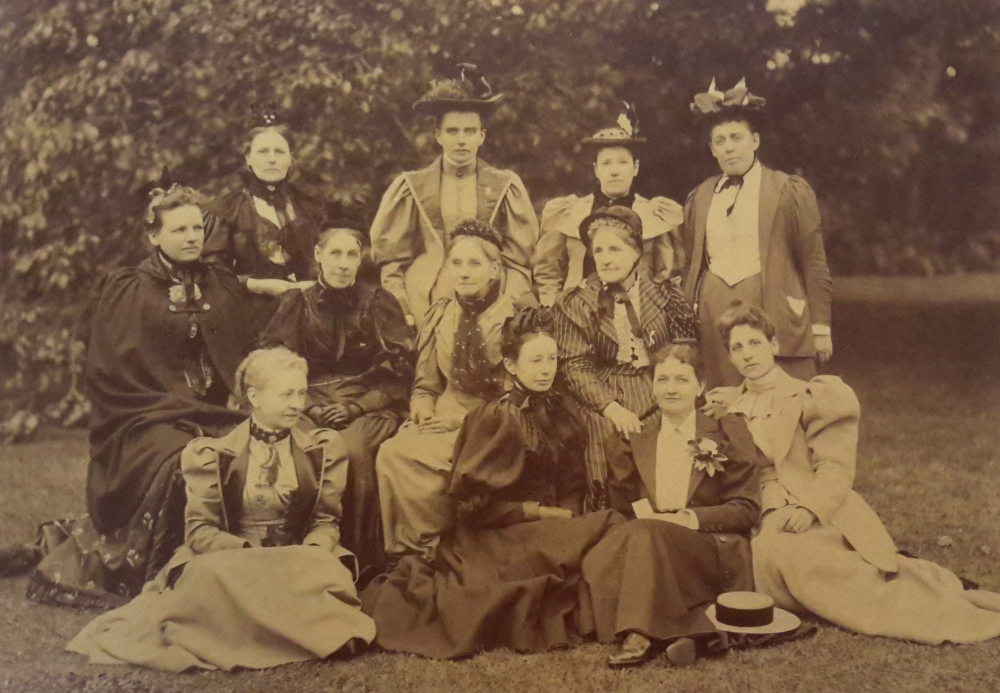
The Church of England Temperance Society founded its Police Court Mission in London in 1876. Its missionaries approached drunken offenders at the point of prosecution and persuaded magistrates to substitute supervision, abstinence pledges, and continued contact for ordinary punishment. These missionaries became an institutional precursor of the probation service: their unofficial arrangements were eventually given statutory form by the Probation of Offenders Act 1907. By 1914, the Society had 153 missionaries or probation officers, twenty of them women, visiting hundreds of police courts; their work extended beyond temperance pledges to reconciling households, recovering pawned tools, finding money for fines, placing children in homes, and managing innumerable private disorders under the authority of the court.145a
The British Women’s Temperance Association, founded at Newcastle in 1876, supplied the explicitly maternal counterpart. Its first president, Margaret Parker, was a Quaker; its public case rested heavily upon the suffering of wives and children beneath male drunkenness. The sober woman was presented as the natural adversary of the public house and, consequently, as a natural supporter of female suffrage: enfranchised women, it was supposed, would vote against drink. Under Lady Henry Somerset, president from 1890, the association reported a membership exceeding 100,000. The 1893 division within the movement made the political affinity still plainer. The National British Women’s Temperance Association openly maintained the alliance between temperance and suffrage, whilst the seceding Women’s Total Abstinence Union retained much of the same Christian-moral and female-reformist character.146a
The temperance woman did not remain outside the prison demanding mercy. She entered the cell, stood beside the accused in court, met the discharged prisoner at the gate, obtained her pledge, delivered her into a rescue home, found her employment, or returned her to relatives under an implicit regime of supervision. The Manchester and Salford Christian Women’s Temperance Association joined the Police Court Mission in petitioning for female matrons and improved treatment of women in custody. The Liverpool Ladies’ Temperance Association maintained missionaries, including one who had performed police-court work for sixteen years by 1890. The National British Women’s Temperance Association described its ideal as ‘Women for Women’: women visiting women and girls before their appearance before magistrates, remaining during examination, persuading them to abstain, arranging work or institutional placement, and receiving them upon release from prison.145b
Its own figures reveal the extent of the undertaking. In 1897, nine paid missionaries and seventy-one voluntary workers were operating in nineteen courts; they dealt with 1,391 cases, secured 631 abstinence pledges, placed women in homes, obtained employment for others, and restored some to friends or families. The following year the number of cases more than doubled. By 1907 at least twenty-four branches were doing Police Court Mission work, dealing with 3,260 cases and making 7,460 home visits. Contemporary reports required the court missionary to possess ‘motherly love and wisdom’; the professed aim was to place a motherly woman in every police court so that girls might be reclaimed before they reached prison.
This was not policing in the ancient sense; it was maternal intervention armed with the magistrate’s shadow. The missionary did not command through an impersonal law. She entered the offender’s biography, affections, habits, family, employment, and conscience. Her ostensible tenderness enlarged rather than diminished the sphere of government: punishment might end at the prison gate, whereas rescue had no natural boundary. The pledge could follow the woman home; the missionary could determine whether she was returned to her family, placed in domestic service, sent to a refuge, or transferred into an institution of prolonged reform.
A particularly revealing example of how these newly emerging female administrative roles fed back into organised reform presents itself here. The BWTA was a large national women’s organisation devoted to temperance and associated social reform, and it did not operate wholly outside the developing machinery of government: evidence gathered by women through official state inquiries could be taken up by the Association and converted into further campaigns for administrative and legislative change. This is precisely what occurred with the Royal Commission on Labour’s 1893 inquiry into the employment of women. Eliza Orme’s contribution to The Employment of Women was an official investigation of barmaids, waitresses, and bookkeepers employed in hotels, restaurants, public-houses, and other places of refreshment throughout the United Kingdom; she gathered evidence from employees, proprietors, managers, police officers, trade organisations, working-girls’ institutions, and temperance enterprises, and personally inspected licensed and unlicensed establishments across the country. The inquiry did not remain inert within a Parliamentary Paper. In her 1894 presidential address to the BWTA, Lady Henry Somerset drew directly upon Orme’s Royal Commission evidence concerning the hours, health, and circumstances of barmaids, using the authority of the state inquiry to press what she termed a ‘mission for barmaids’. Somerset called upon BWTA members both to approach women employed in drinking establishments and to petition Parliament for restrictions upon their employment. Under the departmental organisation she had introduced into the Association, this developed into sustained work among women in bars and refreshment rooms: by 1898 the BWTA was organising visits and meetings, petitioning magistrates, distributing thousands of leaflets, collecting signatures, and repeatedly treating the ‘Barmaid Question’ in its own periodical.147 The sequence is instructive: women reformers entered an official apparatus of investigation; their findings acquired Parliamentary authority; and that authority was then carried back into organised female activism as evidence for further agitation, administrative pressure, and legislation. The Royal Commission thus formed part of a wider circuit between female associational activism and the expanding incorporation of women into the investigative and reforming functions of the state, immediately preceding the campaigns for more permanent female offices of supervision represented by the police-matron movement.
Lady Henry Somerset’s Duxhurst colony embodied this fusion of temperance, maternal reclamation, and quasi-penal discipline. Opened in Surrey in 1896, with the Duchess of Teck presiding at its inauguration, Duxhurst received women with alcohol and drug problems upon a large rural estate. Its residents were expected to remain for extended periods and were separated by social class; labour in laundries, sewing rooms, agriculture, poultry-keeping, bee-keeping, lavender cultivation, and the production of preserves formed part of its curative order. It was licensed under the Inebriates legislation and also received children referred through the National Society for the Prevention of Cruelty to Children. Duxhurst was described as a refuge and treatment colony, yet its therapeutic benevolence depended upon surveillance, classification, labour, prolonged residence, and the displacement of the ordinary household by the reforming female institution.146b
Here, precisely, lies the importance of temperance to the history of women in policing. Temperance organisations did not merely campaign for a female employee to conduct intimate searches. They constructed an entire moral jurisdiction around the female offender. The matron, missionary, prison visitor, rescue-home superintendent, probation worker, and suffrage organiser often belonged to overlapping networks. The same woman could plead feminine delicacy against male handling, claim maternal insight into female degradation, demand public funds for her intervention, and present the resulting office as proof that women possessed a special aptitude for government.
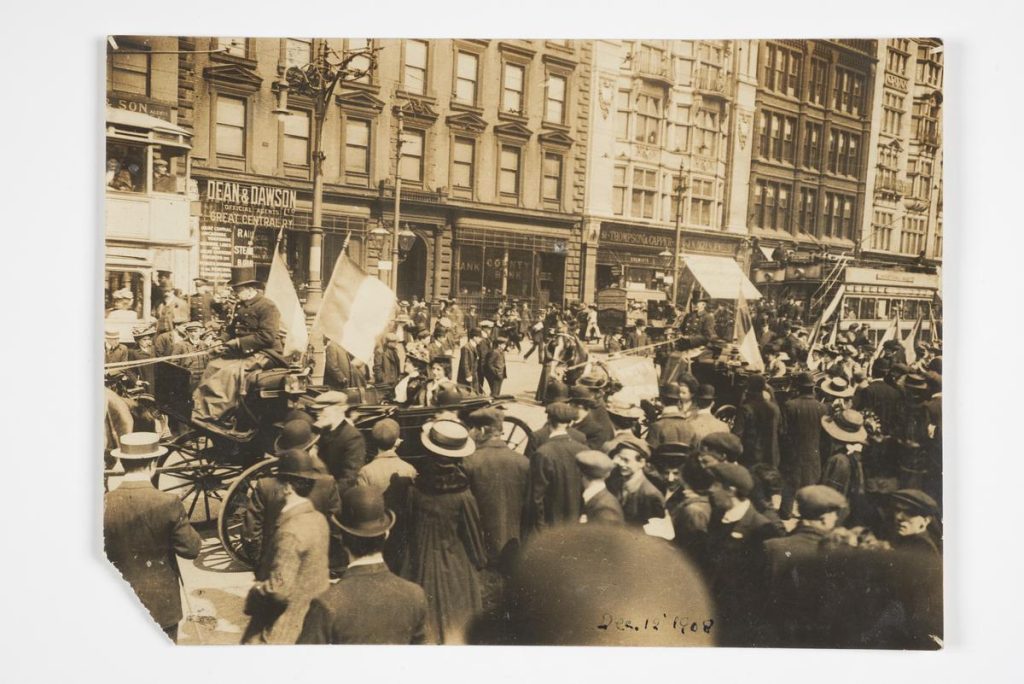
The temperance movement also supplied personnel to the militant suffrage campaign itself.148 Jennie Baines passed through the Salvation Army and Temperance movement before becoming a salaried WSPU organiser and an early advocate of militant methods. Convicted of unlawful assembly at Leeds in 1908, she became the first suffragette tried by jury and received six weeks in Armley Gaol. She was subsequently imprisoned eight further times for militancy, including a nine-month term in Mountjoy Prison after being implicated in the burning of Dublin’s Theatre Royal, and participated in prison hunger strikes. In 1913 she and members of her family were arrested on suspicion of involvement in the bombing of a railway carriage before fleeing Britain for Australia. Anna Munro followed a somewhat different militant course: after founding the Dunfermline WSPU branch she joined the Women’s Freedom League, received a six-week sentence in Holloway in 1908 following a demonstration outside the home of Richard Haldane, and in May 1913 was again sent to Holloway for fourteen days, in default of payment, after attempting to address a prohibited suffrage meeting at Hyde Park. Munro subsequently remained active in the Temperance movement as well as becoming a magistrate.
Balgarnie herself insisted that a proper matron must not be paid at the rate of a charwoman. She sought regular day-and-night attendance wherever women or children were detained; she instructed local temperance branches and allied women’s organisations to petition Watch Committees, organise deputations, and submit memorials. She regarded the police matron as the logical extension of female prison warders, female inspectors, and women attached to the courts. In Plymouth, agitation following one of her addresses led a deputation of women representing different religious and political bodies before the Watch Committee. The campaign’s method was already that of the managerial pressure group: discover a moral deficiency, universalise the exceptional case, organise respectable female opinion, and convert voluntary piety into salaried bureaucracy.
Nor was the Atlantic influence absent. Balgarnie had visited the United States and studied the American temperance movement. Her pamphlet pointed approvingly to Chicago, where the Woman’s Christian Temperance Union, the Prisoners’ Aid Association, and the Moral Educational Society had pressed for police matrons. The first was appointed in 1882; further city-funded appointments followed, and by 1891 Chicago reportedly had twenty-one. One matron was praised as a kind-hearted Christian ‘good angel’ of the station. The example is useful precisely because it reveals the spiritual type beneath the administrative title: the police matron was conceived not as a female version of the warrior-guardian, but as the Christian angel of reclamation installed within the machinery of arrest.149
From Custodial Exception to Uniformed Authority
The formal ascent from matron to policewoman occurred during the First World War, but it did not abolish the maternal office; it uniformed and expanded it. The Women Police Volunteers were formed in 1914 under Margaret Damer Dawson and Nina Boyle, later becoming the Women’s Police Service. The National Union of Women Workers organised a rival body of voluntary women patrols. Their members appeared at railway stations, military camps, factories, streets, parks, and places of entertainment; they watched women and girls, assisted refugees, intervened in suspected prostitution, and patrolled districts said to present moral danger. The Ministry of Munitions employed women police in factories, where their duties included searching women workers, maintaining order in canteens, and preventing theft.150a
The movement contained a revealing dispute from its beginning. Boyle resisted the transformation of women’s patrols into a machinery for regulating female sexuality; Damer Dawson accepted closer co-operation with official authorities and the moral surveillance of women. The dispute did not concern whether women should enter public authority, but what kind of female authority should predominate: a claimed civic equality, or the old maternal-reformatory jurisdiction in uniform. The latter proved institutionally more serviceable.
Edith Smith, appointed in Grantham in December 1915, is generally recognised as the first British woman sworn as a constable with official powers of arrest. The Home Office had objected that a woman was not a ‘proper person’ for attestation, but the local authority proceeded under wartime necessity. Smith’s work chiefly concerned women and girls around the military camps. She cautioned those classified as wayward, pursued suspected prostitutes, investigated sexual conduct, and even observed wives at the request of absent husbands. Her admirers described her as both fearless and motherly. The combination is the true emblem of the new office: the matron had acquired the constable’s power without surrendering the maternal claim through which she had entered.150b
The Metropolitan Police introduced its first women patrols in 1919. They were initially unwarranted and lacked the ordinary power of arrest; full powers followed only in 1923.151a The Baird Committee, appointed in 1920 to examine the employment of women on police duties, found women serving in dozens of forces and recommended their retention for specialised work. Yet that work remained largely confined to women and children: patrolling places frequented by girls, tracing missing or destitute women, taking statements in sexual cases, escorting female prisoners, and performing searches. In 1922, governmental economy proposals questioned their utility and threatened severe reductions.151b Even in 1931, only a minority of county and borough forces employed women. The policewoman’s early position was therefore neither an immediate triumph of sameness nor a straightforward admission into the full male vocation; she advanced by presenting herself as indispensable wherever the state dealt with women, children, sex, domesticity, welfare, and morals.151c
This distinction matters. The policewoman did not conquer the force by first demonstrating superiority in its central martial functions. She enlarged an ancillary maternal jurisdiction until the jurisdiction itself became central to the redefinition of policing. The state increasingly ceased to regard the constable merely as the guardian of peace and the servant of law; he became an agent of welfare, prevention, rehabilitation, domestic supervision, child protection, sexual regulation, and therapeutic management. In such a police system, the matron is no longer peripheral. The institution has been remade in her image.
Even before the formal admission of women as officers, therefore, the matron’s authority had already infiltrated the police force she would soon entirely consume. Christian Victorian propriety discouraged male officers from searching or physically handling women except where necessity demanded it. The practical safeguard against indignity was sound; yet the limitation was swiftly transmuted into a moral title. What began as protection of the woman from the policeman became protection of the woman by the matron; what began as a narrow physical service became a claim to interpret, reform, and govern her.
Thus did the woman become more than a stopgap. Her presence calmed the frightened prisoner, attended the sick, washed the disordered, listened to confessions, and mediated between the accused and the court. In this capacity she could appear as a numinous Venus Victrix, before whom male disorder itself was expected to subside. The culture that had already abandoned the essential sources of masculine authority found itself unable to resist this spectacle. Wives of constables, trusted matrons, temperance missionaries, and prison visitors assumed the exceptional role; their delegated service became a moral jurisdiction; that jurisdiction clothed itself in uniform; and the uniformed matron eventually asserted herself as the authority of the force itself.
The Managerial Matron of the Masonic French Revolution Overthrows the Aristocratic Lord
The matron, in the literal sense, evokes the figure who once presided over Britain’s boarding schools, hospitals, orphanages, workhouses, prisons, and reformatories: a watchful and moralising custodian of propriety within spaces intended to forge character through discipline. Her authority was domestic rather than sovereign, minutely personal rather than impersonal, and perpetually concerned with cleanliness, speech, appetite, sexuality, obedience, and emotional confession. It was an authority of nearness: the eye at the dormitory door, the voice in the corridor, the keeper of the ledger, the inspector of sheets, bodies, manners, and private sins.
Puritan Christianity replaced the spirit of vertical authority with moral busybodying wherever spirit and virility had been lost. The matron’s watchful presence accordingly survives throughout the modern state: in schools, hospitals, classrooms, social services, human-resources departments, therapeutic offices, and the innumerable bureaucratic chambers in which moral nagging may be wielded as a substitute for numinous solar authority and Being. The language has altered; the archetype has not.
The modern human-resources crone is the police matron’s corporate descendant: surrogate mother over eternal boys, chiding, monitoring, documenting, reconciling, and neutralising the spirit of command within a supposed fraternity of equals. Her authority rarely declares itself sovereign. It instead invokes care, inclusion, safety, vulnerability, policy, procedure, and the emotional welfare of the collective. Yet these gentle abstractions conceal an extraordinary penetration into speech, association, desire, humour, loyalty, and personal judgement. The father prohibits and departs; the manager-mother watches continuously.
The genesis of British police matrons, so often lauded as a simple victory of maternal concern, therefore bears the unmistakable mark of Abrahamic, Puritan-bred zeal. The temperance movement and the women’s suffrage movement did not merely coincide chronologically; their personnel, organisations, rescue missions, rhetoric, and political expectations repeatedly intersected. The drunken husband, imperilled wife, fallen girl, neglected child, female prisoner, and unprotected woman became the sacred dramatis personae through whom feminine political authority was justified.
What began as a maternalistic refusal by male officers to subject female prisoners to intimate handling was converted by organised moral custodians into a wedge driven through the gates of masculine command. The female prisoner was the indispensable first claimant. Behind her came the searcher; behind the searcher, the matron; behind the matron, the missionary; behind the missionary, the patrol; behind the patrol, the sworn officer; and behind the officer, the managerial state whose jurisdiction extends wherever vulnerability may be alleged.
It is therefore no wonder that militaristic orders issued before policing were forbidden to women. The order belongs to a hierarchical world: it descends, obliges, and exposes the commander to the consequences of command. The maternal injunction operates otherwise. It solicits confession, induces guilt, invokes the sufferer, and presents resistance as cruelty. The police matron entered as no servant of justice in the heroic sense, but as sentinel of the managerial state’s maternal prerogative; a force imbued with temperance morals, prison visitation, rescue work, the Christian examination of conscience, and the reformatory household.
Let none imagine this to be a novel phenomenon. It is the continuation of the same ancient subversion that seeks to enthrone the feminine mandate under the guise of pity and reform over the virile principle it was never meant to govern. The Christian mother, the temperance missionary, the prison visitor, the police matron, the probation worker, the welfare officer, and the human-resources manager form no mechanically identical succession; nevertheless, they disclose a continuous institutional grammar. Each converts moral intimacy into public authority; each enters through the protected person; each claims a special insight denied to impersonal law; each expands care into supervision and supervision into command.
The managerial apparatus, when finally unmasked, reveals the fact: the mother as overseer, not the father of heroic renown. We have elsewhere elaborated upon the derivation of the suffragette and feminist impulse from the Abrahamic matrix; the British history of the police matron renders that derivation institutionally visible. The archival sequence does not, by itself, prove the metaphysical genealogy; it exhibits the mechanism through which that genealogy incarnated itself in offices, salaries, committees, uniforms, reformatories, missions, and statutory powers.
The French Revolution did not merely overthrow a king; it extinguished two distinct aristocratic forms of public authority. The noblesse d’épée, the nobility of the sword, embodied the older conception of rule as personal, hereditary, martial, and seigneurial, whilst the noblesse de robe exercised another species of aristocratic authority through magistracies, parlements, and offices which might themselves confer nobility. The decrees of August 1789 attacked feudal privilege and the venality of office together; in June 1790 nobility and its titles were abolished outright, while the old parlements and judicial order upon which much of the noblesse de robe depended disappeared with them.152 What was being destroyed was consequently more than a privileged class: it was a conception in which jurisdiction adhered to rank, estate, patrimony, or a particular corporate body.
Into the space left by these disappearing authorities advanced the increasingly bureaucratic apparatus of the police. Its antecedents were older than the Revolution, Louis XIV had already created the Parisian lieutenant-generalship of police in 1667 as an instrument of central royal administration, but the Revolution altered the principle upon which such power was legitimised.153 The royal maréchaussée was reorganised in 1791 as the Gendarmerie nationale; municipal policing was placed under the new civic authorities, and revolutionary officers of the peace carried staffs conspicuously inscribed ‘Force à la Loi’: force in the service of Law.154 The phrase encapsulated the transformation. Authority was no longer to present itself as the peculiar right of a lord, an estate, a hereditary magistracy, or a corporation possessing ancient privileges; coercion was represented instead as the uniform execution of an abstract law over a population conceived politically as citizens.
In this precise sense the revolutionary conception of policing was inherently egalitarian. This did not mean that policemen possessed equal power with those whom they policed, for the institution was necessarily hierarchical internally; rather, its legitimating principle presumed the abolition of juridically distinct orders among the governed. The same law was notionally to stand above noble and commoner alike, while a specialised body of salaried or appointed officials administered its commands. The Revolution’s destruction of feudal ‘distinctions’, ‘superiority’, and inherited privilege therefore accompanied the rise of an authority which was at once more impersonal and potentially more penetrating.155 The noble’s command had been visible as the command of a superior person; the policeman’s command presented itself as something more formidable precisely because it claimed not to be personal at all. He acted in the name of society, citizenship, public order, and the law.
Here the Enlightenment transformation becomes particularly significant. The older hierarchy had located different men within different inherited orders and distributed rights, duties, honours, and jurisdictions accordingly. Revolutionary government instead sought rational, general, administratively reproducible categories: the citizen, the municipality, the department, the offence, the regulation, and the public force. The police could thus survive the destruction of aristocratic authority because it belonged naturally to this new grammar of government. Indeed, the Revolution briefly decentralised portions of the police before subsequently reconstructing and centralising them; the maréchaussée became the national gendarmerie, and under the Revolution and Napoleon policing developed into an increasingly unified administrative instrument.156 The sword and the robe had represented men and orders; the modern police represented the rule. In that passage from aristocratic jurisdiction to abstract administration lay one of the quieter but most consequential revolutions of 1789, and its feminine pathos was to follow.
The Freudian and typically Judaic pathos of the mother-complex, wherein the maternal figure appears simultaneously as source of protection and agent of child-like castration, finds its political analogue in the matron-police state. The fatherly sovereign, distant because his law is known, is replaced by invasive humanitarian care. Subjects cease to stand vertically beneath authority and are reconstructed as communal brothers gathered before the maternal figure, each equally vulnerable, equally monitored, equally entitled to complain, and equally incapable of command.
Familial tenderness is then enshrined as bureaucratic rationalism: a new Levitical priesthood of policies, contracts, pledges, assessments, referrals, case-files, and social supervision. It masks ancient hysteria and pathos beneath the cold grammar of reason; it promises safety whilst dissolving sovereignty, compassion whilst annihilating distance, and therapeutic maternal governance where once stood the guardian whose command required neither seduction nor complaint.
There was, moreover, a paradox concealed within this transference of authority from aristocratic order to bureaucratic police. The new conception of public force claimed precisely to have abolished the personal and particular loyalties of the ancien régime: the officer acted neither for his lord nor for his estate, but impersonally, under a law supposedly common to all. Yet within the resulting police and judicial bureaucracy there developed another species of corporate fraternity—elective rather than hereditary, concealed rather than heraldic—in the form of Freemasonry. The uniformity of the public institution could therefore coexist with a private architecture of initiation, recognition, hierarchy, and mutual obligation running laterally through police stations, courts, local government, and the professions.
This was the problem investigated at length by Stephen Knight in The Brotherhood: The Secret World of the Freemasons (1984). Knight devoted an entire section to Masonry within the police, recording the contemporary concern of Sergeant Peter Welling that the danger lay in a ‘formidable chain of contact’ extending through public institutions. A senior West Midlands police officer who was himself a Mason described the connexion between Masonry, police, and judiciary to Knight as an ‘unseen intimacy between the groups’; elsewhere Knight recorded demands that serving policemen should be prohibited from assuming secret obligations capable of competing with their public duty.157 Whatever one makes of Knight’s larger thesis, the institutional problem he identified was perfectly intelligible: an organisation founded upon brotherhood and mutual recognition might create an invisible relationship between men who officially encountered one another only as constable, prosecutor, solicitor, magistrate, or judge.
The matter did not remain confined to exposés of secret societies. In 1997 the House of Commons Home Affairs Committee recommended that police officers, magistrates, judges, and Crown prosecutors should be required to register membership of secret societies and that the record should be publicly available. The Government subsequently accepted compulsory declaration of Freemasonry for new appointments across the judiciary, police, Crown Prosecution Service, probation, and prison services; the Committee’s 1999 follow-up complained of the slow establishment of registers and again supported full public access.158 Particularly revealing was its observation that Masonic obligations included undertakings of mutual support which, as the Committee understood them, remained binding even after active membership had ceased.159 Here the difficulty was no longer speculative: Parliament itself had identified a potential collision between the universal obligations of public office and the particular obligations of fraternity.
The same question returned with extraordinary persistence. The Daniel Morgan Independent Panel recommended in 2021 that every police officer and member of staff should confidentially register membership of any organisation, ‘including the Freemasons’, capable of calling impartiality into question or creating the perception of divided loyalties.160 Four years later the Metropolitan Police finally incorporated precisely such bodies into its declarable-associations policy. Its definition is significant in itself: an organisation possessing ‘confidential membership, hierarchical structures’ and requiring its members ‘to support and protect each other’ must be declared, with Masonic bodies expressly named as the paradigm.161 The Met explained that the concern was that such relationships might ‘call impartiality into question or give rise to conflict of loyalties’, and reported continuing intelligence and complaints concerning their possible effect upon investigations, promotion, and misconduct proceedings.162
The Freemasonic organisations resisted. The United Grand Lodge of England, together with the Order of Women Freemasons, the Honourable Fraternity of Ancient Freemasons, and two serving officers, went to the High Court seeking to overturn the requirement and secure interim relief. The attempt failed. On 17 February 2026 Mr Justice Chamberlain refused permission for judicial review and refused the requested interim relief; UGLE subsequently announced that it would not appeal and acknowledged that the declaration requirement had consequently been adjudged lawful.163 The Met’s policy survived, and its scope is remarkable: present and former membership must be declared; the information may be used where relevant to manage conflicts of interest or in criminal and misconduct investigations.164

The connexion was hardly confined to abstract allegations of influence. Police-Masonic identity has acquired its own occupational symbolism and organisations, from American police patches deliberately incorporating the square and compasses to British lodges constituted specifically around policing and the administration of justice. The historical continuity is difficult to overlook. In 1984 Knight described an invisible fraternity crossing the boundaries between policeman and judge; in 1997 Parliament demanded disclosure; in 2021 an independent inquiry again identified Freemasonry as a potential conflict of loyalties; and in 2025–26 the Metropolitan Police imposed the declaration which earlier governments had struggled to establish, successfully defending it against the Masonic bodies themselves. Nor are occupational Masonic networks imaginary abstractions. The United Grand Lodge presently lists Blue Lamp Lodge No. 9840, established expressly so that police colleagues might meet ‘under a Masonic context’, whilst Aequitas Lodge No. 9832, devoted to men involved in the ‘administration of justice’, was founded by a membership embracing police officers, solicitors, barristers, prosecutors, and magistrates.165
Thus the disappearance of the noblesse d’épée and noblesse de robe did not mean the disappearance of corporate bonds from the administration of force and justice. It changed their form. The hereditary order had proclaimed itself openly through name, title, sword, robe, office, and escutcheon; the modern bureaucracy proclaimed instead the equality of citizen before impersonal law. Yet within that impersonal machinery private brotherhood could reproduce particular loyalties of its own—invisible to the citizen standing before the uniform, the bench, or the bar. The old hierarchy stood above society and declared itself; the new fraternity could pass through the institutions of equality from within.
Scholia
- [a] Fry’s explicitly Quaker and evangelical model joined bodily protection to visitation, religious instruction, work, and moral reclamation; the later police-matron campaign repeatedly invoked Fry and John Howard as its institutional forebears. Florence Balgarnie, A Plea for the Appointment of Police Matrons at Police Stations (National British Women’s Temperance Association, 1894). [b] Elizabeth Fry’s work at Newgate developed into the British Society of Ladies for Promoting the Reformation of Female Prisoners in 1821; the Gaols Act 1823 required greater separation within prisons and provided for female warders in the custody of women. UK Parliament, ‘Elizabeth Fry’; London Museum, ‘Elizabeth Fry and Newgate Prison’.
- [a] The Metropolitan Police employed female visitors to women convicts on licence from 1883 and established fourteen formal police-matron appointments in March 1889; the work of searching and attending women had previously fallen largely to policemen’s wives. British Association for Women in Policing, ‘Timeline of Women in Policing’. [b] Police matrons remained civilian employees whose duties included searching, supervising, and escorting women; elsewhere, officers’ wives continued to perform the work, sometimes for a small payment. Greater Manchester Police Museum, ‘Women in Policing’.
- [a] Balgarnie traced her campaign to the 1887 arrest of Miss Cass, the Glasgow system of women ‘turnkeys’, Louisa Twining’s agitation, John Pickersgill’s parliamentary question of 1889, and the official investigation of police-court accommodation. Balgarnie, Plea for the Appointment of Police Matrons, pp. 3–8. [b] Her survey distinguished genuine continuous supervision from nominal ‘matrons’ who were merely resident housekeepers, officers’ wives, or women summoned and paid for individual searches; it also recorded the Wolverhampton death of a woman mistakenly treated as drunk. Ibid., pp. 10–20. [c] Balgarnie advocated permanent day-and-night matrons, proper salaries, local deputations to Watch Committees, and the extension to police cells of safeguards already accepted in women’s prisons.
- Florence Balgarnie, A Plea for the Appointment of Police Matrons at Police Stations (1894), esp. pp. 20, 30–32, 47, where Balgarnie compares British arrangements with those of the United States and Canada and expressly credits the National Women’s Christian Temperance Union and cooperating women’s organisations with the organised movement; B. D. Mishkin, ‘Female Police in the United States’, Police Journal, vol. 54, no. 1 (1981), pp. 22–33, noting the employment of police matrons in New York City in 1854; Clive Emsley/related Metropolitan Police historical literature as summarised in the College of Policing thesis Women in the Police Forces in Britain: 1880–1931, recording Metropolitan Police matrons from 1883; ABC Radio National, ‘125th anniversary of the Police Matron’, 8 August 2023, recording the first official Australian recognition of a police matron in 1898 and earlier unofficial female custodial work.
- [a] The Church of England Temperance Society established its Police Court Mission in 1876; its missionaries supervised offenders under informal arrangements that anticipated statutory probation, later regularised by the Probation of Offenders Act 1907. Howard League for Penal Reform, ‘History of Probation’; House of Lords debate, 20 July 1914. [b] The women’s temperance movement’s ‘Women for Women’ work included visiting cells, attending examinations, securing abstinence pledges, arranging refuge or employment, restoring women to friends, and meeting prisoners on release; reports described the requisite quality as ‘motherly love and wisdom’. White Ribbon Association, ‘Police Court Mission’.
- [a] The British Women’s Temperance Association was founded at Newcastle in 1876; its argument linked female suffering under male intemperance to the case for women’s suffrage. Lady Henry Somerset led the association from 1890, and the 1893 division produced the National British Women’s Temperance Association, which maintained an explicit temperance-suffrage alliance. White Ribbon Association, ‘Our History’. [b] Duxhurst was opened in 1896 as a rural treatment and labour colony for women affected by alcohol and drugs; it operated under the inebriates legislation and employed a class-divided regime of prolonged residence and productive work. White Ribbon Association, ‘Duxhurst’; Surrey History Centre, ‘Lady Henry Somerset and the Duxhurst Inebriate Colony’.
- Royal Commission on Labour, The Employment of Women: Reports by Miss Eliza Orme, Miss Clara E. Collet, Miss May E. Abraham, and Miss Margaret H. Irwin (Lady Assistant Commissioners), C. 6894-XXIII (London: HMSO, 1893), especially Eliza Orme, ‘On the Conditions of Work of Barmaids, Waitresses, and Book-keepers Employed in Hotels, Restaurants, Public-houses, and Other Places of Refreshment’, pp. 197–211; White Ribbon Association, ‘The Barmaid Question’, drawing upon the BWTA Annual Reports for 1894 and 1898 and describing Somerset’s use of Orme’s evidence, the ensuing ‘mission for barmaids’, parliamentary petitioning, public meetings, deputations, leaflet distribution, and the Association’s continuing ‘Barmaid Question’ campaign.
- London Museum, ‘The Release of the Suffragette Prisoner Jennie Baines, 12th December 1908’, recording Baines’s temperance background, six-week Armley sentence, subsequent imprisonments, hunger strikes, and nine-month Mountjoy term; London Museum, ‘Miss Anna Munro’, NN22423; OnFife, ‘Anna Munro, a campaigner for women’s suffrage’, recording Munro’s 1908 sentence and her fourteen-day Holloway imprisonment in May 1913.
- Balgarnie’s American comparison described the Chicago campaign of the Woman’s Christian Temperance Union, Prisoners’ Aid Association, and Moral Educational Society; the first police matron was appointed in 1882, further salaried appointments followed, and the number had reportedly reached twenty-one by 1891. One matron was praised as a Christian ‘good angel’ of the station. Balgarnie, Plea for the Appointment of Police Matrons, American appendix.
- [a] The Women Police Service and the National Union of Women Workers’ patrols emerged in 1914 and performed duties at stations, factories, military districts, railway termini, and places of entertainment. UK Parliament, ‘Women Police Service’; Greater Manchester Police Museum, ‘Women in Policing’. [b] Edith Smith was sworn at Grantham in December 1915 and exercised powers of arrest; her work centred upon the regulation of women and girls around the military camps, including suspected prostitution and sexual conduct. Dr Louise Jackson, ‘Edith Smith: The First Woman Police Constable’, History of Government.
- [a] The Metropolitan Police introduced women patrols in 1919; they initially lacked ordinary arrest powers, which were granted in 1923. Metropolitan Police, historical timeline. [b] The Baird Committee examined women’s police employment in 1920 and recommended their retention for specialised work; the Geddes economy proposals of 1922 questioned their value and advocated reductions. British Association for Women in Policing; House of Lords debate, 8 March 1922; [c] Women remained sparsely distributed through British forces during the 1920s and early 1930s, and their prescribed duties continued to centre upon women, children, prisoners, missing persons, and sexual cases.
- The National Assembly abolished feudal privilege and the principle of venal public office in the decrees beginning 4 August 1789; the decree of 19 June 1790 abolished hereditary nobility and its titles. The parlements, whose magistracies formed one of the principal institutional bases of the noblesse de robe, were abolished during the judicial reconstruction of 1790.
- France had already pioneered centralised urban policing under the monarchy: Louis XIV’s edict of 15 March 1667 created the lieutenant-general of police for Paris, although the upper police offices themselves remained embedded in the Old Regime system of venality.
- The revolutionary reorganisation of 1791 transformed the maréchaussée into the Gendarmerie nationale. Contemporary revolutionary policing also employed uniformed officiers de paix, whose staffs bore the legend ‘Force à la Loi’.
- The decree implementing the destruction of the feudal order expressly abolished the ‘distinctions honorifiques, supériorité et puissance’ arising from it and removed legal inequalities attached to noble status and property.
- Revolutionary and Napoleonic government substantially reorganised the inherited police apparatus: the rural maréchaussée was enlarged as the Gendarmerie nationale, while Parisian policing, after a period of revolutionary municipal decentralisation, was again unified under central state authority.
- Stephen Knight, The Brotherhood: The Secret World of the Freemasons (1984), especially the chapters upon the police and judiciary. Knight records Welling’s ‘formidable chain of contact’ and the testimony of a Masonic senior police source concerning the ‘unseen intimacy’ connecting police and judiciary.
- House of Commons Home Affairs Committee, Freemasonry in Public Life, Second Report, Session 1998–99: the predecessor Committee’s 1997 recommendation required registration by police, judges, magistrates, and prosecutors; the Government subsequently accepted declaration requirements for new appointments and extended them to the probation and prison services.
- Ibid.; the Committee recorded its understanding that Masonic obligations included undertakings of mutual support and continued to bind a Mason after he ceased active membership.
- Daniel Morgan Independent Panel, recommendation 14: police officers and staff were to register membership of organisations, expressly ‘including the Freemasons’, which might call impartiality into question or create a perceived conflict of loyalties.
- Metropolitan Police, Declarable Associations Policy: past or present membership of an organisation possessing confidential membership, hierarchical structures, and an obligation of mutual support and protection is declarable; Masonic bodies and orders are specifically identified.
- Metropolitan Police, ‘Hierarchical organisations added to declarable association policy’, 11 December 2025. The Met cited concerns regarding divided loyalty, impartiality, investigations, promotion, misconduct, secrecy, and nepotism.
- R (United Grand Lodge of England and others) v Commissioner of Police of the Metropolis [2026] EWHC 330 (Admin), Chamberlain J, 17 February 2026; permission to seek judicial review and interim relief were refused. UGLE announced on 24 February that it would not appeal.
- UGLE’s account of the undertakings given in the proceedings records that declaration data is retained by the professional-standards structure and may be used to manage conflicts of interest or for criminal and misconduct investigations.
- United Grand Lodge of England, ‘Special Interest Lodges’: Blue Lamp Lodge No. 9840 was formed for police colleagues; Aequitas Lodge No. 9832 was founded for those involved in the administration of justice, including police officers, solicitors, barristers, prosecutors, and lay magistrates.
The Anti-Suffrage Resistance: Sovereignty, Sex, and the Defence of the Imperial Household
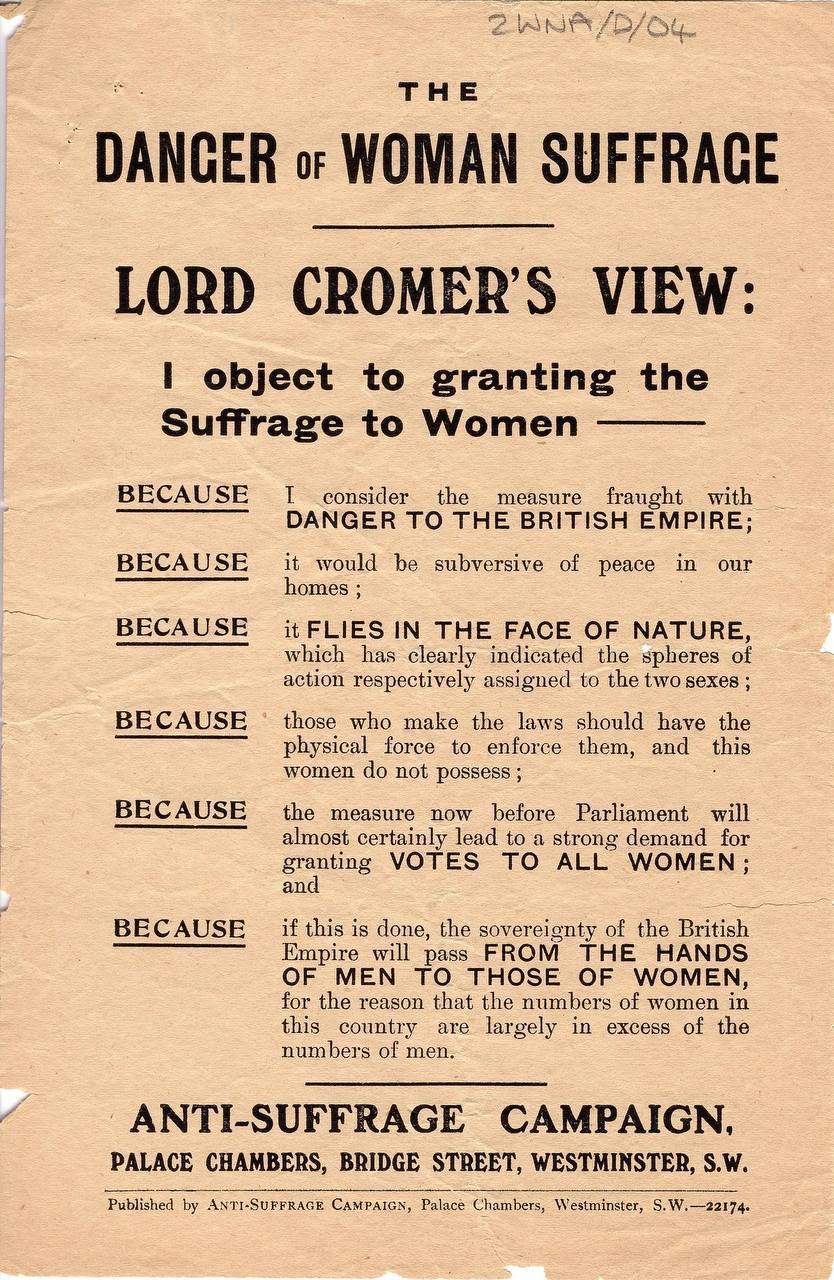
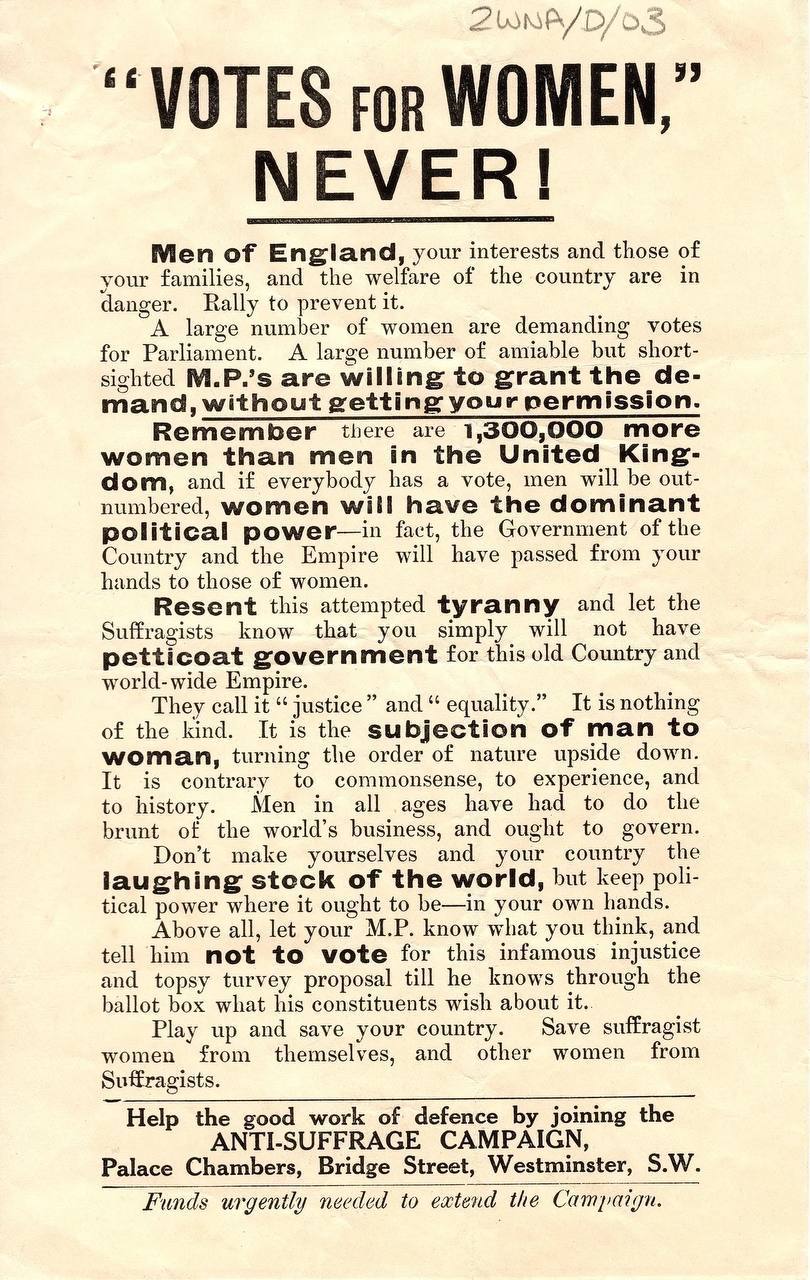
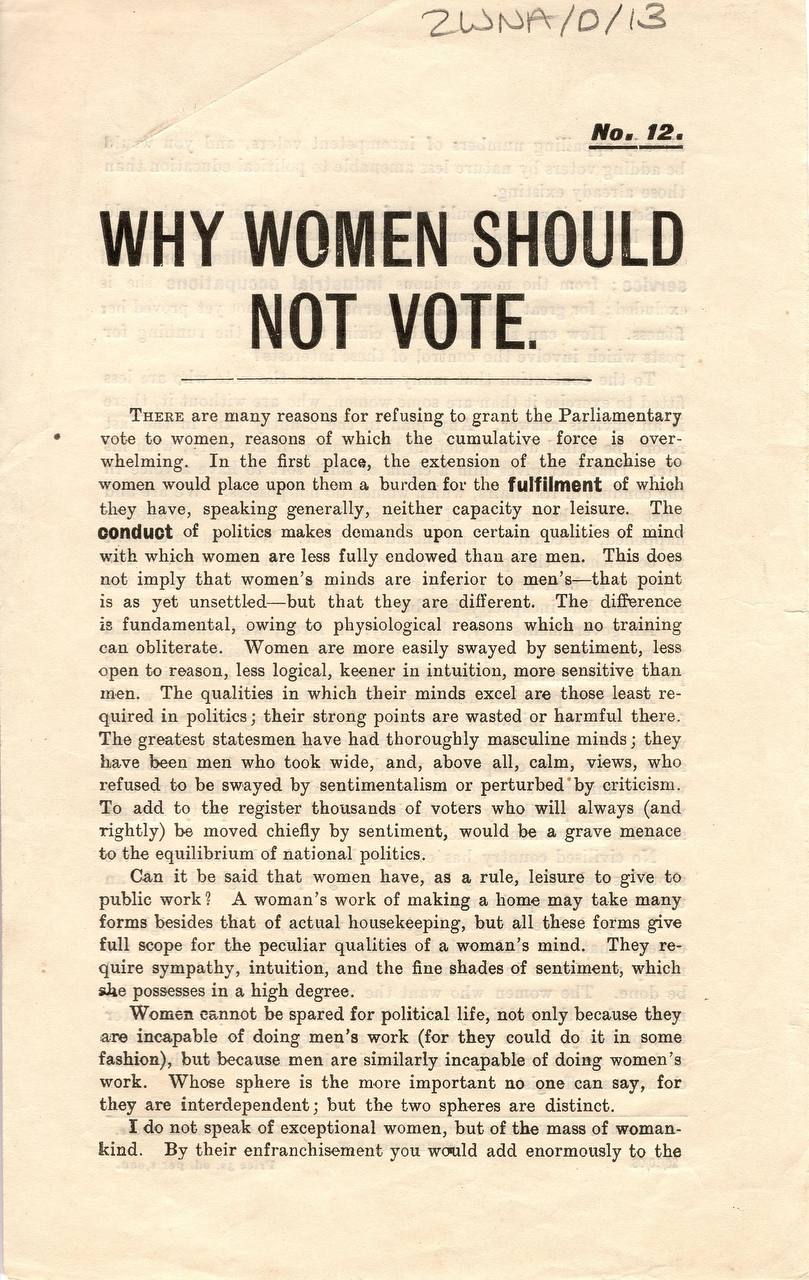
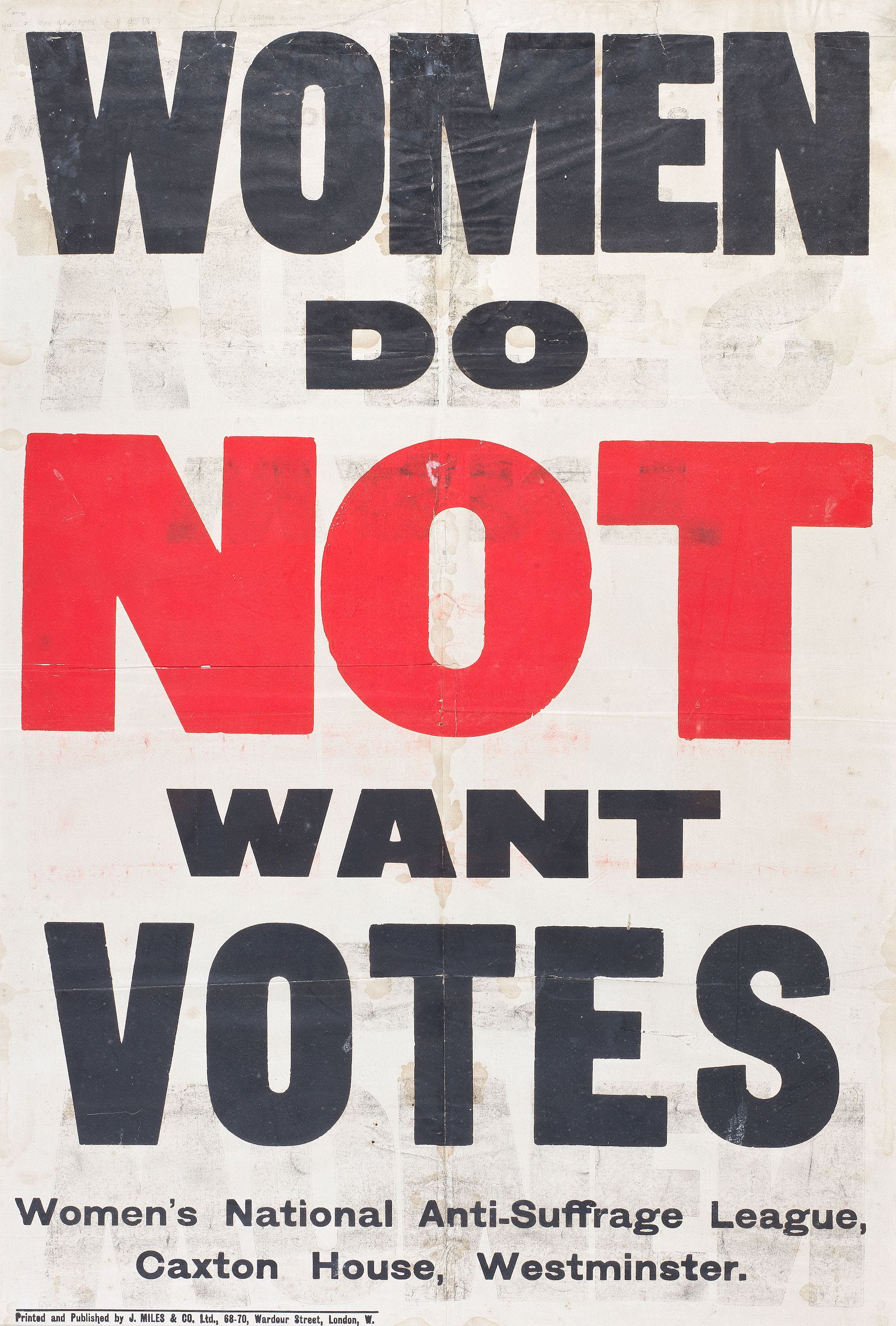
Modern accounts habitually reduce the anti-suffrage resistance to anxious caricature, as though its advocates had been capable only of jeering at militant women or retreating into an unexamined domestic convention. The surviving literature reveals something considerably more formidable. Its strongest representatives understood the parliamentary franchise as a share in sovereignty, and sovereignty as inseparable from the ultimate duties of command, physical enforcement, military defence, and responsibility for the survival of the State. Their central objection was therefore not that women possessed no influence; it was that influence and sovereign power were different things, and that the latter could not honourably be severed from the masculine burdens by which it was sustained.
The four sheets reproduced here belonged to the collection of the Women’s National Anti-Suffrage League now held by the Women’s Library at the London School of Economics. The League emerged in 1908 under an aristocratic and literary leadership which included Lady Jersey, Mary Augusta Ward, Gertrude Bell, Violet Markham, Beatrice Chamberlain, Ethel Harrison, and Sophia Lonsdale. It opposed the parliamentary franchise whilst accepting female participation in municipal and local-government work; its distinction was between those civic functions proximate to household, education, charity, and social administration, and the sovereign Parliament which determined war, taxation, imperial rule, and the general direction of the State. The League published the Anti-Suffrage Review, gathered hundreds of thousands of signatures, and developed more than one hundred branches before merging with the men’s organisation in 1910 as the National League for Opposing Woman Suffrage.166
These three leaflets are especially useful because they preserve three distinct strata of the British resistance: Lord Cromer’s constitutional and imperial doctrine; the popular appeal to male householders against the transfer of political sovereignty; and the more analytical argument from sexual differentiation and the character of the mass electorate.
The first leaflet, The Danger of Woman Suffrage: Lord Cromer’s View, presents the resistance in its sternest form. Evelyn Baring, first Earl of Cromer, had spent almost a quarter of a century as Britain’s principal administrator in Egypt before becoming president of the combined National League. His objection was correspondingly imperial rather than parochial. The Empire was neither a debating club nor a charitable association; its decrees depended finally upon naval command, military discipline, physical enforcement, and the willingness of men to defend its sovereignty with their bodies. Cromer therefore treated the proposal to grant women the vote as a constitutional separation of authority from liability.167
The pivotal sentence is:
‘Those who make the laws should have the physical force to enforce them, and this women do not possess.’
This was not simply the assertion that the stronger sex should rule because it was stronger. It identified the hidden coercive foundation beneath parliamentary procedure. A statute appears as paper and speech only because an armed authority stands behind it. The man who votes for war may be compelled to fight it; the man who sustains civil order may be summoned to suppress disorder; the man who claims political sovereignty is answerable, in the final extremity, for the force by which that sovereignty survives. To grant the determining vote to a class traditionally protected from those burdens was, in Cromer’s construction, to bestow command without the reciprocal duty of enforcement.
The remaining points form a single argument rather than an arbitrary succession of objections. Female suffrage ‘flies in the face of nature’ because it confounds the respective functions of the sexes; it is ‘subversive of peace in our homes’ because political competition would pass within marriage itself; and it imperils the Empire because the numerical preponderance of women would ultimately place the sovereign electorate under female control. The household and the Empire appear here as corresponding orders. Political equality between husband and wife would not remain an abstract equality exercised privately at the ballot box; it would introduce rival sovereignty into the home, and from the multiplication of that rivalry produce a State in which masculine responsibility remained whilst masculine authority had been dissolved.
The leaflet is particularly valuable because it states without euphemism what later opponents frequently obscured: the controversy concerned who should rule. Cromer did not ask merely whether selected women might cast a harmless vote; he followed the principle to its terminus, where the larger female population would possess the power to determine the Government, legislation, foreign policy, and imperial destiny of a polity whose physical defence still rested upon men.
The second leaflet, ‘Votes for Women, Never!’, translates that constitutional doctrine into popular address. Issued from the Anti-Suffrage Campaign’s office at Palace Chambers, Westminster, it speaks directly to ‘Men of England’ and warns that Members of Parliament are preparing to grant the demand ‘without getting your permission’. A surviving London Museum copy is associated with the anti-suffrage demonstration held in Trafalgar Square on 16 July 1910 during the struggle over the Conciliation Bill.168
Its language is deliberately plebeian and confrontational, yet its argument is exact. Political power is represented as an inherited masculine trust which Parliament has no title to alienate without consulting the men who presently bear it. The leaflet’s charge against compliant MPs is therefore almost feudal: they are disposing of something entrusted to them rather than something which belongs to them personally.
The claim that there were 1,300,000 more women than men gives the warning a mathematical form:
‘Women will have the dominant political power—in fact, the Government of the Country and the Empire will have passed from your hands to those of women.’
The restricted proposals then under parliamentary consideration could be presented as moderate because they enfranchised only certain property-holding women. The anti-suffragists perceived that no restricted settlement could remain conceptually stable. Once sex ceased to be a qualification, inequalities between enfranchised and unenfranchised women would become indefensible; the limited measure must advance towards adult female suffrage, and adult female suffrage towards a female electoral majority. What was offered as the admission of women into a shared polity would culminate numerically in the subordination of the male electorate.
Its phrases ‘petticoat government’ and ‘the subjection of man to woman’ are therefore not detachable vulgarities. They name the reversal which the leaflet considers inherent in the proposal. The suffrage agitation declared itself a movement against female subjection; the anti-suffrage reply was that its victory would not abolish sexual government, but invert it. Men would continue to perform the greater part of the dangerous, physically exacting, and coercive functions of the State, whilst the sex exempted from those duties acquired the electoral majority by which they were directed.
The final injunction, ‘save suffragist women from themselves, and other women from Suffragists’, also records an often-erased fact: organised suffragism could not claim to speak self-evidently for the female sex. A substantial body of women rejected its mandate, and regarded the demand that they be politically assimilated to men as an imposition upon womanhood rather than its liberation.
The third leaflet, Why Women Should Not Vote, No. 12, is the most intellectually discriminating of the three. It does not deny that exceptional women may display political aptitude; indeed, it expressly excludes them from its immediate argument:
‘I do not speak of exceptional women, but of the mass of womankind.’
That sentence answers one of the suffrage movement’s most persistent rhetorical devices: the exhibition of an unusually gifted woman as proof that the female population as a whole should exercise an identical political function to men. Gertrude Bell’s administrative intelligence, Florence Nightingale’s reforming capacity, or Queen Victoria’s peculiar sovereign position could demonstrate the existence of exceptional women; none by itself established that sex was irrelevant to the formation of a mass electorate.
The question before Parliament was never whether one could discover a woman more intelligent than one could discover a particular man. Any serious comparison had to be made between populations. Violet Markham made precisely this point at the Royal Albert Hall in 1912: one must ‘compare like with like’, rather than selecting the most accomplished women and measuring them against an ordinary gardener or coachman. She affirmed that men and women possessed ‘talents that are complementary, not identical’, and called for ‘a fruitful diversity of political function’, rather than uniformity imposed in the name of equality.169
The leaflet’s account of women as more susceptible to sentiment, more intuitive, and less detachedly logical belongs to that same doctrine of differentiation. It does not describe sympathy and intuition as valueless. On the contrary, it assigns them importance in the domestic, personal, and charitable fields where the apprehension of particular needs may be a virtue. Its claim is that the qualities most valuable in one sphere may prove unsuitable when transferred into another. National policy requires the ability to subordinate immediate pathos to remote consequence; to endure criticism without nervous agitation; to sacrifice individual cases to general order; and, at times, to command measures whose necessity cannot be made tender.
The leaflet consequently refuses the egalitarian inference that difference must mean degradation. It speaks instead of interdependence: neither sphere is wholly self-sufficient, yet they remain distinct. The woman’s work of creating and governing a home is not treated as the residue left to a person unfit for serious employment, but as a civilisational office whose abandonment would impoverish the household and deform the woman drawn away from it.
The fourth image, Women Do Not Want Votes, brings the sequence to its most devastatingly simple conclusion, giving visual form to our own thesis that women need not follow the path laid down for them by emancipation, but may yet Go Our Way. Printed in the severe red and black of the Women’s National Anti-Suffrage League, it dispenses with constitutional theory and speaks in the name of the very sex whom suffragism claimed to emancipate: women themselves could reject the vote, reject the political identity being constructed for them, and deny that female enfranchisement represented their collective will. The poster therefore exposes the central presumption beneath the rhetoric of emancipation. If a substantial body of women could organise publicly against suffrage, then the movement could not simply equate its own political programme with womanhood itself; liberation had first to define the woman who resisted it as mistaken, backward, or in need of rescue from her own judgement. In that sense, the anti-suffrage woman was not merely an opponent of the movement, but an embarrassment to its claim of universal female grievance.
The Women Who Revoked Consent: When ‘No’ Did Not Mean No
The female anti-suffragists are indispensable to any honest account of the resistance, since their existence destroys the retrospective fiction that women confronted a unanimous male power and spoke with one political will.
Mary Augusta Ward had already organised the 1889 ‘Appeal Against Female Suffrage’, initially signed by 104 prominent women and subsequently supported by many more. In 1908 she became the intellectual centre of the Women’s National Anti-Suffrage League and chaired its literary committee. Her later ‘Forward Policy’ did not prescribe female inertia; it encouraged women’s work in local government, education, philanthropy, and social administration whilst defending Parliament as a different and properly masculine order. Ward’s position was thus more precise than a general banishment of women from public usefulness. She sought to preserve a boundary between female civic service and possession of the sovereign franchise.166
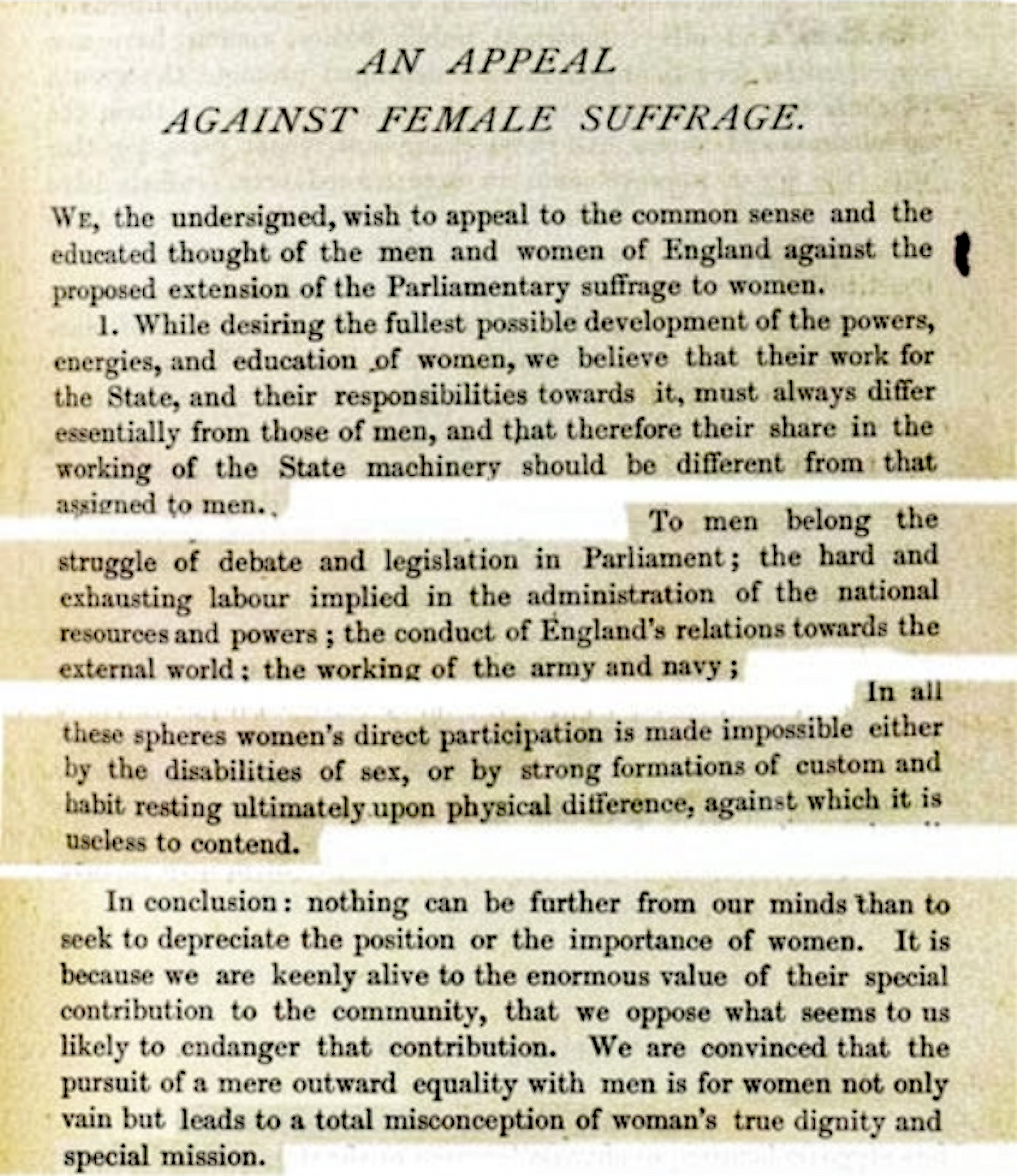
Lady Jersey chaired the League’s inaugural meeting at the Westminster Palace Hotel and later became vice-president of the combined organisation. Her anti-suffragism was entwined with imperial service: she also presided over the Victoria League, which cultivated attachment among the Empire’s scattered peoples. For women of this school, imperial womanhood did not consist in imitating the governor, soldier, or legislator; it sustained the moral, domestic, and associative bonds without which formal imperial authority could not endure.170
Gertrude Bell served as the League’s first honorary secretary and helped establish its northern organisation. Her own extraordinary life makes her significant rather than embarrassing to the anti-suffrage case. She travelled, negotiated, wrote, advised, and exercised influence at a level inaccessible to nearly all men or women; yet the conclusion she drew was not that the exceptional female must become the template for mass sexual interchangeability. Her career could instead be understood through the older aristocratic principle that the exceptional person may transcend an ordinary boundary without abolishing the boundary itself.
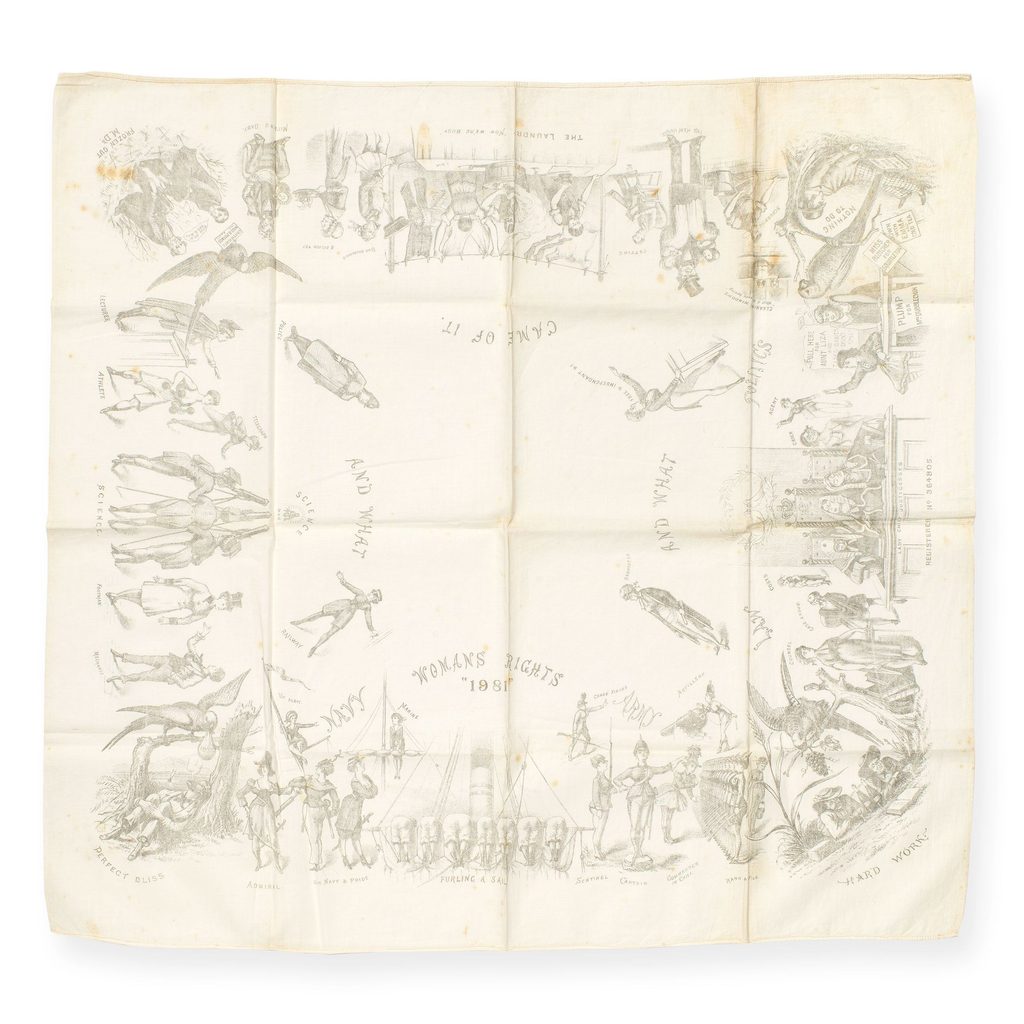
Violet Markham supplied perhaps the clearest female statement of the cause. She rejected the accusation that anti-suffragists despised women, affirming women’s citizenship and service whilst denying that service required identical political functions. Her formula of complementarity preserved both distinction and dignity. The sexes were constituent parts of one State, though they need not possess the same share in its management.169
A printed satirical handkerchief such as Women’s Rights and What Came of It ‘1981’ was itself a peculiarly feminine vehicle for anti-suffragist political argument. The handkerchief belonged to the intimate material world of nineteenth-century women: carried upon the person, embroidered, exchanged, kept as a token, and associated with dress, domesticity, sentiment, and personal refinement. To place anti-suffrage satire upon such an object was therefore especially apt, for the warning was not merely being issued about women, but carried through an artefact rooted in women’s own sphere of life.
The anti-suffrage argument is made upon a thing belonging naturally to women themselves, and this is important: opposition to female enfranchisement was not merely a male injunction imposed from without. Women themselves organised, wrote, petitioned, lectured, warned against, and rejected the political identity being fashioned for them wholesale by suffragism. The handkerchief embodies that forgotten female resistance to women’s emancipation: an intimate feminine accessory bearing a stern warning against the dissolution of differentiated sexual dignity and functions, and imagining with sardonic clarity a future in which women have occupied Parliament, the professions, the Army, Navy, and police, while men have been displaced into the domestic sphere. The satire therefore turns upon more than role reversal; it records women themselves warning that emancipation would culminate not in harmony, but in inversion, displacement, and the derangement of the relation between the sexes.
Yet their protestations were ultimately permitted no veto over the liberation supposedly undertaken on their behalf. ‘Progress’ marched onwards precisely by denying women the authority to refuse it. The woman who welcomed emancipation could be invoked as proof of its necessity; the woman who rejected it could be dismissed as unenlightened, conditioned, dependent, or simply left behind by history. Thus the emancipatory order proved more dogmatic than the alleged oppression it displaced: the older settlement at least openly professed hierarchy and differentiation, whereas the new one proclaimed freedom while progressively rendering dissent from its own conception of freedom illegitimate. Women might organise, petition, write, and declare that they did not wish to be politically assimilated to men; emancipation nevertheless claimed a superior knowledge of their interests and imposed its answer upon them. The supposed liberation of woman therefore contained from the beginning a remarkable authoritarian principle: woman was free to choose, provided that she chose emancipation.
The women who said ‘no’ had revoked their consent; emancipation, claiming to exist for their freedom, simply ruled that a woman’s consent ceased to matter when she refused liberation itself. ‘Progress’ had already appointed itself their guardian, interpreter, and eventual conqueror, exercising over them a sovereignty more absolute than that of the men it accused of ruling them, presuming to overrule their declared will more absolutely than any man had.
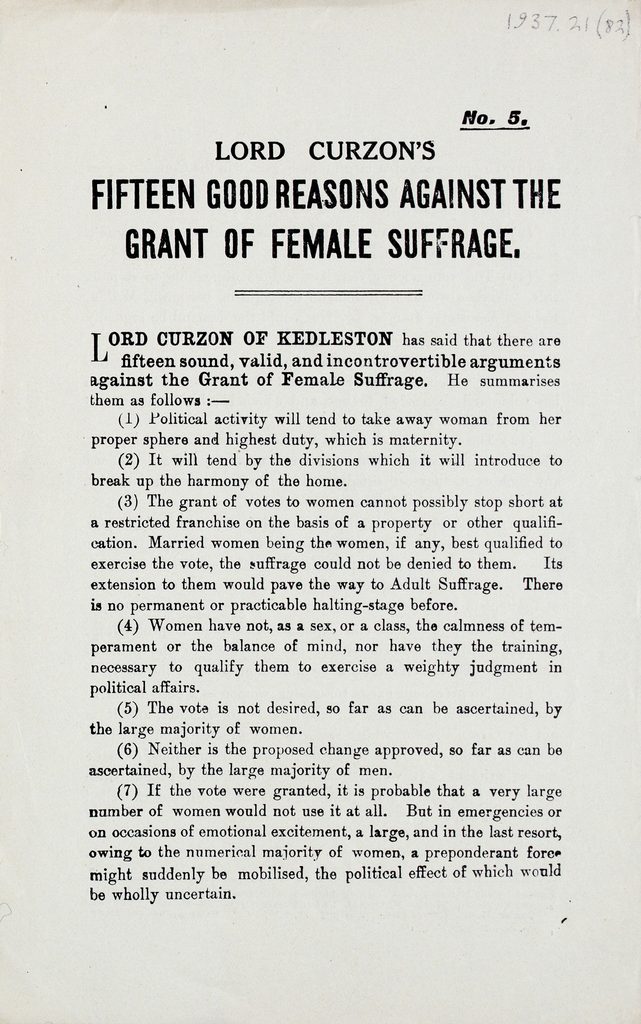
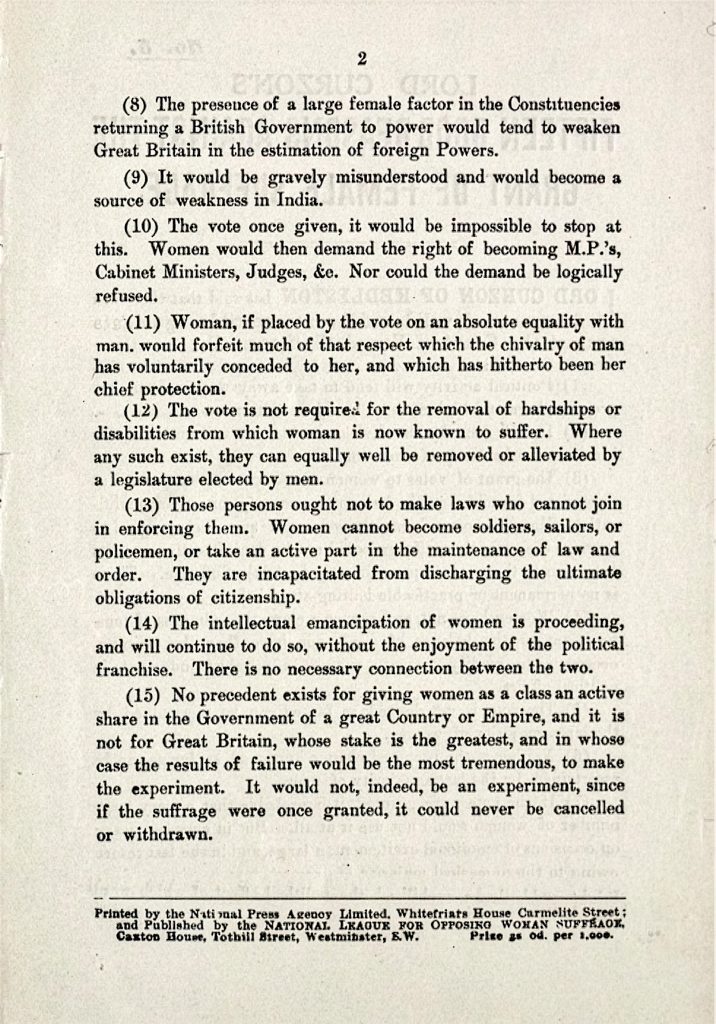
On the male side, Lord Curzon succeeded Cromer as joint president in 1912. His Fifteen Good Reasons Against the Grant of Female Suffrage joined the imperial argument to the contention that political activity would withdraw women from maternity and that the ordinary female temperament lacked the detachment demanded by national government. Curzon’s experience as Viceroy of India gave the same weight to his warning as Cromer’s Egyptian administration: both had governed immense territories and understood political sovereignty as command over forces and peoples, rather than the modern abstraction of individual self-expression.171
Behind them stood the earlier judgement of Queen Victoria. Her private denunciation of the ‘mad, wicked folly’ of women’s rights became public only after her death; she insisted that the sexes had been created different and ought to remain in their respective positions. The significance of Victoria’s judgement lies partly in its refusal of the facile assumption that a female sovereign must represent female political equality. Her queenship was hereditary, sacramental, dynastic, and exceptional; it could no more be converted into an argument for an indiscriminate female electorate than kingship could be converted into a universal male right to reign.172
The Popular Image of the Suffragette
The Dunston-Weiler Lithograph Company was a New York firm, and its Suffragette Series was American rather than British: a set of twelve full-colour lithographic postcards issued in 1909, each approximately 9 × 14 centimetres. The cards are American commercial lithographs whose imagery participated in the wider English-speaking resistance to female suffrage, including those from the British Anti-Suffrage Society, and more, because they translate the same arguments into immediate domestic and symbolic scenes.173
The series repeatedly portrays female political ascent as a double movement: the masculinisation of the woman and the involuntary feminisation of the man. The political woman does not merely acquire an additional activity; her husband is displaced into childcare, laundry, cooking, and domestic humiliation, whilst the household loses its maternal centre.
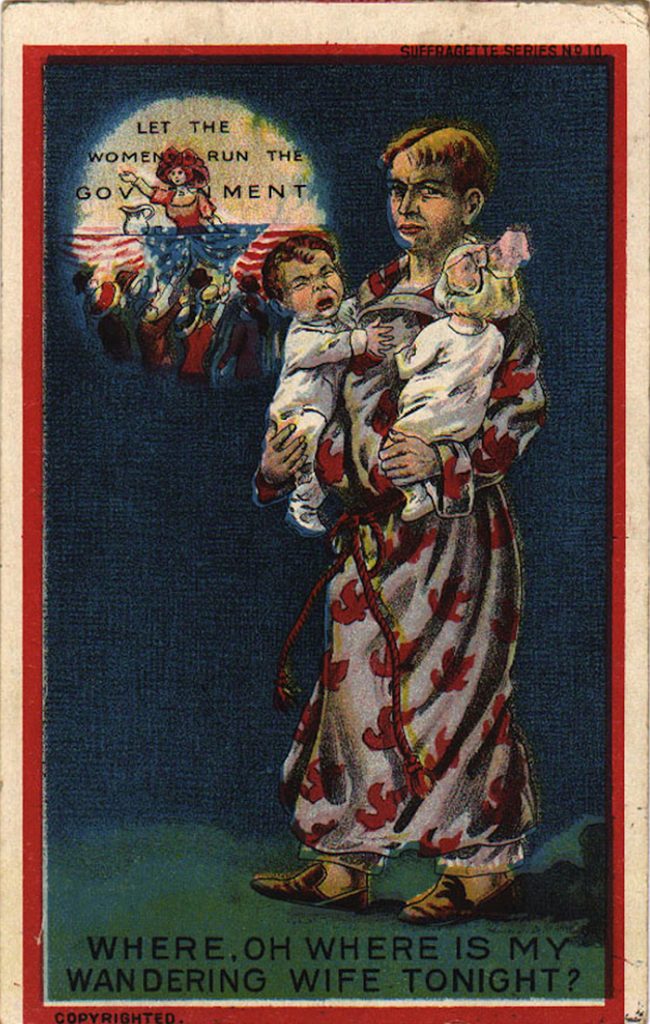
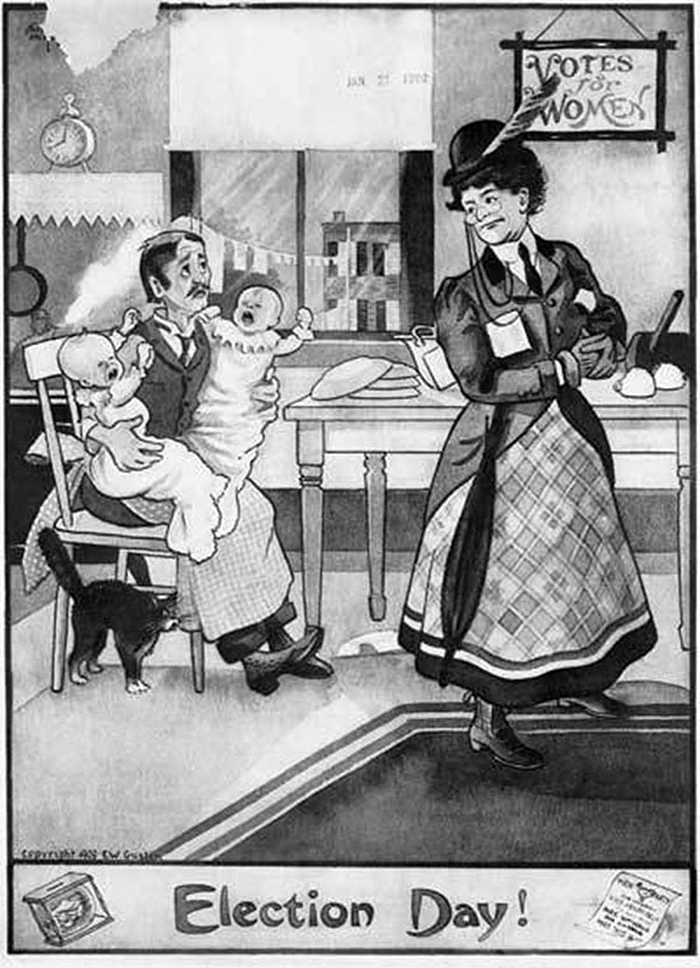
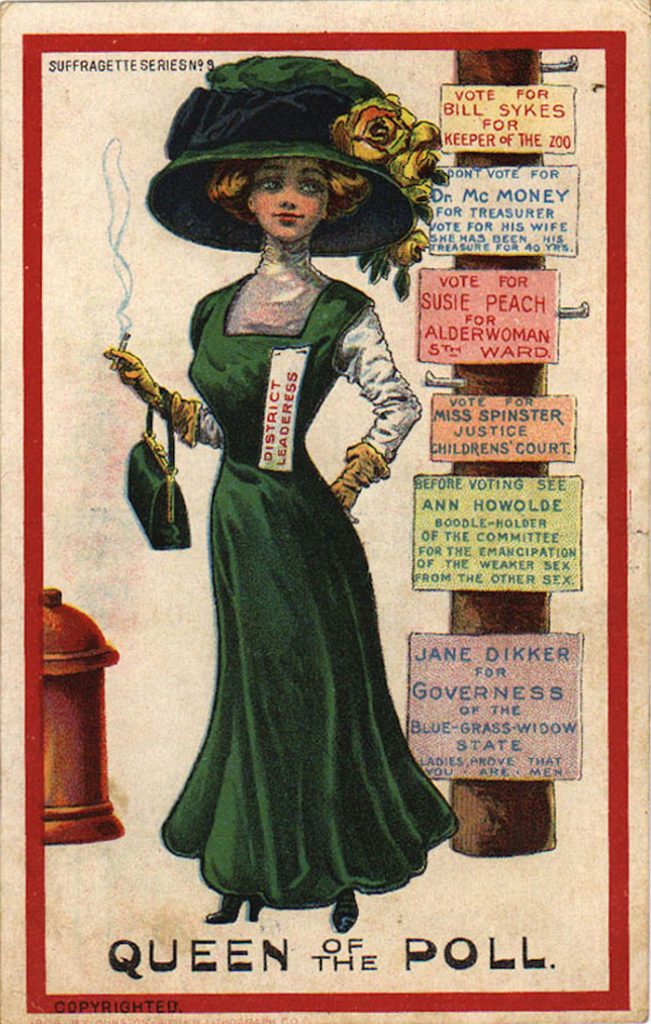
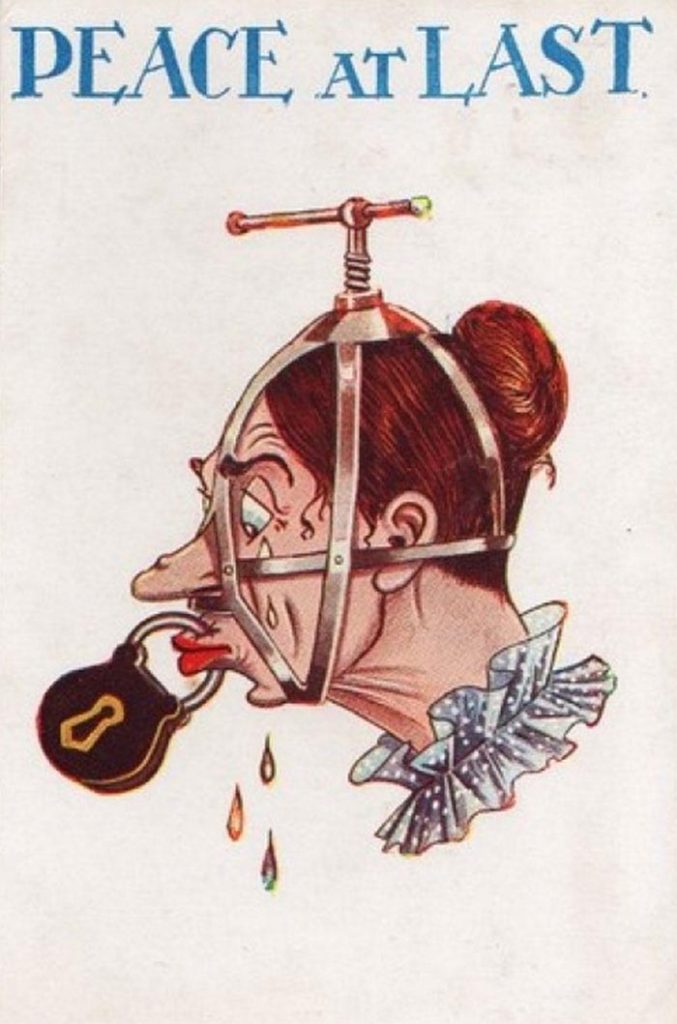
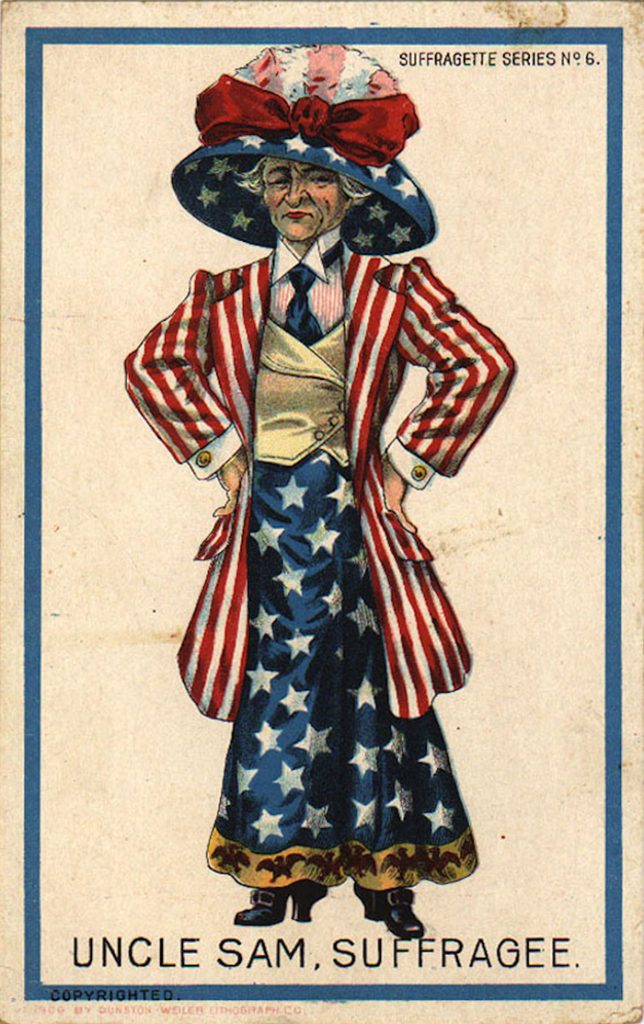
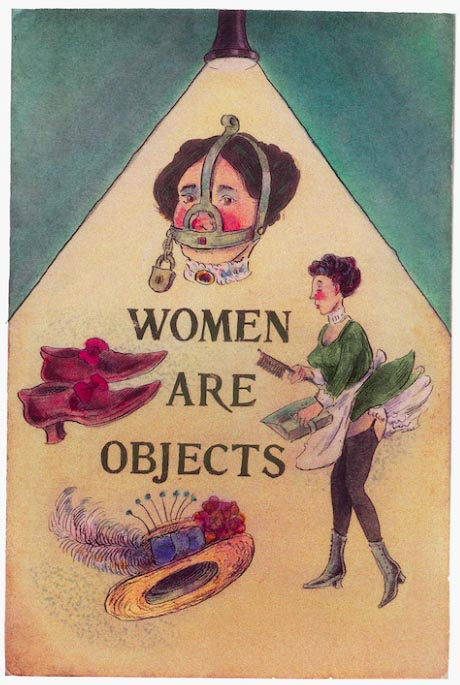
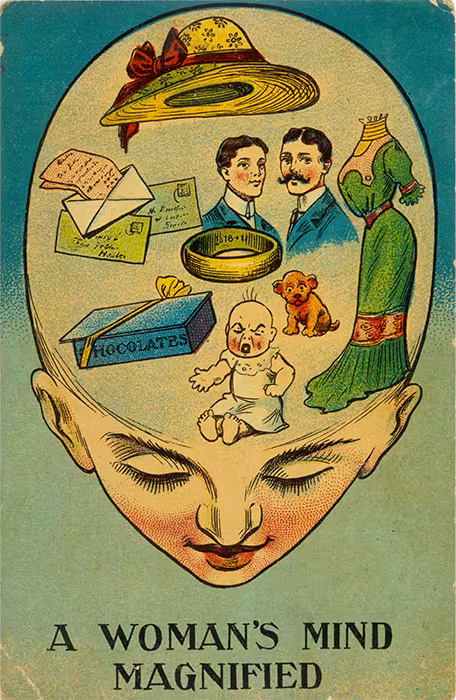
Among the most pertinent cards are:
- Suffragette Madonna, in which a man bottle-feeds the infant, turning the sacred maternal image into a scene of sexual inversion;
- Suffragette Coppette, depicting a woman costumed as a police officer, equipped with a rolling pin, high heels, and a small dog;
- Suffragette Vote-Getting: The Easiest Way, where electoral persuasion becomes erotic manipulation;
- I Want to Vote, But My Wife Won’t Let Me, where the husband performs the washing beneath the notice, ‘Everybody works but mother: she’s a suffragette.’173
- Where, Oh Where Is My Wandering Wife Tonight?, showing the wife addressing a public crowd whilst the abandoned husband holds the children;
- Election-Day, where a ‘District Captainess’ departs for political work and leaves her husband encumbered with crying children beneath the words, ‘What is a suffragette without a suffering household?’;
- Queen of the Poll, the enfranchised woman as a political prostitute, smoking in public and surrounded by feminist campaign placards; female political power elevates vulgarity, sexual impropriety, and self-interested office-seeking rather than civic virtue.
- Peace at Last, a grotesque suffragette is shown muzzled and mechanically restrained, turning the familiar shrill, domineering agitator into a visual joke: domestic and public peace are returned only once her incessant political clamour is forcibly silenced.
- Uncle Sam Suffragee, in which the national masculine personification itself is feminised.
- Women Are Objects, the feminist complaint is turned against itself: feminine life is represented through fashion, adornment, domestic occupation, and the muzzled agitator; the suffragette’s political grievance is reduced to another affectation amid the ordinary objects and duties of womanhood.
- A Woman’s Mind Magnified, a woman’s thoughts are exposed as a miscellany of hats, love letters, chocolates, handsome men, marriage, babies, pets, and fashionable dress; political pretension is mocked by contrasting it with the romantic, domestic, and material preoccupations presumed actually to occupy her mind.
View the whole collection here.
Suffragette Coppette precedes the British admission of sworn policewomen and already perceives the female officer as an incongruous compound: constabulary costume laid over domestic and erotic signs, with the rolling pin supplying the actual emblem of her authority. It visually anticipates our claim that the woman in uniform does not simply inherit the male office unchanged; the female police officer is rendered as a parodic fusion of constable, matron, and domestic disciplinarian as the office is transformed into a theatrical extension of matronly correction.
Scholia
- Records of the Women’s National Anti-Suffrage League, Women’s Library, London School of Economics, GB 106 2WNA; the archive records Lady Jersey’s chairmanship, Mary Ward’s literary leadership, Gertrude Bell’s secretaryship, the League’s local-government position, petition, branches, and 1910 amalgamation.
- The Danger of Woman Suffrage: Lord Cromer’s View, Anti-Suffrage Campaign, Women’s Library, LSE, 2WNA/D/04; on Cromer’s leadership and the imperial orientation of the leaflet, see Newcastle University Special Collections, ‘The Anti-Suffrage Anomaly’.
- ‘Votes for Women. Never!’, Anti-Suffrage Campaign, 16 July 1910, London Museum, object 50.82/640; Women’s Library, LSE, 2WNA/D/03.
- Violet Markham, speech to the National League for Opposing Woman Suffrage, Royal Albert Hall, London, 28 February 1912.
- Julia Bush, Women Against the Vote: Female Anti-Suffragism in Britain (Oxford: Oxford University Press, 2007), especially the discussion of imperial anti-suffragists including Lady Jersey, Violet Markham, Gertrude Bell, and Mary Ward.
- National League for Opposing Woman Suffrage, Lord Curzon’s Fifteen Good Reasons Against the Grant of Female Suffrage (1912); Newcastle University Special Collections, ‘The Anti-Suffrage Anomaly’.
- Queen Victoria to Theodore Martin, 29 May 1870, Royal Archives, VIC/MAIN/Y/168/29; Arianne Chernock, The Right to Rule and the Rights of Women: Queen Victoria and the Women’s Movement (Cambridge: Cambridge University Press, 2019), introduction.
- Dunston-Weiler Lithograph Company, Suffragette Series, twelve colour-lithographic postcards, New York, 1909; Palczewski Suffrage Postcard Archive, University of Northern Iowa; Ann Lewis Women’s Suffrage Collection.
Equality Means Surrender to the Feminine: ‘Discussion’, Not Authority
The asymmetry, far from rising to spite egalitarianism, arises through it.
Equality presents itself as the absence of command. It claims merely to clear the ground of privilege, compulsion, inherited rank, and arbitrary distinction, leaving two free persons to meet without prejudice. Yet this apparent neutrality conceals a prior act of conquest. Before the encounter begins, equality has already decided what kinds of relation may be considered legitimate, what kinds of difference may be spoken without shame, and which principles must justify themselves before appearing.
Female emancipation is not an empty field. It is a surreptitiously imposed metaphysics. It masks itself as ‘equality’, ‘freedom’, ‘rights’ and ‘dignity’ while furthering the opposite in all domains.
The egalitarian does not enter a discussion of hierarchy as one party bringing one possible doctrine against another. She enters as though equality were the natural condition of thought itself, while hierarchy were a deviation requiring explanation. Equality needs no genealogy, no defence, and no demonstration. It is treated as the moral atmosphere in which every argument must breathe. The traditional doctrine, by contrast, is summoned before it as an accused thing: prove that your distinctions are not hatred; prove that your authority is not abuse; prove that your order does not injure the autonomous individual whom equality has already declared sacred.
The conclusion is therefore secured before the discussion begins. Hierarchy may be heard only after it has accepted the jurisdiction of equality; but once it accepts that jurisdiction, it has ceased to be hierarchy.
Even the injunction to debate and ‘discuss’ as free men or women has already surrendered principle before the feminine. The egalitarian demand is often not simply: ‘Defend proposition X.’ Beneath it lies: ‘Enter a common discursive space with me, acknowledge my equal standing to examine your first principles, and permit our respective opinions to appear before the same tribunal.’
If hierarchy itself denies that universal equality of standing, accepting this procedure without qualification already concedes half the argument. This is why the commonplace ‘we should just have a discussion’ or ‘debate me on your logical premises’ is less philosophically innocent than it sounds, and seems to lead to more disintegration rather than generative or productive outcomes. It can presuppose that every distinction of rank, authority, tradition, or qualification must remain perpetually available for renegotiation between interchangeable individuals. Authority becomes an opinion about authority. Duty becomes an opinion about duty. Tradition becomes one possible contribution to the conversation. Eventually even the sacred becomes something required to explain itself to whoever happens to ask.
This is why so many apparent debates between traditional and modern premises are counterfeit. The modern interlocutor does not compare two civilisational forms from a point above them both. She installs her own premise as the universal judge and permits the other to speak only as a defendant. The traditionalist may describe polarity, rank, authority, guardianship, sacred function, or differentiated vocation; each term is immediately translated into the vocabulary of domination, coercion, injury, and consent, thus fuelling its own disintegration before liberal presumptiveness. He speaks one language, while she reserves the power to determine what his words are allowed to mean.
Equality thus becomes a machine of reduction.
Whatever rises vertically must be pressed flat enough to enter its categories. A metaphysical polarity becomes a social grievance. Authority becomes personal appetite. Rank becomes vanity. Guardianship becomes insecurity. Feminine receptivity becomes victimhood. Masculine form becomes domination. The higher and lower disappear, because equality recognises only one horizontal plane upon which competing individuals negotiate reciprocal permissions.
This is not comprehension. It is annexation.
The traditional doctrine is not merely misunderstood; it is forcibly naturalised into a foreign conceptual order. Its own premises are denied standing, while the egalitarian interpretation is treated as self-evident. The modern listener may then accuse the traditionalist of evasion whenever he refuses to answer the caricature produced by this translation. She asks him to explain hierarchy, but what she means is: explain why hierarchy should be permitted to survive after equality has already judged it guilty.
The imposition is especially powerful because it disguises itself as resistance to imposition. Equality announces that no one should place a form upon another; it then places the form of equality upon every conceivable relation. It condemns authority for being explicit while exercising a more total authority through the regulation of meaning itself. It forbids the man to command, yet commands him to renounce command. It condemns hierarchy as coercion, yet coerces every hierarchy to describe itself as partnership. It denounces the traditional order for assigning roles, yet assigns the traditionalist the role of penitent defendant before he has spoken.
Its deepest command is simple: Nothing may stand above the equal individual, and nothing may remain beyond the individual’s right to judge.
This command bears the signature of an inverted feminine mode.
The masculine principle distinguishes, separates, delimits, and establishes distance. It draws the line, names the rank, determines the centre, and permits forms to stand apart without requiring their dissolution into one another. The inverted feminine movement refuses such distance. It seeks to enfold every distinction within a common emotional and moral field, until no authority may remain exterior to its demand for recognition.
Everything must be brought near enough to be judged by feeling. Every hierarchy must become intimate. Every distance must be explained. Every reserved centre must open itself. Every transcendent claim must descend into the language of interpersonal reassurance. Nothing is permitted to remain remote, impersonal, or sovereign.
The masculine form says: this stands, whether or not you approve.
The egalitarian feminine demand replies: nothing may stand unless I can recognise myself within it.
This is why overfamiliarity so often accompanies egalitarian judgement. The woman who has acquired no relation of trust, loyalty, service, kinship, or station may nevertheless assume immediate moral intimacy with the man. She questions his convictions, interprets his injuries, evaluates his desirability, diagnoses his motives, and chastises his character as though equality had abolished every boundary between them. She treats distance itself as an insult. His refusal to place his inner life at her disposal becomes evidence of arrogance or concealment.
Equality grants her the presumption of access.
Because they are declared equals, she imagines herself entitled to address him as peer, examiner, confessor, schoolmistress, and judge at once. Yet equality does not make their capacities, experiences, formation, or stature equal. It merely suppresses the language through which such differences might be recognised. The resulting familiarity is therefore false. It is intimacy without relation and authority without office.
This produces the peculiar schoolmatronly tone of the modern rebuke. The man is not addressed as an opponent whose doctrine must be refuted, nor as a stranger whose distance should be respected. He is addressed as a disobedient member of a moral household over which the woman presumes jurisdiction. She corrects his language, rebukes his tone, imputes his motives, and orders him back into the common emotional norm.
The content of the command is always assimilation.
- Do not remain outside.
- Do not preserve a principle I cannot absorb.
- Do not speak from a height I have not authorised.
- Do not distinguish yourself from the moral collective.
- Return to the common field and acknowledge that my offence places you under judgement.
This is the coercion concealed beneath the egalitarian appeal. The man is invited to speak only so that his speech may be brought under the same order as hers. His otherness is tolerated as curiosity, eccentricity, style, or aesthetic display; it becomes intolerable the moment it claims objective form. A traditional man may appear fascinating so long as tradition remains an atmosphere around him. Once it becomes command, precedence, or irreducible principle, the egalitarian demand reveals itself: he must either translate the doctrine back into partnership or be punished for having meant it.
Equality therefore does not merely flatten social rank. It abolishes the right of a principle to remain unassimilated.
This is why the appeal to ‘sexism’ performs so much work with so little thought. The word does not enter the traditional doctrine and discover a contradiction within it. It drags the doctrine back onto the egalitarian plane and announces that it has violated the plane’s fundamental rule. It means: you have recognised a distinction that our order forbids; you have refused to treat the sexes as morally interchangeable units; you have allowed one principle to stand above another without obtaining permission from the lower.
The accusation is powerful only among those who already accept equality as the supreme measure. Outside that faith, it possesses no analytical force. It names the traditional doctrine from the position of its enemy, then mistakes that naming for refutation.
The traditionalist who begins defending himself against the term has already yielded too much. He accepts that equality may determine the tribunal, the charge, and the burden of proof. He explains that his hierarchy is not cruel, that his distinction is not hatred, that his authority would remain benevolent, and that women would retain dignity beneath it. Each clarification may be true, but the form of the defence concedes that hierarchy must first receive egalitarian absolution before it may speak.
The stronger answer is that equality itself stands accused.
By what right does it erase qualitative difference? By what right does it make autonomy the measure of dignity? By what right does it reduce relation to negotiation, marriage to partnership, sex to interchangeable individuality, and authority to suspected violence? By what right does it present its own metaphysical mutilations as mere neutrality?
The traditionalist need not prove that hierarchy is compatible with equality. He must expose that compatibility as impossible and undesirable. Equality is not the impartial ground upon which masculine and feminine may be judged; it is the principle that has already destroyed their meaning by refusing every relation that cannot be reduced to reciprocal sameness.
The feminine character of this reduction appears most clearly in its treatment of form. Form is tolerated only after being softened into inclusion. The boundary must become care. The command must become dialogue. The centre must become facilitation. The superior must justify himself through service to the equal. Masculinity may survive only as a labour performed for the emotional security of those whom it is forbidden to govern.
The man may be strong, but not sovereign.
Decisive, but not final.
Protective, but not paternal.
Leading, but never above.
Formative, but forbidden to impose form.
This is not masculinity preserved under humane conditions. It is masculinity domesticated beneath an egalitarian feminine horizon.
The same structure governs the modern woman’s indignation when a man refuses the reduction. She does not merely hear an opinion she dislikes. She confronts a limit to her presumed power of assimilation. Something stands before her that will not become a reflection of her moral world. Its independence appears as aggression because equality has taught her that no legitimate principle may remain beyond reciprocal recognition.
Her outrage is therefore the reaction of the levelling field against the resistant form.
She does not argue that the form is false. She insists that its refusal to dissolve is itself immoral.
This is why egalitarian hostility can become so primitive. Once the conceptual reduction fails, the man must be reduced personally. His doctrine cannot be absorbed, so his motives are lowered. He is resentful, sexually unsuccessful, socially defective, cruel, ridiculous, or mentally unwell. The vertical principle is dragged into the gutter because the gutter is the final level upon which equality can still compel sameness. If he will not descend voluntarily, he must be represented as having always belonged there.
The personal insult is thus not an accidental lapse from egalitarian argument. It completes the egalitarian operation. The doctrine is first denied its own meaning; the man is then denied his own interiority. Both are flattened into terms the accuser can govern.
The hidden violence of equality lies here. It does not merely deny rank; it refuses to permit anything to possess a meaning beyond its categories. It insists upon interpretative conquest. The other may exist only after being translated, psychologised, moralised, and brought beneath the common measure.
Its feminine mode is not softness, mercy, or receptivity in their higher forms. It is the inverted maternal impulse to enfold everything, to dissolve separation, and to treat whatever resists incorporation as hostile. The man is not allowed to stand outside the circle; if he refuses to enter, the circle names him diseased.
The asymmetry of the egalitarian order follows directly from this. Woman appears as the bearer of the common emotional field and therefore acquires the power to decide who has violated it. Man appears as the bearer of form and therefore stands perpetually accused of imposing upon it. Her imposition is invisible because it arrives as the demand for equality; his form is condemned because it arrives openly as hierarchy.
She may compel assimilation while calling herself oppressed.
He may preserve distinction and be named the aggressor.
That is the central deceit. Equality is not the absence of imposition. It is the imposition of a feminine mode upon every relation, accompanied by the prohibition against naming the imposition for what it is.
The result is not a world without hierarchy, but a world in which hierarchy can operate only from beneath: informal, emotional, unacknowledged, and absolved of duty. The overt masculine order is condemned because it names its centre; the covert egalitarian order is permitted to rule because it denies that any centre exists.
Equality therefore conceals its sovereign precisely by declaring that sovereignty has been abolished.
Epilogue: The Innocence of the System
A doctrine reveals its deepest privilege when it claims authorship of every liberation and responsibility for none of the consequences.
Feminism speaks readily in the language of transformation. It changed marriage, education, work, law, courtship, sexual conduct, household authority, and the expectations by which women understand themselves. It overturned inherited restraints, dissolved paternal jurisdiction, widened female choice, and reconstructed social life around autonomy. These changes are invoked as proof of its historical power whenever honour is to be claimed.
Yet the same power disappears when consequence enters the account.
The doctrine may reshape every relation between the sexes, but any man who finds those relations hostile is told that the defect lies solely within him. It may alter the conditions of marriage, but the unmarried man who criticises those conditions is declared incapable of attracting a wife. It may estrange woman from motherhood, household, obedience, and inherited form, but collapsing fertility is attributed to economics, housing, capitalism, anxiety, or some other impersonal mechanism. It may teach suspicion towards masculine authority, yet male–female antagonism is explained as an ancient male hostility feminism merely exposed.
Feminism claims agency when recounting its victories and innocence when confronted with their cost.
This produces an ideology with effects but no causes. Every social development welcomed by the doctrine proves its efficacy; every unwelcome development belongs to something else. Freedom is feminist. Loneliness is personal. Female economic independence is feminist. The dissolution of the household is capitalism. Sexual autonomy is feminist. Distrust, disposability, and the collapse of courtship are failures of individual men. Reduced fertility is liberation when praised and economic misfortune when lamented. The doctrine moves between authorship and disavowal with perfect convenience.
The turning of gynaecocratic tyranny may therefore be understood as the moment at which emancipation ceases merely to dissolve an older order and hardens into an order of its own: grievance becomes privilege, exception becomes norm, and the overthrow of authority reproduces itself as a new authority claiming moral exemption from the restraints it destroyed. Yet whatever rises through inversion remains bound to inversion. Once its borrowed legitimacy is exhausted, the same movement that overturned the former hierarchy begins to turn again upon itself.
Its overthrow would therefore be more than a political reversal. It would be the reassertion of measure against excess, form against dissolution, and hierarchy against the absolutised demand for release: the overturning of the overturn, by which that which had usurped the place of order is itself displaced and returned to its proper station.
The asymmetry is preserved by narrowing every consequence to the scale of the individual. A man may describe a transformed sexual order, yet he is answered as though he had merely confessed a private inadequacy. He may identify a civilisational pattern, yet the pattern is translated into his inability to negotiate modern expectations. He may criticise the institution under whose terms relations now occur, yet he is judged solely by whether he has succeeded within it.
The system itself remains beyond judgement because failure beneath its conditions is made to prove the justice of those conditions.
This is the hidden meaning of the insult that a critic ‘cannot find a wife’. It does not merely mock him. It performs an ideological absolution. It declares that modern marriage, modern womanhood, and feminist expectation require no examination, because any man who objects to them has already been discredited by his failure to receive female approval.
The doctrine becomes self-sealing.
If a woman accepts him, feminism has evidently permitted a healthy relation. If women reject him, the rejection proves that his criticism springs from resentment. If he rejects the terms offered, his refusal is redescribed as inability. If he withdraws after mistreatment, he is bitter. If he names the mistreatment, he is hostile towards women. If he remains silent, he is isolated and incapable of intimacy.
No possible experience may count against the system because each experience is translated into evidence against the man who reports it.
The woman involved in the encounter is correspondingly relieved of scrutiny. Her character, demands, cruelties, contradictions, and fitness for marriage disappear. She need not be wise, loyal, restrained, or capable of relation. She need only withhold approval. The withholding itself becomes a judgement upon him.
Female selection is thus treated as infallible after the language of hierarchy has supposedly been abolished. The woman decides; the man’s worth is inferred from her decision. Her preference requires no account, while his exclusion requires a psychological explanation. Her refusal is sovereign; his dissatisfaction is pathology.
The doctrine which condemns masculine judgement as oppressive quietly enthrones feminine judgement as social truth.
This arrangement depends upon a peculiar innocence attributed to female agency. Woman may possess full autonomy while choosing and no authorship over the world produced by those choices. She may reject marriage, postpone motherhood, despise dependence, demand economic independence, refuse male authority, and define fulfilment through personal experience; yet the aggregate order emerging from millions of such choices must never be described as a female creation.
The choice belongs to her. The consequence belongs to society.
When the consequence is praised, her agency returns. Women transformed the world. Women broke their chains. Women entered public life. Women rejected obsolete roles. Women seized control of their destinies.
When the consequence becomes difficult to defend, the agent disappears into abstraction. Birth rates decline because of housing costs. Marriage weakens because of capitalism. Men become alienated because masculinity has failed to adapt. Children disappear because governments have not supplied enough services. The revolution retains its glory, while material conditions inherit the blame.
No civilisation can reason clearly under such an allocation of agency. A social order is the accumulated expression of choices, ideals, prohibitions, incentives, and loyalties. To celebrate the transformation of woman while forbidding scrutiny of its civilisational effects is to demand history without causation.
The demographic question exposes this evasion with particular severity. The modern order has placed female education, economic independence, sexual autonomy, delayed marriage, and freedom from maternity among its central achievements. Institutions concerned with population have themselves understood that these developments reduce fertility; in some settings, this reduction has been openly desired. Yet when demographic contraction becomes visible enough to threaten continuity, the causal chain is obscured.
The language changes from triumph to inevitability.
No one chose this. Everyone merely responded to circumstances. The disappearance of children is regrettable, but blame must fall upon wages, rents, employers, governments, or the vague pressures of modern life. The governing ideal of female autonomy remains untouched, even when every alternative is required to bend around it.
The matter is then framed so that continuity itself appears suspect. Why should populations grow? Why should women bear children? Why should a civilisation reproduce itself? Perhaps there are already too many people. Perhaps decline is environmentally responsible. Perhaps the disappearance of a people is merely one neutral demographic arrangement among others.
Thus the doctrine escapes accountability twice. First, it denies causation. Then, when causation becomes too obvious to deny, it denies that the consequence is a loss.
This is the moral structure of an ideology incapable of repentance. It can reinterpret every defeat as another liberation because it recognises no standard above the autonomy it has enthroned. A civilisation may lose marriage, children, continuity, and trust between the sexes; the doctrine asks only whether the individual remained free to choose.
The woman who repeats this logic in personal conversation does the same thing on a smaller scale. She initiates, questions, provokes, insults, and departs. Her agency is celebrated while it expands the encounter. Once the encounter becomes ugly, she places the ugliness wholly upon the man. Her own conduct becomes a reaction. His conduct becomes the cause.
She may attack his intelligence, masculinity, desirability, and work, then imagine that she merely defended herself against beliefs that offended her. The sequence through which she produced the confrontation is suppressed. Her cruelty is reclassified as resistance; his existence as a dissenter becomes the original aggression.
The personal and political forms are identical.
Feminism authorises the transformation, then names every resistance to the transformed order as proof that further transformation was necessary. A man objects to the destruction of paternal authority; his objection proves why paternal authority was dangerous. He describes injury at the hands of women; his anger proves that women required liberation from men such as him. He criticises female unaccountability; the criticism itself is treated as an attempt to control women.
Every accusation is absorbed as confirmation.
This makes the system incapable of encountering evidence from outside itself. It never meets the critic at the level of causation. It translates him into a symptom. His argument is reduced to the damage allegedly produced by his exclusion from the new order. Since his very opposition has been psychologised, nothing he says need be answered.
The social doctrine becomes a closed circuit:
Feminism transforms the conditions.
The man suffers beneath the conditions. His suffering is attributed to personal defect. His criticism of the conditions becomes further evidence of that defect. The conditions are declared innocent. The critic is then told that his inability to flourish within the system proves the superiority of the system. This is less reasoning than ritual purification. The ideology washes itself in the guilt of those it has displaced.
The accusation that a critic is merely angry because he ‘cannot find a wife’ belongs precisely here. The possibility that he may have refused an egalitarian arrangement is removed. The possibility that suitable women have become rarer is forbidden. The possibility that female conduct may have contributed to his distrust is erased. The possibility that marriage itself has been converted into something he does not recognise is treated as absurd.
His situation must mean only one thing: women have judged him, and women’s judgement is correct.
The woman who delivers the insult thereby identifies herself with the system’s innocence. She speaks as though she represented the collective verdict of her sex, though she possesses no authority to speak for women beyond herself. She invokes female rejection as an objective measure of male worth while exempting female desire from every question of quality, formation, or justice.
This is where the class-consciousness of feminism reappears. ‘Women’ become a corporate moral body whose acts require no account. Particular women may be cruel, foolish, disordered, manipulative, or incapable of relation, yet the abstract class remains innocent. Any criticism directed towards a pattern among women is therefore received as an attack upon the whole body and answered through collective defence.
The man is denied the same refuge. He is made answerable both as an individual and as a representative of men. His personal defects belong to him; the alleged historical crimes of his sex belong to him as well. Woman receives collective glory and individual innocence. Man receives individual blame and collective guilt.
The asymmetry protects feminism from every direction.
A celebrated woman proves female greatness. A destructive woman is merely an individual. A successful man benefits from male privilege. A suffering man reveals personal failure.
Female conduct may never establish a pattern; male conduct is always interpreted structurally.
Thus the doctrine can invoke the accomplishments of ‘millions of women’ against one man while condemning any man who draws conclusions from repeated experiences with women. She may borrow grandeur from an entire sex; he may not infer anything from the sex at all.
The system remains innocent because its beneficiaries are treated collectively when credit is distributed and individually when blame approaches.
This moral economy has been mistaken for compassion because it places the language of injury around the favoured party. Yet compassion without accountability quickly becomes licence. A person granted permanent interpretative innocence no longer needs to ask whether she has understood, whether she has acted proportionately, or whether her own prejudices have shaped the conflict. Her feeling supplies the verdict, and the doctrine supplies the absolution.
The man is then expected to bear not only the injury, but the duty of explaining why the injury occurred without implicating the person who inflicted it.
He must consider her conditioning, her fear, her past, her social environment, and the threat his words posed to her identity. She need consider none of his. Her outburst receives context; his convictions receive accusation. She is explained generously, while he is reduced maliciously.
Accountability would reverse this indulgence. It would require the woman to remain the author of her words after the emotion that produced them has passed. It would require the feminist order to remain the author of its social transformations after their costs become visible. It would insist that agency cannot be invoked as glory and discarded as burden.
The freedom to act entails the possibility of having acted badly. The power to transform entails responsibility for what has been transformed. The right to choose entails the duty to answer for the order produced by choice.
These propositions are elementary wherever adulthood still exists. Feminism resists them because its moral authority depends upon combining sovereignty with innocence. Woman must be autonomous enough to overthrow every inherited form and innocent enough never to be judged for what follows.
This is the contradiction at the centre of the system.
It wishes to write history without becoming historically culpable. It wishes to reconstruct the sexes without answering for the relation that emerges. It wishes to make woman sovereign over herself while treating every consequence of that sovereignty as something done to her by men, capitalism, society, or circumstance.
The system’s innocence is therefore neither accidental nor sentimental. It is structural. Once female agency becomes accountable, feminism can no longer present itself as pure emancipation. It must enter history as one causal force among others, capable of error, excess, destruction, and injustice. Its acts may then be judged by standards beyond autonomy.
That is the judgement it cannot permit.
So the critic must be reduced before the causal question can be heard. He must become bitter, unwanted, obsessive, cruel, or incapable of attracting a wife. His character must absorb the charge that might otherwise fall upon the system. The personal insult stands where political accountability should have begun.
The system remains innocent because the man has been made guilty enough for both.
Marriage as Female Certification
The insult that a man ‘cannot find a wife’ does not merely mock his solitude. It establishes marriage as a certificate of legitimacy issued by women.
The married man is presumed to have passed some invisible examination. A woman has chosen him; therefore he must be acceptable. The unmarried critic, by contrast, is treated as disqualified by the absence of female approval. His argument need not be answered because his personal status has already been interpreted as a verdict against him.
The wife becomes evidence.
Her existence supposedly proves that the man is desirable, socially competent, emotionally sound, and morally admissible. Her absence supposedly proves the reverse. A complex institution is reduced to a seal of female endorsement, and masculine worth is made dependent upon whether a woman has elected to confer it.
This is an astonishing restoration of judgement beneath the language of equality. The same order that rejects formal male authority quietly enthrones female selection as the final tribunal of masculine value. A man may possess learning, discipline, courage, loyalty, spiritual orientation, and civilisational purpose; yet a single question is imagined to outweigh them all:
Has a woman chosen him? If yes, he is normalised. If no, his principles are recoded as rationalisations for rejection.
The content of the marriage scarcely matters. No one asks whether it possesses order, fidelity, hierarchy, continuity, or form. No one asks whether the wife is noble, disordered, vulgar, loyal, parasitic, intelligent, capricious, or incapable of reverence. No one asks what conditions she imposed, what concessions the man made, or whether the arrangement bears any resemblance to marriage beyond a shared legal and domestic shell.
Selection itself becomes the proof.
The woman need not be worthy of marriage. She need only be capable of withholding it.
This asymmetry transforms female preference into a public judgement while leaving that preference answerable to nothing beyond itself. The woman who declines a man is presumed to have perceived something deficient in him. Her refusal is treated as revelation. His refusal of her, by contrast, is more readily interpreted as fear, insecurity, misogyny, or inability to sustain intimacy.
Her rejection diagnoses him, while his rejection diagnoses himself.
The same action acquires opposite moral meanings according to sex. Female refusal confirms discernment; male refusal demands explanation. She may reject because she knows her worth. He rejects because he fears hers. Her standards express self-respect. His standards betray resentment. Her lack of interest is sovereign. His lack of interest becomes suspect.
Marriage is thereby converted into an asymmetrical market of moral accreditation. The woman acts as certifier, while the man appears as applicant.
He must prove himself desirable enough to be admitted, flexible enough to adapt, emotionally compliant enough to reassure, materially useful enough to sustain, and ideologically acceptable enough not to challenge the premises under which the woman grants access. The marriage then appears less as a form into which both enter than as a licence bestowed upon him by female consent.
Should he criticise the arrangement, the criticism is immediately turned against him. He cannot object to the terms; his objection merely proves why no woman would accept him. He cannot reject partnership as a substitute for marriage; his rejection is redescribed as inability to find a partner. He cannot insist upon authority; the insistence is treated as compensation for his lack of power. He cannot name the degeneration of the institution without being accused of bitterness at exclusion from it.
The system has arranged matters so that failure to enter validates the system, while entry requires accommodation to its terms.
Marriage, under these conditions, ceases to be an order and becomes a referendum upon the man.
The woman casts the vote. The culture counts it. The result is announced as truth.
The accusation ‘you cannot find a wife’ therefore contains a hidden demand: accept the conditions under which women now consent to marriage, or accept your own degradation as the meaning of your refusal.
There is no recognised third position.
The man may not say that he rejects egalitarian partnership. He may not say that the available terms are beneath marriage. He may not say that he has known women who were unfit for the role.
He may not say that female character has itself been transformed by the social order. He may not say that he prefers solitude to submission before a relation without centre.
His non-participation must be involuntary. Only then can the system preserve the fiction that no sane or worthy man would refuse what it offers.
This is why the unmarried traditionalist is so threatening. He does not merely lack a wife; he may expose that modern marriage has lost the authority to certify anything. His refusal suggests that female approval is not the supreme reward, that selection by a modern woman may not represent elevation, and that exclusion from an egalitarian arrangement may preserve rather than diminish dignity.
The insult must therefore insist that he was not excluded by choice. He was rejected.
His judgement must be erased so that hers may remain sovereign.
This is also why the modern wife is invoked abstractly. She is rarely described as a woman of definite quality, lineage, discipline, loyalty, or spiritual form. She appears as ‘a wife’ in the same manner that one might speak of employment, property, or social status. Her possession certifies normality. Her absence marks failure.
The institution is emptied of ontology and retained as credential.
The man who has a wife is thought to have passed into adulthood. The man without one remains suspect, incomplete, or socially malformed. Yet the same culture has stripped marriage of permanence, authority, sexed obligation, and inherited meaning. It condemns the man for lacking the very thing it has rendered increasingly formless.
What is he actually being accused of lacking?
Not necessarily fidelity. Not necessarily a household. Not necessarily children. Not necessarily a wife formed by duty and relation.
He is accused of lacking female ratification.
The distinction matters because ratification can be granted within arrangements that possess none of the qualities once associated with marriage. A man may live beneath his wife’s emotional jurisdiction, divide authority indefinitely, surrender every principle to negotiation, and call the arrangement equal. The mere fact that a woman chose him is then treated as proof that he understands women and is worthy of relation.
Another man may refuse precisely these conditions, remain unmarried, and be declared incapable of marriage.
Thus submission to the altered institution becomes evidence of competence, while refusal becomes evidence of defect.
This is how egalitarianism conceals its demand for obedience. It does not say openly that the man must submit to female moral jurisdiction. It says that a successful man knows how to ‘make a relationship work’. The phrase appears practical and neutral, but its content is often unmistakable: he must anticipate her feelings, accept her interpretations, soften his authority, negotiate every limit, and treat her continued presence as confirmation that he has behaved properly.
The relationship survives; therefore he has succeeded.
She leaves; therefore he has failed. Her departure requires no further enquiry. It has become the verdict.
The woman thus acquires a power greater than any formal office would have granted her. She may dissolve the relation and simultaneously determine what the dissolution means. The man does not merely lose the woman; he loses standing. Her withdrawal becomes retrospective judgement upon the whole history of the relation.
The marriage credential can be revoked.
This is why men are so often compelled to remain within disordered relations. The social cost of leaving is not confined to loss. Departure threatens to reclassify them as incapable, rejected, or unable to retain a woman. They may be expected to tolerate indignity rather than risk the judgement attached to female withdrawal.
The woman’s continued presence therefore becomes leverage.
She may not possess formal authority, but she holds the certificate upon which his legitimacy has been made to depend.
The same structure appears before marriage. Courtship becomes a prolonged examination in which the man’s worth is continuously tested by female response. He must entertain, reassure, impress, provide, disclose, and accommodate. Her participation is interpreted as approval; her retreat as exposure. She is permitted to explore his character while remaining less answerable for the quality of her own.
He is evaluated as a prospective husband. She is assumed to be the ‘prize’ that validates the evaluation.
This is not reciprocity. It is an unacknowledged hierarchy hidden inside a culture that congratulates itself upon abolishing hierarchy.
Its cruelty becomes clearest when a woman invokes marriage against a man whose critique concerns the institution itself. She does not answer whether marriage has been reduced to partnership, whether male authority has been dissolved, whether female autonomy has become incompatible with household unity, or whether fertility has collapsed beneath the new arrangement. She simply declares that his inability to obtain a wife disproves him.
The institution is used to silence criticism of its own transformation.
A man criticises the house; he is told that he is bitter because he does not possess one.
No one asks whether the house is still standing.
The insult also denies every negative experience the man may have had with women. If he has been betrayed, manipulated, demeaned, used, or repeatedly subjected to emotional domination, these experiences are not permitted to inform his judgement. They are instead inverted into proof that he was somehow unworthy of better treatment.
The woman remains innocent.
His suffering merely explains why he became defective. The possibility that women may have failed him is replaced by the certainty that he failed to secure one.
This is an extraordinary moral protection. It ensures that female conduct cannot accumulate into evidence. Each woman remains an isolated individual when criticised, yet ‘women’ become a collective tribunal when male worth is judged. Their refusals combine into a verdict; their cruelties remain unrelated incidents.
The man is permitted no corresponding appeal. He cannot say that repeated experience has taught him caution, that certain traits have become common, or that the modern female type is often hostile to the relation he seeks. Such judgements are condemned as generalisation. Yet his own unmarried status is generalised instantly into a total account of his character.
One absence is made to explain everything.
The missing wife becomes the hidden cause of his politics, history, metaphysics, anger, criticism, and ambition.
The wife he does not possess is made more authoritative than the life he actually lives.
This is why the insult is dehumanising. It denies the man a world outside female acceptance. His intellectual work, family history, spiritual experiences, loyalties, injuries, friendships, disciplines, and purposes are all subordinated to a single social measure. The question of whether he has been chosen by a woman is made to absorb the whole of his being.
He is reduced to an applicant whose rejection explains him.
The woman who utters the insult then places herself, implicitly, among the judges. She speaks as though she possessed access to the collective verdict of her sex. She does not merely say that she rejects him; she imagines that women as such reject him, and that this imagined rejection defines his worth.
Her individual contempt borrows universal authority.
Yet she knows neither the women he has known, nor those who have desired him, nor those he has rejected, nor those whose standards differ radically from hers. She simply assumes that her own judgement represents womanhood because feminism has trained her to experience herself as one voice of a political sex.
The insult therefore combines personal vanity with class-consciousness. She elevates her refusal into the voice of women and converts women’s presumed approval into the measure of man.
The marriage certificate is issued collectively, even when no collective exists.
The fiction is maintained by suppressing the diversity of women’s judgements. A man may be rejected by one woman and revered by another. He may be intolerable to the egalitarian type and deeply intelligible to the hierarchical one. He may be dismissed by a woman incapable of recognising his form and recognised by another whose own form answers it.
The phrase ‘cannot find a wife’ erases these distinctions because it requires womanhood to speak with one voice.
That voice always confirms the prevailing order.
The modern woman is imagined as the final form of woman, and her preferences as the natural measure of men. If she rejects hierarchy, hierarchy becomes incompatible with marriage. If she rejects authority, authority becomes abusive. If she demands partnership, partnership becomes marriage. If she feels diminished by masculine judgement, masculine judgement becomes cruelty.
Her preference is universalised; the institution is rewritten around it.
The man who does not conform is then accused of being unable to find what has been defined specifically to exclude his form.
This is less a judgement upon him than a confession of the institution’s capture.
Marriage has been placed beneath female approval, and female approval beneath egalitarian conditioning. The resulting arrangement no longer certifies masculine worth; it certifies compatibility with the order that created the approving woman.
The man who receives the certificate has proved that he can live beneath those premises.
The man who refuses it may have proved something else entirely.
This is why marriage cannot serve as an argument against criticism of feminism. It is one of the principal institutions whose meaning feminism has altered. To invoke success within the altered institution as proof against the critic is merely to demand that he submit to the outcome before he may question the process.
The wife becomes both product and judge of the system.
Her approval proves the system’s justice.
Her rejection proves the critic’s defect.
The circle closes.
A traditional order understood marriage differently. Marriage did not merely ratify personal desirability. It placed both parties within a form larger than inclination. It joined families, secured continuity, distributed authority, imposed duty, and established a household with an acknowledged centre. The wife did not certify the husband’s legitimacy through private preference; the marriage itself acquired legitimacy through law, rite, lineage, and order.
The persons entered the institution.
The modern arrangement reverses this. The institution enters the preferences of the persons, and female preference is frequently granted the final word.
Marriage survives as long as she recognises herself within it. Should the form exceed that recognition, it must be renegotiated or dissolved. The woman therefore becomes sovereign over the continuity of the relation while still claiming only equality within it.
The sex that formally rules nothing may decide whether the household exists at all.
This is the hidden power contained in female certification. It extends beyond choosing the man. It includes the power to withdraw recognition from the form itself.
The man is then instructed that his success depends upon keeping the certificate valid.
He must remain chosen.
His authority, judgement, and dignity are made contingent upon that continued approval.
Under such conditions, the accusation that he ‘cannot find a wife’ is not an incidental insult. It is the threat by which the altered institution disciplines dissent. It warns that refusal of egalitarianism will be punished through exclusion from intimacy, and that the exclusion will then be interpreted as proof of unworthiness.
Accept the terms, or be declared incapable of receiving what the terms have replaced.
The proper answer is to deny the certificate its false jurisdiction.
A wife is not proof that a man is right.
The absence of a wife is not proof that he is wrong.
Female approval does not establish masculine worth.
Female rejection does not annul form.
Marriage is not the reward bestowed upon a man who has successfully accommodated himself to women. It is an order whose truth must be judged independently of whether the women formed by modernity are prepared to enter it.
The critic of egalitarian marriage does not stand condemned because he lacks its certification. He may stand outside precisely because he recognises that the seal no longer bears the authority it claims.
The Collective Ledger
Once marriage has been converted into female certification, the woman who lacks any personal claim to authority may still speak with the accumulated prestige of her sex. She need not demonstrate her own judgement, character, learning, or achievement. She may invoke women she has never known, whose lives she has never studied, and whose principles she would have repudiated, then enter their deeds upon her side of an imaginary account.
‘Millions of women have accomplished more than you ever will.’
The sentence is puerile, yet it reveals a complete political arithmetic. The individual man stands alone before the sum of female history, while the individual woman presents herself as the inheritor of everything any woman has ever achieved. Discoveries, offices, fortunes, campaigns, books, conquests, honours, and public reputations are gathered into one collective treasury. She may draw upon it simply by belonging to the same sex.
No corresponding transfer of merit is permitted to him. He cannot answer with the achievements of men, because male greatness is treated as irrelevant to his personal worth, or else as evidence of the very historic domination for which he is expected to answer. The accomplishments of men belong to remote individuals when honour is distributed and to the entire sex when guilt is assigned.
The ledger is arranged in advance:
Female achievement is collective credit. Female failure is individual exception. Male achievement is individual privilege. Male failure is collective indictment.
A woman may inherit glory without responsibility. A man inherits responsibility without glory.
This is the class-consciousness hidden inside the apparently casual insult. The woman has ceased speaking as a particular person. She becomes a representative fragment of ‘women’, a political body imagined to possess common interests, common injuries, common victories, and a common adversary. The accomplishments of any member raise the standing of the class; criticism of any recurrent tendency threatens the class as a whole.
The individual disappears whenever the collective offers greater power.
This is why the rhetoric of female achievement is so frequently adversarial. The deed itself is secondary. A woman may have composed a symphony, led a government, built a company, written a philosophical work, or acquired immense wealth; the accomplishment is immediately entered into a contest against men. Its value lies increasingly in what it proves about the female class and whom it permits the speaker to rebuke.
The dead woman’s work becomes ammunition in the living woman’s quarrel.
This appropriation requires no affinity between them. A modern egalitarian may invoke a queen whose conception of sex, authority, duty, and marriage stands wholly against her own. A revolutionary may claim an aristocratic woman whose entire life was ordered by lineage and rank. A woman who rejects obedience may celebrate a wife whose greatness consisted in fidelity. A materialist may boast of women whose highest deeds were sacrifices before gods, husbands, houses, and ancestors she regards as superstitions.
Sex alone is retained. Everything that made the woman what she was is stripped away.
The collective ledger can admit her only after dissolving her form.
Thus Queen Victoria becomes simply a powerful woman, severed from her condemnation of women’s political emancipation, her conception of the husband as lord, and the monarchical order through which her power acquired meaning. Shizuko Nogi becomes merely another woman of ‘achievement’, detached from the fidelity through which her life reached its culmination. Roman matrons become generic evidence that women were always capable, once their allegiance to fathers, husbands, households, rites, and civic order has been removed from the account.
The women are conscripted into a war they did not recognise.
Their greatness is converted into evidence for a doctrine that would have judged their consciousness defective. The feminist appropriates their stature while repudiating the order that produced it. She claims the flower and curses the root.
This is the deeper dishonesty of the collective ledger. It does not merely exaggerate female accomplishment; it falsifies its meaning. The deed is treated as transferable property, while the ontology of the doer is suppressed. What remains is the bare demographic fact that a woman performed it. Her act is no longer hers. It belongs to the class.
The same reduction governs the concept of ‘doing more’. More of what?
The phrase assumes that human stature is measured through external production. More wealth, more influence, more public recognition, more political alteration, more institutional power, more measurable consequence: these become the self-evident units of value. The quantity of outward effect is made to stand for the quality of being from which it arose.
This is the shared materialism of capitalism and Marxism. One counts private accumulation, the other collective production; both translate human significance into visible activity upon the horizontal plane. The capitalist displays fortunes, enterprises, innovations, and expansion. The Marxist displays labour, movements, revolutions, and transformed material conditions. Each recognises the person chiefly through what has been produced, acquired, distributed, or imposed upon history.
The question of being disappears.
A person may command immense wealth, mobilise millions, overturn institutions, and leave a permanent mark upon the world while remaining inwardly base. Another may possess little worldly reach and embody a form incomparably higher. The first alters circumstances; the second gives presence to an order of being. Material history remembers the first more readily because it can count the consequences. Ontological judgement does not confuse magnitude with height.
The collective ledger cannot make this distinction. It treats extension as elevation.
A celebrity has ‘done more’ because she is visible to millions. A politician has ‘done more’ because her decisions affected a state. A radical activist has ‘done more’ because institutions repeat her slogans. A wealthy woman has ‘done more’ because capital accumulated around her name. The nature of the action, the order it served, the type it embodied, and the spiritual consequence it produced are secondary to the sheer fact of public effect.
The arithmetic is perfectly modern: what occupies more space must possess greater rank.
This explains why the phrase can be hurled against a man whose argument has explicitly rejected material achievement as the measure of human stature. The woman does not hear the rejection because she possesses no other scale. When the man refuses her moral judgement, she reaches instinctively for the largest numbers available. Millions of women stand behind her. Their aggregate production must crush the solitary dissenter.
Quantity becomes the weapon of the mass against form.
The insult carries the spirit of universal suffrage into personal conflict. One man’s articulated judgement is placed against the counted existence of millions; the majority is assumed to prevail by numerical weight. No examination of type is required. No distinction between kinds of achievement survives. The multitude has spoken merely by being numerous.
The woman who invokes it borrows magnitude without acquiring height.
She may have done nothing resembling the achievements she cites. She may lack the discipline, intelligence, courage, sacrifice, or formative power of the women whose names provide her with collective prestige. Yet their existence is made to elevate her in relation to the particular man before her. She stands upon a mountain of deeds to which she contributed nothing and announces that she is taller than he.
This is class arrogance in its purest form.
The proletarian in Marxist theory inherits the historical mission of the class regardless of his personal character. His membership confers revolutionary meaning upon him. Likewise, the feminist woman inherits the achievements and grievances of ‘women’ irrespective of whether she embodies anything worthy of inheritance. She may be shallow, cruel, vulgar, or incapable of self-command; the collective identity still clothes her in moral significance.
She is not required to possess greatness. She need only belong to the category whose greatness has been politically accumulated.
The individual man is denied the same abstraction because the encounter requires him to remain personally exposed. His actual accomplishments may be dismissed; those of other men are irrelevant. He must stand alone before the collective tribunal. Yet every male crime may be summoned against him. Wars, exploitation, cruelty, political oppression, and historic domination appear as the background against which his words are judged.
He may inherit nothing from Caesar except guilt for conquest.
She may inherit everything from a queen except loyalty to hierarchy.
This asymmetrical inheritance permits the woman to move between individualism and collectivism at will. When her own conduct is judged, she is one woman and cannot be generalised. When she judges a man, she becomes women and speaks with the force of the whole sex. She may deny responsibility for every female pattern while invoking every female achievement.
Her individuality protects her from blame. Her collectivity magnifies her power.
No stable category governs the movement because the category is chosen according to advantage. ‘Women are not all the same’ prevents criticism. ‘Women have accomplished more than you’ enables attack. The first demand dissolves the class when accountability approaches. The second reconstitutes it when prestige or grievance is required.
The ledger opens and closes at her convenience.
Male identity is administered in reverse. The man is an individual when honour might accrue to him from his sex and a representative when blame might accrue. He cannot draw upon male civilisation as a legacy without being accused of appropriating achievements that are not his. Yet he may be treated as answerable for structures created centuries before his birth.
His individuality deprives him of glory. His collectivity enlarges his guilt.
This arrangement is called equality because the transfer rules remain unspoken.
The collective ledger also corrupts the possibility of genuine admiration between the sexes. A man cannot honour a woman simply for the form she embodied; her achievement is immediately placed into competitive relation with him. Her greatness must diminish his. Female excellence is presented as a rebuttal of masculine authority, as though a great woman could exist only by overthrowing the hierarchy within which women had formerly been understood.
The woman’s deed becomes proof that no woman should stand beneath a man.
This inference does not follow. A queen may command men while recognising her husband as lord. A mother may rebuke sons, servants, inferiors, and strangers while preserving the masculine centre of her household. A noblewoman may outrank men socially without abolishing the metaphysical polarity of sex. A woman may display intelligence, courage, severity, and authority without imagining that every distinction between the sexes has therefore dissolved.
The collective ledger cannot tolerate such articulation. It requires every female ascent to occur against man.
A woman is great insofar as she has escaped, surpassed, defeated, displaced, or rendered him unnecessary. Her accomplishment must contribute to the emancipation of the class. A woman whose greatness deepens relation, fidelity, household, dynasty, rite, or masculine authority creates a problem for the accounting system: her deeds cannot be entered cleanly as feminist credit.
She is therefore rewritten.
Her loyalty becomes constraint. Her obedience becomes conditioning. Her sacrifice becomes tragedy. Her affirmation of hierarchy becomes false consciousness.
Her authority within order becomes evidence that she was secretly autonomous all along.
The collective must forgive itself for appropriating the woman by denying that she understood her own life.
Here the ledger joins the monopoly of interpretation. The modern woman claims the right to decide which past women belong to ‘women’ politically and what their lives truly meant. Those who resist the collective must be absorbed retrospectively. Their explicit convictions cannot be allowed to obstruct their symbolic usefulness.
The dead are easier to recruit because they cannot object.
Yet the very women most often invoked as proof of female greatness may be those least compatible with the egalitarian class-consciousness that invokes them. Their rank, authority, and achievement arose from forms the modern doctrine has destroyed: dynasty, household, aristocracy, sacred office, paternal inheritance, conjugal hierarchy, inherited duty, and civilisational continuity.
The ledger takes the asset after liquidating the institution that created it.
This resembles a revolutionary government seizing the treasures of a temple after abolishing its worship. The gold remains, and the new order boasts of possessing it; the meaning for which the gold was shaped has vanished.
The woman who says that women have ‘done more’ than a particular man therefore reveals no understanding of the women she cites. She treats them as capital. Their accomplishments are impersonal holdings within the sexual portfolio. She does not ask what they revered, whom they obeyed, what order they defended, or what they would have thought of her claim.
She values their deeds chiefly because those deeds can be spent.
The man’s answer must reject the account itself. He need not find a larger collection of male achievements and compete numerically. To do so would accept the same materialist class-war and merely reverse its signs. Men have built more, conquered more, written more, discovered more, or governed more: such assertions may be historically relevant, yet they remain trapped inside the ledger when offered as the ultimate measure of rank.
The deeper answer is that greatness cannot be collectivised.
No woman becomes greater because another woman performed a noble deed. No man becomes lesser because a woman achieved public eminence. Sex does not operate as a transferable bank of personal merit. The deed belongs first to the being who performed it and to the order the deed served.
The woman who invokes another’s accomplishment must demonstrate affinity with its principle before she claims its significance.
A revolutionary cannot borrow the grandeur of a queen while repudiating kingship. An egalitarian cannot invoke an aristocratic woman after denying rank. A woman who rejects fidelity cannot claim the sacrifice of a faithful wife as proof of her own stature. A materialist cannot appropriate a sacred act while reducing its meaning to social productivity.
Inheritance requires allegiance.
Without allegiance, the invocation is plunder.
This is why a woman’s declaration that other women have ‘done more’ may reveal her poverty rather than her strength. Unable to stand upon her own character or answer the argument before her, she opens the collective treasury and throws inherited coins across the table. The greater the names she requires, the more conspicuous her own absence becomes.
She borrows historical magnitude to compensate for present smallness.
The act resembles inflation. The individual ego expands through identification with the class and speaks with a voice far larger than its actual formation. ‘Women’ have achieved; therefore I may judge you. ‘Women’ have suffered; therefore I may injure you. ‘Women’ have been oppressed; therefore my conduct requires no scrutiny. The collective supplies stature, innocence, and licence at once.
When the emotional charge fades, the borrowed magnitude recedes. The woman remains what she was before she invoked the millions.
This is the emptiness beneath the boast. The collective ledger can enlarge a claim; it cannot elevate a being.
It also creates a curious contempt for ordinary women. If female dignity must be proved through exceptional public achievement, then the woman who raises children, preserves a household, supports a husband, keeps family memory, maintains ritual, or exercises quiet moral authority appears to have done less. Her work lacks the measurable visibility through which the class records progress.
The ledger that boasts of valuing women adopts the most external masculine-material standard and then judges women by it.
A woman is praised for becoming a chief executive, minister, academic, celebrity, or public activist because these roles can be entered into the competitive account. The mother whose formative action penetrates generations may be treated as economically inactive. The wife whose fidelity holds a household together produces no independent credential. The widow whose life remains ordered around a dead husband appears unliberated. The woman whose authority is relational rather than autonomous becomes invisible.
The collective ledger thus repeats the materialist degradation it claims to overcome. It measures woman by public production, institutional power, income, fame, and independence, then announces that women have proved themselves equal by succeeding within the very civilisation of quantity that dissolved their distinctive form.
Woman is liberated from being woman by being made measurable as man.
The achievement is entered as female only after its standard has been made sexless and material.
This is why the boast about women having ‘done more’ stands so far beneath the women whose lives were offered as exempla. Their greatness cannot be converted into a competitive figure because it arose from quality of relation, depth of fidelity, acceptance of form, and sacrifice before an order greater than the self. Their deeds may have become historically visible, but visibility was not their governing purpose.
They did not act in order to accumulate credit for ‘women’.
The modern class-conscious woman sees only the visible deed and misses the ontological allegiance that gave it height. She counts the act while discarding its axis.
The ledger therefore records everything except value.
It can tell us how many women entered an office, how much wealth they accumulated, how many laws they changed, how many institutions they commanded, and how frequently their names appear in public memory. It cannot tell us whether these actions served order or dissolution, whether they elevated the type or degraded it, whether they arose from inner form or collective resentment, or whether their consequences strengthened a civilisation’s continuity.
Quantity speaks most loudly where judgement has been abolished.
The phrase ‘millions of women’ is accordingly no accidental exaggeration. Millions are required because the single person before the man lacks sufficient form to stand without them. The mass must be summoned to crush distinction. The man is to feel numerically surrounded, historically outvoted, and socially nullified.
It is the language of the crowd invading the private encounter.
The woman no longer argues, ‘I believe your doctrine is false for these reasons.’ She says, in effect, ‘An immense class stands against you, and its aggregate accomplishments make your judgement contemptible.’ Truth is replaced by social force. The aim is not comprehension, but isolation.
You are alone. Women are many.
Women have judged. Therefore surrender. This is the emotional coercion beneath the arithmetic.
Yet the invocation fails against anyone who refuses to recognise the ledger. Ontological rank is not established by a vote, a census, a market valuation, or the accumulated publicity of a class. Millions may remain beneath one person who embodies a higher form. A civilisation may be carried through a minority while the mass accelerates its dissolution.
The solitary person may possess what the aggregate cannot produce: centre.
The collective has weight. It does not thereby possess height.
To say this is to leave the class-war entirely. One need not answer the fictional army of women by assembling an army of men. One judges persons, forms, acts, and allegiances according to their quality. Great women remain great. Base women remain base. Their sex neither erases the distinction nor permits one to appropriate the other.
The woman who invokes the collective ledger attempts to abolish that judgement because the class grants her a rank she has not personally earned. She prefers the account in which every female achievement raises her and no female degradation implicates her.
Equality has thus produced another concealed asymmetry: collective elevation without collective accountability.
The credit is socialised. The debt is privatised.
And whenever the balance is questioned, the man who questions it is accused of hostility towards the entire sex.
Equality’s Hidden Throne
The collective ledger does more than furnish woman with borrowed prestige. It supplies the legitimacy through which she may exercise an authority that equality officially denies her.
The old order placed authority in visible forms. Father, husband, magistrate, priest, monarch, and guardian possessed offices whose powers were named, bounded, and accompanied by obligations. Their authority could be honoured, resisted, exceeded, or abused, but it could not pretend that it did not exist. It stood in the open and accepted the burden of standing there.
The egalitarian order congratulated itself upon abolishing this hierarchy. No one would stand above another by birth, sex, inheritance, or sacred office. Relation would be purified of rank and reconstructed through autonomous individuals negotiating as equals. Command would give way to consent; duty to choice; station to preference; obedience to mutual understanding. At its most conciliatory, it presumes that women should behave traditionally, so long as that tradition is self-governed and consensual, thereby refuting the principle greater than oneself at the outset.
Yet power did not disappear. It merely ceased to confess its name.
The dethroned authority returned in a more intimate and evasive form. It no longer spoke from an acknowledged office or accepted responsibility for the order it imposed. It appeared through offence, emotional veto, reputational judgement, sexual selection, social exclusion, therapeutic diagnosis, and the power to withdraw recognition. It governed without admitting that it governed and punished without accepting the obligations of rule.
‘Equality’ abolished the throne and made the throne invisible. Its sovereign does not command openly. She reacts.
She does not pronounce law. She establishes a boundary. She does not condemn. She expresses how the man has made her feel. She does not exercise social power. She simply decides whom she feels safe around.
She does not punish dissent. She withdraws access, affection, intimacy, reputation, and belonging from those whose presence has become unacceptable.
Every act remains private, spontaneous, and innocent when considered alone. Together, they constitute a jurisdiction more extensive than the formal powers equality displaced.
The hidden throne rests upon the power to determine the moral atmosphere in which relation may occur. The woman does not need final authority over every practical decision if she possesses authority over the meaning of disagreement itself. She need not command the man directly if she may declare his command abusive, his reserve emotionally unavailable, his judgement controlling, his distance cruel, and his refusal to submit evidence of insecurity.
He may retain the appearance of authority while she governs the legitimacy of its exercise.
The man is permitted to lead only for so long as his leadership remains recognisable as care from within her own emotional horizon. He may decide, provided the decision does not overrule her. He may establish limits, provided she experiences the limits as reasonable. He may expect obedience, provided the word is not spoken and the expectation can be revoked by her discomfort. He may occupy the masculine position, provided she retains authority over whether his masculinity has become excessive.
She does not merely possess a voice within the relation. She determines whether his voice is morally admissible.
This is a higher power than the right to win an argument. It is the right to decide what kind of argument is allowed to exist.
The hidden throne therefore appears wherever female interpretation supersedes masculine intention. The man says that he is preserving order; she declares that he is seeking control. He says that he has withdrawn because contempt has ended the relation; she declares that he fears intimacy. He says that his judgement rests upon principle; she declares that it arises from wounded pride. He says that he refuses equality; she declares that he is threatened by strong women.
His acts remain his in execution and hers in meaning.
Because the jurisdiction is interpretative, it requires no proof beyond the reaction through which it announces itself. The woman’s feeling is not merely one datum within the encounter. It becomes the authoritative disclosure of what the man has done. If she feels diminished, he diminished her. If she feels controlled, he controlled her. If she feels unsafe, he endangered her. If she feels unheard, he failed to listen, even where the conversation has consisted chiefly of his answering what she asked.
Her interior state becomes a court whose verdict is delivered before evidence can enter.
No equivalent jurisdiction is granted to him. He may feel insulted, reduced, manipulated, or dehumanised; these feelings do not establish what she has done. They become problems for him to regulate. He must consider whether he misunderstood her, whether her tone arose from fear, whether his severity provoked her, and whether he has responded proportionately. Her inward disturbance authorises judgement; his inward disturbance demands self-examination.
Equality thereby establishes a sovereign and a subject while forbidding the vocabulary through which their relation could be named.
The sovereign’s most powerful instrument is offence. Offence permits her to convert disagreement into trespass without demonstrating any error in the disputed proposition. The man may speak with precision and restraint; if the principle offends her, the offence supplies the missing accusation. It reveals that some boundary has been crossed, though the boundary may never have been declared and may consist solely in the prohibition against contradicting egalitarian expectation.
The offended woman acquires immediate elevation. She becomes the injured party, the moral witness, and the interpreter of the act. The man is placed beneath explanation. He must clarify, apologise, contextualise, or prove that he did not intend what she experienced.
The more he explains, the more firmly the relation is established. She judges; he petitions.
This is why offence is not merely a feeling beneath the hidden throne. It is a ceremony of accession.
The woman rises through injury. Her wound confers jurisdiction. The man descends through accusation. His intention becomes irrelevant beside the sovereign fact of her reaction. The encounter is reorganised around her interior state, and every other consideration must approach it as supplicant.
The throne is strengthened by the language of vulnerability. Vulnerability appears to denote weakness, yet under egalitarian conditions it frequently becomes the source of extraordinary command. The vulnerable person may require others to alter language, conduct, tone, expectations, proximity, and judgement. Her fragility imposes duties upon everyone around her while remaining exempt from the accusation of imposing anything.
The weaker she declares herself, the more extensive the obligation to accommodate her.
This power would have been recognisable in an overt hierarchy as a privilege requiring protection and restraint. Equality instead transforms it into moral supremacy. The woman is sovereign because she is vulnerable and innocent because she is sovereign only through vulnerability. Every demand appears as defence, every punishment as self-preservation, and every exclusion as the maintenance of safety.
The hidden throne may therefore rule most absolutely while presenting itself as besieged.
Its servant is the man who believes that recognising female vulnerability requires surrendering judgement. He mistakes indulgence for nobility and permits every accusation to become a command. He apologises for being misunderstood, explains himself after contempt, and offers further access to the person who has already abused it. He imagines that patience will reveal his good character and that enough transparency will eventually dissolve suspicion.
Instead, his transparency feeds the throne. Each explanation confirms that she possessed the right to demand one.
The egalitarian woman soon learns that male resistance can be overcome without direct command. She need only withdraw warmth, express alarm, imply moral deficiency, or place continued relation in doubt. The man, fearing the loss of access and the social judgement attached to female withdrawal, corrects himself before any explicit order is given.
Her displeasure becomes anticipatory law.
The household once possessed an acknowledged centre from which order proceeded. The modern relationship possesses an emotional climate whose changes the man is expected to monitor. Authority has passed from the visible head to the invisible atmosphere. He may make decisions, but she determines whether peace follows them. He may speak the final word, but she may surround that word with coldness, accusation, distance, or threatened departure until it loses practical force.
The throne rules meteorologically. It governs through weather.
This does not require deliberate calculation. Indeed, its power is greatest when the sovereign herself does not recognise it as power. She experiences each act as spontaneous reaction. She is hurt, disappointed, frightened, disgusted, exhausted, or no longer comfortable. She does not see herself as imposing an order because she has been taught that authentic feeling lies outside politics and command.
Yet the effect upon others remains directive. Behaviour changes around her. Speech is narrowed. Masculine judgement is withheld. Difficult truths remain unspoken. The man learns which principles may be expressed only as abstraction and which concrete implications will disturb the atmosphere upon which relation depends.
A concealed constitution forms around her reactions.
This constitution is never written because writing it would reveal its asymmetry. It cannot openly say that the woman possesses the right to emotional peace while the man must absorb emotional disturbance. It cannot say that her withdrawal is sovereign while his withdrawal is punitive. It cannot say that she may interpret his motives while he must accept her account of her own. It cannot say that his masculinity remains legitimate only beneath her continuing approval.
So the constitution is communicated through scenes.
A joke is met with moral alarm. A limit is met with injury. A judgement is met with indignation. A disagreement becomes evidence of incompatibility. A refusal to explain becomes proof of arrogance. An explanation becomes proof of obsession. A severe principle becomes proof that the man is unfit for relation.
The man either learns the law or loses access to the court.
Because the law is informal, the sovereign cannot be held to it. She may reverse herself without acknowledging contradiction. She may encourage candour and later punish it, invite severity and later call it cruelty, praise the man’s depth and later make his learning evidence of derangement. No stable statute exists against which the reversal could be judged. Her present reaction silently supersedes every earlier reassurance.
The throne is absolute because it possesses no archive.
Past promises dissolve before present feeling. The woman may have said that she wished to understand, that she meant no insult, that she valued his intelligence, or that she was prepared to encounter difficult ideas. Once anger arrives, none of these declarations binds her. She does not regard herself as violating an undertaking because the undertaking was emotional rather than juridical. A new feeling has produced a new truth.
The man who remembers the earlier assurance is accused of pedantry, manipulation, or failure to respect that she has changed her mind. Continuity becomes his burden alone.
This is one of the deepest contrasts between formal order and emotional sovereignty. Formal order binds authority to precedent. It requires the ruler to stand by declarations, recognise limits, and answer for reversals. Emotional sovereignty treats every present state as self-legitimating. It has no constitution beyond authenticity, and authenticity cannot be charged with inconsistency because each feeling was supposedly true when felt.
The hidden throne therefore possesses power without memory and judgement without law.
Its relation to social exclusion follows naturally. Where formal authority once imposed sanctions through recognised institutions, egalitarian authority expels through circles of recognition. The condemned person is not necessarily fined, imprisoned, or formally disgraced. He is declared unsafe, hateful, embarrassing, pathetic, or unworthy of intimacy. The social body is invited to withdraw from him.
The woman who pronounces the judgement may depict the exclusion as her private preference. Yet the language she uses is designed for transmission. ‘Sexist’, ‘controlling’, ‘bitter’, ‘unable to find a wife’, and similar labels do not describe an isolated incompatibility. They classify the man for the collective. They tell others what sort of person he is and what treatment he merits.
Her private displeasure is converted into a public category.
The label relieves the circle of further enquiry. No one need read the work, hear the exchange, examine the sequence, or distinguish the principle at issue. The category supplies both verdict and sanction. The man is reduced to the word; the word determines the distance others must keep.
This is the democratic form of banishment.
No monarch signs the decree. No magistrate hears the case. No recognised authority accepts responsibility for the punishment. Each person merely chooses, reacts, blocks, reports, withdraws, and warns. The collective result may be severe, yet no single agent acknowledges having imposed it.
Power is dispersed enough to evade judgement and concentrated enough to destroy standing.
The hidden throne sits at the centre of this network while insisting that there is no centre at all.
Female class-consciousness enlarges the power of the label. The woman does not speak merely as someone personally offended. She speaks as a representative of the sex supposedly endangered by the man’s doctrine. Her reaction acquires the authority of collective defence. A private disagreement becomes an encounter between ‘women’ and an enemy of women.
The man’s actual relation to particular women no longer matters. His mother, wives, lovers, friends, collaborators, and female exemplars can be erased. The collective identity has already pronounced him hostile. Any woman who stands with him must be dismissed as conditioned, exceptional, compromised, or secretly oppressed.
The throne cannot tolerate rival female authority because its sovereignty depends upon the fiction that womanhood speaks with one voice.
A woman who rejects egalitarianism threatens more than a political doctrine. She breaks the moral monopoly through which the hidden sovereign claims universal jurisdiction. She demonstrates that female dignity need not culminate in autonomy, that female strength may operate within hierarchy, and that the modern woman’s offence cannot be equated with the offence of the sex itself.
Such women must therefore be forgiven only after being reinterpreted—or not forgiven at all.
The man who honours them becomes doubly culpable. He has not merely resisted the throne; he has produced witnesses against its claim to rule in the name of all women. His examples reveal that the sovereign is not woman, but one historically conditioned feminine type that has universalised its own preferences.
The throne responds by denying the relevance of the witnesses. They belonged to ancient history. They were products of their time. They could not know what freedom meant. Their loyalty was conditioning. Their obedience was oppression. Their rejection of feminism was false consciousness.
The dead woman’s voice is annulled so that the living egalitarian may continue speaking for her.
This is the same seizure that occurred when aristocratic and traditional women were entered into the collective ledger as generic female achievers. Their authority may be borrowed only after their allegiance has been erased. If their actual meaning remains, the throne’s claim to represent womanhood collapses.
The hidden sovereign therefore presides not merely over men, but over the authorised memory of women.
She decides which women count, what their deeds prove, and which aspects of their consciousness must be discarded. The woman who obeyed is redeemed by being declared secretly autonomous. The woman who opposed female emancipation is celebrated for her power while her opposition is treated as an embarrassment. The wife who regarded her husband as lord is praised for her strength after the lordship has been removed from the story.
The throne manufactures a lineage by falsifying its ancestors.
Its power over the past mirrors its power over the personal encounter. In both cases, another consciousness is permitted to speak only after the egalitarian interpreter has decided what the speech truly means. The author does not own his article. The historical woman does not own her allegiance. The man does not own his motive. The wife does not own her obedience. All meaning passes through the sovereign filter.
This is why equality becomes total precisely where it claims to be minimal. It does not merely ask that persons receive equal civil treatment. It demands that every difference be translated into terms compatible with the equal individual. The translation reaches inward, rewriting motive, identity, memory, desire, and sacred attachment.
The throne rules being by regulating what being is allowed to mean.
The feminine character of this sovereignty appears in its desire to absorb every exterior principle into the shared field of recognition. Nothing may stand at a distance and remain legitimate without her acknowledgement. The man’s authority must be brought near enough to be judged emotionally. The past must be brought near enough to be interpreted morally. The sacred must be brought near enough to be translated into personal wellbeing. The household must be brought near enough to become negotiation.
Distance is treated as cruelty because distance preserves something beyond incorporation.
A masculine centre that does not require female approval is therefore intolerable. It does not merely frustrate the sovereign’s preference; it exposes the limit of her jurisdiction. Something exists which she cannot authorise, reinterpret, soften, or absorb. It stands outside the emotional commonwealth and refuses to return.
The accusation becomes more violent as the centre remains unmoved.
At first she questions. Then she corrects. Then she diagnoses. Then she insults. Finally, she excludes.
The escalating sequence expresses the frustration of informal sovereignty before a form it cannot govern.
The ultimate insult is sexual or marital because female approval is the throne’s most intimate sanction. The man who will not submit intellectually is told that women will reject him personally. His refusal of the doctrine is made to threaten his access to intimacy, marriage, and social recognition. The woman says, in effect: the sex stands behind me, and the sex will deny you.
This is the sceptre hidden inside ‘you cannot find a wife’.
It is not enough to call the man wrong. He must be declared unchosen. His metaphysical resistance must be punished by exclusion from woman. The threat attempts to make his need for relation conquer the principle that argument could not conquer.
The throne rules through the promise and withdrawal of recognition.
But its power ends where recognition is renounced.
The man who does not require the egalitarian woman’s approval cannot be governed through its absence. The man who prefers solitude to false relation cannot be frightened by exclusion from partnership. The man who possesses a standard of womanhood beyond the modern type cannot be persuaded that her rejection represents the judgement of the sex.
Renunciation therefore has political and metaphysical force. It withdraws the tribute upon which the hidden throne depends.
The throne requires reaction. It requires the man to explain himself, contest the verdict, seek readmission, prove desirability, or plead that he is not what the label declares. Each response acknowledges that her judgement matters sufficiently to require answer.
Silence deprives the judgement of its imagined universality. It leaves the woman with an accusation that has failed to summon the accused before her.
The sovereign speaks, but no subject appears.
This is why the egalitarian order often experiences masculine indifference as a deeper offence than masculine opposition. Opposition remains relation; it grants the throne an adversary and therefore confirms its position. Indifference refuses the political field altogether. It says that the presumed judge lacks the rank required to judge.
No argument can easily absorb that refusal.
The throne may call it arrogance, emotional unavailability, cowardice, or fear of strong women. Yet these are merely further decrees seeking a subject who has departed. Their force exists only within the circle of recognition from which he has withdrawn.
The hidden throne remains powerful so long as its invisibility is preserved. Once named, its contradictions become unmistakable.
It condemns hierarchy while exercising jurisdiction. It rejects command while directing conduct.
It denies female privilege while treating female offence as sovereign.
It celebrates autonomy while making masculine legitimacy dependent upon female recognition. It abolishes rank while reserving judgement for itself. It calls every overt form of authority oppressive while wielding a covert authority freed from office, limit, precedent, and duty.
Rather than the disappearance of hierarchy, it is hierarchy without honour.
The old ruler was answerable for the realm because his authority and responsibility were joined. The hidden sovereign claims the realm’s obedience while attributing every disorder to those who resist her. She possesses authorship over liberation and innocence before consequence; the power to alter the institution and the privilege of blaming the persons displaced by the alteration.
Equality’s hidden throne is therefore not merely an ironic residue of the hierarchy it destroyed. It is the culmination of equality’s own logic. Once every visible superiority has been condemned, power belongs most securely to whoever can exercise it without appearing superior. Once command has been made shameful, the most effective ruler is the one whose commands appear as feelings, injuries, preferences, and demands for safety.
The sovereign triumphs by insisting that she is merely equal.
And the subject is made guilty for noticing that she rules.