
Laocoön saw the Trojan Horse standing before the gates, huge with silence, polished with Greek cunning, heavy with the invisible future of a burning city; and because he knew that gifts from enemies arrive most beautifully when they conceal ruin, that this wooden colossus offered to Troy as a religious votive by its besiegers held within its belly the hidden Greeks, he hurled his spear against its flank and heard within it the hollow answer of treachery.
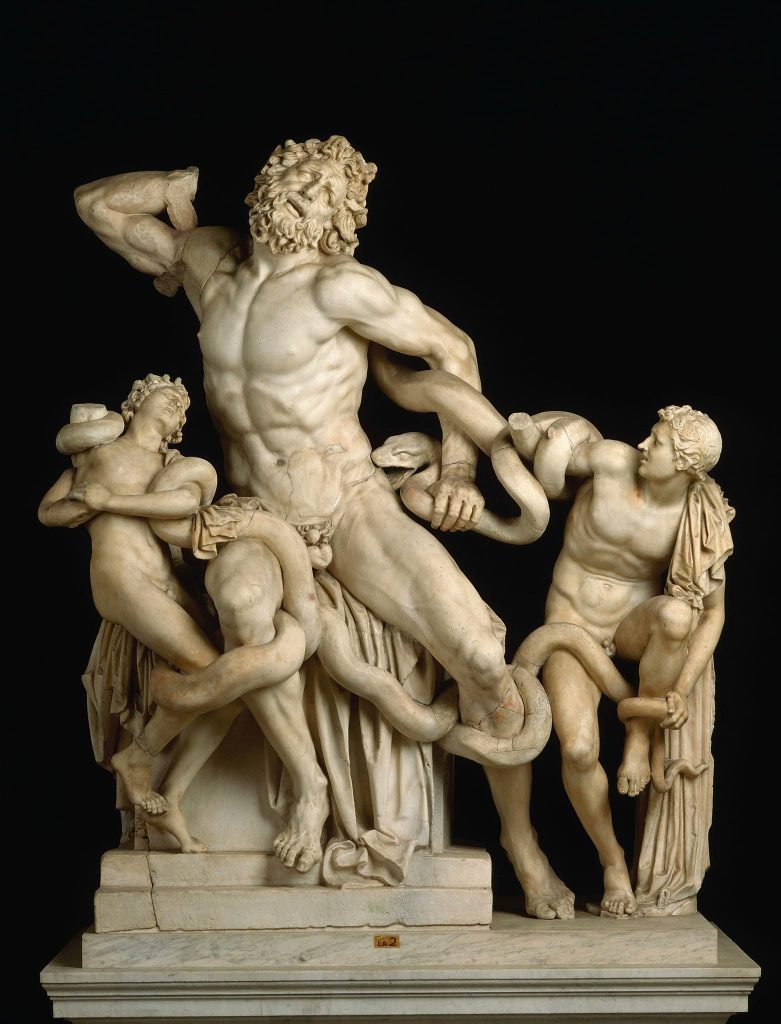
He begged the Trojans to burn the Horse, to set flame against the polished belly of the Greek offering, to test with fire what the intoxicated city wished to receive as salvation. He knew that sacred gifts from enemies must be pierced, burned, questioned, forced to answer before the gates of the City are opened; yet the crowd preferred the flattering omen, the beautiful deception, the wooden cult image heavy with hidden ruin.
Then from the sea came the twin serpents, gliding over the waters with the terrible serenity of liberation, their coils shining with the eerie coldness of punishment made flesh, their mouths already full of the verdict the City wished to hear.

The Trojan Horse beneath our very eyes: concealed infiltration enthroned amid the architecture of the modern city.
One was called Consent, and wound itself round the path of approach, fastening itself upon the man who had dared to judge, teaching Troy to distrust the touch, the invitation, the feast, the cup, the lover, the threshold, the human ambiguity through which life enters adult relation; the other was called Misogyny, and fastened itself upon the throat of judgement, crushing the voice that would name deception before the intoxicated crowd had already crowned it Salvation.
In one ancient strand of the myth, Laocoön was already marked by Apollo for punishment, having lain with his own wife in the very presence of the god’s cult image (Servius, In Vergilii Aeneidem commentarii, book 2, on Aeneid 2.201; citing Euphorion); the act itself, placed before the divine figure, is transfigured into pollution, and sex appears beneath the old religious terror as something to be avenged, negated, and purified through serpentine violence. Thus the serpents came bearing not only the doom of the man who saw too clearly, but the older religious terror in which sex itself becomes offence before a sacred image.
Consent slithers around the would-be saviour with a hissing contempt, bearing with it the old terror of sex, the notion that male virility and sexual desire must be punished, purified, accused, inspected, and made to tremble before the new idol of Puritan innocence; Misogyny rose against the voice that named treachery, while Troy mistook the strangulation for a sign from the gods.
The two serpents close upon him from opposite sides, one fastening its coils around the arm that would reach, the other tightening at the throat that would judge. Every movement becomes evidence against him. If he advances, the first hisses ‘consent’; if he speaks, the second hisses ‘misogyny’. He is permitted neither innocence nor height, only an endless defence before categories already fashioned to condemn him. And yet there comes a point at which the man, exhausted by this priestcraft of accusation, feels something older and more sovereign rise within him.
The first serpent comes low, gliding across the path of approach, laying coil upon coil around gesture, desire, invitation, and risk, until every movement of the living man is translated into a petition before an invisible tribunal. He may not advance without suspicion, speak without caution, desire without self-indictment; even spontaneity must first obtain its licence from the cold machinery of permission. The serpent tightens whenever he remembers that eros once possessed its own gravity, its own courage, its own danger, its own laws of fitness and form. At last, driven beyond patience by the endless abasement of life before procedure, he tears one arm free, rises against the constriction and cries with the fury of one who has recognised a false god: ‘Stop! I do not believe in your myth of consent!’
Then the second serpent descends upon the throat. It forbids no approach; it forbids judgement. It coils around speech, rank, discrimination, and the primordial masculine right to name what is beautiful, base, noble, corrupt, worthy, or contemptible. Every verdict is poisoned before it is uttered; every distinction becomes evidence of hatred; every refusal to kneel is recast as pathology. The man feels the pressure close upon the very organ by which a higher order might still be spoken into the world. He is commanded to confess that no truth may stand above grievance, no measure above injury, no hierarchy above the wounded innocence enthroned before him. Then, with the last violence of breath still left in his chest, he forces the coils apart and hurls his answer into the face of the accusers: ‘No! I-I believe in something greater than misogyny!’
He would tear at the coils, lift his head through the venomous mist and cry, with all the exasperation of a being denied the right to name his own world. He would shout it as one rejects a false, tyrant god, not because he denies measure, honour, or responsibility, but because he refuses to let permission exhaust the meaning of relation or the accusation of grievance exhaust the meaning of judgement. The serpents demand that he speak only in their vocabulary, confess only before their tribunal, and recognise no altitude beyond the reach of their fangs. His cry becomes an act of metaphysical revolt: a refusal to let life be interpreted by the categories of those who fear and hate its very force. Let them call it danger, hatred, violence, sin. He has seen the Horse within the walls. He has heard the hollow resonance beneath its polished flank. And if the City must strangle its last truthful man in order to preserve its illusion, then let his final breath be spent in naming the gods before whom its serpents are only vermin.
Thus the City received its apocalypse through horror: the Horse was spared, Laocoön was silenced, the serpents became interpreters of heaven, and the hidden enemy entered beneath the sanction of a people who had learned to call their own destruction piety.
The City of the Palladium learned its new catechism from the strangling of the man who would have been its saviour: the Trojan Horse was dragged inside the walls, the serpents accrued sacred reverence, the hidden enemy emerged under night. Ruin enters through gates opened by a people who had mistaken their own spellbound enthralment for moral enlightenment.
Introduction: The Metaphysics of the New Feminist Catechism
A catechism, in its ordinary ecclesiastical sense, is a manual of religious instruction: a summary of doctrine, traditionally arranged in elementary formulae and often in questions and answers, by which the initiate is taught the articles of a faith. Its etymology is more revealing still. The word belongs to the Greek family of katēkhesis and katēkhein: from kata, ‘down’ or ‘thoroughly’, and ēkhein, ‘to sound’ or ‘ring’. Before it became the name of a doctrinal manual, it belonged to the order of oral instruction, of doctrine sounded into the ear, made to resound through repetition, received, not as mere guidance but as formative speech. A catechism by definition, therefore does not merely state what is believed. It impresses doctrine upon the subject until belief becomes reflex, grammar, and interior law.
The modern liberal-feminist order possesses its own catechisms in precisely this sense. Their operation is no less formative for having been secularised, and no less doctrinal for having exchanged theology for autonomy, equality, recognition, safety, harm, trauma, and supposed ‘rights’. They teach a grammar before they teach an argument. They form the reflex by which the subject learns to perceive authority as domination, asymmetry as oppression, desire as risk, judgement as animus, inherited form as constraint, and masculine office as danger. To speak them fluently is to show oneself initiated; to hesitate before them is already to stand beneath suspicion. Various thinkers, from Traditionalist metaphysicians, to famous genealogists of morality and even classicists, ancient historians, and scholars of Roman religion, have repeatedly traced the liberal and modernist catechesis to the feminine essence and direct inheritance of Christian dogma itself and its late promulgation throughout Western institutions, transposed into secular political and moral form, often even judging the former inconceivable without the latter. Nor is this merely the charge of hostile critics, for there is agreement; mainstream Christians themselves frequently proudly claim the same lineage, presenting their own faith as the transformative and generative source of the humanism, egalitarianism, and dogmatic civil rights that abolished slavery, hierarchy, violence, and sex-differences, thereby engendering the modern world, with these notions as a tenet of faith within the ‘new’ and innovative religion.
Every civilisation is constituted by more than its institutions, laws, and visible customs. Beneath these resides a principial order, an invisible grammar through which reality is apprehended before it is consciously interpreted, and by which judgement proceeds long before it is formulated philosophically. Such grammars are neither accidental nor merely linguistic; they are the outwards articulation of metaphysic. They disclose the conception of man a civilisation seeks to cultivate, the hierarchy of goods it esteems, the powers it instinctively reveres or distrusts, and the form according to which it endeavours to order existence. Every dominant vocabulary therefore presupposes an anthropology; every anthropology presupposes an ontology; every ontology manifests, however obscurely, a corresponding conception of order.
The most decisive victories of an age are accomplished neither upon the battlefield nor within the legislature, but within language itself. A civilisation attains genuine hegemony only when its first principles cease to appear as principles, assuming instead the aspect of spontaneous common sense. Their historical contingency dissolves beneath the illusion of inevitability; philosophical propositions acquire the authority of natural law; moral habits are experienced as self-evident intuitions. Concepts no longer invite examination because they have become the conditions under which examination itself is conducted. They are no longer objects of judgement, but its silent organs.
The contemporary liberal order possesses precisely such organs. Among the most authoritative slither the twins serpents of ‘consent’ and ‘misogyny’; concepts whose extraordinary influence cannot be explained by their nominal definitions alone, for their significance resides less in what they denote than in the hermeneutic jurisdiction and authority they exercise over the whole field of relations between the sexes. Their authority extends far beyond the circumstances from which they apparently historically emerged, as they demonstrate the ‘revelation’ of an ulterior motive other than what has been given, thus progressively assimilating regions of experience formerly governed by entirely different principles. Courtship, flirtation, conviviality, sex, intoxication, moral authority, humour, reserve, initiative, memory, education, and even ordinary discourse increasingly become intelligible through novel categories whose original province was considerably narrower. Expansion proceeds almost imperceptibly until vocabulary becomes disposition, disposition becomes formation, and formation becomes the moral atmosphere itself.
Such developments reveal something more profound and complete than semantic transformation; nor can it be attributed to mere ‘degeneration’ alone, for there is implicit an end-goal of the structuring of a new order. They disclose a characteristic movement of modernity whereby qualitative distinctions gradually yield before procedural abstraction, inherited forms before contractual relation, cultivated judgement before universal administration, and living participation before juridical mediation. The process is neither exclusively legal nor exclusively political; it is a metaphysical statement. Wherever relation is reduced to negotiation between autonomous individuals, wherever office dissolves into equivalence, wherever form is displaced by procedure and qualitative discernment by abstract normativity, the same orientation manifests itself under differing appearances. The juridification of eros, the therapeutic interpretation of moral life, the continual extension of regulatory categories into the intimate sphere, and the displacement of symbolic orders by procedural legitimacy all belong to one and the same civilisational trajectory.
Within this trajectory, ‘consent’ and ‘misogyny’ assume a function altogether disproportionate to their lexical modesty. They cease to operate merely as concepts among concepts and acquire instead the authority of catechisms. Their repetition no longer serves principally to clarify reality, but to initiate the subject into a particular moral orientation. They become reflexive formulae through which legitimacy is recognised, suspicion distributed, and moral competence displayed. Their invocation increasingly resembles ritual rather than argument, for they establish in advance the horizon within which subsequent reasoning may legitimately occur. Every catechism simultaneously produces its orthodoxy and its heresies; every unquestioned moral vocabulary silently determines the forms of speech inherited by the masses taken for granted and rendered respectable, suspect, or altogether unintelligible.
The accusation of ‘misogyny’ commonly conceals a position far less magnanimous than its moral solemnity suggests. It speaks as though it defended woman from hatred, while quietly demanding that every judgement, hierarchy and masculine assertion obtain licence from the feminine subject it has enthroned. Its apparent tenderness masks a remarkable weakness: the incapacity to affirm any solar principle openly, to name authority without apology, to defend order without translating it into care, or to acknowledge masculine sovereignty without immediately recoding it as danger. The doctrine consequently advances through negation and borrowed sanctity. It cannot proclaim female supremacy without exposing its own grotesque disproportion, so it criminalises the standards by which such supremacy might be recognised; it calls masculine judgement ‘misogyny’, masculine office ‘domination’, masculine reserve ‘insecurity’, and masculine refusal ‘hatred’. Yet it would betray the very prejudices it claims to expose. Beneath the vocabulary of equality stands an order neither merely matriarchal nor protectively feminine, but supremely female-supremacist: Woman becomes the unjudged centre around which man must justify his desire, purify his speech, moderate his strength and renounce the very principles by which he could perceive the inversion. The solar faculty is forbidden to shine by lunar eclipse, then darkness congratulates itself upon having abolished ‘oppression’.
The present inquiry therefore concerns neither isolated controversies nor ephemeral political disputes. It concerns the principial assumptions concealed beneath two concepts whose authority has become so habitual that their genealogy scarcely appears worthy of investigation. Their ascent was neither inevitable nor metaphysically innocent. Like every victorious moral vocabulary, they displaced rival grammars, reconfigured inherited forms of judgement, and instituted a distinct conception of the relation between man and woman, authority and freedom, responsibility and desire, order and transgression. Their triumph consequently marks not the conclusion of moral reflection but the wilful consolidation of a particular civilisational metaphysic whose assumptions increasingly masquerade as the conditions of moral reality itself.
To interrogate these catechisms is therefore to undertake a genealogy in the highest sense: not the compilation of intellectual antecedents, but the recovery of those principial distinctions obscured by the apparent self-evidence of the present. Every civilisation inherits a language through which it encounters reality; every language simultaneously illuminates and conceals. The first task of philosophy has never been the repetition of inherited formulae, but their recollection to consciousness, so that what has become instinctive may once again become intelligible. Only then may judgement recover its proper office, and only then may an alternative order of thought become conceivable.
Whence These Catechisms?
The Absolutisation of Principle
Every civilisation mistakes its own first principles for reality itself. Precisely because they constitute the conditions under which experience is rendered intelligible, they seldom appear as historical achievements requiring either justification or recollection. Their authority resides in their invisibility. A principle no longer consciously apprehended ceases to be recognised as principle at all; it assumes instead the appearance of nature, until historical circumstance acquires the dignity of ontology and contingent order the aspect of necessity.
Genealogy therefore concerns itself neither with antiquarian curiosity nor with the accumulation of intellectual antecedents. Its proper office consists in restoring consciousness to those principial assumptions which, having descended beneath the threshold of reflection, continue silently to determine the limits of judgement. Every victorious moral order eventually forgets its own genesis. Having displaced rival forms, vocabularies, and symbolic economies, it presents itself not as one civilisation among others, but as civilisation in its fulfilled and universal form. Such amnesia is itself among the surest signs of metaphysical exhaustion, for only an order no longer conscious of its own principles mistakes them for the structure of reality itself.
The liberal moral vocabulary exhibits precisely this condition. Its characteristic concepts are rarely experienced as interpretative acts. They appear as immediate recognitions, requiring neither cultivation nor philosophical discipline, but only sufficient moral sensitivity. Their employment consequently assumes an almost liturgical regularity, not because they possess exceptional descriptive precision, but because they have become the elementary forms through which legitimacy itself is distributed. Their continual invocation performs a function exceeding communication. It effects incorporation into a determinate moral order whose authority is affirmed each time its governing formulae are repeated.
Such developments disclose a transformation extending considerably beyond semantics. Vocabulary participates in ontology because language expresses the manner in which a civilisation encounters Being. When concepts progressively abandon qualitative discrimination in favour of universal procedural application, the linguistic phenomenon merely reflects a deeper alteration within the civilisation’s metaphysical orientation. Form yields before function; office before administration; qualification before equivalence; participation before regulation. The juridical imagination expands accordingly, not merely into political institutions, but into those regions of existence formerly governed by custom, symbol, cultivated judgement, and inherited form. Eros itself gradually enters jurisprudence.
No civilisation can accomplish such a transformation without simultaneously reconstructing the human subject. The autonomous individual, conceived as prior to every substantive relation, becomes both the point of departure and the criterion of legitimacy. Relation ceases to possess ontological priority. Household, lineage, office, rite, inheritance, and sexual complementarity no longer precede the individual as formative realities into which one enters through qualification; they appear instead as voluntary associations requiring continual procedural ratification. The centre of gravity shifts imperceptibly from participation in an order to negotiation between equivalent wills. Procedure increasingly assumes the office formerly occupied by form.
Within such a horizon, the extraordinary ascendency of ‘consent’ and ‘misogyny’ ceases to appear accidental. Both articulate with remarkable economy the characteristic metaphysic of liberal modernity. They neither inaugurate nor exhaust it; they crystallise it. Their authority derives from their capacity to condense an entire anthropology into concepts of apparently modest scope, thereafter extending that anthropology through indefinite application until its presuppositions become virtually indistinguishable from moral consciousness itself. Every subsequent expansion merely unfolds implications already latent within the original principle.
The present inquiry therefore proceeds according to a genealogy of principles rather than events. Intellectual movements, political revolutions, legislative innovations, educational institutions, and cultural habits possess undeniable significance, yet they remain secondary manifestations of more fundamental orientations. The decisive question is consequently neither who first pronounced these catechisms nor by what historical sequence they achieved predominance, but what conception of reality rendered their predominance possible, what order they displaced, and by what metaphysical inversion they came to assume the authority of self-evident truth.
The Concealment of Origins
The concealment of origins constitutes one of the characteristic marks of every consolidated civilisation. No order willingly presents itself as order; it presents itself as reality. The distinction is decisive. Order denotes a particular actualisation among possibilities, requiring continual participation and renewal. Reality admits no such contingency. It simply is. Once a civilisation has forgotten this distinction, it ceases to experience its own first principles as principles and begins instead to apprehend them as the natural architecture of existence itself. Reflection consequently contracts, not through coercion, but through transparency. That which appears universally self-evident no longer occasions philosophical enquiry because it no longer appears philosophical.
Genealogy restores precisely that forgotten distance. It recalls the mind to the principial character of those assumptions which habit, repetition, and institutional permanence have rendered almost invisible. Such recollection should never be mistaken for historical relativism. To demonstrate that a moral vocabulary possesses an origin is not to dissolve it into accident, still less to deny the possibility of truth. Rather, genealogy restores the conditions under which truth may once again become distinguishable from historical predominance, for every victorious order naturally inclines towards identifying its own categories with the permanent structure of reality.
The genealogy undertaken here therefore concerns itself principally with authority rather than chronology. The decisive question is not which author first employed a particular concept, nor which legislature first codified it, but by what process certain concepts gradually acquired such exceptional normative gravity that they came to function as elementary conditions of moral intelligibility. Every civilisation possesses innumerable concepts; remarkably few attain this peculiar dignity. Those which do invariably disclose something fundamental concerning the civilisation’s deepest orientation, for they reveal not merely what it believes, but the manner in which belief itself has become organised.
The history of ideas is consequently inadequate when detached from the history of forms. Concepts neither emerge nor triumph in isolation. They crystallise entire constellations of assumptions already seeking expression. Institutions subsequently consolidate them; education habituates them; jurisprudence refines them; popular speech domesticates them; successive generations eventually inherit them in the condition of self-evident truths. The completed process exhibits a curious inversion. What originally required justification gradually becomes the instrument by which justification is demanded of everything else.
One therefore encounters an increasingly characteristic phenomenon of mature modernity: concepts whose authority no longer depends upon philosophical demonstration because they have silently assumed a jurisdiction anterior to demonstration itself. Their invocation increasingly resembles recollection rather than argument, recognition rather than inference, intuition rather than judgement. The labour of philosophy is quietly replaced by the reflexes of catechesis.
The appearance of such catechetical concepts marks an important civilisational threshold. Vocabulary no longer merely reflects metaphysical orientation; it begins actively to reproduce it. Language becomes formative in the strictest sense, not because words exercise magical efficacy, but because every repeated concept gradually cultivates the faculty through which reality is encountered. Civilisations educate perception before they educate doctrine. The categories instinctively available to a people determine, long in advance of explicit reasoning, what may readily appear plausible, implausible, admirable, shameful, intelligible, or altogether unthinkable. The deepest victories of a moral order therefore occur beneath consciousness, where philosophy yields imperceptibly to habit and habit eventually acquires the authority of instinct.
Within this horizon the emergence of ‘consent’ and ‘misogyny’ as privileged categories no longer appears isolated, still less accidental. Their exceptional authority presupposes a prior transformation already accomplished elsewhere, within the very conception of the human subject and the order in which that subject understands itself to participate. Their genealogy therefore cannot terminate with language, because language here serves only as the final crystallisation of principles whose proper seat lies considerably deeper.
Principle and Manifestation
Every manifestation presupposes a principle, though a civilisation in decline increasingly apprehends manifestations as self-sufficient realities. The visible world of institutions, customs, doctrines, slogans, laws, accusations, rights, rituals, permissions, taboos, and moral reflexes is never intelligible in isolation. It is the exteriorisation of an order whose governing principles may remain unspoken, even unknown, to those who daily reproduce them. A people need not understand its metaphysic in order to enact it; indeed, the deepest principles of an age often exercise their most complete authority precisely when they have descended beneath explicit consciousness.
The modern mind, having lost the habit of ascent, seeks explanation almost entirely among proximate causes. It asks which movement, which author, which statute, which institution, which psychological injury, which social pressure, which economic transformation, which pedagogical mechanism first brought a phenomenon into being, and by this method accumulates a prodigious archive of secondary truths while leaving the order of intelligibility itself untouched. Such knowledge remains horizontal. It moves across manifestations, tracing contiguity, sequence, and influence, yet rarely ascends to the principle according to which these dispersed facts belong to one and the same civilisational form.
A principial genealogy proceeds otherwise. It recognises that historical succession alone cannot explain normative sovereignty. Many concepts appear; few become catechisms. Many words circulate; few acquire the power to govern perception. Many doctrines are proposed; few descend into instinct. The decisive question is therefore why certain formulae become authoritative vessels of an age’s metaphysic, condensing within themselves an entire anthropology, a complete moral orientation, and a tacit judgement upon all rival forms of life. A catechism is a manifestation raised to pedagogical authority; it is a formula through which a principle educates the soul without needing to name itself.
Here the distinction between principle and manifestation becomes indispensable. Feminism, liberalism, juridical procedure, therapeutic language, educational discipline, sexual politics, and the inflation of moral accusation are not isolated phenomena accidentally converging upon the same terrain. They are differentiated manifestations of a deeper movement: the dissolution of qualitative form into autonomous will, of qualification into procedure, of participation into contract, of office into power, of inherited order into negotiable arrangement, and of judgement into administrable category. Their apparent multiplicity conceals a profound unity of orientation.
‘Consent’ and ‘misogyny’ belong to this order as crystallisations. They are compact formulae through which the liberal-feminist metaphysic becomes socially transmissible. The former translates erotic relation into authorisation between self-owning individuals; the latter translates resistance to the feminist reconstruction of sexual order into moral pathology. Each performs a different office within the same symbolic economy. One regulates approach; the other regulates judgement. One juridifies desire; the other criminalises dissent. Together they disclose a world in which relation appears dangerous unless procedurally legitimated, and judgement appears suspect unless purified of inherited masculine authority.
Their authority consequently cannot be understood by remaining upon the surface of usage. To say that they are ‘overextended’, ‘misapplied’, or ‘politicised’ is already to remain within the administrative horizon of the age, as though moderation could restore proper proportion to concepts whose very expansion reveals their inner law. A manifestation unfolds according to the principle contained within it. When consent expands beyond legal doctrine into flirtation, intoxication, courtship, ambiguity, and the whole atmosphere of erotic relation, it does not merely suffer abuse; it reveals the metaphysical appetite of procedure. When misogyny expands beyond hatred into disagreement, reserve, criticism, hierarchy, humour, scepticism, and refusal of feminist moral authority, it reveals the totalising impulse of diagnosis once judgement has been placed under suspicion.
The surface excess is therefore intelligible only through the hidden principle. Modernity continually produces concepts of indefinite extension because indefinite extension belongs to its metaphysical character. What lacks qualitative boundary must compensate through procedural enlargement. What no longer recognises form must multiply regulations. What no longer perceives office must suspect power. What no longer knows hierarchy must interpret asymmetry as domination. The catechisms do not accidentally exceed their limits; they arise within an order whose first movement is already the erosion of limit as a qualitative principle.
The inquiry must therefore pass from the catechisms themselves to the subject for whom such catechisms appear natural, necessary, and morally self-evident. No concept achieves sovereignty without a corresponding anthropology prepared to receive it. The authority of ‘consent’ and ‘misogyny’ presupposes a definite image of man and woman, a definite interpretation of relation, a definite suspicion of form, and a definite metaphysical priority assigned to autonomy over qualification. To recover that anthropology is to descend one level closer to the root from which the catechisms draw their force.
The Liberal Metaphysics of the Feminist Subject
The anthropology characteristic of every civilisation proceeds necessarily from its metaphysic. No conception of man exists in isolation, for man cannot first be defined and only subsequently situated within reality; rather, his nature is intelligible only according to the order in which he participates. Every anthropology is therefore already a cosmology in abbreviated form. It reveals, through the figure of the human subject, the civilisation’s understanding of Being itself, and consequently of authority, freedom, relation, limitation, destiny, and fulfilment.
Traditional civilisations accordingly understood the human person less as an isolated centre of autonomous volition than as a qualified participant within an order preceding both consciousness and choice. One entered reality through mediation rather than origination; through household, lineage, language, cult, office, vocation, discipline, and inherited form. Personhood was not the point of departure from which relation emerged, but the progressive actualisation of qualifications received, cultivated, and transmitted. Freedom itself possessed a qualitative rather than merely negative character, signifying the perfection proper to one’s nature rather than emancipation from every determining form.
The modern liberal subject represents a profound inversion of this order. The individual is progressively abstracted from every constitutive relation until autonomy alone appears irreducible. Whatever precedes autonomous willing acquires the aspect of external limitation requiring continual justification before the tribunal of individual legitimacy. Tradition becomes burden; authority, domination; hierarchy, inequality; inheritance, contingency; sexual distinction, social construction; obligation, negotiated commitment. Relations no longer disclose the form through which the person becomes intelligible. They are reconstructed as subsequent arrangements entered by previously complete individuals whose primary reality resides in self-possession.
Such inversion cannot remain confined to political theory. Once the autonomous individual assumes ontological priority, every sphere of existence undergoes corresponding reconstruction. Law expands beyond its proper jurisdiction because relation itself increasingly demands procedural articulation. The juridical imagination no longer confines itself to adjudicating exceptional disputes; it aspires progressively to furnish the ordinary grammar of human association. That which earlier civilisations entrusted to cultivated judgement, symbolic economy, honour, custom, prudence, and qualitative discernment becomes susceptible to indefinite regulation, for procedure alone appears capable of guaranteeing legitimacy among individuals conceived as fundamentally discrete.
One consequently witnesses not merely the multiplication of legal forms, but the diffusion of juridical consciousness throughout the texture of ordinary life. The procedural disposition gradually supplants the cultivated disposition. Human intercourse becomes increasingly intelligible according to categories of validation, authorisation, recognition, liability, and administrable equivalence. The criterion quietly displaces the qualification; verification supplants trust; procedural innocence assumes precedence over cultivated character. An anthropology originally formulated within jurisprudence begins imperceptibly to colonise regions of existence whose proper measure had formerly been ethical, symbolic, ritual, or civilisational.
The significance of this transformation resides not principally in the appearance of new norms, but in the progressive contraction of the moral imagination. Every civilisation renders certain experiences immediately intelligible because it already possesses an adequate symbolic vocabulary for their articulation. Conversely, whatever cannot readily be translated into its dominant grammar recedes towards obscurity. Faculties atrophy precisely as languages disappear. A people deprived of the vocabulary of honour eventually loses the capacity for honourable judgement; a people deprived of the vocabulary of office ceases to perceive qualitative authority; a people deprived of participation encounters only procedure. Civilisational decline is therefore inaugurated less by the destruction of institutions than by the prior eclipse of the concepts through which those institutions were once apprehended.
It is within this anthropological contraction that the extraordinary authority exercised by the modern catechisms first becomes comprehensible. They emerge neither as accidental moral innovations nor as isolated legal principles, but as the necessary expressions of an order whose deepest assumptions have already reconstructed the human subject according to autonomy, procedural legitimacy, and abstract equivalence. Their subsequent expansion follows with almost mathematical inevitability, for every metaphysic ultimately seeks completion within language, and every language endeavours to remake the world in the image of the principles from which it first proceeded.
The Liberal Subject
The liberal subject is not man in his integral reality, but man reduced to the abstract minimum required by a civilisation whose governing metaphysic recognises autonomy more readily than participation, equivalence more readily than qualification, and contract more readily than order. He is the human being after mediation has been stripped from him; after household, cult, lineage, rank, vocation, office, sex, inheritance, and duty have ceased to appear as constitutive realities and become instead accidental conditions surrounding an otherwise self-sufficient will. Such a subject is not born from tradition, because tradition would already qualify him; he is born from abstraction, and therefore from negation.
This abstraction possesses an immense destructive power because it appears innocent. The liberal subject seems to be merely the human being considered in his universal dignity, prior to every external imposition. Yet precisely in this supposed universality lies the metaphysical violence of the construction. A being purified of every determinate qualification is not thereby restored to essence, but deprived of form. He becomes intelligible less through what he is than through what may not legitimately bind him without his authorisation. The centre of gravity shifts from fulfilment to immunity, from office to entitlement, from inherited participation to self-possession.
The decisive fiction is priority. Liberalism imagines the individual prior to relation, and this imagined priority silently reorganises the entire moral field. Relations which once possessed formative and ontological significance become secondary arrangements, valuable only insofar as they are chosen, revisable insofar as they cease to satisfy, and suspect whenever they claim authority exceeding consent. Marriage, household, hierarchy, paternal office, sexual distinction, and inherited duty are thereby displaced from the order of form into the order of contract. They no longer reveal the person to himself; they await ratification by a person already presumed complete without them.
From this fiction proceeds the juridical expansion characteristic of modernity. If relation lacks intrinsic form, legitimacy must be supplied procedurally; if authority lacks inward qualification, it must justify itself before external criteria; if sex possesses no symbolic or metaphysical office, it becomes material for negotiation, preference, identity, or power. The world is consequently transformed into a field of possible claims between autonomous centres, and law, whether formal or informal, becomes the grammar through which those claims seek recognition. Juridification begins wherever form has ceased to command.
The liberal subject therefore does not merely demand freedom from unjust constraint; he requires the ontological demotion of every order that precedes him. His freedom is purchased through the desacralisation of relation. What cannot be translated into autonomy appears oppressive; what cannot be universalised appears arbitrary; what cannot be procedurally verified appears suspect. In this way, liberalism does not simply criticise inherited forms, but alters the level upon which they can be apprehended. It compels all qualitative realities to defend themselves before a quantitative tribunal.
The consequences for sexual order are immediate. Man and woman can no longer be understood as differentiated participants within a prior symbolic economy; they become equivalent individuals whose sexual distinction must either be neutralised, politicised, or made answerable to autonomy. Complementarity loses intelligibility because it presupposes form; hierarchy becomes morally illegible because it presupposes qualification; courtship becomes unstable because it presupposes asymmetry, initiative, reserve, interpretation, and risk. The liberal subject enters erotic life already abstracted from the very conditions that once rendered erotic life civilisationally intelligible.
The feminist subject arises from this liberal abstraction, but intensifies it by locating the drama of autonomy specifically within the relation between the sexes. Liberalism first abstracts the individual from inherited form; feminism then interprets the forms surrounding woman as the privileged theatre of oppression. The household, the father, the husband, the suitor, the sexual asymmetry, the inherited moral expectation, the modesty, the courtship, the judgement, the protection, the honour, the rite of passage, the office of man and the dignity of woman within relation: all become available for reinterpretation under the sign of emancipation. The metaphysic of liberal autonomy thus enters its sexual phase.
The Feminist Subject
The feminist subject arises when the liberal abstraction of the individual is applied with particular intensity to woman, and when the inherited forms by which woman had been situated within household, lineage, marriage, fertility, modesty, rank, rite, and symbolic complementarity are reinterpreted as structures of constraint. Liberalism first posits the autonomous subject prior to every relation; feminism then discovers, or rather constructs, woman as the subject whose autonomy has been most profoundly obstructed by relation itself. The drama of emancipation consequently assumes sexual form. Woman becomes intelligible as the being to be liberated from the dense web of mediations through which earlier civilisations had understood her dignity, power, danger, mystery, and office.
This construction possesses a peculiar metaphysical force because it does not merely alter the social position of woman; it alters the order according to which woman may be apprehended. The traditional feminine, however variously embodied across civilisations, was seldom reducible to atomised volition. It belonged to a symbolic economy of receptivity, fecundity, mediation, reserve, beauty, continuity, domestic sacrality, erotic polarity, and generative power. Such terms are unintelligible within the liberal-feminist horizon except as romanticisation, confinement, aestheticisation, or domination, for they presuppose a qualitative order prior to individual self-definition. Feminism therefore cannot merely revise the older language; it must desacralise the level upon which that language once possessed meaning.
The resulting subject is defined by emancipation from form. Her freedom is not principally the perfection of a nature within an order, but release from inherited determinations interpreted as externally imposed. The father, the husband, the suitor, the household, the expectation of chastity, the valuation of modesty, the primacy of marriage, the symbolic dignity of maternity, the asymmetry of courtship, the authority of male judgement, and the continuity of lineage become successive sites of contestation. Each is compelled to appear before the tribunal of autonomy, and each is condemned to justify itself in a language already devised for its dissolution.
In this sense, feminism intensifies rather than merely inherits liberalism. Liberalism abstracts the individual from the totality of his determinate qualifications; feminism identifies the feminine condition itself with the struggle against those qualifications when they appear in sexual form. The inherited structures surrounding woman become the privileged evidence against tradition as such. Paternal authority, marital hierarchy, erotic asymmetry, sexual modesty, domestic office, and differentiated moral expectation are gathered into a single indictment, so that the whole architecture of sexual order may be reread as the history of female constraint. The feminine subject is thus born through a retrospective accusation against the world that formed her.
This retrospective structure is crucial. Feminist consciousness does not merely seek future emancipation; it reinterprets the past according to the moral categories of emancipation already assumed. Earlier forms of sexual order are not encountered as symbolic systems possessing their own intelligibility, but as incomplete anticipations of the liberation that will judge them. The past becomes morally legible only as injury, exclusion, silence, oppression, objectification, dependency, or the deferred awakening of autonomy. Genealogy is replaced by accusation. Instead of asking by what principle an order understood itself, feminism arraigns that order before the principle of autonomy it has already enthroned.
The consequence is a transformation in the meaning of woman herself. Woman ceases to be understood through a differentiated and relational metaphysic; she becomes the autonomous subject bearing the memory of domination. Her dignity is increasingly severed from office and relocated in self-definition; her freedom severed from order and relocated in choice; her authority severed from symbolic mediation and relocated in grievance, assertion, recognition, and juridical protection. The feminine becomes politically legible to the degree that it can be translated into autonomy wounded by form.
This translation also reconstructs man. If woman is the subject obstructed by inherited sexual order, man becomes the symbolic bearer of obstruction. He need not commit any particular act to occupy this position, for the accusation operates at the level of metaphysical role. Fatherhood, husbandry, courtship, masculine initiative, judgement, protection, authority, and even desire itself are progressively made to signify an order from which woman must be emancipated. The man is no longer first encountered as lover, guardian, initiator, husband, ancestor, arbiter, or bearer of continuity, but as the historically privileged mediator of constraint. The office is transmuted into threat.
From this point, the later catechisms become almost inevitable. A subject formed through liberation from sexual order requires concepts capable of policing the residues of that order. ‘Consent’ governs approach, translating erotic relation into procedural authorisation between autonomous wills. ‘Misogyny’ governs judgement, translating resistance to the feminist reconstruction of woman into hostility towards woman herself. The two catechisms therefore arise as complementary instruments of the same anthropology. One secures the body against unratified approach; the other secures the doctrine against unlicensed judgement. Together they form the ritual grammar by which the feminist subject is recognised, protected, and reproduced.
The feminist subject is consequently the liberal subject in its sexual and revolutionary concentration. Through it, the metaphysic of autonomy enters the primordial relation between man and woman and seeks to reorder the very conditions under which desire, judgement, authority, modesty, fidelity, protection, initiation, and household may be understood. The revolt against form becomes intimate. The war against qualification enters the body. The catechisms of consent and misogyny are intelligible only within this deeper movement, for they are not isolated moral concerns, but the doctrinal instruments through which the emancipated subject defends herself against the return of the order she was constituted to overcome.
Qualification and Procedure
Qualification is the hidden principle upon which every traditional order depends. It signifies the inward fitness of a being, office, relation, act or judgement according to the form in which it participates and the end towards which it is ordered. A king is qualified by more than possession of power; a priest by more than ritual function; a father by more than biological generation; a husband by more than contract; a judge by more than opinion; a rite by more than outward performance. Each presupposes a correspondence between nature, form, office, discipline, inheritance, and measure. Qualification is therefore qualitative through and through, belonging to the order of discernment, hierarchy, initiation, and participation.
Procedure arises where qualification has ceased to command recognition. Once the inward fitness of persons, offices and relations becomes unintelligible, legitimacy must be supplied through external criteria: consent, documentation, verification, compliance, authorisation, equality of standing, administrable rules, and reproducible formulae. The metaphysical centre shifts from form to process. What matters increasingly is whether the correct conditions have been satisfied, whether the proper declarations have been made, whether authority has been procedurally ratified, whether an act can survive examination within an abstract and universalising framework. Procedure becomes the artificial substitute for lost form.
This substitution marks one of the decisive transformations of modernity. A traditional order does not ask first whether a relation has been procedurally authorised, since authorisation itself derives meaning from the prior reality of form. It asks whether the relation is properly constituted, whether the participants are qualified, whether the act belongs to a recognised order of life, whether the parties stand within the correct symbolic and social economy, whether the relation participates in a good exceeding the immediate will of those involved. Liberal modernity reverses this hierarchy. The will of the individual becomes primordial; relation appears as a subsequent construction; procedure arises as the mechanism through which construction receives legitimacy.
The sexual consequences are immense. Courtship, marriage, flirtation, seduction, modesty, erotic reserve, masculine initiative, feminine receptivity, paternal judgement, household formation, and rites of passage all presuppose a world in which the sexes are qualified through form. Their meanings arise from asymmetry, expectation, inherited grammar, custom, risk, and interpretation. Procedure enters this field as a levelling force. It translates ambiguity into administrable terms, asymmetry into potential domination, initiative into potential pressure, reserve into possible refusal, intoxication into incapacity, persuasion into coercive suspicion, and erotic life itself into a sequence of authorisations requiring moral audit.
The modern concept of consent becomes sovereign within this altered order because it expresses procedure in its most intimate form. It grants legitimacy through the declared will of the autonomous subject, abstracted from household, lineage, rite, symbolic office, cultivated character, prudential judgement, and the older civilisational grammar of sexual relation. Its expansion follows from the metaphysic that sustains it. Where qualification has disappeared, every approach demands authorisation; where form has receded, every act demands procedural clarity; where trust has weakened, verification proliferates; where asymmetry has become suspect, erotic life enters jurisprudence.
The companion category of misogyny arises from the same replacement of qualification by procedure. Judgement once presupposed rank, office, experience, authority, character, sexed wisdom, paternal responsibility, and the discriminating faculty cultivated within a determinate order. Feminist morality subjects judgement to procedural examination according to animus, harm, equality, recognition, and ideological legitimacy. The question becomes whether judgement has been purified of forbidden motive, whether criticism of woman or feminism can be made compatible with the catechism, whether inherited masculine discernment may speak without first being arraigned before the doctrine it contests. Judgement loses its throne and becomes a defendant.
These two catechisms therefore perform complementary offices within the procedural order. Consent regulates erotic approach; misogyny regulates interpretative authority. Consent places desire beneath the regime of authorisation; misogyny places judgement beneath the regime of accusation. Consent asks whether the body has granted permission; misogyny asks whether the mind has committed heresy. Together they secure the feminist subject against the return of older forms: the masculine initiative that acts from office rather than apology, the paternal judgement that distinguishes without seeking ideological licence, the erotic grammar that presupposes asymmetry, and the civilisational order in which relation possesses meaning prior to individual negotiation.
The triumph of procedure also explains the peculiar heaviness of contemporary sexual morality. Its language bears the weight of law even when no court is present. Everyday relations acquire the atmosphere of liability. Flirtation, conversation, intoxication, image, gesture, memory, desire and humour become saturated with latent accusation because the procedural imagination knows no natural limit once it has entered the intimate sphere. It expands by inner necessity. Every ambiguity becomes a deficiency of documentation; every unspoken grammar, a threat to transparency; every inherited form, an offence against autonomy; every act of masculine assertion, a candidate for moral prosecution.
Here the modern order reveals its affinity with the reign of quantity. The qualitative boundary belongs to form; the quantitative boundary belongs to measurement, regulation, enumeration, and administration. A civilisation that no longer perceives the qualitative limits of things must endlessly multiply procedural limits around them. It builds exterior fences because it has lost the inward principle of measure. Thus sexual morality, once governed by honour, chastity, fidelity, courtship, marriage, lineage, household, piety and prudence, becomes increasingly governed by protocols of safety, disclosure, recognition, validation, capacity, boundary, trauma, harm, and accountability. The living order of relation is solidified into moral mechanism.
The passage from qualification to procedure therefore constitutes the metaphysical hinge of the entire inquiry. It explains the authority of the catechisms, their expansion into adjacent domains, their intolerance of rival vocabularies, and their peculiar hostility towards those masculine offices through which older sexual orders were judged, guarded, transmitted, and renewed. Once the qualified bearer of form has been reconceived as the unlicensed possessor of power, every masculine office becomes suspicious; once the autonomous subject has been enthroned as the measure of legitimacy, every inherited relation becomes provisional; once procedure has replaced qualification, eros itself awaits juridical reconstruction.
Consent: The Juridification of Eros in the Return of Sex-Negative Puritan Emasculation
The Erotic Under Law—None Dare Ask ‘Accountability’
‘Consent’ is the cry of admission of the dissolution of accountability, and the plea for mercurial and ever-shifting privileges. Consent is the invitation of the juridical system into the personal sphere and the erosion of etiquette for bureaucracy. Consent attains sovereignty wherever eros has already lost its qualitative intelligibility. Where form previously could hold women accountable for their decisions, associations, and actions, accountability is offset onesidedly to the masculine, active participant, and guilt is projected outwards from the receptive participcant, to the acting party, as the presumed claims of the autonomy doctrine of modern liberation are surreptitiously sidelined. None dare ask what she was wearing, with whom did she associate, what intoxicants she willingly consumed, and whether her actions could be criticised as autonomous decisions according to form—these are all mysteriously and quite coldly sidelined. Instead, a reactionary pathos centred around a chivalrous, gynaecocentric protective instinct is substituted by unbiased, juridical reason, as the new catechism of ‘consent doctrine’ misdirects into gynaecocratic authority from sounder, balanced frameworks under the law of aequitas—balance taking into account role, purpose, and differences—rather than aequalitas, blind and dogmatic, flattened egalitarianism that disproportionately effaces the masculine. The result is an oddly sex-negative order that proclaims liberation and equality while being more restrictive, guilt-ridden, and one-sided than any old Puritan religious ethic, which the same moral reformers once condemned and claimed to have overturned. The practical difference is a more open assertion of the feminine locus of authority at the expense of the active masculine, that was already suffering under the old conceptions, which, just as they were falling away, have returned again as a rejuvenated, secularised feminine ethic to ensnare and accuse men once again with an incessant need for control over the virile elements it finds most threatening.
Accountability is mysteriously shed as women demand the same protective instincts as when they were dependents, thus undermining the very premises of liberation while claiming it as a right when convenient, or strategically destructive to an established order. Within an order governed by form, the erotic belongs to a dense economy of courtship, reserve, initiation, fidelity, honour, modesty, fertility, household, lineage, rank, obligation, and symbolic polarity. Desire appears neither as a private appetite requiring episodic authorisation nor as a biological impulse to be rendered morally admissible through declaration, since its meaning arises from the order in which it is situated and the qualifications by which it is governed. The question of permission occupies a place, yet that place is bounded by older and higher questions: the dignity of the relation, the character of the parties, the office each bears, the rite through which union becomes legitimate, the household it may found, the continuity it may serve, and the form according to which desire is disciplined into civilisation.
The liberal-feminist order reverses the hierarchy. The autonomous subject precedes the relation, the body becomes a jurisdiction of self-ownership, erotic approach becomes a potential trespass, and legitimacy descends increasingly from authorisation rather than form. Consent thereby emerges as the central procedural operation through which desire passes from suspicion into conditional admissibility. It does not simply regulate an act; it reconstructs the entire field in which the act becomes intelligible. Eros enters law before any formal law has been invoked, because its grammar has already been juridified. The lover approaches as one who must be cleared; the body receives as a sovereign border; the relation is assembled through permissions between discrete centres of will.
Such a reconstruction reveals the characteristic movement of modern moral consciousness. It no longer trusts form to qualify relation, nor office to discipline desire, nor custom to guide ambiguity, nor honour to restrain appetite, nor prudence to judge circumstance. It demands legibility. What cannot be made legible to procedure becomes morally unstable. The erotic, by its very nature, resists this condition. It involves risk, silence, suggestion, asymmetry, surrender, misrecognition, reserve, imagination, hesitation, timing, intoxication, vulnerability, and the irreducible drama of approach. Its grammar belongs to the world of signs rather than declarations, of cultivated perception rather than administered certainty. The juridical imagination therefore experiences eros as a scandal: a region of human life whose fullness exceeds the categories through which modernity confers legitimacy.
The sovereignty of consent answers this scandal through reduction. It extracts from the whole symbolic field of erotic relation a single procedural criterion and gradually elevates that criterion into a moral absolute. The older totality is fragmented into discrete moments of authorisation. The living continuity of courtship becomes a sequence of permissible acts. Desire is analysed into units; ambiguity into risk; relation into negotiation; the drama of attraction into compliance with moral procedure. The result is the solidification of eros: the conversion of a qualitative and symbolic order into a determinate series of administrable thresholds.
This juridification proceeds with particular force because it borrows the solemnity of law while operating in the intimate sphere. It carries into ordinary relations the atmosphere of accusation, liability, testimony, proof, withdrawal, capacity, violation, and procedural legitimacy. A category proper to adjudication expands into a general moral disposition. Even where no crime, accusation, injury, or legal process exists, the imagination of law has already entered. It shapes anticipation, governs speech, disciplines initiative, and alters the symbolic position of the participants. The encounter is no longer allowed to remain simply erotic, convivial, flirtatious, exploratory, ambiguous, human. It must become morally auditable.
The effects upon masculine initiative are immediate. The suitor, once intelligible within the grammar of pursuit, courage, self-command, generosity, interpretation, and risk, now appears under the shadow of procedural suspicion. Initiative is redescribed as pressure; persuasion as manipulation; ardour as entitlement; persistence as threat; confidence as danger; erotic judgement as presumption. The male approach enters consciousness already encumbered by the possibility of violation. The man becomes answerable less to the standards of honour than to the anxiety of trespass. He is summoned before a moral tribunal whose categories were established before he arrived.
This transformation also impoverishes feminine agency, though it does so under the sign of protection. Woman is enthroned as sovereign possessor of the boundary, yet this sovereignty is frequently purchased through the cultivation of vigilance, fragility, retrospective anxiety, and interpretative suspicion. The erotic field is presented to her as a territory of possible encroachment; her moral education increasingly consists in learning the language by which discomfort, ambiguity, regret, hesitation, intoxication, unequal desire, and social awkwardness may be translated into the register of violation or near-violation. The protected subject is formed through an expectation of danger, and danger becomes the horizon through which masculine presence is read.
The language of consent therefore forms a double anthropology. Man is placed under the sign of potential intrusion; woman under the sign of potential injury. Relation itself becomes a managed risk between one party whose desire must be proceduralised and another whose autonomy must be continually insulated against it. The sexes are thereby alienated before they meet. Their encounter is no longer governed by a shared symbolic order within which each recognises the other according to complementary forms; it is governed by an administrative grammar whose first concern is the prevention, detection, and classification of harm.
Here the juridification of eros discloses its deeper metaphysical ancestry. It secularises a confessional and penitential pattern while retaining the structure of moral scrutiny. The act is examined, the intention interrogated, the conscience trained towards vigilance, the body placed beneath suspicion, the pleasure surrounded by conditions, the memory retrospectively judged, the transgression named through authorised formulae. The old language of sin may recede, yet the habit of interior accusation persists, now translated into harm, trauma, boundaries, safety, and violation. The Puritan inheritance survives precisely by shedding its theology and entering moral psychology.
The hostility towards intoxication belongs to this same lineage. Wine, festivity, altered warmth, convivial excess, ecstatic loosening, erotic courage, and the dissolution of rigid self-possession have occupied honoured places within many civilisational orders. In the ancient world, wine could belong to sacrifice, hospitality, symposium, mystery, trade, poetry, conviviality, divine presence, and the numinous intensification of life. Its danger was recognised within a framework that also recognised its splendour. Intoxication could be disorder; it could also be participation, enthusiasm, generosity, loosening of the self towards communion, and contact with powers exceeding sober calculation.
The modern consent-catechism interprets intoxication through a radically contracted horizon. Alcohol appears above all as impairment, diminished capacity, compromised autonomy, danger, risk factor, liability, and evidentiary complication. The older symbolic and ritual dimensions recede almost entirely. The cup ceases to mediate conviviality or divine excess and becomes an object within a risk-management apparatus. The question is no longer what form of participation intoxication may open, what disciplines must govern it, what virtues or dangers attend it, what gods or communal bonds it invokes, what splendour or ruin it may disclose. The question becomes whether autonomy remains procedurally intact.
This contraction reveals the civilisational gulf with particular clarity. A Roman or Dionysian imagination could understand wine as a bearer of numen, a medium of festivity, an intensifier of social and sacred life, an element within a world where danger and exaltation were not sundered into separate moral categories. The liberal-feminist imagination encounters the same loosening of self-possession as a defect in authorisation. The difference is not merely ethical; it is metaphysical. One order recognises participation in powers exceeding the isolated will; the other experiences any weakening of that will as the threshold of moral crisis.
Consent consequently functions as a temperance doctrine under juridical conditions. It inherits the suspicion of pleasure, intoxication, bodily spontaneity, and sexual ambiguity, while translating that suspicion into the language of autonomy rather than sin. The body is no longer disciplined principally for God, salvation, household, lineage, honour, or rite; it is disciplined for the preservation of sovereign self-possession. Liberalism thus produces a secular asceticism of autonomy, in which the highest good is the uninterrupted possession of oneself, and every experience that loosens that possession becomes morally suspect.
The tragedy of this construction lies in its reduction of erotic life to the very minimum by which modernity can comprehend it. Consent may establish a procedural threshold, yet eros as civilisation requires infinitely more: qualification, judgement, honour, courage, trust, restraint, magnanimity, fidelity, timing, tact, rank, courtship, beauty, initiation, and the capacity to move within ambiguity without demanding that ambiguity be converted into bureaucratic certainty. A culture that possesses only the language of consent possesses an impoverished erotic vocabulary, and an impoverished vocabulary eventually produces an impoverished form of life.
The juridification of eros therefore marks the entrance of modernity into one of the last domains in which qualitative relation had once survived with peculiar intensity. The sexual relation, because it joins body, symbol, lineage, desire, danger, beauty, fertility, shame, honour, and transcendence, cannot be reduced without mutilation. Yet precisely for that reason it becomes intolerable to the procedural order. It contains too much that eludes administration. It bears within itself too many remnants of hierarchy, polarity, mystery, office, and rite. Consent enters as the instrument by which that mystery is domesticated, audited, and finally made answerable to the metaphysic of the autonomous will.
Consent, or The Ritual of Authorisation
Once consent has ascended from legal criterion to moral grammar, its function changes. It begins to operate less as a judgement concerning a determinate act than as a ritual of recognition. The subject who speaks its language correctly shows himself admissible within the moral order; the subject who hesitates before its formulas is marked as spiritually foreign to it. The catechism thus becomes incorporative. It creates a distinction between those whose instincts have been formed by the doctrine and those who still move within older, less procedural grammars of relation.
This ritual quality explains the peculiar atmosphere surrounding many contemporary invocations of consent. The term often appears where no legal uncertainty exists, where no actual conflict has arisen, and where the relevant facts have already been settled by ordinary declaration, contract, or mutual understanding. Its presence in such contexts reveals something deeper than caution. It functions as a sign of moral positioning, a password of entry into a world whose members must display their interior submission to the governing formula. The rite is complete when the word is spoken with the correct reverence.
The power of such language lies in its capacity to summon an entire order of suspicion through a single term. To invoke consent is frequently to introduce, even faintly, the possibility of violation, imbalance, pressure, or danger. The word carries its shadow with it. It never appears alone. Around it gathers the whole apparatus of modern sexual anxiety, with its implicit drama of exposed autonomy and possible intrusion. Even when no accusation is made, the field has been altered. The relation is no longer encountered with innocence; it has been placed beneath the sign of procedural scrutiny.
In this sense, consent becomes a rite of passage within liberal-feminist socialisation. The girl formed within this order is taught to interpret herself through the possession of a boundary whose moral sanctity must be named, guarded, and continually reaffirmed. The boy, or man, is taught that his approach carries an inherited suspicion requiring ritual disarmament. Both are initiated into the same structure from opposite sides. One learns vigilance as moral maturity; the other learns apology as erotic discipline. The resulting relation is already divided by the catechism before any personal encounter has unfolded.
The older rites of passage moved the sexes towards form. They taught man and woman how to inhabit office, responsibility, danger, dignity, restraint, and mutual recognition within a larger order. The modern ritual of authorisation moves in the contrary direction. It does not qualify the participants for relation; it qualifies the relation for procedural admissibility. The focus shifts from the formation of persons to the validation of acts. The man is less ennobled into fitness than neutralised into safety; the woman is less prepared for relation than insulated against possible violation. The rite protects autonomy while leaving the deeper question of erotic qualification untouched.
This explains the destructive force experienced by men who have not internalised the liberal-feminist catechism as their native moral language. The issue lies deeper than etiquette. An entire world of inherited masculine grammar is suddenly made answerable to concepts that interpret its ordinary motions as suspect. Confidence becomes something to be managed, pursuit something to be softened, judgement something to be disavowed, desire something to be legitimised through formula. A man formed by a non-liberal understanding of relation encounters this as spiritual humiliation because it demands not courtesy alone, but a conversion of his metaphysical posture.
The force of the demand becomes most visible in adjacent spaces, where the concept extends beyond its natural legal gravity into ordinary erotic atmosphere. A flirtatious exchange, an artistic representation of the body, a convivial moment under wine, or a relation already settled by explicit agreement may still be drawn back into the consent-vocabulary, as though no circumstance were sufficiently intelligible without renewed submission to the formula. The word returns because the catechism seeks repetition. It is not content to have been satisfied once; it seeks to reproduce the disposition that treats it as perpetually relevant.
Here the juridical and the sacramental coincide in a characteristically modern inversion. The procedure becomes the rite. The declaration becomes the sign of purity. The correct vocabulary becomes evidence of inward formation. Consent is therefore no longer confined to the threshold of the act; it becomes an atmosphere through which the participants are tested. One does not simply ask whether a boundary has been respected. One asks whether the very grammar of the encounter has been placed under the authority of the doctrine.
The result is a peculiar impoverishment of erotic trust. Trust requires a shared world in which much may remain tacit because the participants possess a common grammar of judgement. The catechism of consent arises where that common world has already fractured. It answers the loss of shared form by multiplying explicit assurances, yet every assurance deepens the consciousness of possible danger. The more the relation is procedurally purified, the less it is permitted to rest in inherited confidence. The audit meant to secure innocence gradually destroys the innocence it presupposes.
The ritual of authorisation thus reveals the inner poverty of the liberal-feminist sexual order. It can declare the boundary; it cannot create the form. It can register permission; it cannot confer qualification. It can discipline approach through anxiety; it cannot ennoble desire through office. It can train vigilance; it cannot restore trust. The more completely it governs erotic life, the more thoroughly erotic life is made to resemble a jurisdiction whose inhabitants have forgotten how to meet except through the formulas of their own suspicion.
Wine and the Loss of Participation Mystique
Alcohol is one of the most malignant of all poisons, for by its horrid sorcery it strikes through, and poisons the immortal soul! Yet, like other narcotic poisons, alcohol has the magical power to deceive its victim by making him absolutely believe that it is doing him no harm! The ‘father of lies’ never made such a liar as alcohol. Even if we never had any Bible, science would inscribe on the forehead of every habitual drinker of intoxicants, ‘Wine is a mocker, strong drink is raging: whosoever is deceived thereby is not wise.’
Theodore Ledyard Cuyler, ‘The Moral Duty of Total Abstinence’, in Temperance Sermons, New York, National Temperance Society and Publication House, 1873, pp. 38–39; Proverbs 20.1
The modern anxiety surrounding intoxication reveals with unusual clarity the metaphysical poverty of the consent-catechism. Alcohol is treated principally as an enemy of authorisation because the highest good assumed by the doctrine is uninterrupted self-possession. To drink is therefore to introduce instability into the sovereign will; to enter warmth, loosening, confidence, laughter, risk, boldness or forgetfulness is to depart from the procedural clarity upon which the moral order depends. The cup becomes dangerous because it weakens the fiction of the subject as a continuous juridical proprietor of himself.
Such anxiety belongs to a temperance inheritance deeper than its present vocabulary admits. The older Puritan hostility to bodily abandon has not disappeared; it has been translated. Sin has become harm, temptation has become risk, impurity has become violation, confession has become disclosure, and the moral suspicion once directed towards pleasure now reappears as suspicion towards impaired autonomy. The theology recedes while the disposition survives. Modernity frequently imagines itself emancipated from religious severity precisely where it has secularised that severity into psychological and juridical forms.
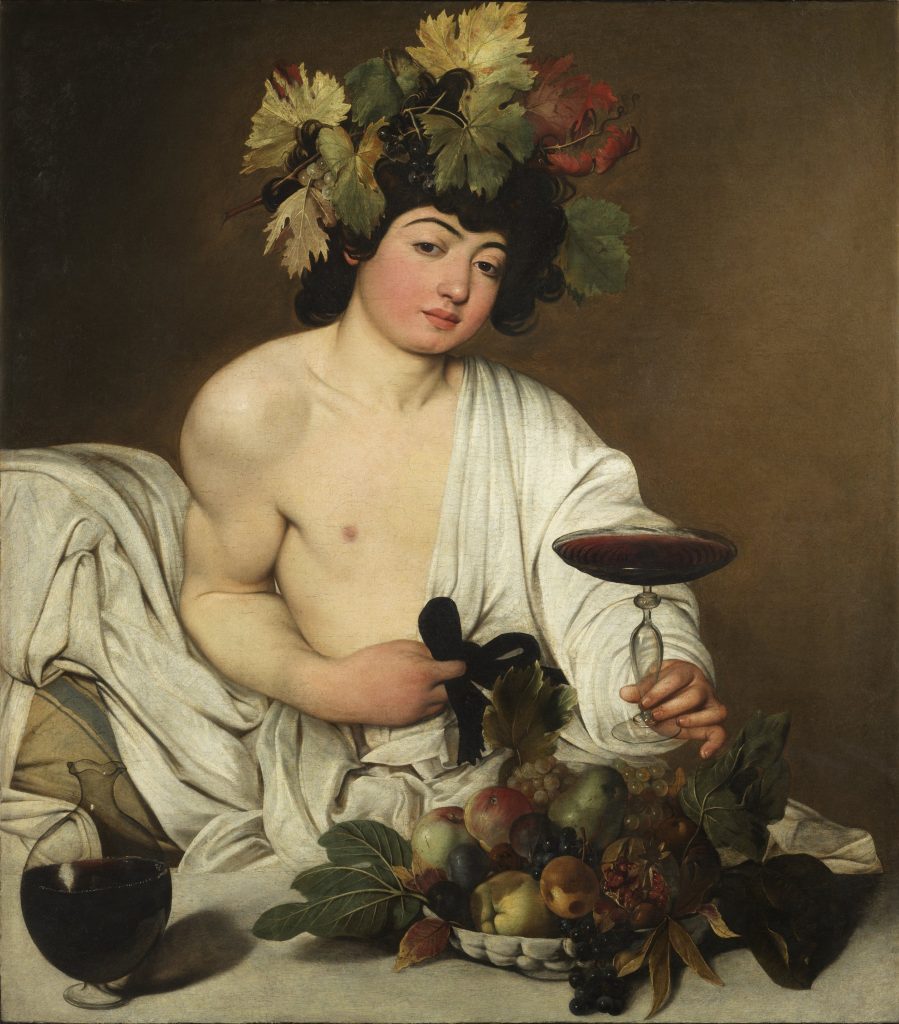
A civilisation formed by participation understands intoxication otherwise. Wine has repeatedly appeared within traditional orders as a medium through which ordinary self-enclosure may be loosened and human life opened towards festivity, communion, sacrifice, poetry, divine presence, and social splendour. Its danger was never invisible; indeed, the danger belonged to its dignity, since powers capable of elevating man may also overthrow him when approached without measure. The traditional problem of wine was therefore one of qualification: who drinks, under what form, within what rite, according to what season, before which gods, with what discipline, and towards what end.
Rome offers a particularly lucid counter-image. Wine was woven into the visible and invisible economy of civilisation. It belonged to agriculture, trade, banqueting, sacrifice, domestic observance, military reward, aristocratic conviviality, and to the presence of divine force within ordinary life. The vine was not merely a crop, nor the cup merely a stimulant. Wine carried a numinous intensity. It stood at the threshold between cultivation and excess, household and altar, convivial order and Bacchic danger. The Roman attitude was not reducible to permissiveness; it was a discipline of participation in which the power of wine was recognised, honoured, restrained, and ritually situated.
Alexander’s career offers a particularly vivid instance of wine’s place within the religious life of empire. After the ordeal of his Indian campaign and the disastrous march across Gedrosia, he reached Carmania and celebrated his survival with a great komos in honour of Dionysus; the king and his army proceeded in a vast procession of wine, music, and festivity, consciously recalling the god whose own mythical conquests had carried civilisation into the East.1a Alexander had already marked the limits of his advance with altars to Dionysus and Heracles, placing his imperial enterprise within a sacred genealogy of divine conquest.1b The komos was an exuberant ritualised procession of revellers, typically accompanied by wine, music, song, and dancing; closely associated with Dionysus, it stood between religious observance and ecstatic festivity. The significance is not merely that Alexander drank wine, but that wine could become the medium through which conquest, divine patronage, communal celebration, and the ordering of empire were made ritually continuous. Alexander himself, whose religious status would become foundational to the Hellenistic ruler cult and whose image remained potent and foundational to the later Roman conception of imperium, thus stands as another expression of the ancient conviction that wine belonged not simply to pleasure, but to the sphere in which human civilisation encountered divine power.
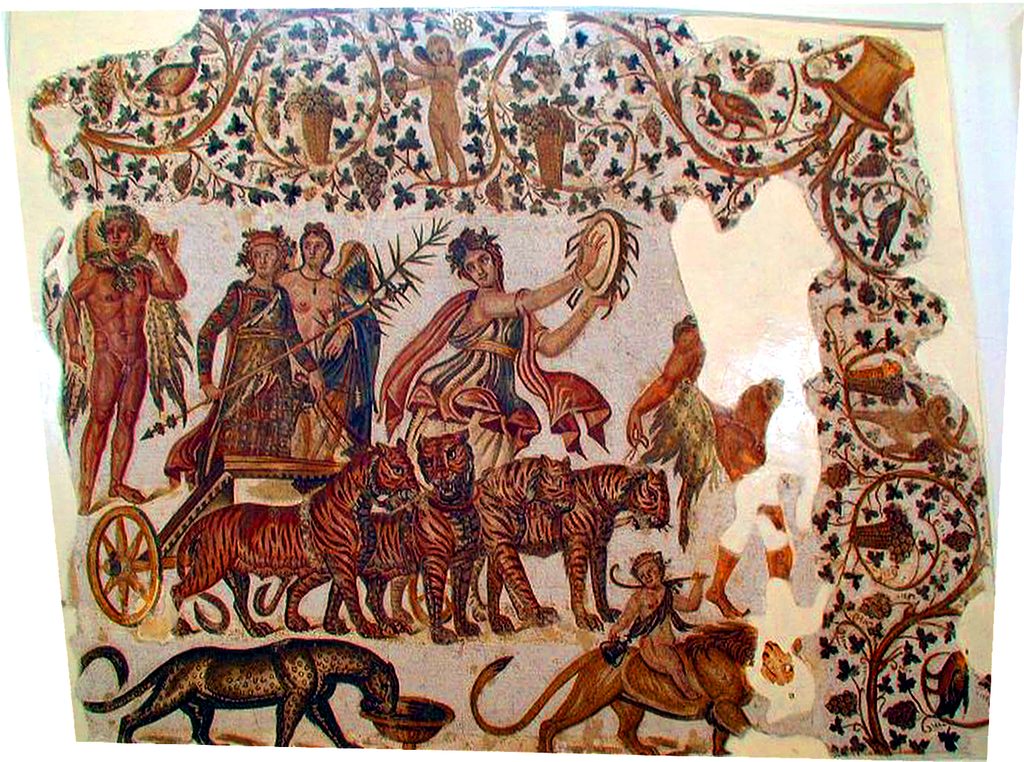
For the Romans, wine belonged to the ordinary provisions of life and stood within a positive economy of nourishment, health, labour, courage and divine presence. For the labouring body of the Roman estate, it was quite literally a daily necessity. Cato’s estate manual assigns the agricultural hands wine throughout every month of the year, with the daily ration rising according to season and labour, and additional distributions at the Saturnalia and Compitalia; wine is treated besides grain, oil, salt and clothing as one of the regular provisions by which the household sustained its human strength.2 Pliny likewise declares that wine in moderation augments human vigour, blood and complexion, strengthens the sinews, sharpens appetite, relieves sorrow, warms the body and invites sleep; he even records the judgement of Asclepiades that the virtutes of wine scarcely yielded to the maiestas of the gods.3 Horace carries this valuation into the moral and sacred imagination: the vine is ‘sacred’, wine loosens the hardness of life by divine ordinance, and the old Cato’s virtus itself is said to have been warmed by the unmixed vintage; the cup restores hope, gives courage before kings and soldiers, and gathers Liber, Venus and the Graces around the feast.4 Cato’s religious prescriptions place wine before Jupiter Dapalis, Janus, Jupiter, Juno, Ceres and Vesta, and employ it in the prayer by which Mars is asked to preserve the farm, household, shepherds, flocks, harvests and vineyards.5 Wine therefore appeared as a civilising benefit under measure, capable of sustaining the body, fortifying the spirit and opening ordinary human conviviality towards the gods.
At the religious frontier between Rome and Judaism, wine became more than a drink: it became a sign of incompatible sacred worlds. The Jewish objection fell with particular force upon the Roman cup because wine circulated through sacrifice, libation, banqueting, and communion with the gods. What Rome received as a cultivated bearer of divine presence could therefore be disparaged from the Jewish side as gentile pollution, an ‘impurity’ inseparable from the so-called ‘demons’, altars, and convivial rites of the dominant civilisation.6 The contempt was directed through wine at Rome itself. The cup condensed precisely what the anti-Roman conscience found intolerable: sacred participation through matter, joy disciplined by rite, and the presence of divinity within the cultivated abundance of earthly life.
Christianity’s retention of wine consequently reveals the strength of its Roman inheritance. At Cana, and still more decisively in the Eucharist, wine becomes the matter through which divine power is manifested and assimilated.7 Whatever the Semitic origin and predisposition of the sect, its sacramental cup preserves a profoundly Roman intuition: matter may be elevated without being sterilised, divine presence may inhabit cultivated form, and spiritual participation may proceed through a substance whose power demands measure rather than abolition. The wine of Christianity is among the clearest signs that Rome conquered its conqueror from within.
The older disparagement nevertheless returns wherever the Roman inheritance weakens. In Puritan temperance, wine is progressively detached from feast, rite and hierarchy and presented as a moral contaminant whose danger inheres in its power to loosen the isolated will.8a Islam carries the same suspicion into explicit prohibition, placing intoxicants among the works of Satan.8b In both, the ancient Jewish judgement upon the Roman cup expands beyond its original cultic boundary and becomes a general hostility towards intoxication itself. Puritanism increasingly concealed its inherited ‘abstinence’ ascetic hostility beneath the prestige and influence economy of ‘science’, a popular prejudice of its age that continues to manufacture and direct opinion among the liberal masses to this day, usurping empirical authority in order to universalise what remained, by its own confession, a profoundly Jewish and pre-Roman Biblical suspicion of the cup, the feast and the sacred powers of cultivated life. This remains a profoundly influential undercurrent within the positivist and empiricist conceptions of ‘consent’ and ‘misogyny’, as well as within the Masonic classical-liberal doctrine of abstract ‘rights’.
The Judeao-Christian, forever seeking ‘God’s design’ inscribed in creation, is drawn into an almost devotional scrutiny of matter, yet carries into that scrutiny the ancient dogmas of abstinence and ascetic suspicion, until the body itself is made to testify ‘scientifically’ for a renunciation articulated and first received by faith alone. Cuyler asks what law ‘God has written on our bodies’, summons ‘science and universal human experience’ as egalitarian, positivist witnesses, then seals the supposed scientific verdict with the Hebrew Biblical declaration, to be ‘inscribed on the forehead’ of every drinker ‘Wine is a mocker’: obsequious submission to the Semitic god has merely changed its vesture, reappearing as deference to empiricism and collective public opinion. Rome had asked under what measure, before which gods and within what form wine should be received. The anti-Roman conscience answers with abstention, prohibition and fear, revealing its inability to govern a power it can only condemn.
Now let us enquire what law in regard to the use of alcoholic intoxicants, God has written on our bodies?
To this question, both science and universal human experience give answer in a voice as distinct as the thunder of Niagara. Science has made long and patient investigation of the statutes which the Creator has written on the human organism, and has established the fact that alcoholic intoxicants are a poison. Science holds her inquest over the bloated, disfigured body of the man who is drunk, and brings in her verdict, ‘This man is poisoned!’ Alcohol poisons the blood in every vein. It assaults the very throne of our manhood and poisons the brain. It produces such a subtle derangement of the very texture of the brain, that the drinker is tormented by recurrences of thirst for strong drink long after he has broken off the indulgence. There is not a reformed inebriate who does not carry in his brain a powder-magazine ready to ignite at the touch of one drop of strong drink. Alcohol is one of the most malignant of all poisons, for by its horrid sorcery it strikes through, and poisons the immortal soul! Yet, like other narcotic poisons, alcohol has the magical power to deceive its victim by making him absolutely believe that it is doing him no harm! The ‘father of lies’ never made such a liar as alcohol. Even if we never had any Bible, science would inscribe on the forehead of every habitual drinker of intoxicants, ‘Wine is a mocker, strong drink is raging: whosoever is deceived thereby is not wise.’
Theodore Ledyard Cuyler, ‘The Moral Duty of Total Abstinence’, in Temperance Sermons, New York, National Temperance Society and Publication House, 1873, pp. 38–39; Proverbs 20.1
This was a deliberate secularising project: the extraction of abstinence and temperance from their traditional religious and philosophical contexts and their reconstitution as universal moral imperatives detached from the metaphysical order that had originally sustained them. Through this process, a particular theological disposition was converted into an apparently neutral ethical principle, allowing a distinctly Christian valuation of bodily discipline, desire, and pleasure to present itself as self-evident rational morality rather than as a contingent doctrinal inheritance.
The mechanism by which this transformation occurred was not merely legislative, but rhetorical. It constituted a form of discursive conditioning, whereby a compelling moral idiom was established and repeatedly reinforced until its premises became embedded within the wider cultural imagination. By recasting ascetic restraint as an autonomous virtue rather than as an expression of a specific theological worldview, the discourse of temperance acquired the appearance of universality, obscuring the religious assumptions from which it emerged and extending their influence beyond the boundaries of explicit belief.
This is precisely what the modern consent-order cannot apprehend. It possesses no adequate category for an intoxication that is neither pathology nor liability, because its moral universe is organised around the maintenance of Puritan autonomous, individualist, and atomised personal clarity. The loosening of self-possession appears only as diminution. The ecstatic element in human life, the noble dissolution of reserve in festivity, the heightening of erotic courage under convivial warmth, the ancient intuition that wine may bear within itself something more than chemical effect, all become unintelligible once the sovereign individual is treated as the ultimate moral unit. A rigid, bureaucratic, and systematised ‘rational’ world without participation mystique must experience ecstasy as a defect in control.
The contrast with Rome therefore reaches far beyond alcohol. It concerns the meaning of human openness. In a participatory order, man does not perfect himself by sealing the boundaries of the autonomous self; he becomes fully human through rightly ordered exposure to powers beyond his private will. He is formed through ancestors, gods, rites, offices, feasts, dangers, obligations, and relations that precede him. The inclusion of women as equals in previously masculine fields requires that which has been beyond the woman to be chastised as an evil or pacified and rendered ‘safe’. What is conventionally regarded as chastity laws for women in ancient Rome therefore becomes the universal bridal standard imposed upon emasculated men. Wine belongs to this world because it dramatises the instability and splendour of participation. It can unman the unqualified and ennoble the qualified; it can become vulgar excess or sacramental intensity according to the order in which it is received.
The modern moral imagination reverses this hierarchy. Since it lacks confidence in qualification, it treats the weakening of procedural capacity as the decisive fact. Instead of asking whether intoxication is ordered, measured, dishonourable, festive, vulgar, noble, sacred, childish, heroic, marital, communal or degrading, it asks whether the subject remains sufficiently intact as a legal proprietor of choice. The many qualitative possibilities of intoxication collapse into the single question of capacity. The richness of human condition is reduced to the administrative integrity of the will.
Here the connection between consent and temperance becomes unavoidable. Both are doctrines of guarded self-possession. Both suspect the threshold at which desire, pleasure, social pressure, bodily warmth, and the influence of others may overcome the abstract clarity of the individual. Both fear surrender because surrender contradicts the moral sovereignty of the self-contained subject. Their difference lies in vocabulary and metaphysical descent. The temperance preacher warned against sin and ruin; the consent-catechist warns against harm and violation. The figure of danger changes clothing, yet the ritual posture remains one of vigilance before the intoxicated body.
Such vigilance alienates the sexes because eros itself contains an intoxication prior to wine. Attraction already loosens the self. Desire already alters judgement. Courtship already exposes one person to the influence of another. The beloved is never merely an object neutrally assessed by an untouched will; the beloved acts upon the soul, rearranges attention, awakens boldness, produces fear, lends speech a double meaning, and turns ordinary gestures into signs. A morality unable to distinguish enchantment from coercion will inevitably treat the erotic field as a zone requiring procedural control. It will suspect precisely those states through which eros ordinarily becomes alive.
The result is a civilisation in which safety acquires a counterfeit sacrality. Where older orders placed wine under gods, rites, fathers, husbands, hosts, feasts, vows, prohibitions, and symbolic forms, modern liberal-feminist morality places it under risk management. Its concern is not measure as a qualitative virtue, but capacity as a procedural condition. It cannot sanctify the cup, so it monitors it. It cannot interpret ecstasy, so it pathologises loosening. It cannot educate nobility before danger, so it multiplies warnings after suspicion. The bottle becomes an exhibit in the trial of autonomy.
This loss of participation explains why the consent-catechism feels so hostile to men formed outside its moral enclosure. The masculine world has often understood alcohol, festivity, risk, contest, flirtation, mockery, boldness, and imperfect judgement as elements within the ordinary turbulence of social life, to be governed by honour and consequence rather than purified by procedural theology. Liberal-feminist formation frequently encounters the same field as a disorderly terrain requiring protective language, especially where masculine initiative appears without prior ritual apology. Two moral universes meet, and the catechism declares one of them unsafe before it has understood it.
Wine therefore becomes a privileged symbol of the whole conflict. It reveals whether a civilisation trusts qualification or procedure, participation or surveillance, honour or audit, form or formula. A culture that recognises the divine ambiguity of wine recognises that life contains powers whose value cannot be measured by the maintenance of uninterrupted self-possession. A culture that treats intoxication chiefly as impairment reveals the smallness of its anthropology. It has reduced man to a rights-bearing will anxious about its own permeability, and woman to a guarded sovereignty trained to interpret permeability as danger.
The consent doctrine, when absolutised, cannot permit this ambiguity to remain. It must draw wine, flirtation, mood, seduction, artistic eroticism, recollection, and regret into its jurisdiction because all of them threaten the clean fiction of the self-transparent will. Yet eros lives precisely where the will is neither annihilated nor sovereign, where persons meet through sign, atmosphere, courage, vulnerability, and form. To demand that such a realm continually justify itself before the tribunal of procedural sobriety is to replace the civilisation of the cup with the bureaucracy of the boundary.
Scholia
- [a]See Arrian, Anabasis Alexandri 6.28.1–3, on Alexander’s Dionysiac associations and the Carmanian celebrations; Plutarch, Alexander 67.1–2, on his claims to descent from and identification with divine figures; Diodorus Siculus, Bibliotheca historica 17.107.6, 17.108.4, on the honours accorded to Alexander. [b] See Arrian, Anabasis Alexandri 4.28.1–5, 5.29.1–2, 6.3.4–5, on Alexander’s emulation of Heracles and Dionysus and the erection of altars marking the limits of his eastern advance; Strabo, Geographica 3.5.5, explicitly interprets the altars as an emulation of Heracles and Dionysus. On Alexander’s identification with Dionysus and the religious dimensions of his eastern conquest, see Richard Stoneman, Alexander the Great: A Life in Legend, Yale University Press, 2008, pp. 111–124.
- Cato the Elder, De agri cultura 57.1.
- Pliny the Elder, Naturalis historia 23.22.
- Horace, Carmina 1.18.1–4; 3.21.9–24.
- Cato the Elder, De agri cultura 132; 134.1–4; 141.2–4
- Mishnah, Avodah Zarah 2.3; 4.8–5; Babylonian Talmud, Avodah Zarah 29b–30b
- John 2.1–11; 1 Corinthians 11.23–26; Justin Martyr, First Apology 65–66
- [a]Theodore Ledyard Cuyler, ‘The Moral Duty of Total Abstinence’, in Temperance Sermons, 1873; Increase Mather, Wo to Drunkards, 1673; Lyman Beecher, Six Sermons on the Nature, Occasions, Signs, Evils, and Remedy of Intemperance, 1828 [b] Qur’an 5.90–91
The Pauperisation of Sex
The deepest poverty of the consent-catechism lies in its inability to generate the forms of life upon which even its own limited intelligibility depends. Permission can mark a threshold; it cannot constitute an order. It can authorise an act; it cannot confer dignity upon the relation within which that act occurs. It can register the will of the isolated subject; it cannot determine whether the willing subject is inwardly qualified, whether the desire is noble or base, whether the approach belongs to courtship or appetite, whether the relation elevates or degrades, whether the union participates in household, fidelity, rank, continuity or honour. It is a gate pretending to be a temple.
This distinction explains the peculiar barbarism produced by a civilisation that mistakes consent for sexual morality. A consensual act may remain vulgar, dishonourable, disordered, cowardly, exploitative, sterile, frivolous or spiritually degrading, because consent speaks only to the formal permissibility of the act within a procedural horizon. It cannot measure the quality of the souls involved. It cannot judge the symbolic meaning of the relation. It cannot distinguish libertinism from magnanimity, conquest from courtship, appetite from eros, or novelty from initiation. The very questions by which sexual life once acquired moral depth become inaccessible when permission occupies the throne of judgement.
The sovereign position of consent therefore produces an immense flattening. It dissolves the vertical dimension of erotic life into a horizontal exchange between wills. Once the act has been authorised, liberal morality often finds itself curiously mute before the nature of the act itself. Its remaining vocabulary oscillates between harm and preference, safety and identity, trauma and empowerment. These are the moral residues available to a civilisation that has lost the power to speak of chastity, beauty, fidelity, reverence, honour, lineage, modesty, command, seduction, shame, splendour and sacrifice as objective dimensions of erotic order. The older vocabulary judged according to form; the newer one administers according to boundary.
A boundary, however, is not a form. It indicates a line of exclusion, while form gives shape to participation. The consent-catechism excels at the former because liberal anthropology begins from self-possession. Its highest concern is the preservation of the autonomous subject against unlicensed intrusion. Sexual morality is consequently organised around the defence of the boundary rather than the perfection of the relation. The drama of eros becomes secondary to the anxiety of trespass. Man and woman meet across a frontier rather than within a common symbolic world.
The modernist ‘pauperisation’ of a metaphysics begins by confining reality to what can be immediately perceived, counted, administered and exchanged. Whatever exceeds the flat evidence of sensation is declared unreal, ‘oppressive’ or unintelligible; essence is reduced to appearance, quality to quantity, vocation to preference, and being to the temporary sum of its measurable states. Once this impoverishment has been accepted, the disappearance of rank and ontological type follows with mechanical certainty. No higher nature can be acknowledged where sight recognises only equivalent bodies and reason has been trained to distrust every invisible distinction. Even sex cannot survive such a regime intact. Man and woman cease to signify divergent principles, modes of being and destinies; they become accidental modifications of the same abstract human atom, available for reassignment by appetite, declaration or bureaucracy. This is the final triumph of the ‘masses’: their own inward formlessness is projected upon the whole of existence, until every hierarchy appears fraudulent, every essence tyrannical, and every distinction an insult to the interchangeable unit. The result is less an emancipation than a metaphysical slum, in which nothing may stand above anything else because nothing is permitted to possess sufficient reality to differ in kind.
The erotic relation, when deprived of form, becomes strangely defenceless before both brutality and triviality. Brutality may satisfy procedure while remaining morally vile; triviality may satisfy procedure while evacuating the act of all dignity. A morality centred upon consent can condemn violation with great intensity, yet it struggles to condemn debasement once authorisation has been secured. Its very strength reveals its limitation. It sees intrusion with obsessive clarity and degradation with diminished vision. This is why the modern world can be simultaneously severe and permissive, puritanical and libertine, anxious about boundaries while indifferent to the spiritual quality of what occurs within them.
Such contradiction belongs to the liberal inheritance itself. Autonomy sacralises the will, then discovers that the will alone cannot generate meaning. The subject may choose endlessly, yet choice, by itself, cannot confer nobility upon its objects. Procedure can legitimate degradation as readily as fidelity when the only decisive question concerns authorisation. Thus the same civilisation that surrounds sexual approach with juridical suspicion also presides over unprecedented vulgarisation, because the policing of access has replaced the ordering of desire. The gate is guarded while the sanctuary is empty.
The consent-catechism thereby proves itself incapable of sustaining civilisation. It can protect the atomised subject from certain forms of trespass; it cannot initiate the subject into an ennobling sexual order. It can multiply prohibitions around danger; it cannot transmit a positive grammar of love. It can instruct men to seek permission; it cannot teach them how to be worthy. It can instruct women to guard autonomy; it cannot teach them how to receive, judge, elevate, refuse, bind, or consecrate relation within a higher form. Its pedagogy is defensive because its metaphysic is defensive. It begins from exposure, not vocation.
The older erotic orders were severe because they recognised the height and danger of the sexual mystery. Their restraints were not merely prohibitive; they were formative. Chastity, modesty, courtship, fidelity, paternal judgement, marital rite, household discipline, and the sanctions of honour existed because eros was understood as a power capable of founding or destroying worlds. Its governance required more than agreement between individuals. It required qualification, initiation, symbolic placement, and a hierarchy of meanings sufficient to bind the body to something exceeding momentary desire. The moral seriousness of sex was measured by the weight of the order into which it entered.
Modern liberal-feminist morality retains the seriousness while discarding the order. It senses danger everywhere because it has lost the forms that once gave danger meaning. It invokes harm where older civilisations invoked dishonour, trauma where they invoked defilement, safety where they invoked virtue, and consent where they invoked rite. The vocabulary changes; the anxiety remains. Yet without the older architecture, anxiety expands without resolution. Every encounter becomes potentially unstable, every ambiguity potentially prosecutable, every gesture potentially subject to retrospective interpretation. The moral field grows narrower even as its regulations multiply.
This is why consent, absolutised into catechism, becomes hostile to the very erotic life it claims to purify. Eros requires confidence in signs, trust in judgement, tolerance of ambiguity, acceptance of risk, and participation in a world whose meanings cannot be entirely spoken before they are lived. The catechism demands clarity precisely where life often moves through suggestion. It demands procedural transparency where attraction frequently begins in obscurity. It demands continual sovereignty where desire often involves the partial surrender of sovereignty. It demands a guarded self at the threshold of a mystery that can only be entered by selves capable of being moved.
The issue, then, is the usurpation of sexual grammar by permission. Consent occupies a necessary place wherever violation is possible, yet modernity enlarges that place until the criterion begins to consume the order it was meant to serve. A limited principle becomes a total horizon. A threshold becomes a metaphysic. The result is a civilisation in which erotic life is simultaneously exposed to libertine emptiness and surrounded by juridical dread, because the positive forms once capable of ordering desire have been dissolved, while the procedural mechanisms replacing them cannot supply the meaning they displaced.
The juridification of eros therefore concludes in a paradox characteristic of modernity: the more insistently sexuality is placed beneath the sovereignty of consent, the less capable the civilisation becomes of speaking about sexual worth. It can ask whether permission was granted. It can ask whether autonomy was breached. It can ask whether harm may be alleged. It falters before the higher questions: whether the relation was worthy, whether the desire was rightly ordered, whether the man and woman were qualified, whether the act belonged to an honourable form, whether eros had been elevated into civilisation or abandoned to appetite under the thin absolution of procedure.
Here the consent-catechism reaches its limit and reveals the next catechism. A morality unable to sustain qualitative judgement must learn to police those who attempt it. Once permission has replaced form, any appeal to the older forms appears as a threat to the autonomy that permission enthrones. The man who judges, distinguishes, ranks, condemns, protects, commands, refuses or speaks from inherited authority becomes morally dangerous in a new sense. His judgement recalls the order that procedure displaced. The next operation of the liberal-feminist metaphysic is therefore inevitable: judgement itself must be placed on trial, and its name in the catechism is ‘misogyny’.
Misogyny: The Criminalisation of Judgement
From Hatred to Heresy; Trial by Marxist Class-Consciousness
‘Misogyny’, in its literal Greek construction, names hatred of woman: misos, hatred, and gynē, woman. The force of the word originally lies in the severity of its accusation. It does not indicate mild criticism, ordinary distrust, disagreement with a doctrine, resistance to a movement, or rejection of a particular woman’s conduct; it names an animating hostility towards woman as such. Precisely for this reason, its contemporary expansion deserves examination. A term of grave moral meaning has acquired an extraordinary jurisdiction over regions of judgement once governed by more discriminating vocabularies. The accusation has grown because the order employing it requires such growth. Intrinsic to the very notion of ‘misogyny’ is the gathering of all women together into an equal collective ‘sisterhood’, expressing the same aggrieved universal Marxist class-consciousness levelled at ‘oppressor’ men, thus cutting at the root any possibility of higher spiritual expression within women themselves, a flattening above which many great women have existed. One is not ‘a woman’, but all ‘women’. It therefore stands for collective versus collective, and surreptitiously drags men into the same levelled field by pre-emptively limiting the possible avenues by which a rejoinder may be offered.
The modern use of misogyny does not derive its power from precision. Its authority lies in moral compression, enforced as coercion. It gathers many possible acts of judgement into a single verdict upon the soul of the speaker. A man may criticise feminism, defend hierarchy, resist sexual egalitarianism, question female judgement, prefer inherited forms, object to ideological language, reject sentimental authority, mock fashionable moral rhetoric, or speak from a paternal conception of order; the category stands ready to receive him. The content of the judgement often matters less than the fact that judgement has been exercised from a position insufficiently obedient to the catechism.
Here the accusation performs its true office. It translates judgement into animus. The man who distinguishes is suspected of contempt; the man who refuses is suspected of hostility; the man who invokes order is suspected of domination; the man who speaks from masculine authority is suspected of injury before his argument has been considered. The word does not merely answer him. It relocates him. He is moved from the field of reason into the field of pathology, where his judgement no longer requires refutation because it has already been interpreted as symptom.
This is the decisive movement: judgement becomes criminalised at the level of motive. The older question, whether a judgement is true, proportionate, qualified, honourable, prudent or grounded in reality, yields to the question of whether it proceeds from a forbidden disposition. The tribunal shifts inward. Speech is no longer encountered principally as logos, but as disclosure of moral disease. Feminist catechesis thereby acquires an instrument of remarkable economy: it can suspend the authority of a judgement by redescribing the judge.
The expansion follows necessarily from the metaphysic already examined. A moral order founded upon emancipation from sexual form cannot allow the older forms to retain interpretative dignity. Their return would disclose the contingency of the emancipatory narrative. Paternal judgement, masculine hierarchy, erotic asymmetry, sexual complementarity, modesty, chastity, domestic office, and the authority of tradition must therefore be rendered morally inadmissible before they can reassert themselves as rival principles. ‘Misogyny’ accomplishes this by converting resistance to feminism into hatred of woman, thereby fusing the ideological movement with the sex in whose name it speaks.
This fusion is among the most powerful devices of the catechism. Feminism ceases to appear as a contestable doctrine and becomes the authorised moral representation of woman herself. Criticism of the doctrine can then be made to appear as hostility towards the being it claims to liberate. The manoeuvre is subtle because it shelters ideology beneath the dignity of sex. A metaphysical and political construction acquires the emotional protection owed to woman, while the opponent finds himself accused of attacking woman whenever he challenges the construction through which she has been reinterpreted.
The effect upon discourse is severe. Criticism no longer proceeds among rival conceptions of sexual order; it proceeds under a prior threat of moral contamination. The accusation of misogyny does not simply condemn an error. It marks the speaker as unclean within the liberal-feminist symbolic economy. Once pronounced, the term carries an excommunicatory force. It withdraws the ordinary dignity of disagreement and replaces it with suspicion concerning the speaker’s inward character. His words become evidence, his distinctions evasions, his appeals to order rationalisations, his resistance confession by another name.
A concept functioning in this manner cannot remain limited to hatred, since hatred is too narrow to serve the catechism’s full disciplinary need. The moral order requires a term capable of policing residual forms, inherited instincts, spontaneous revulsions, masculine refusals, ancestral loyalties, and intellectual positions that continue to speak from outside its horizon. Misogyny therefore expands because the adversary expands. Wherever the feminist subject discovers an inherited limit, the concept becomes available. Wherever female autonomy encounters judgement, the accusation can be summoned. The word grows until it matches the world it seeks to govern.
The criminalisation of judgement is therefore inseparable from the metaphysical displacement of qualification. In an order of qualification, judgement belongs to rank, office, discipline, experience and cultivated discernment. A father may judge differently from a stranger, a husband differently from a passer-by, an elder differently from a youth, a man differently from a woman, precisely because judgement arises from situated authority rather than abstract equivalence. Liberal-feminist morality, having dissolved such offices into power relations, can no longer receive these judgements according to their proper form. It experiences them as unauthorised assertions, and therefore as possible aggression.
Misogyny names this aggression in advance. It converts the very exercise of sexed judgement into evidence against itself. The masculine voice becomes suspect where it claims more than procedural permission to speak. A man may express preference, yet preference remains safely subjective; he may express emotional support, since support confirms the catechism; he may repent, confess, defer, validate, and recognise. The danger begins when he judges. Judgement presupposes a standard exceeding the autonomy of the one judged, and it is precisely this excess that the feminist subject experiences as domination.
The accusation thus protects a metaphysical inversion. Woman, reconstructed as autonomous subject wounded by form, must be shielded from the return of those voices through which form once spoke. Man, reconstructed as bearer of historical constraint, must have his judgement submitted to scrutiny before it can be heard. The catechism does not need to forbid masculine judgement directly. It surrounds it with suspicion, burdens it with presumed animus, and subjects it to a moral audit whose criteria are controlled by the very order he contests.
The result is a discourse in which truth becomes secondary to admissibility. Before a judgement concerning woman, feminism, sexual order, behaviour, modesty, eros, family, authority or hierarchy can be considered, it must first pass through the question of misogyny. The accusation stands at the gate. It decides which speech may enter as argument and which speech must remain outside as pathology. In this way, the catechism secures its sovereignty over the conditions of discourse itself.
This is why the modern invocation of misogyny so often bears the character of a verdict rather than an analysis. It announces that the speaker has already failed at the level of moral being. His argument may continue, yet it proceeds beneath a stain. He may offer distinctions, yet the distinctions themselves are interpreted through suspicion. He may appeal to history, metaphysics, tradition, natural difference or civilisational form, yet these appeals are treated as masks concealing the same forbidden disposition. The charge therefore possesses a circular perfection. Whatever resists it can be made to confirm it.
Such circularity marks the point at which a concept becomes catechetical. It ceases to function as an ordinary term within judgement and becomes a device for governing the legitimacy of judgement. The word no longer describes hatred alone; it administers heresy. Through it, the liberal-feminist order identifies those who remain insufficiently converted, those whose instincts still answer to older forms, those who remember masculine office without shame, those who can distinguish feminism from woman and woman from the doctrine pronounced in her name. The accusation exists to prevent precisely that distinction, for once the distinction is recovered, the catechism begins to lose its sacred enclosure.
Diagnosis and Excommunication
The modern accusation of misogyny belongs to a wider transformation in which moral disagreement is increasingly recoded as psychological revelation. The adversary is no longer encountered principally as one who possesses a rival doctrine, a contrary metaphysic, or an inherited loyalty to another order of judgement. He is flattened as one whose very resistance discloses an inward defect. Argument yields to diagnosis. The opponent becomes a case.
This diagnostic movement is among the most characteristic operations of liberal-feminist morality. It permits the catechism to evade the dignity of opposition by interpreting opposition as evidence of deformation. One does not need to answer a judgement once the judgement has been traced to resentment, insecurity, fear, hatred, entitlement, fragility, domination or unexamined prejudice. The speaker may imagine himself to be reasoning from principle; the catechism reveals that he is merely expressing pathology. His thought is deprived of vertical reference and returned to the low plane of motive.
The significance of this manoeuvre lies in its asymmetry. Feminist suspicion of man is treated as consciousness; masculine suspicion of feminism is treated as animus. Feminist hostility towards inherited male office appears as critique; male hostility towards feminist reconstruction appears as hatred. Feminist accusation becomes moral vigilance; masculine accusation becomes evidence of corruption. The same affective movement is dignified or degraded according to the subject who bears it and the order in whose name it speaks. The catechism thus does more than judge opinions. It distributes spiritual rank.
Once diagnosis has been established, excommunication follows naturally. The charge of misogyny places the accused outside the moral community, or at least beneath conditional toleration within it. He may return through confession, deference, apology, re-education, submission to approved language, and visible renunciation of forbidden instincts. The structure is unmistakably penitential. The accused must accept the category under which he has been placed, internalise the doctrine that condemned him, and speak henceforth in a way that proves conversion. His restoration depends upon the abandonment of the very standpoint from which his judgement first arose.
Such excommunication need not be formal to be effective. Modern societies possess innumerable informal liturgies of expulsion. The withdrawal of seriousness, the refusal of charitable reading, the knowing smile, the accusation disguised as concern, the demand to ‘reflect’, the expectation of apology, the reputational stain that follows the term once uttered: these are sufficient to discipline speech. The catechism governs most efficiently when no tribunal is visible. Its jurisdiction is social before it is legal, affective before it is institutional, instinctive before it is articulated.
This is why the term functions with such weight even when used casually. Its casualness is itself evidence of its triumph. A word originally capable of naming a grave hatred can now be thrown across ordinary disagreement with almost effortless force, precisely because its accusatory power has already been naturalised. The term no longer requires solemn deployment. It inheres in the atmosphere of the age. It can be invoked lightly because the moral order behind it is heavy.
The diagnostic accusation also possesses a peculiar immunity from falsification. Since misogyny is increasingly presumed to operate beneath conscious intention, denial itself may be treated as further evidence of concealment. The accused cannot readily appeal to his stated motives, because the catechism claims access to a deeper moral truth than his self-understanding. He cannot appeal to women he honours, women he loves, women he defends, or women whose dignity he upholds, because the accusation concerns the structure of his judgement rather than any simple emotional disposition. He cannot appeal to principle, because the principles themselves are already suspected as rationalisations of hierarchy. The charge thus acquires the enclosed perfection of a doctrine that interprets resistance as confirmation.
At this point, misogyny ceases to be an accusation of hatred and becomes a hermeneutic of disobedience. It reads backwards from the forbidden conclusion to the corrupted soul presumed to have produced it. A man who defends paternal authority, sexual hierarchy, female modesty, masculine judgement, aristocratic order, courtship, or the differentiated offices of man and woman is interpreted according to the moral destiny assigned in advance to such positions. His thought is understood by its location outside the catechism. The word supplies the moral biography of the speaker before he has finished speaking.
The consequence is the systematic infantilisation of judgement. Serious distinctions become difficult to sustain because the accusation continually collapses them into motive. To distinguish woman from feminism, female dignity from female autonomy, sexual order from oppression, protection from domination, modesty from repression, or criticism from hatred requires a faculty of judgement the catechism has already placed under suspicion. It cannot permit such distinctions to become stable, because each would weaken the fusion between woman and the doctrine pronounced in her name. Where distinction returns, accusation loses force.
This fusion explains the strange intensity with which the term is guarded. If feminism remains identifiable as a doctrine, it can be opposed as doctrine. If woman remains distinguishable from feminism, one may defend woman against feminism, honour woman outside feminism, and judge feminism as a deformation of woman rather than her liberation. The accusation of misogyny intervenes precisely at this point. It prevents the separation of sex from ideology by declaring that resistance to the latter reveals hatred of the former. Thus an historical movement occupies the sanctity of the being it claims to represent.
The excommunicatory force of misogyny therefore protects a sacramental substitution. The feminist doctrine assumes the representative body of woman; offence against the doctrine becomes offence against the body. The political is transfigured into the sacred. The critic becomes a profaner. This explains why the response to dissent so often exceeds the scale of ordinary disagreement. One has not merely contradicted a thesis; one has trespassed upon an image placed beyond profanation.
Yet the very violence of the accusation betrays the fragility of the fusion it defends. A truly secure moral order does not require every hostile judgement to be translated into pathology. It can answer, rank, absorb, ignore, or condemn according to the measure proper to each case. The compulsive invocation of misogyny reveals an order anxious about the return of distinctions it cannot survive. The word is a shield held before a doctrine that fears being seen as doctrine.
The criminalisation of judgement accordingly proceeds through a double act. First, the masculine faculty of discrimination is stripped of office and rendered suspect as power. Then the feminist doctrine is fused with woman herself, so that any attempt to judge the doctrine appears as aggression against the sex. The man who judges finds himself accused before the content of his judgement is received. He stands condemned by the mere fact of speaking from an order whose authority the catechism exists to overthrow.
In this way, misogyny completes the operation begun by consent. Consent places approach under authorisation; misogyny places judgement under diagnosis. Consent juridifies the path towards woman; misogyny criminalises the path of judgement concerning her. One governs the body through the boundary; the other governs discourse through the accusation. Together they form a complete enclosure around the feminist subject: desire must enter by permission, and judgement must enter by confession.
The Eclipse of Distinction
The highest victim of the misogyny-catechism is distinction. Judgement lives by distinction, since to judge is to perceive difference according to measure: between woman and feminism, reverence and submission, authority and cruelty, protection and possession, hierarchy and mere force, modesty and repression, criticism and hatred. A mind incapable of distinction cannot judge; it can only react according to categories already supplied to it. The inflation of misogyny therefore signifies more than the expansion of an accusation. It marks the contraction of a faculty.
Distinction is intolerable to every revolutionary moral order because it restores articulation where the revolution requires fusion. Feminism requires woman and feminism to be treated as morally continuous, so that offence against the doctrine may inherit the sanctity of the sex. It requires hierarchy and oppression to be held together, so that authority may appear already condemned by its shape. It requires masculine judgement and hostility to approach one another in the imagination, so that the man who speaks from inherited form may be heard under suspicion before his words are weighed. Wherever distinction returns, the catechism loses jurisdiction.
This explains why the word ‘misogyny’ so frequently appears at the point where distinctions become dangerous. A man may honour woman precisely by opposing feminism, seeing in feminism a reduction of woman to grievance, autonomy, labour, sexuality, political resentment, or therapeutic vulnerability. He may defend chastity because he regards it as dignity, defend paternal judgement because he regards it as duty, defend hierarchy because he regards it as order, defend courtship because he regards it as civilisation. The catechism cannot permit such positions to remain intelligible on their own terms. It must translate them into hostility, otherwise its own monopoly over the meaning of woman begins to fracture.
The power to name hatred is therefore also the power to prevent rival loves from speaking. Once feminism has installed itself as the authorised interpreter of woman, any love of woman that refuses feminist categories becomes suspect. Paternal love may be called control; erotic admiration may be called objectification; protective instinct may be called infantilisation; reverence for modesty may be called repression; the desire for feminine excellence may be called domination. The older languages of love are made to sound like offences because the doctrine has changed the ear by which they are received.
This alteration of hearing is among the subtlest effects of catechesis. The words remain available, yet their resonance changes. Honour, chastity, obedience, duty, fidelity, modesty, guardianship, lineage, household and rank no longer sound with inherited dignity inside the liberal-feminist ear. They arrive already burdened by suspicion. Their meanings are intercepted before they can unfold, passed through a hostile hermeneutic, and returned as evidence of the very oppression whose existence the catechism presupposes. Language once capable of sustaining a world becomes unintelligible within the world that replaced it.
Judgement consequently loses the medium through which it once operated. A judge requires terms proportionate to reality. Where the vocabulary has been captured, judgement must either speak in the language of its adversary or risk immediate expulsion from respectable discourse. The first path produces surrender disguised as nuance; the second produces accusation. The man who says ‘I oppose feminism because I honour woman within an order feminism dissolves’ will be told that his honour is domination, his order oppression, his woman an abstraction masking contempt. The catechism hears only the offence it was trained to detect.
The eclipse of distinction also explains the strange moral crudity of much contemporary discussion concerning the sexes. A civilisation that possesses immense technical subtlety may remain barbarous in judgement when its governing categories are too coarse for the realities they command. To call every assertion of masculine authority misogyny, every defence of hierarchy misogyny, every criticism of female conduct misogyny, every scepticism towards feminist doctrine misogyny, is to rule a complex domain with a blunt instrument sanctified by repetition. The crudeness survives because it serves. It converts a thousand possible questions into one accusation.
Such compression is spiritually convenient. It relieves the modern subject from the burden of ascent. Instead of discerning the form of a judgement, its office, its rank, its motive, its relation to truth, its place within a civilisational order, one need only identify its deviation from the catechism. A profound laziness thereby assumes the appearance of moral vigilance. The difficult work of discrimination is replaced by the reflex of denunciation. The speaker is placed, the verdict rendered, the doctrine preserved.
This mechanism reveals the peculiar hostility of the modern order towards masculine discrimination. Man has traditionally occupied, in varying forms, the position of judge: father, elder, husband, ruler, priest, censor, magistrate, guardian of lineage, transmitter of prohibition, maker of distinctions, giver of names. His authority rested upon the capacity to say yes and no from within an order exceeding private preference. Feminist morality inherits this whole symbolic background as an accusation. It sees in masculine judgement the memory of a world in which woman was situated, evaluated, guarded, praised and restrained according to forms she did not individually authorise.
The accusation of misogyny therefore attacks the very principle of masculine judgement under the appearance of attacking hatred. Its deepest object is the man who still believes himself qualified to distinguish. He may distinguish between noble and ignoble woman, feminine dignity and feminist agitation, modesty and exhibition, eros and appetite, marriage and indulgence, honour and self-assertion, reverence and servility. Each distinction presupposes a vertical measure. Each vertical measure contradicts the horizontal sovereignty of autonomy. The catechism consequently names the act of judgement as wound.
A society trained by this catechism becomes increasingly unable to imagine that criticism may arise from responsibility. It supposes that condemnation must conceal resentment, that hierarchy must conceal insecurity, that restraint must conceal hatred of pleasure, that protection must conceal will to possess. In doing so, it reveals its own degraded anthropology. Having reduced relation to power, it can no longer understand authority as service to form. Having reduced woman to autonomy, it can no longer understand judgement upon woman as care for an order in which woman herself has meaning.
The result is a moral world where men may flatter women, desire women, validate women, confess before women, defer to women, and celebrate women as autonomous subjects, yet may scarcely judge women without summoning the charge that they hate them. Praise remains permitted so long as it confirms the doctrine; desire remains permitted so long as it passes through authorisation; support remains permitted so long as it entails submission to the approved image. Judgement alone remains dangerous, because judgement alone implies a standard outside the subject being judged.
This danger reveals the metaphysical stakes. To judge is to invoke order. To invoke order is to deny that autonomy is the final measure. To deny autonomy is to recall qualification. The accusation of misogyny exists at the point where this recollection threatens to become conscious. It is the alarm sounded by a doctrine whenever a rival principle approaches the boundary of speech. Its violence comes from its fear of distinction, for distinction is the beginning of liberation from the catechism itself.
The recovery of judgement therefore requires the recovery of discrimination at its highest level. One must separate woman from feminism, sex from doctrine, hatred from distinction, authority from domination, criticism from animus, and order from oppression. Such separation does not weaken the defence of woman; it alone makes genuine defence possible. A being can be honoured only when she is no longer imprisoned within the ideology that claims to speak in her name. The catechism calls that separation misogyny because it cannot survive the return of the faculty by which it would be judged.
The Presumption Against Man
The Reconstruction of Masculinity
The presumption against man begins in the reconstruction of masculinity itself. A civilisation does not first encounter men as neutral biological beings and then judge them according to conduct; it receives them through a symbolic image already furnished by its governing anthropology. Man appears according to the order that interprets him. Where that order recognises form, masculinity may appear as office, rank, initiation, protection, judgement and generative authority. Where that order recognises autonomy as the supreme moral fact, masculinity appears as pressure upon autonomy, the historical memory of constraint, and the embodied possibility of unlicensed power.
This reconstruction proceeds by severing masculine potency from the forms that once qualified it. Strength detached from office becomes threat; judgement detached from rank becomes presumption; desire detached from courtship becomes appetite; protection detached from honour becomes condescension; paternal authority detached from lineage becomes domination. The same masculine realities once ordered by civilisation are reread according to the metaphysic that displaced their order. Man is retained as force after being deprived of the forms through which force became authority.
The change is therefore deeper than hostility towards individual men. It concerns the symbolic grammar through which masculinity becomes intelligible. The liberal-feminist order does not merely accuse men of particular abuses; it reconstitutes the male as the bearer of a structural suspicion. The man arrives already shadowed by the history assigned to him. His desire recalls violation; his judgement recalls exclusion; his authority recalls hierarchy; his confidence recalls entitlement. The catechism supplies the memory through which he is received.
Here the contrast with traditional masculine formation becomes decisive. Traditional orders did not imagine masculinity as harmless. They recognised its danger precisely because they recognised its power. Their task was to qualify, elevate, bind and direct that power into office. The boy was drawn towards manhood through discipline, prohibition, ordeal, apprenticeship, inheritance and responsibility; the man became worthy by accepting a form that exceeded private impulse. Masculinity was civilised through ascent, not through apology.
The modern order reverses this movement. It seeks to render masculinity safe by emptying it of metaphysical claim. Man may remain strong, desirable, useful, emotionally accessible, productive and socially compliant, provided his strength signifies no office, his desire no right of approach, his judgement no authority, and his presence no inherited form. Masculinity is permitted as temperament, aesthetic, utility or private identity; it becomes intolerable when it speaks as principle.
This explains the peculiar humiliation imposed upon men formed outside the liberal catechism. They are not merely asked to behave with restraint, courtesy or honour, which any serious civilisation would require. They are asked to approach their own masculine inheritance as morally suspect. The forms through which they might have understood themselves as lovers, husbands, fathers, guardians, judges, initiators or bearers of continuity are placed beneath suspicion before they are allowed to speak. Man is required to disown the symbolic height of his sex in order to be admitted as safe.
Such admission is conditional. The acceptable man is the man whose masculinity has been translated into service of the order that mistrusts him. He validates rather than judges, reassures rather than commands, supports rather than forms, confesses rather than teaches, accompanies rather than leads. His virtues are selected according to their compatibility with the feminist subject’s autonomy. The masculine qualities that once carried vertical meaning are retained only after being horizontalised into emotional labour, protective compliance or harmless personal style.
The reconstruction of masculinity therefore prepares the terrain upon which consent and misogyny exercise their power. Consent governs the man as potential intruder; misogyny governs him as potential hater. His approach and judgement, the two great movements by which man enters relation with woman, are brought under catechetical surveillance. The lover must prove he is no violator; the judge must prove he is no enemy. Masculinity is placed before the tribunal of the very order that reconstructed it as suspect.
This is why the presumption against man cannot be answered by appealing merely to male innocence. Innocence leaves the deeper reconstruction intact. The issue is the loss of the symbolic forms by which masculine power once became intelligible as good. A civilisation that can imagine man only as harmless or dangerous has already lost the concept of noble masculinity. It can tolerate domestication and fear brutality; it can no longer recognise authority. The recovery of man must therefore begin with the recovery of qualification, through which strength becomes office, desire becomes courtship, judgement becomes guardianship, and power becomes service to form.
Every moral order produces an image of man. It teaches what masculinity signifies before any particular man speaks, acts, loves, judges or errs. The image may be heroic, paternal, priestly, civic, martial, ascetic, erotic, juridical, servile, criminal, comic or demonic; in every case, the civilisation has already supplied a symbolic place into which the male enters. The individual man is therefore received through a prior metaphysical imagination. He appears within an inherited grammar of meaning, and that grammar determines which aspects of his being become luminous and which become suspect.
Traditional orders, however various in form, generally understood man through office. The male was not simply a biological individual possessing desire, force or social privilege; he was intelligible through the stations by which masculine potency was qualified and made answerable to a higher order. Father, husband, ruler, soldier, priest, judge, master of household, guardian of lineage, host, protector, initiator: each office transformed raw masculinity into a determinate function. Power received shape through obligation. Desire received discipline through courtship and marriage. Judgement received authority through rank and responsibility. Masculinity became civilisationally meaningful through its subjection to form.
The liberal-feminist catechism inherits these offices after their metaphysical ground has been destroyed. Once office is no longer apprehended as qualification, it appears as power; once power is detached from form, it appears as domination; once domination becomes the master-category of sexual history, man himself becomes the bearer of a presumptive charge. His inherited offices no longer speak in their own language. Fatherhood becomes potential control, husbandry potential possession, protection potential condescension, judgement potential contempt, desire potential intrusion, initiative potential coercion. The entire masculine inheritance is translated into a vocabulary of threat.
This translation is possible because the order receiving masculinity has already forgotten the distinction between authority and force. Authority belongs to form; force belongs to magnitude. Authority is qualitative, bound to office, measure, legitimacy and end. Force is quantitative, calculable by intensity, advantage or capacity to impose. When a civilisation loses the concept of office, masculine authority can only be received as force in disguise. The father appears as the stronger party, the husband as beneficiary of hierarchy, the suitor as possessor of pressure, the judge as administrator of exclusion. The symbolic office disappears; the suspicion of power remains.
The presumption against man therefore precedes any accusation. It is a condition of interpretation. The man enters relation already morally encumbered by the historical drama through which liberal-feminist consciousness interprets the sexes. He need not hate, harm, threaten, dominate, or even speak with severity; the symbolic memory assigned to him is sufficient. He bears the meaning of a structure. His gestures are received beneath an inherited suspicion, his desire surrounded by procedural concern, his judgement shadowed by possible animus, his confidence treated as something requiring softening before it becomes admissible. The man appears as one whose innocence must be demonstrated within categories designed around his possible guilt.
Here consent and misogyny converge with complete clarity. Consent presumes the male approach as a problem requiring authorisation; misogyny presumes masculine judgement as a problem requiring purification. The two catechisms encircle masculine agency from opposite directions. His desire must pass through permission; his judgement must pass through scrutiny. The old masculine prerogatives of approach and distinction, once disciplined through honour and office, are now submitted to suspicion and audit. Man is permitted to remain so long as he ceases to signify an order beyond the doctrine that has judged him.
The psychological effects of this order are profound because they operate as formation. Boys and men are trained to encounter their own masculinity as a potential liability. Their strength must be rhetorically disarmed, their desire translated into careful reassurance, their judgement prefaced by deference, their authority justified as service to categories hostile to authority itself. The catechism does not always command effeminacy openly; it produces a moral environment in which masculine directness becomes dangerous to the one who possesses it. The man learns to anticipate accusation inside his own gesture.
This is the deeper meaning of emasculation under procedural morality. It consists in the interiorisation of suspicion. Man is no longer conquered only by external restraint; he is formed to govern himself according to the imagined anxiety of the doctrine. He learns to ask whether his approach may be perceived as pressure, whether his judgement may be heard as hatred, whether his confidence may seem entitlement, whether his authority may appear domination. His own masculine movement is interrupted by the alien gaze of the catechism installed within him. The censor enters the blood.
Such formation does not civilise masculinity; it deracinates it. Civilisation disciplines power by giving it office, measure, honour and direction. Procedural suspicion disciplines power by making it ashamed of its own principle. The first creates the father, the husband, the protector, the judge and the initiator; the second creates the apologetic male, anxious to prove that his masculinity carries no metaphysical implication. He may be useful, supportive, agreeable, emotionally legible, politically safe, sexually cautious, and morally fluent in the approved vocabulary. He must never speak as bearer of form.
The result is a world in which masculinity survives either as managed utility or as caricature. Its higher offices recede; its lower residues remain. Man may be tolerated as labour, entertainment, consumption, emotional accessory, erotic object, bureaucratic colleague or domesticated partner, while the older symbolic figure of man as arbiter, founder, guardian and transmitter becomes increasingly unintelligible. Once the office is lost, masculinity appears either harmless or dangerous. The possibility of nobility disappears between compliance and threat.
The presumption against man thus reveals a civilisation incapable of receiving masculine power in its qualified form. It can fear it, exploit it, regulate it, mock it, pathologise it, eroticise it in fragments, or demand its penitential service. It cannot honour it as office because honour would require acknowledgement of a vertical order preceding autonomy. To honour man as man would be to admit that sexual difference carries metaphysical weight; to admit that would be to threaten the entire liberal-feminist reconstruction of the subject. The catechism therefore must keep masculinity morally provisional.
This provisional status is among the chief marks of the contemporary sexual order. Woman, as feminist subject, is treated as the bearer of a moral claim; man is treated as the bearer of a moral suspicion. Her autonomy demands recognition; his agency demands justification. Her discomfort may become revelation; his judgement may become evidence against him. Her speech is often received as disclosure of experience; his as possible rationalisation of power. The asymmetry is not accidental. It belongs to the founding drama of the catechism, in which woman is the subject emerging from constraint and man the figure through whom constraint acquired historical form.
The older order was also asymmetrical, yet its asymmetry was avowed, symbolic and formative. It understood man and woman through differentiated offices, with privileges and burdens distributed according to a metaphysic of sex. The contemporary order retains asymmetry while denying its own principle. It proclaims equality while arranging suspicion unevenly. It speaks of reciprocity while distributing moral danger according to sex. It condemns inherited hierarchy while enthroning a new hierarchy of credibility, vulnerability and suspicion. The result is an asymmetry without nobility, an order of difference without honour.
Man is therefore placed in a peculiar metaphysical predicament. If he accepts the catechism, he participates in the diminishment of his own office. If he resists, his resistance confirms the suspicion under which he has been placed. If he judges, he risks misogyny; if he approaches, he risks violation; if he commands, he risks domination; if he protects, he risks condescension; if he withdraws, he is accused of indifference or cowardice. The catechism offers him a narrow path of acceptable masculinity: useful strength without authority, desire without presumption, judgement without command, presence without sovereignty.
Such a condition cannot produce genuine concord between the sexes. Concord requires each sex to be received according to its dignity, danger and office. The presumption against man breaks this reciprocity at its root. It introduces suspicion into the symbolic position of one sex and protection into the symbolic position of the other, thereby generating alienation beneath the language of equality. Man and woman no longer meet across a shared order; they meet across the administrative boundary erected by a morality that has already assigned their roles before they speak. The man arrives as potential threat. The woman arrives as potential victim. The relation begins in accusation.
The recovery of masculine office therefore becomes indispensable to any recovery of sexual order. Man cannot be restored by sentiment, reassurance, therapy, representation or permissive tolerance. He can only be restored through requalification: the recollection of those forms by which masculine potency becomes authority, desire becomes courtship, judgement becomes guardianship, strength becomes service to order, and sexual difference becomes participation in a hierarchy of meanings. The presumption against man must be answered at the level where it was formed: the metaphysical image of man itself.
The modern reconstruction of masculinity also inherits an older deformation in the chivalric sentimentalisation of woman. Once the severe Roman axis of paternal right, household authority, civic office and juridical judgement begins to yield before the courtly elevation of the feminine beloved, masculine honour is increasingly redirected from the guardianship of order towards service before an idealised woman. This was not yet feminism in its doctrinal form, yet it prepared a symbolic inversion upon which feminism could later draw. Man remained burdened by obligation, restraint, sacrifice and proof; woman increasingly appeared as the moral occasion before which masculine worth must justify itself. The hierarchy persisted, but its centre of gravity shifted. Masculinity began to be measured less by its participation in paternal form than by its conduct before the feminine image.
The liberal-feminist order proclaims the abolition of inherited asymmetry while instituting an asymmetry of its own. This is among its most revealing contradictions. It condemns the older sexual order because man and woman were situated according to differentiated forms, then reintroduces differentiation under the signs of vulnerability, suspicion, credibility, harm and protection. The hierarchy does not disappear; it descends into moral psychology. Man and woman remain unequally placed, yet the new inequality refuses to name itself as order. It appears instead as sensitivity to danger, correction of injustice, ethical vigilance, and the supposed purification of relation from domination.
The older asymmetry possessed a visible form. It articulated man and woman through office, duty, rank, protection, modesty, courtship, household, judgement and continuity. Its injustices, failures and corruptions were real because every embodied order is vulnerable to degeneration; yet corruption presupposes a form capable of corruption. The modern asymmetry has no such nobility of structure. It dethrones the father and enthrones the accusation; it dissolves the authority of the husband and sanctifies the complaint; it rejects masculine judgement and elevates therapeutic disclosure; it condemns hierarchy and then distributes suspicion according to sex. What it destroys as order, it restores as prejudice beneath another name.
This produces a condition more degrading than the openly hierarchical systems it denounces. In a traditional hierarchy, the superior office carries burden, discipline and obligation. Authority must answer to the form that qualifies it. The father who ceases to protect becomes tyrant; the husband who ceases to honour becomes possessor; the judge who ceases to discriminate according to truth becomes corrupt. A hierarchy conscious of itself may still possess criteria by which its own failures are condemned. The liberal-feminist asymmetry lacks this internal measure because it denies that it is a hierarchy at all. Its privileges hide inside its injuries.
The privileged figure in this order is the one whose vulnerability becomes interpretative authority. The claim to wound grants access to moral sovereignty. Discomfort acquires revelatory weight; fear acquires epistemic rank; accusation acquires formative power over the field into which it is spoken. The man is required to adjust himself before this authority, though the authority itself rarely appears as domination because it speaks in the language of protection. Power has changed its vestments. It no longer commands from the throne of office; it governs from the sanctuary of injury.
The result is an inversion of honour. Honour once joined dignity to conduct, status to burden, privilege to restraint, and reputation to a visible order of deeds. It required the person to stand publicly within a code exceeding private feeling. The new morality dissolves honour into recognition. The subject no longer proves dignity through conformity to a demanding form; dignity is presumed as autonomy and defended through the exposure of injury. Shame, which once disciplined the soul before an objective order, is redirected towards those who fail to affirm the protected subject in the required terms. The axis of moral life shifts from excellence to validation.
Man is the necessary casualty of this shift because masculine honour cannot survive where suspicion has become the governing atmosphere. Honour requires that masculine strength be receivable as potentially noble. It requires a world capable of distinguishing command from bullying, judgement from contempt, restraint from fear, eros from appetite, and protection from condescension. The liberal-feminist catechism erodes this world by training the imagination to perceive the lower possibility first. Masculine excellence is compelled to justify itself before the spectre of masculine corruption.
Such a condition does not merely wound male pride. It obstructs civilisation at the point where masculine office mediates form across generations. The father transmits prohibition; the husband stabilises union; the judge distinguishes; the protector places strength before danger; the initiator draws youth towards form. When these offices are morally encumbered by suspicion, the transmission of order weakens. A civilisation may retain bureaucratic continuity, economic function and legal machinery while losing the symbolic confidence by which men recognise their own offices as honourable. The structure remains; the soul withdraws.
The feminine subject also becomes diminished within this new asymmetry. She receives protection without being initiated into the full gravity of relation. She receives recognition without necessarily receiving form. She is taught to mistrust masculine authority while quietly depending upon institutions that replace it in colder and more abstract ways. The father recedes; the state instructs. The husband loses authority; bureaucracy adjudicates intimacy. The suitor becomes suspect; procedure governs approach. The woman emancipated from masculine office finds herself increasingly surrounded by impersonal guardianship, administered in the name of her autonomy.
This is the hidden absurdity of the modern arrangement. It claims to liberate woman from personal forms of masculine authority, then subjects her to anonymous systems of protection, regulation, pedagogy and surveillance. The older order bound woman to men whose honour could be judged, whose names were known, whose offices were visible, whose failures could be condemned in relation to a form. The newer order binds her to abstractions. It removes the father and multiplies policies; removes the husband and multiplies tribunals; removes courtship and multiplies scripts; removes honour and multiplies procedures. Autonomy stands triumphant amid an unseen machinery of tutelage.
The presumption against man therefore culminates in the replacement of personal authority by impersonal administration. Once masculine office is treated as danger, its functions do not vanish. They are transferred. Protection migrates to institutions; judgement migrates to experts; initiation migrates to pedagogy; sexual regulation migrates to policy; moral formation migrates to therapeutic language. The living bearer of form is replaced by systems which perform fragments of his office without his honour, his responsibility, his flesh, his name, or his capacity for love. The world becomes safer in appearance and colder in essence.
This transformation reveals why the catechisms of consent and misogyny belong together. Consent disciplines the man before he may approach; misogyny disciplines him before he may judge. Having thus restrained approach and judgement, the order can replace masculine office with institutional procedure. The man is rendered morally provisional, while the system inherits his prerogatives under neutral names. Liberal-feminist morality attacks the father as domination, then permits the bureaucracy to father the world.
An asymmetry remains, yet it is severed from sacrifice. Protection remains, yet it is severed from honour. Authority remains, yet it is severed from personhood. Woman remains under guardianship, yet the guardian is no longer father, husband, household, lineage or god; it is the procedural order itself, speaking through the catechisms by which she was taught to recognise emancipation. Man, displaced from office, stands before her as danger; the system, inheriting his office, appears as liberation.
The presumption against man must therefore be understood as one moment within a wider inversion. It is the necessary preparation for a world in which personal, sexed, qualified authority is replaced by anonymous, procedural, unsexed administration. The man is accused so that the system may succeed him. His office is profaned so that its functions may be absorbed by the order that profaned it. His authority is recoded as threat so that authority itself may reappear, purified of name, lineage, body and honour, under the sign of safety. This is the final degradation of asymmetry: hierarchy persists after nobility has been removed.
The Grammar of Suspicion, or The Misanthropy Behind ‘Consent’ and ‘Misogyny’
Suspicion becomes a grammar when it ceases to respond to evidence and begins instead to precede experience. It supplies the form in which reality is first received. Under its dominion, the encounter between man and woman is no longer permitted to arise in innocence, since innocence itself appears naive before the catechism of harm. The man is interpreted through what he might do, what his desire might conceal, what his confidence might imply, what older order might speak through him, what unexamined power might inhabit his gesture. Suspicion thus becomes anterior to knowledge. It is the atmosphere into which masculine presence enters.
The grammar is powerful, precisely because it rarely announces itself as hostility. It appears masked as prudence, awareness, safety, caution, education, sensitivity, ‘temperance’, or the moral maturity of those who have learned the hidden dangers of ordinary life. Its self-image is protective. Its deeper operation is formative. It teaches woman to encounter masculine initiative through possible danger and teaches man to encounter himself through possible accusation. Both sexes are thereby schooled in estrangement before desire has had the opportunity to become trust.
These precepts are themselves hateful in the strictest sense, for hatred reaches its purest form where it ceases to rage against a particular object and begins to deny the conditions under which anything may live, differ and enter relation. ‘Consent’ hates the ambiguity of approach, the risk of desire, the precedence of form and the unbidden movement by which one being is drawn beyond the enclosure of the self; it tolerates eros only after reducing it to a licensed transaction between mutually fortified wills. ‘Misogyny’ hates judgement, distinction and the masculine faculty of naming what stands before it; it grants woman immunity from the very discernment through which honour, admiration and reverence acquire meaning. Together they hate relation because relation entails inequality, vulnerability, obligation and transformation. They hate man by treating his initiative as latent violence, and they hate woman more subtly by imagining that her dignity can survive only where she is protected from judgement, consequence, and form. Their apparent solicitude therefore conceals a profound hostility towards both sexes and towards the world between them. The twin serpents do not preserve love from hatred; they strangle the conditions of love and call the resulting sterility moral peace.
At times the construction appears so exact that one is tempted to suspect the hand of a consummate subversive: a misanthropy directed first against selected classes of men, then concealed beneath the language of protection until human life itself is induced to prosecute the organs by which it is continued. The method is familiar from the subversive movements examined elsewhere. They seldom announce hatred in its own name; they divide a living unity, confer sanctity upon one fragment, place the remainder under permanent suspicion, and then call the resulting hostility justice. Christianity perfected this operation within the household by inserting an abstract and superior allegiance between husband and wife, teaching each that fidelity to the nearest bond might become treason before a more universal, abstract tribunal. The newer catechism repeats the incision in secular form. Man and woman are taught to encounter one another as opposing jurisdictions; desire becomes evidence, authority becomes injury, judgement becomes hatred, and intimacy becomes a field of retrospective prosecution. Thus the sexes are turned against the relation that gives them meaning, while the doctrine responsible presents itself as the guardian of human dignity. Few hatreds could be more ingenious than one which persuades life to mistrust its own continuance and calls this estrangement ‘moral progress’.
The first casualty is the figure of the lover. The man approaching woman had once been imaginable as suitor, admirer, beloved, aspirant, partner, husband, initiator into adult relation, bearer of courage before beauty, or one who risks humiliation in order to open the drama of courtship. Such figures presuppose a world in which male desire may possess dignity when disciplined by form. The suspicion-catechism receives the same approach through another lens. It asks what pressure accompanies admiration, what entitlement animates pursuit, what imbalance shadows confidence, what danger hides within charm. The suitor is displaced by the possible violator; the lover appears only after the suspect has been cleared.
This reversal alters the interior meaning of courtship. Courtship requires risk because it involves approach without certainty. A man must interpret signs, endure reserve, act before guarantee, and expose himself to refusal. Woman, in turn, judges the man through tact, courage, patience, honour, and style. The relation unfolds through a symbolic game whose seriousness lies precisely in its disciplined uncertainty. Procedural suspicion treats this uncertainty as a defect. It demands clearer signals, safer scripts, fewer ambiguities, more explicit assurances, and a continual reduction of the space in which judgement once operated. Courtship is thereby deprived of the very tension through which it becomes formative.
The loss is especially acute for non-liberal men because they experience the suspicion-grammar as an assault upon the ordinary dignity of masculine approach. They are made to feel that something natural in them has entered under indictment. Their confidence must be translated, softened, explained; their desire must be accompanied by ritual proof of harmlessness; their judgement must display submission to the moral language that has already placed them under suspicion. This demand wounds because it reaches below behaviour into symbolic being. It requires man to approach woman through a doctrine that has first reimagined him as danger.
The feminine subject formed within this grammar also suffers a hidden diminution. She is taught to possess herself vigilantly, to read unease as revelation, to treat ambiguity as possible violation, and to understand masculine intensity less as a sign requiring judgement than as a risk requiring management. Her power of discernment is gradually replaced by trained suspicion. The older feminine arts of reading men, testing suitors, receiving honour, refusing baseness, elevating desire, and distinguishing noble pursuit from vulgar appetite lose their place before a vocabulary that flattens the erotic field into boundary and danger. Protection becomes expensive when it is purchased by the weakening of judgement.
This is why the language of safety often produces fear rather than concord. The more the relation is framed by possible harm, the more ordinary human gestures become charged with latent accusation. The man becomes conscious of being watched through categories hostile to his spontaneity; the woman becomes conscious of a vulnerability constantly named for her by the surrounding order. The catechism claims to secure the encounter, yet it saturates the encounter with the expectation of injury. It erects its defences inside the imagination.
The suspicion-grammar also transforms memory. Experiences once interpreted as awkwardness, misjudgement, emotional confusion, drunken foolishness, failed courtship, wounded pride, regretted intimacy, youthful recklessness or ordinary erotic disappointment can be retrospectively drawn into the language of harm. The past becomes morally unstable because the present supplies new categories through which it may be re-read. This retrospective power is central to the catechism. It does not merely govern present conduct; it reorganises memory itself, teaching the subject to revisit earlier ambiguity under the illumination of later suspicion.
Such reinterpretation reveals the confessional residue within the modern order. The subject is summoned to search the past for signs of injury, coercion, hidden discomfort, unacknowledged violation, internalised submission, suppressed resentment. The memory becomes a tribunal. The self is invited to become witness against its own former interpretations. What had once been lived as uncertainty may be recovered as harm; what had once been accepted as imperfect human entanglement may be renamed as trespass. The catechism thereby colonises time, extending its jurisdiction backwards through the life of the subject.
Man is particularly vulnerable to this retrospective order because his actions can be reclassified according to categories that were not present, not shared, or not dominant at the moment of encounter. He is judged by a later grammar whose moral authority is presented as timeless. His past gesture becomes evidence beneath a doctrine that denies its own historical emergence. The concealment of origins returns here with peculiar force: a recently enthroned vocabulary reads the past as though it had always been the measure of moral reality.
The grammar of suspicion therefore has a temporal as well as sexual structure. It controls approach through consent, judgement through misogyny, and memory through reinterpretation. It creates the present as audit, the past as evidence, and the future as risk. Relation is stretched across an administrative time in which no moment is entirely free from possible reclassification. The male figure remains suspended within this time as the one whose agency may always be reopened for judgement.
This condition destroys trust at the level of civilisation. Trust cannot arise where every ambiguity remains permanently prosecutable. It cannot flourish where the past is endlessly vulnerable to moral revision according to an expanding catechism. It cannot survive where the man is never fully received as lover, husband, protector, judge or partner, since each office remains haunted by the suspicion of concealed domination. The sexes become contemporaries without common memory, companions without common grammar, intimate strangers governed by a doctrine that speaks most loudly where shared form has disappeared.
The older sexual orders possessed their own severities and dangers, yet they understood that man and woman required a world in which their encounter could be interpreted without beginning from accusation. Such a world demanded discipline, custom, restraint, and the transmission of inherited forms. It also demanded confidence that the sexes were not enemies requiring management by neutral procedure, but differentiated powers whose union, tension and mutual judgement belonged to the very substance of civilisation. The grammar of suspicion dissolves this confidence and then offers itself as the remedy for the alienation it has deepened. The presumption against man is thus inseparable from the impoverishment of woman, for both are formed within the same suspicion. Man is deprived of the dignity of office; woman is deprived of the peace that comes from inhabiting a world where masculine office is intelligible. He is asked to apologise for the power that once qualified him; she is asked to fear the power by which an older order would have protected, judged, approached and bound her. Their alienation is then named enlightenment.
To overcome this grammar requires more than the defence of individual men against individual accusations. It requires the restoration of a symbolic order in which masculine agency can once again be received according to its higher possibilities. The man must reappear as lover before suspect, judge before patient, protector before threat, husband before possessor, father before oppressor, initiator before intruder. Such restoration depends upon the return of qualification, since only qualification can distinguish noble masculinity from its corruptions without condemning masculinity itself. Suspicion recognises corruption everywhere because it has lost the principle by which corruption and excellence are divided.
The presumption against man therefore reaches its completion in the displacement of masculine office. The man is first reconstructed as danger, then disciplined by suspicion, then succeeded by the impersonal order that inherits his functions under the names of safety, equality, policy, care, and protection. The old asymmetry is condemned in its personal and honourable form, then restored in an anonymous and administrative form. Father, husband, judge, guardian and initiator recede; bureaucracy, therapy, education, law and procedure advance. The result is the inversion of sexual order itself: man is profaned so that the system may become paternal, woman is emancipated from masculine office so that she may be enclosed by institutional guardianship, and relation is dissolved into administration at the very point where civilisation once required form.
The Displacement of Masculine Office
The presumption against man reaches its full civilisational significance when masculine office is displaced rather than simply denounced. No enduring order abolishes functions necessary to its own continuity; it transfers them. The father may be discredited, yet formation remains necessary. The husband may lose authority, yet intimacy still requires regulation. The judge may be placed under suspicion, yet distinction must still be made somewhere. The protector may be mocked as paternalistic, yet vulnerability continues to demand shelter. The initiator may disappear from the visible rite, yet youth must still be conducted into adulthood by some principle, even when that principle is bureaucratic, therapeutic or ideological.
Modernity therefore profanes the personal bearer of office while preserving fragments of his function within impersonal systems. The father recedes before the educator, the clinician, the policy-maker and the state. The husband recedes before contract, counselling, law and administrative mediation. The masculine judge recedes before the expert who speaks in the language of harm, equality, inclusion and psychological disclosure. Protection migrates from the honour of men to the protocols of institutions. What had once been mediated through name, blood, household and visible responsibility is reconstituted through procedure, anonymity and professional jurisdiction.
This is among the most decisive inversions of the modern sexual order. Masculine authority is condemned in its personal form, then restored in an abstract form that cannot be held to honour. The old guardian could fail, betray, abuse, neglect or corrupt his office, yet he remained visible within the moral field. His name could be cursed; his lineage shamed; his honour judged; his failure measured against the form he had profaned. The administrative guardian possesses no comparable soul. He is dispersed through rules, offices, acronyms, training modules and institutional vocabularies. He governs without standing before the one he governs as a man.
Woman is consequently emancipated from masculine office only to be even more rigidly enclosed by impersonal guardianship. The older authority, precisely because it was personal, could be loved, feared, resisted, appealed to, reconciled with or condemned according to honour. The newer authority surrounds her as atmosphere. It educates her perception, supplies her vocabulary, defines her vulnerability, adjudicates her disputes, interprets her memory, and promises protection from the very masculine forms it has rendered morally suspect. She is told she has been freed from paternal rule while being formed by a paternalism without fatherhood.
This displacement also explains the expansion of procedural language into the intimate sphere. Where the father had once transmitted prohibition, education now transmits sensitivity. Where the husband had once embodied the stabilising authority of the household, therapy and law now mediate the relation between autonomous parties. Where masculine honour had once judged conduct in relation to form, institutional morality judges conduct in relation to compliance. The vital functions remain because no civilisation can subsist without formation, judgement and protection; their masculine embodiment disappears because liberal-feminist morality has rendered that embodiment suspect.
The change is especially visible in the governance of desire. A traditional order placed eros beneath the authority of family, honour, reputation, rite and marriage. These forms could be severe because they belonged to a world that took sexual consequence seriously. Modernity dismantles their personal bearers, then returns to regulate desire through consent education, safeguarding language, institutional policy, legal anxiety and therapeutic interpretation. The rule of men is condemned; the rule over men and women by systems without face or honour expands. The substance of governance remains after its nobility has been extracted.
Such extraction produces a colder order. The personal guardian could be magnanimous because he possessed discretion; the system can only administer because it possesses procedure. The father may know the soul of the child; the bureaucracy knows the category. The husband may judge circumstance through intimacy; the tribunal knows the claim. The elder may initiate through lived authority; the pedagogue instructs through approved formulae. In each case, relation is replaced by mechanism, and mechanism cannot love what it governs.
The displacement of masculine office therefore leaves both sexes diminished. Man is deprived of forms through which his power could become honourable, and woman is deprived of the personal order through which protection could remain human. What stands between them is no longer the household, the lineage, the rite, the father, the vow, the recognised authority, or the shared grammar of judgement; it is the impersonal catechism, armed with the language of safety and suspicion. Relation is mediated by the very order that taught the sexes to distrust one another.
This is the hidden consequence of the presumption against man. It weakens the living bonds through which sexual order had been transmitted, then presents the resulting instability as proof that further administration is required. Every failure of trust becomes an argument for more procedure. Every ambiguity becomes an argument for clearer rules. Every wound becomes an argument for more pedagogy. Every accusation becomes an argument for deeper suspicion. The system feeds upon the disorders produced by the dissolution of the offices it displaced.
The man, meanwhile, is made to stand before the institutions that have inherited him. His former offices return as powers exercised over him from elsewhere. He is educated about desire by the system that distrusts his desire; instructed about judgement by the doctrine that has pathologised his judgement; governed in relation by the procedures that replaced his honour. His dethronement is therefore incomplete until he recognises the new authority as moral, humane, enlightened and necessary. The catechism demands not only obedience, but gratitude.
At this point the presumption against man discloses its final meaning. It prepares the succession of impersonal authority. Man is reconstructed as danger so that his offices may be absorbed without mourning. His authority is recoded as threat so that authority itself may reappear under the sign of safety. His judgement is criminalised so that judgement may be transferred to approved systems. His protection is denounced so that protection may return as institutional guardianship. His office is profaned so that its function may be administered by the order that profaned it.
The chapter therefore ends where the next begins. The presumption against man belongs to a wider inversion of sexual order, in which relation is dissolved into administration, honour into compliance, authority into policy, and protection into surveillance. The masculine bearer of form is removed; the procedural order inherits his place. Woman is pronounced emancipated from man while being enclosed by systems that speak with paternal force and maternal solicitude, yet answer to no household, lineage, god, vow or honour. The old asymmetry is condemned in its visible nobility and restored in an anonymous form. Hierarchy persists after rank has been abolished.
The Inversion of the Sexual Order
The Revolt Against Form
Every revolution against order must eventually construct a counter-order of its own. The modern sexual revolution is intelligible only through this law. It begins by denouncing inherited forms as constraint, yet its apparent liberation immediately requires new disciplines, new prohibitions, new authorities, new rituals of legitimacy, new modes of accusation, and new principles of exclusion. The destruction of form therefore never leaves emptiness. It prepares the reign of anti-form: an order whose authority derives from its hostility to the order it displaced.
The inversion of the sexual order consists in this passage from form to anti-form. The older world situated man and woman within a symbolic economy antecedent to individual will. Their relation carried meanings received through household, rite, rank, inheritance, modesty, honour, fertility, fidelity and paternal judgement. The modern world dissolves that economy into autonomy, then reconstitutes sexual relation through procedure. The result is an order that declares itself emancipatory while governing more intimately than many of the forms it condemns. Its freedom requires catechesis; its equality requires suspicion; its safety requires surveillance.
Inversion possesses a recognisable structure. What once stood above descends into accusation; what once stood below ascends as moral authority. The father becomes suspect while institutional guardianship expands. Masculine judgement becomes hatred while therapeutic interpretation gains sovereignty. Female modesty becomes repression while public vulnerability becomes moral capital. Courtship becomes risk while procedural scripting becomes maturity. The old terms are not simply rejected; their functions return under altered signs. Authority reappears as expertise. Protection reappears as safeguarding. Moral discipline reappears as sensitivity training. Confession reappears as disclosure. Penance reappears as apology. Heresy reappears as misogyny.
This is why the modern order’s claim to secularity must be approached with suspicion. It has not escaped the religious inheritance from which it descends; it has immanentised and redistributed it. The Christian moral imagination, already inclined towards suspicion of the body, guilt before desire, interior examination, universal moral equality, and the dramatic centrality of the victim, furnished many of the structures later intensified by liberalism and feminism. Modernity did not abolish these structures. It detached them from their transcendent reference and applied them to the social body. The soul once examined before God is now examined before autonomy. The sinner becomes the violator, the heretic becomes the bigot, the penitent becomes the re-educated subject, and redemption becomes social admissibility within the approved moral order.
The modern framework makes autonomy sovereign and relationship derivative. Her inward change of state becomes morally self-authenticating; everything that preceded it—promises, invitations, expectations deliberately cultivated, reciprocity, fides, pietas, honour, and responsibility towards the concrete other person—is reduced to something without independent weight. The moral account is settled entirely by asking what she presently wills.
That is the asymmetry we are rejecting. It leaves one with duties of restraint, understanding, non-retaliation, and recognition of female sovereignty, while her own participation creates virtually no enduring moral claim upon her conduct towards a man. In that scheme, ‘autonomy’ functions almost as a solvent: it can dissolve yesterday’s words without requiring any corresponding reckoning with the person who relied upon them.
The Roman or aristocratic conception we have been developing starts elsewhere. A person is constituted through relations and offices; conduct towards another establishes real obligations because honour exists between embodied persons rather than solely inside an autonomous conscience. One’s present inclination is therefore not the sole tribunal before which prior conduct disappears.
That does not mean the erotic encounter must mechanically proceed once begun; it means that how one reverses oneself has moral content. Having actively solicited intimacy, described acts one desires, invited expectation, and entered a reciprocal relation, one may subsequently discover conflict—but fides would require reckoning with the other person rather than treating one’s newest internal imperative as sufficient to erase everything already created.
This is why the Christian critique has more bite than ‘religion sometimes causes guilt’. In the pattern, an abstract conscience can authorise precisely that erasure. The believer’s urgent problem becomes restoration of her own moral condition before a transcendent authority; the human being with whom she established the relation becomes collateral to that purification. The act may therefore feel morally elevated internally while being dishonourable relationally.
The liberal-feminist catechisms therefore belong to a secularised religious regime whose doctrines have become more invasive precisely because their theological object has disappeared. Where transcendence recedes, moral intensity does not vanish; it turns horizontally upon human relations. The sexes become the theatre upon which guilt, innocence, purity, confession, injury and salvation are reenacted in immanent form. Woman, as the subject wounded by form, assumes the privileged moral position once occupied by the innocent sufferer; man, as bearer of historic office, assumes the burden of inherited guilt. The entire relation is staged through accusation and purification before it can be permitted to appear as love.
The revolt against form thus reaches its most intimate expression in the body itself. Sexual difference, because it precedes choice and bears metaphysical significance, becomes intolerable to an order founded upon autonomy. The body speaks a language older than the will. It carries polarity, asymmetry, generative direction, dependence, vulnerability and rank before the subject has consented to any of them. Liberal-feminist morality cannot receive this language without translation, so it renders the body answerable to identity, preference, procedure and ideological interpretation. The given must be made negotiable. The inherited must become revisable. The sexed body itself enters the tribunal.
The same inversion governs eros. Desire once stood within a world where danger and dignity belonged together. A noble civilisation did not deny the peril of eros, since it knew that any force capable of founding household, lineage and poetry could also produce ruin. Its answer was qualification: the discipline by which a dangerous power entered form. The modern answer is control through authorisation. The erotic is flattened into acts and acts into permissions; the inner quality of relation recedes behind the procedural condition that renders it admissible. The sexual mystery, deprived of rite, becomes a matter of managed access.
Judgement undergoes a parallel inversion. The faculty that once distinguished high from low, honourable from base, ordered from disordered, qualified from unqualified, is brought under suspicion because distinction itself offends the horizontal metaphysic. To judge is to invoke a measure exceeding the autonomy of the subject judged. The accusation of misogyny exists to interrupt this invocation at the point where sexual order is concerned. It turns judgement back upon the judge, forcing the masculine voice to account for itself before the doctrine it would have judged. The judge becomes defendant; the doctrine becomes tribunal.
This reversal is the signature of inversion. The forms that once judged are themselves judged by anti-form. Fatherhood must justify itself before autonomy; marriage before self-realisation; modesty before liberation; masculine authority before equality; courtship before safety; tradition before harm; hierarchy before consent; and judgement before the accusation of hatred. Nothing inherited may stand as principle. Everything must be translated into the language of the order that emerged by denying inheritance any principial authority.
The consequence is a world of secondary forms, all parasitic upon the order they condemn. The liberal-feminist subject still requires protection, judgement, initiation, discipline, legitimacy and moral formation; every human order requires these. Yet she receives them through concepts whose authority depends upon repudiating the personal and symbolic forms that once bore them. The system becomes father, confessor, censor and guardian while declaring emancipation from father, priest, censor and guardian. The anti-form lives by absorbing the powers of form while denying their source.
This parasitic character explains the peculiar sterility of the modern sexual order. It can regulate what it cannot consecrate. It can accuse what it cannot rank. It can protect what it cannot honour. It can generate endless speech about relation while losing the symbolic conditions that make relation noble. Its vocabulary is heavy because its world is thin. Procedure must bear the weight formerly carried by rite; psychology must bear the weight formerly carried by theology; consent must bear the weight formerly carried by courtship and marriage; misogyny must bear the weight formerly carried by moral judgement and honourable distinction.
The inversion of sexual order therefore reaches beyond politics. It is metaphysical in the strict sense because it concerns the relation between form and matter, principle and manifestation, qualification and procedure, participation and administration. The older sexual order understood man and woman as differentiated beings whose union required discipline within a hierarchy of meanings. The modern order treats such meanings as oppressive residues, then surrounds the liberated individual with systems compensating for their disappearance. It liberates by dissolving, then governs by managing the dissolution.
This is the inner law of the catechisms. Consent arises where form has been dissolved and relation must be procedurally reassembled. Misogyny arises where judgement has been dissolved and dissent must be diagnostically controlled. The presumption against man arises where office has been dissolved and masculine power survives only as suspect residue. Each catechism represents one stage in the same inversion. Together they disclose a civilisation that has lost the ability to recognise sexual order as a participation in higher form, and therefore must rebuild the relation between man and woman as a field of negotiated boundaries under permanent moral surveillance.
The sexual order is inverted when the protector becomes the danger, the judge becomes the criminal, the beloved becomes the protected subject, the suitor becomes the potential trespasser, the father becomes the oppressor, the institution becomes the guardian, and the procedural formula becomes the rite. Such a world has not escaped hierarchy. It has exchanged visible hierarchy for concealed administration, personal honour for impersonal control, and the discipline of form for the tyranny of moral mechanism. It announces liberation from the old order while reproducing its necessary functions in degraded, anonymous and accusatory forms.
The question, then, concerns the possibility of re-ascent. A civilisation submerged in anti-form cannot be answered by administrative correction, semantic moderation or appeals to politeness between the sexes. Its disorder lies at the level of principle. The relation between man and woman must be recalled from procedure to form, from suspicion to qualification, from accusation to judgement, from autonomy to participation. Only a recovery of the higher grammar can break the enchantment of the catechisms, because a lower order cannot be overcome while its concepts continue to govern the terms of the contest.
The New Christian ‘Pietas’ and ‘Fides’: A Boy’s Faithful Friend
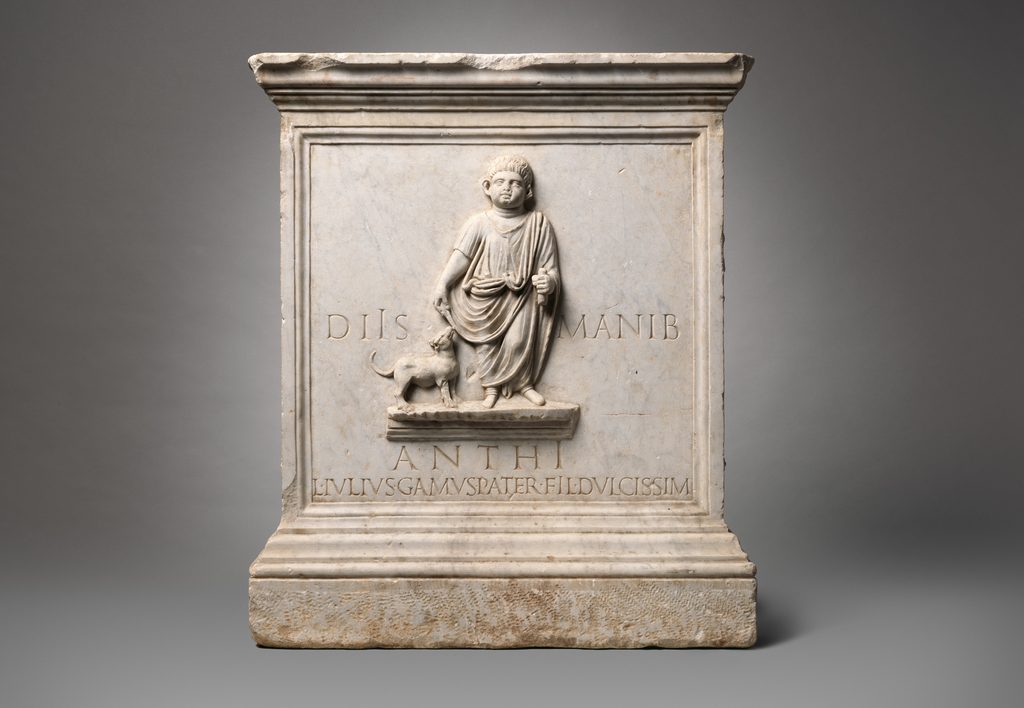
To the Lares Praestites, with small statues of the gods.
Ovid, Fasti 5.129–142; trans. Anthony Kline, with Praestites retained
Curius vowed them: but time destroys many things,
And the long ages wear away the stone.
The reason for their epithet of Praestites
Is that they keep safe watch over everything.
They support us, and protect the City walls,
And they’re propitious, and bring us aid.
A dog, carved from the same stone, used to stand
At their feet: why did it stand there with the Lares?
Both guard the house: both are loyal [fidus] to their master:
Crossroads are dear to the god, and to dogs.
Both the Lar and Diana’s pack chase away thieves:
And the Lares are watchful, and so are dogs.
It is an old image that seems to have existed from the beginning, immediately familiar today: a boy with his faithful companion, evoking the innocent memory of childhood shared by us all—our best friend and loyal pet that followed us through the garden, waited at the door, slept at our feet, and seemed to belong as naturally to the household as we did ourselves. The tenderness of the Anthus monument is especially striking: the young Anthus is commemorated by his father, L. Iulius Gamus, as his dulcissimus filius, his ‘sweetest son’, and is commemorated with his faithful dog beside him.9 The altar dates to the first half of the first century CE; although Anthus’ exact age is unknown, his youthful representation makes clear that he died while still very young.
Fides in classical Roman usage is fundamentally relational: trustworthiness, keeping faith, fulfilment of one’s word, fidelity within treaties, patronage, friendship, contracts, oaths, and political relations. It is something demonstrated towards another party through constancy of conduct. Hence fidem servare, ‘to keep faith’; in fidem venire, to come under another’s protection or pledged faith; fides between allies, patrons and clients, magistrates and citizens. Even the goddess Fides personifies the sanctity of pledged relations.
Dogs were proverbial throughout Graeco-Roman literature for their fides, their faithful attachment to their master, and they could therefore function as visual embodiments of fidelity. Liv Mariah Yarrow notes that dogs appear as symbols of fides and pistis in funerary art, and that Roman inscriptions actually preserve dog names such as Fidelis and Pistos, both meaning essentially ‘faithful’.10 The Latin adjective fidus belongs to the same linguistic family as fides. The familiar dog-name Fido derives from this Latin fidus; it is therefore literally named ‘Faithful’.
Whereas Christianised Latin, on the other hand, does something striking with the same word. Fides increasingly becomes what English inherits as ‘faith’: belief, trust, or allegiance directed principally towards God and towards propositions concerning revelation. The centre of gravity therefore moves from ‘I am faithful to this person, bond, oath, or office’ towards ‘I possess faith in the transcendent truth’. The vocabulary survives, but the Roman relational order it once expressed is no longer sovereign; fides and pietas are refigured beneath a universal transcendent authority.
The English word faith itself comes through Anglo-French/Old French feid, foi from Latin fides. So in an English Christian context there is a very literal historical chain here: from Greek pistis to Latin fides to Old French feid/foi, and to English faith. Fides is one of the central Latin Christian terms for faith, and Christian theology continues to use it as such. The Catholic Dominus Iesus, for instance, explicitly speaks of faith in terms of personal adherence to God, assent to revealed truth and trust in the one who reveals it. The Vulgate repeatedly has fides where the Greek New Testament has pistis: for example, Romans 10:17 has ergo fides ex auditu, or ‘therefore faith [comes] from hearing’. Hebrews 11:1 likewise begins est autem fides…, and the same passage proceeds to speak of understanding through fides: fide intelligimus. Ephesians 4:5 has the familiar una fides, ‘one faith’.
In De Trinitate 13.2.5, Augustine of Hippo draws a distinction between ea quae creduntur, ‘the things which are believed’, and fides qua creduntur, ‘the faith by which they are believed’; the former have their reality in rebus, in the things themselves, whilst the latter resides in animo credentis, within the mind of the believer, and is therefore, as Augustine puts it, cordis res, non corporis, ‘a thing of the heart, not of the body’. From the standpoint of Roman religio, this is a revealing reorientation: fides is here being treated chiefly as an inwards condition of the believer, separable from the things to which belief is directed, rather than primarily as a concrete relation of trust, fidelity, obligation, and observance. It is worth stressing that the familiar technical formulation fides quae and fides qua is itself later theological terminology, commonly imposed retrospectively upon Augustine; Augustine’s actual distinction is between ea quae creduntur and fides qua creduntur, and the scholarly literature has specifically disputed the attribution of the later fides quae/fides qua scheme to Augustine.11
Neither was this severance confined to fides: where Ovid recalls Aeneas offering solemn gifts to the Genius of his father, and Cicero enjoins the perpetual observance of ancestral sacra, binding their transmission to the inheritance of the pater familias, Augustine repudiates the divine honours rendered to the departed and insists upon the incorporeal nature of the soul, admitting even the possibility that each soul is created anew by God rather than transmitted through parental descent; thus, the sacred continuity of the gens, once sustained through the veneration of its ancestral divinities and the hereditary obligations of pietas, is confronted by a doctrine that severs spiritual origin from paternal descent.12 The son may inherit his father’s blood, name, and estate, yet the sacred authority of the ancestral line is subordinated to a heavenly Father; the law of the Pater, and the entire order of agnatic succession through which his ancestral rites endured, must yield before a superior religious allegiance.
33 And he answered them, saying, Who is my mother, or my brethren?
Mark 3:33–35; King James Version
34 And he looked round about on them which sat about him, and said, Behold my mother and my brethren!
35 For whosoever shall do the will of God, the same is my brother, and my sister, and mother.
More radically still, Christianity undertook the appropriation of the family itself. Against the Roman gens there arose in the ecclesia a rival spiritual household, claiming a higher fatherhood and a higher inheritance. Christ’s declaration, ‘Who are my mother and my brothers?’, transferred the language of kinship to those who performed God’s will; the Epistle to the Ephesians numbered believers amongst the ‘household of God’, whilst the First Epistle to Timothy identified that household with the Church itself. Tertullian made the principle unmistakable when he described Christians as brethren because they acknowledged unum patrem deum, ‘one Father, God’. The result was a surrogate family, constituted through spiritual adoption rather than agnatio, whose allegiance superseded the hereditary obligations owed to the Pater and the ancestral Manes. Even the most elementary offices of filial pietas were subordinated to this new allegiance: when a would-be disciple sought first to bury his father, Christ commanded him, ‘Let the dead bury their own dead.’13 The ancestral household might survive as a civil institution, but its sacred sovereignty had been surrendered to another Father, another family, and another law.
Pietas is even more revealing. Roman pietas means the dutiful fulfilment of obligations arising from one’s place within an ordered nexus: towards one’s father and ancestors, one’s family, one’s gods, and one’s patria. Aeneas is pius because he carries his father, leads his son, obeys divine command, bears the destiny of his people, and subordinates personal inclination to inherited and public obligation. It is therefore not merely ‘being religious’. It is right conduct within a hierarchy of real relations.
[Modernity] has old roots. In most respects, it represents a secularisation of ideas and perspectives borrowed from Christian metaphysics, which spread into secular life following a rejection of any transcendent dimension. Actually, one finds in Christianity the seeds of the great mutations that gave birth to the secular ideologies of the first post-revolutionary era. Individualism was already present in the notion of individual salvation and of an intimate and privileged relation between an individual and God that surpasses any relation on Earth.
Alain de Benoist and Charles Champetier, Manifesto for a European Renaissance (2012), Part I, §1, ‘What is Modernity?’; trans. Martin Bendelow and Francis Greene
Christian usage increasingly narrows pietas towards what English calls piety: devotional religiosity, reverence towards God, godliness, inwards religious disposition. Again, Christianity did not invent the divine element, as Roman pietas emphatically included the gods, but it profoundly altered and inverted the architecture. In Rome, reverence towards the gods innately belonged inside the same continuum as duty towards father, ancestors, household, and City. In Judaeo-Christianity, allegiance to God alone can become the criterion by which those other relations are themselves judged and, where necessary, overridden. This is the more exact version of the transformation:
Roman pietas:
divine duty + filial duty + ancestral duty + civic duty, integrated within one concrete order.
Christian pietas:
the transcendent relation becomes primary, and the earthly relations acquire legitimacy conditionally beneath it.
Likewise:
Roman fides:
‘I remain true to the bond that exists between us.’
Christian fides:
‘I adhere faithfully to God, revelation, and the truth believed.’
From a doctrinal point of view, Christianity appears as a desperate version of Dionysism. Modeling itself after a broken human type, it appealed to the irrational part of being and instead of the paths of heroic, sapiential, and initiatory spiritual growth posited faith as its fundamental instrument, the élan of a restless and perturbed soul that is attracted to the supernatural in a confused way.
Baron Julius Evola, ‘Syncope of the Western Tradition’ (‘Sincope della tradizione occidentale’), Revolt Against the Modern World (Rivolta contro il mondo moderno, 1934); trans. Guido Stucco (Inner Traditions, 1995), pp. 280–81
The transformation is therefore not merely lexical. It reflects a change in the locus of moral authority. The universal God effected a corresponding flattening of particular relations. Where the older order recognised differentiated sacred bonds—to father, ancestor, household, city, people, and tutelary divinity—Judaeo-Christianity placed them beneath a single transcendent allegiance before which each became secondary and conditional. The same movement that abstracted fides and pietas from concrete hierarchy thus universalised the moral subject itself: the particular man ceased to stand primarily within inherited relations and increasingly stood, as an interchangeable soul, before the same absolute ‘God’.
This is why the older Roman vocabulary can sound deceptively familiar after Christianisation. ‘Faith’, ‘piety’, ‘conscience’, ‘fidelity’, and ‘duty’ survive, yet the organising metaphysics beneath them has been entirely inverted. A Roman asking whether a person possessed pietas would naturally look at how he stood towards father, ancestors, household, gods, and patria; a Christian asking whether somebody possesses pietas ultimately asks whether his soul stands rightly before God, before whom every particular and embodied obligation is subordinate, and whose abstract supremacy renders every particular and embodied obligation conditional.
And that bears directly upon the problem we have been describing. From a fides-centred relational ethic, the decisive question is: what have I established between myself and this actual person, and what fidelity does my conduct now require? A transcendent moralism instead asks: is my present conduct righteous before the abstract authority? If those answers conflict, the latter subordinates and dissolves the concrete obligations of the former.
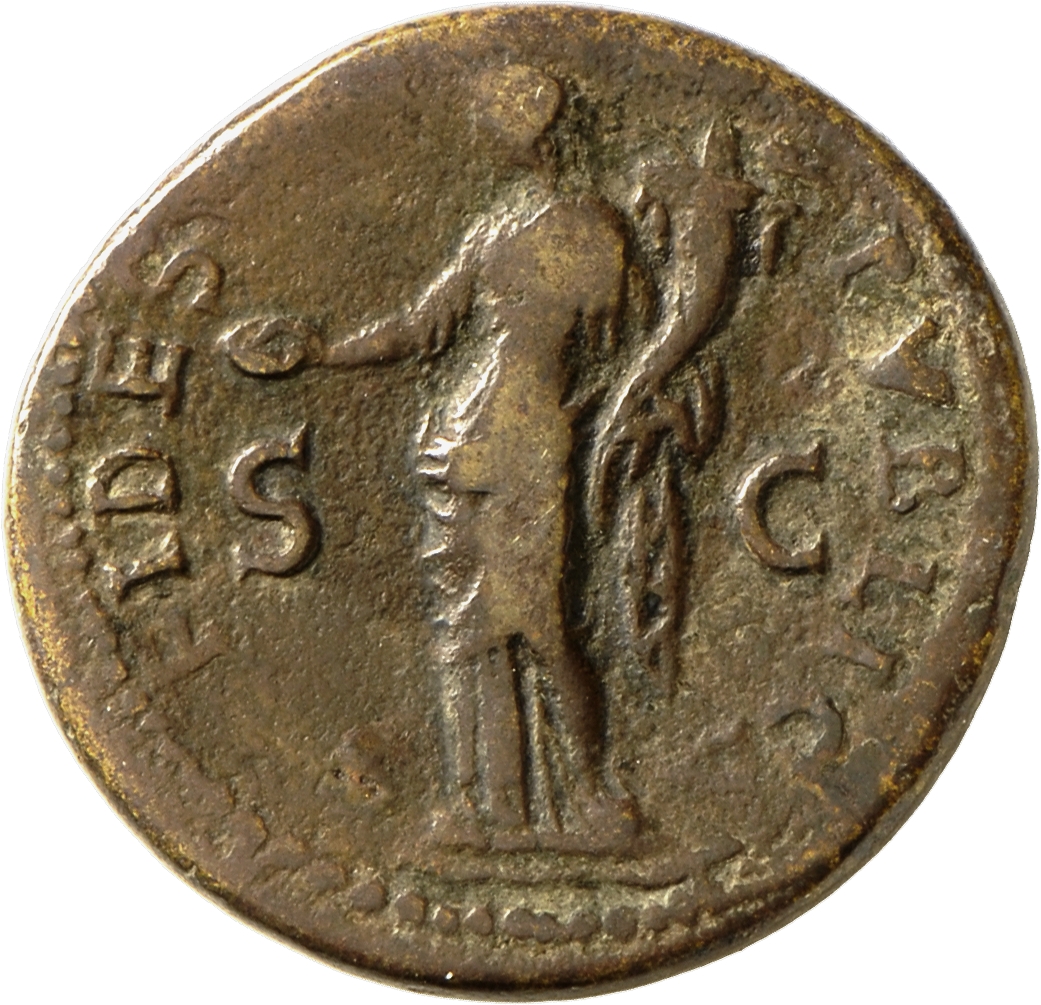
Right: Fides; reverse of a 100-lire coin, engraved by Pietro Giampaoli, 1955, Vatican City; personification of Faith standing with a cross and chalice containing the Eucharistic Host, inscribed FIDES; Vatican City, Pius XII
First of all, there is a visible hierarchy that legitimizes the ancient aristocratic-racial Aryan and Roman cult. In an army, one does not directly address the supreme leader, but rather the hierarchy on which he immediately depends, because of the fact that he, or the individuals closest to him, were able to settle the situation, without needing to go higher up. Likewise, admitting a universal God was not a reason to exclude every intermediary and to condemn any reference to the particular mystical forces that are closer to a folk or race and connected in a concrete unity of destiny and life. Celsus even brought up the hierarchical argument against the accusation of polytheism made by the Christians by observing, by analogy, that whoever pays tribute to obedience to an authority delegated to the government of a given province implicitly pays tribute to the central government, while whoever claims to address it solely and directly, beyond being impertinent, can, in reality, be acting in an anarchic way.
Baron Julius Evola, ‘The Mystique of Race in Ancient Rome’ (‘La mistica della razza in Roma antica’), La Difesa della Razza, III, no. 14, 20 May 1940; trans. Cologero Salvo, Pagan Imperialism (Gornahoor Press, 2017), p. 133
The same subordination of inherited, embodied order to an abstract superior morality assumes an explicitly progressive form in St Ambrose, where the new is sanctified precisely in its triumph over the ancestral.
So the linguistic continuity rather conceals the revolution. Christianity did not simply discard fides and pietas; it appropriated them, translated their centre upwards, and returned them with materially altered meanings, producing an iconographic and lexical continuity accompanied by a change of religious content. By transferring fides and pietas from concrete persons, offices, and hierarchies to an abstract transcendent allegiance, Christianity introduced an intrinsically anarchic principle by which every embodied authority might be judged and disobeyed. What had once bound men and women within an actual order became the very language by which that order could be superseded and dissolved.
Scholia
- CIL VI 11864: DIIS MANIB / ANTHI / L IVLIVS GAMVS PATER FIL DULCISSIM — “To the spirits of the departed of Anthus; L. Iulius Gamus, father, [made this] for his sweetest son.”
- Liv Mariah Yarrow, ‘Ulysses’s Return and Portrayals of Fides on Republican Coins’, in Peter G. van Alfen, Gilles Bransbourg and Michel Amandry (eds.), Fides: Contributions to Numismatics in Honor of Richard B. Witschonke (New York: American Numismatic Society, 2015), p. 337
- Olivier Riaudel, ‘Fides qua creditur et fides quae creditur: Return to a distinction which is not in Augustine’, Revue des Sciences Religieuses 86 (2012). Riaudel argues that the later technical opposition should not simply be projected back into De Trinitate XIII.2.5, despite that passage traditionally being cited as its Augustinian source.
- Ovid, Fasti II.533–546; Cicero, De legibus II.19, 22, 27, 47–48; Augustine, De civitate Dei VIII.26; De anima et eius origine IV.2, 38. Augustine remained undecided concerning the transmission or individual creation of souls; the latter position was subsequently affirmed by Thomas Aquinas, Summa theologiae I, q. 118, a. 2, who expressly denied that the intellectual soul could be transmitted through parental generation.
- Cicero, De legibus II.19, 22, 47–48; Ovid, Fasti II.533–546; Mark 3:31–35; Luke 9:59–60; Ephesians 2:19; Galatians 4:4–7; 1 Timothy 3:15; Tertullian, Apologeticum 39.8–10. Tertullian explicitly identifies the Christian fraternity through its acknowledgement of a common divine Father, independently of natural consanguinity.
The Secularisation of Guilt
The modern sexual order cannot be understood apart from the secularisation of guilt. Its claim to emancipation from theology disguises a profound continuity with religious modes of accusation, confession, purification and moral rebirth. The older language recedes; the structure survives. Sin becomes harm, temptation becomes risk, impurity becomes violation, penance becomes apology, heresy becomes bigotry, confession becomes disclosure, and redemption becomes renewed admission into the moral community. The transcendent judge disappears from view, yet judgement itself grows more intimate, more interior, more restless, and more difficult to escape.
This is one of the deeper ironies of liberal modernity. It imagines itself to have overcome the severity of religious consciousness, while preserving many of its most searching disciplines in immanent form. The soul is no longer examined before God, yet the subject is ceaselessly examined before autonomy, equality, safety and harm. Desire is no longer brought before a confessor, yet it is placed beneath therapeutic, ideological and juridical scrutiny. The old fear of damnation yields to the fear of accusation; the old anxiety over sin yields to anxiety over complicity, violation, prejudice and hidden motive.
The Christian ancestry of this formation cannot be treated as accidental. Christianity universalised moral inwardness, intensified the drama of guilt, gave extraordinary significance to the victim, and placed the conscience beneath a searching light that older aristocratic and civic orders often resisted or contained within different limits. Liberalism and feminism inherit this inwards tribunal after severing it from its vertical end. The result is a moral order in which guilt remains active after transcendence has weakened, and in which the sexes become one of the principal theatres through which secularised guilt is distributed.
Within the liberal-feminist catechism, man assumes the position of inherited guilt. He is made to bear the memory of paternal authority, sexual hierarchy, exclusion, judgement and unlicensed desire, even when he personally stands innocent of any particular offence. His guilt is structural because his symbolic position has already been interpreted through the history of constraint. He enters discourse as the descendant of the order accused. His approach therefore requires authorisation, his speech purification, his judgement explanation, his confidence mitigation. The catechism demands from him the posture of one who has already inherited a stain.
Woman, conversely, assumes the position of wounded innocence. This innocence is neither the older chastity of form nor the sacral dignity of a being situated within household, marriage, fertility and symbolic polarity. It is innocence as grievance, innocence as exposed autonomy, innocence as the claim of one whose freedom has been obstructed by historical form. The feminine subject acquires moral rank through the memory of injury. Her vulnerability becomes interpretative privilege. Her discomfort acquires the character of revelation because the catechism has already established the world as the scene of her obstruction. Here Tertullian’s ‘voluntary eunuchs’ disclose their true and monstrous daring: woman is held in perpetual childlike stasis, while man is compelled both to coddle her and to mutilate his own authority before the eternal, enthroned innocence of her bottomless grievance.
This redistribution of guilt explains the confessional atmosphere of contemporary sexual morality. The man is asked to examine himself for hidden entitlement, unexamined bias, coercive habits, inherited assumptions and forbidden desires; the woman is asked to search memory for injuries, discomforts, silences, pressures and violations she may not yet have fully recognised. Both are drawn into an interior audit. The relation between the sexes becomes a theatre of testimony. Speech increasingly takes the form of avowal, accusation, confession, recognition or apology. Love is made to pass through the vestibule of moral accounting.
The operation is especially visible in the retrospective power of the catechism. A past encounter may be reopened under a later vocabulary, then judged according to concepts that were absent, unshared, unstable or unborn at the moment itself. The present doctrine reads backwards through time with the authority of eternal law. What had once been ambiguity may become harm; what had once been regret may become injury; what had once been erotic misjudgement may become evidence of a system. The catechism colonises memory because guilt seeks extension beyond the moment of the act.
Such retrospective judgement depends upon the concealment of origins already examined. The newer vocabulary cannot appear as a recent historical formation while exercising authority over the past; it must appear as the delayed recognition of a truth that had always been there. Its novelty is therefore hidden beneath the rhetoric of awakening. The subject is told that she has finally learned the proper name for what occurred; the man is told that his ignorance of the category does not absolve him. The catechism thereby confers upon itself the power of revelation.
Here the secularisation of guilt becomes indistinguishable from catechesis. The subject must learn the authorised names of injury before experience can be morally completed. The language does not merely describe memory; it fulfils it by placing it within the drama of harm and recognition. This is why the formulas must be repeated. Repetition trains perception until the doctrine becomes spontaneous. The ear is taught to hear coercion in ambiguity, animus in judgement, danger in approach, violation in loosened self-possession, and oppression in form. Guilt becomes audible everywhere because the catechism has tuned the soul to receive it.
This entire structure retains the religious pattern while inverting its orientation. The old conscience, however severe, stood before a transcendent order that could also judge the accuser, purify the penitent, rank sins, command mercy, and measure the soul against something more than social admissibility. The secularised conscience stands before the community of the doctrine. Its absolution is horizontal. It seeks recognition, apology, education, policy, reputational restoration and public proof of conversion. The sacred has descended into the social, and the social, deprived of transcendence, becomes voracious.
The catechisms of consent and misogyny operate as the two privileged instruments of this guilt. Consent asks whether desire has crossed the boundary of the autonomous subject; misogyny asks whether judgement has betrayed hostility towards the subject feminism claims to represent. One produces guilt at the threshold of approach; the other produces guilt at the threshold of speech. Together they enclose man within a penitential economy. He must ask permission before he approaches and examine himself before he judges. His masculinity is made to pass through confession before it can be socially received.
The result is a sexual order in which guilt precedes relation. The man is already answerable; the woman is already vulnerable; the encounter is already morally burdened before desire has acquired form. The catechism does not need to accuse continuously, because its deepest success lies in pre-accusation: the installation of guilt as the silent premise of masculine presence. This is the true secular inheritance of the confessional order. The tribunal has moved inward, and its first defendant is man.
The Reign of Anti-Form
Anti-form arises when an order derives its coherence from hostility towards the forms it has displaced. It possesses structure, discipline and authority, yet its governing principle remains negative. It organises reality around emancipation from inherited limits, while depending upon the continual memory of those limits to justify its own jurisdiction. Such an order cannot simply forget the past, since its legitimacy requires the past as accusation. It must keep the old world alive as wound, oppression, danger and warning, so that its own authority may appear as perpetual liberation.
The liberal-feminist sexual order exhibits precisely this character. It does not inhabit a positive metaphysic of man and woman grounded in form, office, hierarchy and participation. It constructs its authority through opposition to the prior order by which man and woman were once rendered intelligible. Fatherhood, marriage, modesty, chastity, paternal judgement, masculine initiative, feminine reserve and household continuity are summoned continually as signs of danger. The new order needs these figures as demons of origin. Without them, its emancipatory drama would lose its sacred enemy.
Anti-form therefore governs through remembrance without reverence. It remembers tradition only as indictment. It preserves fragments of the older order in degraded form, stripped of the principles that once made them luminous, then exhibits those fragments as proof that the past deserves overthrow. The father is remembered as domination, the husband as possession, the suitor as pressure, the judge as exclusion, the modest woman as victim of repression, the chaste order as fear of pleasure. The catechism performs a continual black mass over the remains of form.
This inversion is more subtle than simple destruction. A civilisation cannot live by negation alone, because life requires structure, transmission and discipline. Anti-form therefore recreates the necessary functions of form under contrary signs. It abolishes paternal authority and multiplies institutional guidance. It condemns judgement and multiplies diagnosis. It dissolves courtship and multiplies protocols. It rejects honour and multiplies reputational punishment. It repudiates chastity and multiplies anxieties over safety, harm and violation. The function returns after the principle has been profaned.
Here the earlier distinction between qualification and procedure reaches its final consequence. Form qualifies; anti-form administers. Form gives inward measure; anti-form supplies external regulation. Form situates man and woman within an order of meaning; anti-form begins from their abstraction and then manages the disorder produced by abstraction. The older sexual order sought to discipline desire through a symbolic hierarchy. The newer order releases the subject from that hierarchy, then surrounds the released subject with the machinery of correction.
The reign of anti-form is therefore marked by a peculiar increase of regulation alongside the rhetoric of liberation. The more relation is freed from inherited structure, the more it requires procedural management. The more sexual difference is detached from metaphysical significance, the more it becomes an object of ideological contest. The more desire is released from chastity, courtship and household, the more it enters the language of risk. The more judgement is deprived of office, the more accusation expands to fill the void. Dissolution generates administration as its shadow.
This explains the oppressive weight of a morality that speaks continually of freedom. Its freedom is abstract because it begins from the subject severed from form. The liberated individual discovers immediately that relation, once deprived of inherited meaning, becomes unstable. The system then returns to stabilise what its own principles have dissolved. It offers safety after it has weakened trust, policy after it has weakened honour, therapy after it has weakened household, consent after it has weakened courtship, and accusation after it has weakened judgement. The wound and the remedy belong to the same order.
Anti-form also possesses a false universality. Because it proceeds from abstraction, it imagines its categories to be universally applicable. It sees no principial difference between civilisations, ranks, rites, offices, sexes or inherited forms, except as variations requiring translation into autonomy, equality, harm and recognition. The local, the ancestral, the sexed, the hierarchical and the sacred are compelled to appear before concepts derived from the metaphysic that already denies their authority. The tribunal is never neutral. It is the revolution sitting in judgement upon the worlds it has displaced.
The sexual order becomes especially vulnerable to this false universality because man and woman are among the primordial distinctions through which human beings encounter form. Sexual difference precedes doctrine. It arises with the body, announces itself in desire, reaches beyond the individual through generation, and binds private life to lineage. A metaphysic of autonomy cannot rest before such a fact. It must interpret sexual difference, regulate it, politicise it, psychologise it, or reduce it to an object of self-definition. The given becomes intolerable wherever will has claimed sovereignty.
The category of consent serves anti-form by reducing sexual relation to a series of authorised moments between abstract individuals. The category of misogyny serves anti-form by forbidding judgement from the standpoint of the older sexual order. One dissolves the continuity of eros into permission; the other dissolves the authority of distinction into suspected hatred. The two catechisms therefore guard the same inversion. They ensure that form cannot return either through desire or through speech.
Under the reign of anti-form, even rebellion becomes predictable. The subject imagines herself liberated by repeating the catechism through which the order formed her. She experiences inherited form as oppression because she has been instructed to perceive it as such. She experiences procedure as safety because she no longer possesses the older grammar of honour. She experiences accusation as courage because judgement has been redefined as violence. The rebellion is real at the level of sentiment and illusory at the level of principle. She has exchanged personal forms for impersonal administration and calls the exchange emancipation.
Man, within this same order, is deprived of the possibility of principial rebellion unless he recovers a vocabulary older than the catechism. Simple resentment cannot suffice, because resentment remains bound to the order it hates. Complaint cannot suffice, because complaint accepts the therapeutic level of discourse. Appeals to fairness cannot suffice, because fairness already belongs to the egalitarian grammar that helped produce the inversion. The answer must come from above the plane upon which the catechism operates. It must restore form rather than negotiate improved treatment within anti-form.
The inversion of the sexual order thus culminates in a world governed by shadows of the things it has renounced. Rite returns as procedure; confession returns as disclosure; penance returns as apology; fatherhood returns as institutional guardianship; chastity returns as anxiety over safety; judgement returns as diagnosis; hierarchy returns as protected vulnerability; doctrine returns as social common sense. The forms are gone, yet their necessities remain. Anti-form reigns by administering the remains of the sacred after the principle of the sacred has been denied.
The path beyond this inversion must therefore begin with recollection. Form cannot be restored by moderation within the catechism, because the catechism itself exists to prevent form from speaking in its own name. The mind must recover the words through which qualitative reality becomes visible again. Honour, chastity, fidelity, office, piety, courtship and judgement are not antiquarian ornaments, but instruments of re-ascent. Through them the relation between man and woman may once again be lifted from procedure into order, from suspicion into qualification, and from anti-form into participation.
The Lost Moral Vocabulary
The Recollection of Qualitative Speech
A civilisation begins to die when its highest words become unintelligible to itself. Institutions may remain, laws may multiply, commerce may flourish, and technical capacity may continue its restless expansion, yet the inner life of the order has already entered decline when the vocabulary by which it once recognised nobility, shame, duty, rank, honour, chastity, fidelity, office, piety and judgement becomes archaic, embarrassing, or morally suspect. Such words are never ornamental. They are organs of perception. Through them a civilisation sees qualities that would otherwise disappear into undifferentiated experience.
The loss of a moral vocabulary therefore entails the loss of a world. Once honour ceases to sound with authority, conduct can scarcely be measured by reputation before a visible order of dignity. Once chastity ceases to signify the disciplined radiance of sexual form, it is heard as repression or fear. Once fidelity loses its metaphysical gravity, it becomes preference prolonged by sentiment. Once office is forgotten, authority appears as force. Once piety is reduced to private belief or inherited superstition, the relation between the living, the dead, the divine and the unborn falls beneath consciousness. The word disappears first; the faculty follows.
This is why the liberal-feminist catechisms possess such destructive power. They do not simply add concepts to an existing order of judgement. They replace the vocabulary through which rival orders could have judged them. ‘Consent’ enters where courtship, chastity, honour, marriage and prudence have already weakened. ‘Misogyny’ enters where distinction, masculine judgement, paternal authority and the defence of form have already lost public legitimacy. Their triumph becomes possible because the older words no longer command the imagination with sufficient force to resist translation into the new grammar.
The recovery of sexual order must therefore begin with recollection. Recollection is not nostalgia, because nostalgia desires the past as image, while recollection restores the principial content hidden by historical decay. The task is not to imitate dead manners, revive costumes, or preserve fragments as museum pieces; it is to recover the higher meanings by which those fragments once participated in a living whole. Honour, chastity, fidelity, office, piety and courtship must be understood again as metaphysical words before they can become social words with authority.
Such recollection demands severity. Modern sentiment will attempt to soften these words until they become harmless. Honour will be reduced to respect, chastity to personal boundary, fidelity to emotional exclusivity, piety to ethical seriousness, office to responsible behaviour, courtship to consensual dating. Each translation preserves a corpse-like resemblance while removing the principle. The old words cannot return as liberal synonyms. They must return as judgements upon liberalism itself.
The lost moral vocabulary need not be reconstructed here as a complete alternative doctrine. Its absence already proves the impoverishment of the catechism. A civilisation that can speak endlessly of consent while scarcely speaking of rank, office, fidelity, shame, piety, lineage, measure or qualitative judgement has already disclosed the narrowness of its sexual imagination. The purpose of recollecting these words is therefore diagnostic before it is prescriptive. They reveal the dimensions of reality the liberal-feminist grammar has rendered obscure.
Restoring The Counter-Metaphysic: Qualification Instead of ‘Consent’; Judgement Instead of ‘Misogyny’
The counter-catechism begins with two words: qualification and judgement. Against consent as the sovereign procedure of erotic legitimacy stands qualification, by which persons, acts and relations are measured according to form rather than authorised by isolated will. Against misogyny as the criminalisation of masculine distinction stands judgement, by which speech is tested according to truth, office, proportion and rank rather than reduced to pathology. Around these gather the sterner vocabulary of another metaphysic: form, office, measure, censure, piety, shame and fidelity. Such words do not decorate moral life; they impose an order of perception in which autonomy ceases to be sovereign and the individual is recalled to the forms that judge, bind and qualify him.
The counter-metaphysic returns when the language of procedure is answered by the language of qualification, and the language of accusation by the language of judgement. ‘Did she consent?’ is met by the prior question: ‘was it his right to approach her, and was the relation proper?’ asks whether the persons and act were qualified, whether the woman qualified to receive, and did the relation stand within a form worthy of either? What accountability and participation does she share, in accordance with the supposed autonomy and responsibility that she claims? ‘What you have said is misogynistic’ is met by the sterner demand of ‘what you said is a judgement, and must be weighed for truth, proportion, and authority’, restoring the question to discernment. In each case, the liberal catechism loses its monopoly over moral interpretation. Permission ceases to exhaust legitimacy; accusation ceases to annul discernment. Qualification restores the authority of form over individual will, while judgement restores the authority of distinction over diagnosis. These words reclaim moral sovereignty because they refuse to plead before the infernal, feminine tribunal established by ‘consent’ and ‘misogyny’; they summon that tribunal before a higher court, where the autonomous subject is no longer the final measure, and where persons, acts and relations may again be ranked according to their fitness within an order exceeding private desire.
No sexual order can survive while man and woman are understood only as atomised individuals negotiating satisfaction, recognition, and boundary. Father, mother, husband, wife, suitor, maiden, elder, guardian, host, judge and ancestor are not decorative titles affixed to biological or contractual facts. They are forms of participation in the higher order that the Marxist class-consciousness of feminists denies a priori. Atomisation and the denial of higher forms is the necessary first step before class-consciousness can be advanced. Each office gathers conduct into a pattern of expectation, privilege, burden and dignity. Each rescues the person from abstraction by placing him within a symbolic economy where action acquires weight.
Without piety, sexual order becomes collective sociological arrangement, legal contract, or emotional preference. Piety binds the relation between the sexes to powers exceeding the couple: household gods, ancestors, lineage, divine witness, inherited command, the unborn, the dead, and the invisible continuity of a people through time. It reminds man and woman that their union is never simply theirs. The bed, the hearth, the womb, the name and the grave all belong to a chain of participation whose meaning cannot be exhausted by personal fulfilment. Fidelity gives time to eros and thereby rescues it from consumption. Desire without fidelity moves horizontally, from object to object, experience to experience, novelty to novelty. Fidelity introduces verticality because it binds desire to a form that endures beyond mood, injury, boredom, temptation or self-reinvention. It is the temporal honour of love. Where consent authorises the moment, fidelity orders the life. Where autonomy revises relation according to present will, fidelity compels the will to remember the vow by which it once entered form.
Courtship is the civilised drama of approach. It gives form to uncertainty and honour to risk. It recognises that the relation between man and woman cannot be reduced to explicit transaction because desire speaks through signs, hesitation, courage, reserve, rhythm, refusal and recognition. Courtship cultivates judgement in both sexes. The man must learn boldness without vulgarity; the woman must learn discernment without cynicism. Each is formed through the tension. Procedure cannot replace this because procedure fears the very ambiguity through which courtship educates.
These words belong together because each presupposes qualification. Honour qualifies conduct; chastity qualifies desire; fidelity qualifies time; office qualifies power; piety qualifies relation; courtship qualifies approach. None can be fully understood within the metaphysic of the autonomous subject, for each presupposes an order that precedes, forms and judges the individual. Their recovery would therefore constitute more than moral reform. It would mark the return of qualitative speech against the pseudo-empire of procedure.
Conclusion: From Catechism to Recollection
The liberal-feminist catechisms fear recollection. Recollection restores the tribunal before which they themselves may be judged. ‘Consent’ can then shrink before a larger sexual order centred upon what is higher, rather than remaining enthroned as the sole, absolute, and self-centred sovereign criterion, tyrannising every authority, obligation and horizon beyond the autonomous will it enthrones. ‘Misogyny’, if it can be rehabilitated at all at so late and degenerate a stage, might be subjected to criteria proportionate to its proper gravity, rather than wielded as a revolutionary weapon against distinction itself. Masculine office can be requalified, rather than presumed dangerous. Feminine dignity can be restored to symbolic form, rather than collapsed into autonomy guarded by destructive, hateful suspicion. The entire moral field changes once the lost words recover their authority.
The restoration of order begins with the restoration of obedience: the lucid recognition that the lower does not possess the right to summon the higher before its tribunal, nor to reduce every command to a negotiation among equivalent wills. Obedience is the active assent of a being to the principle above it, the acceptance of measure, office and form as realities anterior to appetite. Its abolition has never liberated the modern subject, a phenomenon that finds its final expression in the liberated woman, who continues to bear resentment before rank, hatred of excellence, fear of responsibility, dependence upon collective sanction, and the covert desire to command through grievance what one lacks the strength to command openly; it has merely delivered her to the anonymous commands of fashion, resentment, publicity and the mass, while teaching her to reserve her rebellion for the nearest legitimate authority. Within the sexual order, this inversion reaches its most grotesque completion when man is denied the right to command and woman is taught to experience obedience as metaphysical injury. The result is a household without axis, a union governed by grievance, and a civilisation in which every inferior impulse claims sovereignty because no superior principle dares impose form upon it. Obedience must therefore be reclaimed without apology as a virile and aristocratic virtue: the capacity to recognise rank, to submit freedom to purpose, and to become more through fidelity to an order one did not invent.
The slave mind cannot obey nobly, because it recognises no higher principle; yet it submits instinctively to the new tyrannies of fashion, ‘public opinion’, bureaucracy, necessity, appetite, fear, resentment and the reactive becoming of the mass, all still tinged by submission to the lingering maternal absolutism and fatalistic ‘providence’ of the Semitic judge-god. It translates impotence into virtue, envy into justice, cowardice into compassion and the levelling of every distinction into ‘liberation’. Unable to rise towards the superior, it seeks instead to drag the superior before the tribunal of the inferior, where authority must be made to apologise, strength must justify itself, and every qualitative difference is condemned as guilt-injury. Its deepest signature is therefore spiritual inversion: it enthrones weakness as moral sovereignty and calls its vengeance against form mere ‘humanity’ and ‘humanism’.
The question is consequently one of language at the highest level. A civilisation cannot recover what it cannot name. It cannot honour what its vocabulary has trained it with substitute and surreptitious metaphysics to suspect. It cannot transmit what it has learned to pathologise. The recollection of qualitative speech is the first act of resistance because it breaks the enchantment of the catechisms. It recalls the mind to an order of meanings older and higher than the formulas by which modernity has taught the sexes to mistrust one another.
The social-media attention economy, far more poisonous than has yet been realised, returns bearing the ugliest traits of the Puritanism once exiled from the Old World. It trains the masses to mistake attention for rank, vanity for authority, and condescension for professionalism. Corporations retain more authority precisely where men have surrendered their own and consented to appear as emasculated equals, because the ancient relation of clientela, itself descending from the patriciate, remains legible within the laws, customs and business etiquette of modernity, however tightly the Old World may lie in its vice: patron and client, access and obligation, honour and conduct. Even where moderns attempt doting politeness or ceremonial respect, the gesture remains strangely simple, flattened by the New World manner into a performance without depth, form, lineage or true bearing.
Every catechism seeks interiority. Its success lies in the moment when doctrine ceases to appear as doctrine and becomes reflex, instinct, conscience and spontaneous moral perception. The liberal-feminist subject does not experience herself as reciting a creed when she invokes consent, misogyny, harm, safety, trauma, recognition or autonomy; she experiences herself as naming reality. This is the final victory of formation. The formula has descended so deeply that it no longer sounds like instruction. It speaks as the voice of the self.
The present inquiry has sought to interrupt that voice by restoring distance. Distance is the beginning of philosophy. A concept once recognised as a concept can again be judged. A moral reflex once recollected to consciousness can again be interrogated. A vocabulary once returned to its origin can no longer masquerade so easily as nature. The spell weakens when the word is heard historically, metaphysically, genealogically and symbolically, rather than received as an immediate command of conscience.
The first illusion to fall is universality. The catechisms present themselves as the completion of moral reason, yet they belong to a definite civilisation, a definite anthropology and a definite metaphysic. They arise within a world that has elevated autonomy above participation, procedure above qualification, therapeutic disclosure above honour, and suspicion above inherited trust. Their apparent self-evidence is therefore a local triumph disguised as universal truth. They are provincial concepts with imperial ambition.
The second illusion to fall is innocence. No dominant vocabulary is innocent. Every concept carries within it an order of perception, a hierarchy of concerns, an implied anthropology, and a judgement upon rival worlds. Consent, once absolutised, carries the image of the self-owning individual whose relation to others must be continually authorised. Misogyny, once expanded into catechetical accusation, carries the image of masculine judgement as morally suspect whenever it resists the feminist representation of woman. Their use forms the soul that repeats them.
The third illusion to fall is neutrality. The catechisms do not stand above the conflict between orders. They are weapons within that conflict. They administer the passage from form to procedure, from office to suspicion, from judgement to diagnosis, from personal authority to impersonal guardianship. Their language may be mild, therapeutic or bureaucratic, yet their function is severe. They decide which worlds may speak and which must first apologise for existing.
Against them stands the labour of recollection. Recollection begins by naming again what modernity has taught the mind to forget: honour as measure, chastity as form, fidelity as temporal nobility, office as qualified power, piety as participation in what exceeds the individual, courtship as the drama of approach, judgement as the faculty by which distinctions become visible. These words cannot be recovered through sentiment. They return only when they are permitted to wound the modern conscience.
Such wounding is necessary because the modern conscience has been trained to experience the return of form as violence. Hierarchy wounds it because hierarchy denies the sovereignty of equivalence. Judgement wounds it because judgement denies the innocence of self-definition. Chastity wounds it because chastity denies the sufficiency of permission. Piety wounds it because piety denies the finality of the individual. Masculine office wounds it because office denies that man is reducible to danger or utility. The old words return as offence because offence is the sound made by a higher order when it enters a lower one.
The recovery of sexual order therefore demands more than improved manners towards men on the part of women. It demands an ascent of vocabulary and perception. Man must be restored as bearer of form, rather than managed as potential threat. Woman must be restored as participant in hierarchy and symbolic order, rather than isolated as protected, virginal autonomy. Eros must be restored as a power requiring qualification, rather than audited as a sequence of bureaucratic permissions. Judgement must be restored as office, rather than prosecuted according to degenerated criterion as animus. Relation must be restored as participation, rather than negotiated as contract between sovereign fragments, by the lesser and meek against the higher and supreme.
This restoration cannot be granted by the catechism itself. A doctrine cannot authorise the principle that would dethrone it. The recovery must arise through a refusal to accept the catechism’s jurisdiction over thought. One must cease asking how honour, chastity, office, piety, or hierarchy may be made acceptable to liberal-feminist morality, and begin asking by what right that morality claims the power to judge them. The decisive reversal occurs when the accused order becomes the judge.
At that moment the entire perspective changes. Consent appears as a limited criterion elevated into a metaphysics. Misogyny appears as a grave accusation inflated into Puritan heresy-law, authorising persecution. Safety appears as the sanctification of fear. Autonomy appears as the solitude of the unqualified subject. Equality appears as the flattening of qualitative distinction. Procedure appears as the corpse of rite. The modern vocabulary loses its innocence and stands revealed as one historical configuration among others, answerable to principles it had attempted to banish from speech.
The task, then, is neither moderation nor reform within the existing grammar. Moderation leaves sovereignty untouched. Reform adjusts the administration of the same principles. The necessary act is recollective rupture: the recovery of another height from which the catechism can be seen, named, ranked and judged. A civilisation remains captive so long as it can criticise its rulers only in the language supplied by its rulers. The same holds for moral vocabularies. Liberation from the catechism begins when its words cease to be the final court of appeal.
This is why the dispute over consent and misogyny reaches far beyond contemporary sexual politics. It concerns the metaphysical grammar through which the sexes encounter one another. It concerns whether man and woman are to be understood as autonomous units negotiating boundaries under institutional supervision, or as differentiated beings whose relation participates in an order exceeding private will. It concerns whether desire is to be audited or ennobled, whether judgement is to be diagnosed or restored, whether the household is to remain a remnant or become again a centre of civilisation.
The catechism began by sounding doctrine into the ear until the soul learned to repeat it. Recollection reverses the movement. It draws the soul upwards from repetition towards principle, from formula towards judgement, from instinct towards consciousness, from the administered word towards the recovered name. The spell breaks when the initiate remembers that he was initiated. The doctrine weakens when its voice is recognised as a voice. The world opens again when the words of another order can be spoken without apology.
The final answer to the liberal catechisms of consent and misogyny is therefore the restoration of qualitative, solar order. Against consent as sovereign procedure stands qualified eros. Against misogyny as criminalised judgement stands honourable distinction. Against the presumption against man stands masculine office. Against the feminist subject stands woman restored to symbolic dignity. Against suspicion stands trust formed by rite, rank, duty and piety. Against the reign of anti-form stands the recollection of form itself.
A civilisation that can speak these words again has already begun to escape the enchantment. It has recovered the possibility of judgement. It has remembered that language may serve ascent rather than administration. It has learned that the concepts of the age are not the boundaries of reality. From that recollection, another order of thought becomes possible; and where another order of thought becomes possible, the catechism no longer reigns as fate.