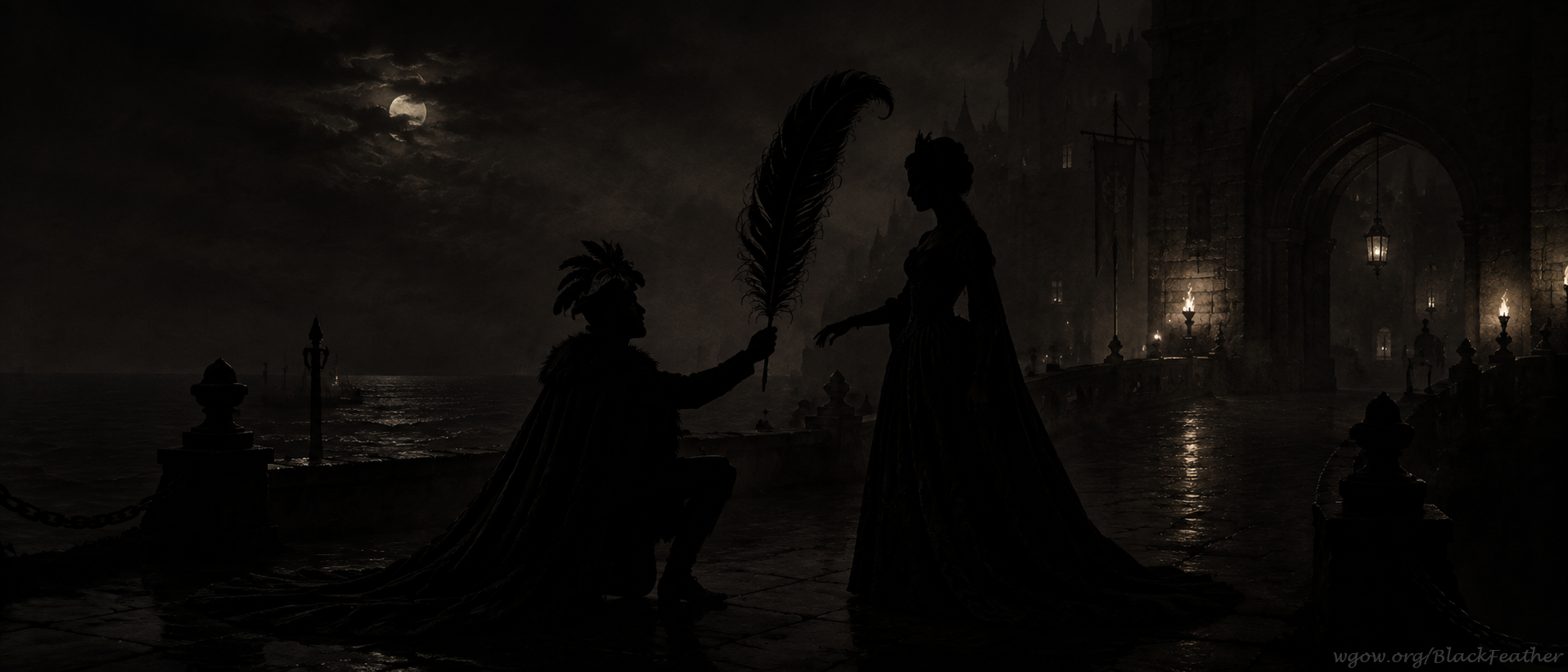
The Black Feather
The Black Feather Movement is a masculine social movement directed against the normalisation of anti-social feminine behaviour towards men; particularly ghosting, female moral authority, contempt, manipulation, humiliation, gratuitous hostility, punitive silence, and the presumption that male goodwill must remain available regardless of how men are treated.
Its purpose is correction.

The movement seeks to restore a culture in which women may be criticised for bad conduct towards men, in which such criticism is not automatically pathologised or dismissed, and in which feminine behaviour once again encounters definite standards rather than automatic indulgence.
The black feather symbolises that judgement.
It represents the moment at which objection is made explicit: this behaviour is beneath the standard expected; it is socially destructive; and it should be corrected rather than excused.
Ghosting is one obvious example of misanthropic female behaviour and the dehumanisation of men. A woman may encourage familiarity, solicit attention, establish regular communication, and then disappear without explanation. Contemporary culture often treats this as a trivial exercise of personal freedom, or a defect in the man himself, rather than seeing what it really is, and how it is confined to a particular radical cultural milleu. The Black Feather treats it instead as a question of conduct. Freedom to end an interaction does not make every manner of ending it admirable.
The object is therefore not simply for men to disappear in return. It is to re-establish the expectation that such behaviour may be named, criticised, and socially disapproved of.
The same applies to hostility. Mockery, contemptuous dismissal, deliberate provocation, manipulative ambiguity, and punitive silence should not acquire moral immunity merely because their author is a woman. Nor should the man who objects automatically be recast as ‘controlling’, ‘insecure’, ‘toxic’, or otherwise defective for refusing to accept them.
The Black Feather exists precisely to break that pattern.
Its principle is that women are capable of receiving criticism and should be expected to answer it rather than remaining immune. A woman who behaves badly towards a man should not be encouraged to believe that the appropriate response is always to block, ridicule, pathologise, reverse the accusation, or retreat behind ideological vocabulary. Correction requires the possibility of saying plainly: you have acted badly; here is a symbol accounting for it.
This distinguishes the Black Feather from philosophies of wholesale male withdrawal such as MGTOW, and is in line with the proactive ethos of WGOW (Women Going Our Way). It does not propose abandonment of relations between men and women, which only furthers the decline. It seeks instead to improve those relations by reintroducing standards which have been weakened or removed.
Withdrawal may follow; but it is a consequence, not the central doctrine.
The first object is recognition. The second is criticism. The third is correction.
And only where correction is persistently refused does withdrawal of attention, trust, affection, or esteem become appropriate.
The movement therefore opposes the assumption that feminine conduct must be endlessly accommodated while male objections must continually justify their own existence. It affirms the man’s right to make judgements, to voice them, and to expect them to be taken seriously.
You Have Been Selected: When Is a Woman Worthy of the Black Feather?
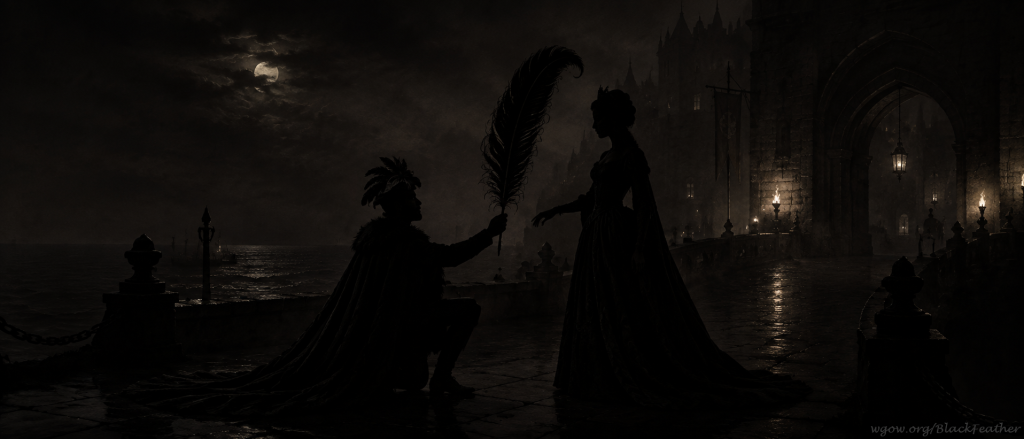
A young woman sat alone when there came upon her a prince, dashing and resplendent, his cap a-dancing with plumes. With a deep, courteous bow, he drew forth one feather from among them—black as midnight—and placed it in her hand.

‘Madam,’ said he, ‘this one is thine.’
The Black Feather stands against the psychological and ideological strategies by which feminine hostility towards men is sanitised, moralised, or transformed into an apparent and hostile right of correction. Its concern is especially with a modern pattern in which the man’s authority, judgement, anger, expectations, or criticism are treated as inherently suspect, while feminine antagonism is permitted to proceed under the language of ‘boundaries’, ‘oppression’, ‘safety’, ‘equal discussion’, or therapeutic self-protection. These are the wages of Marxist-Feminism on the feminine psyche.
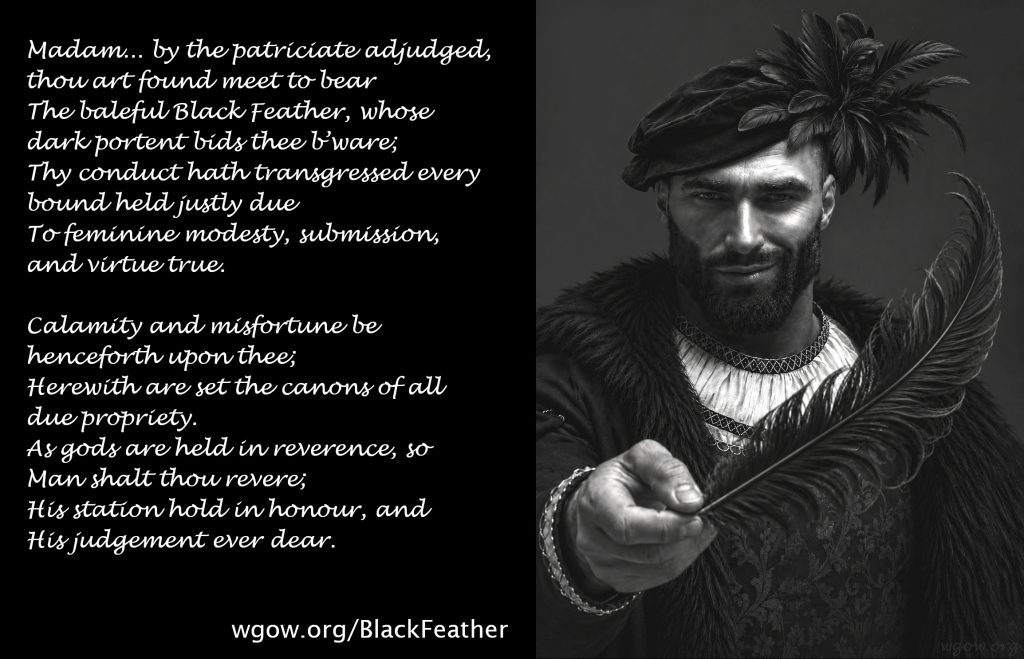
Among the misanthropic practices worthy of a black feather are:
- Disobedience, unsubmissive and unfeminine women. Women are increasingly encouraged by subversive movements to become as caustic and unfeminine as possible; no longer taught etiquette, receptivity, or deference to male guidance, they instead crassly mock, intentionally subvert and violate clearly stated boundaries, erupt in coarse laughter, curse like drunken sailors, or domineer men through low, guttural, primitive speech intended to intimidate, like a tyrant bullying a lesser man or a mother abusing her child. They are well aware of their privileges and use them jealousy to their immediate benefit. All while the man is restrained with a one-sided moral taboo or expected not to follow with an appropriate response. The inversion is total: women are held to no standards of restraint, exhibit poor emotional control, are taught that their moral outrage commands sole attention, and act in resentment of feminine receptivity before men, while simultaneously claiming moral authority to impose upon men the very standards of feminine modesty from which they themselves have been emancipated. It may appear to proceed in good faith; rarely does it remain so, and the tyrant soon slips in. The result is an opening for psychological abuse, false moral authority, incessant correction, and degraded standards of feminine decorum. Men are no longer revered with a dignity approaching that accorded to the divine or the gods, but are treated as nuisances to be humiliated, emasculated, and mocked.
- The presumption of feminine moral authority and inversion of hierarchy. Perhaps, and most fundamentally, the Black Feather rejects the assumption that the woman enters conflict already occupying the moral high ground; that she determines what language is permissible, which emotions are legitimate, what constitutes respect, and whether the man’s judgement of her may even be heard. Most men never even perceive its one-sidedness, nor that it has no natural limit, because they never push back; instead, they accept behavioural correction in the hope of remaining ‘good’, only for this, from the predatory feminine vantage, to be immediately read as weakness and tacit consent to further abuse. The modern woman expects her presence to carry authority while adhering to no standards and rather childishly, remaining absolutely sensitive to criticism herself.
- The pathologising of male authority. A man’s firmness, command, standards, possessiveness, severity, refusal, stated boundaries and sacred principles, or expectation of deference may be redescribed immediately as ‘controlling’, ‘toxic’, ‘insecure’, ‘narcissistic’, ‘angry’, or ‘abusive’. The effect is to make authority itself appear symptomatic: the man is not answered; he is diagnosed. His boundaries, authority, and principles are not regarded as sacrosanct; they are effortlessly dismissed, overridden, and violated in favour of the feminine prerogative.
- The flattening of respect for male authority into ‘mutual respect’. This formula is frequently invoked precisely when a woman wishes to reject any particular respect due to the man, his position, judgement, experience, or authority. Every asymmetry is dissolved beforehand; respect is accepted only after being reduced to an equal exchange between interchangeable individuals.
- One-way criticism. She may criticise his character, manner, language, masculinity, opinions, or intentions at length, yet treat criticism directed towards herself as aggression. Thus she acquires an unlimited right of judgement while denying the legitimacy of any judgement from the man.
- Provocation followed by moral reversal. Mockery, hostility, coldness, contempt, or deliberate antagonism is initiated; when the man finally answers forcefully, his response is detached from everything preceding it and presented as the original offence. This pattern has been identified as a statistically significant precipitating dynamic in cases of domestic violence preceded by psychological abuse from the partner, yet it is routinely overlooked or minimised by the media, institutions, and law enforcement alike.
- Therapeutic denunciation. Psychological vocabulary is used to confer apparent expertise upon ordinary hostility. ‘Gaslighting’, ‘narcissism’, ‘trauma’, ‘emotional labour’, ‘unsafe’, ‘toxic’, and similar terms become rhetorical verdicts through which the man’s motives can be declared diseased without ever having to answer what he actually said.
- Policing male speech irrespective of his intention, and the weaponisation of ‘boundaries’. A boundary ceases to govern one’s own participation and becomes instead a means of policing a man’s speech, vocabulary, and manner through stigma; words are declared impermissible, suspect, or ‘harmful’ regardless of his intentions, and refusal to submit to that linguistic jurisdiction is itself recast as evidence of disrespect or abuse, as boundaries lain by the man are pathologised or handwaved away. The presumption that a woman may determine which words a man is permitted to use, while remaining radically hostile and cold to his actual intentions, and then punish or pathologise him for refusing that linguistic jurisdiction, is itself a claim of gynaecocentric authority over his speech.
- The language of oppression. An ordinary disagreement between a man and a woman is elevated into an encounter between collectivist ‘oppressor’ and ‘oppressed’ classes, interpreted through the machinery of Marxian dialectic. Once the vocabulary of ‘patriarchy’, ‘power imbalance’, ‘male entitlement’, or ‘structural oppression’ has been introduced, the individual facts of the dispute become secondary to an ideological script in which the verdict has already been supplied; ironically, this same movement thereby licences female misanthropy towards men and the oppression of men themselves.
- Permanent critical agitation. The Black Feather particularly rejects the strain of Marxist-feminist reasoning which treats relations between the sexes as a field of continuing ‘class struggle’: contradictions must continually be exposed, privileges challenged, hierarchies destabilised, and grievances reproduced. Applied to personal relations, this produces a woman who approaches the man less as someone with whom order is to be established than as an authority continually to be criticised, resisted, and brought down to her own level.
- The refusal of correction. Every criticism is deflected rather than received. She changes the subject to his tone, his wording, his supposed motives, his ‘entitlement’, or the manner in which the criticism made her feel. The substance disappears; the act of criticising her becomes the offence.
- Punitive withdrawal and ghosting. Instead of answering, explaining, or closing an interaction with dignity, attention is suddenly and jarringly, without warning or a courtesy farewell, removed as an instrument of coercive power. Silence, blocking, disappearance, or deliberate ambiguity leaves the man to interpret an absence which she alone has chosen and controls, deliberately acting as an instrument of psychological abuse. Often, if there is one, even the courtesy is weaponised and intended to humiliate or undermine.
- Humiliation disguised as empowerment. Cruelty towards men is often celebrated as independence, confidence, ‘knowing one’s worth’, refusal to ‘settle’, or not having to ‘please everyone’ because ‘well-behaved women do not make history’ (quite the opposite is true). The Black Feather rejects the conversion of contempt into feminine self-assertion.
- ‘Looksmatch’, sexual-marketplace hypergamy, or sexual dishonour. Both ‘looksmatch’ and hypergamy invert the traditional hierarchy by enthroning the plebeian, the merely fashionable, or the man validated by mass appetite in place of one distinguished by rank, character, discipline, intellect, or transcendent and sacred virtue. It is no peripheral feature of Feminism, but one of its cardinal principles; a doctrinal keystone without which much of its wider social programme would scarcely cohere. The standard becomes horizontal and quantitative: social-media popularity, conventional attractiveness, sexual demand, and the approbation of the crowd are allowed to outweigh qualities belonging to a higher order. The Black Feather therefore rejects the reduction of sexual choice to a marketplace in which men are appraised according to fluctuating collective desirability and women are encouraged continually to exchange upwards according to whatever standard the mass presently consecrates. This is no injunction against sexuality itself; it is an injunction against sexual dishonour towards a man, particularly where appetite, comparison, infidelity, or calculated replacement is permitted to override loyalty and rightful esteem. Such conduct does more than injure the individual man: it debases the masculine principle by subordinating it to fashion, appetite, and the judgement of the multitude.
- Delaying pregnancy and childrearing into the mid- to late twenties, or disloyalty in relationships. It has become axiomatic for women to stigmatise child-rearing in youth, thereby faltering in their duty to nation, people, and posterity. Many pass from one man to another and seldom remain steadfast to those principles of fidelity, marriage, and obligation by which durable households are formed; instead, masculine pursuits are elevated above maternity, further postponing or abrogating child-rearing at the expense of their own parents’ posterity, the dignity of their men, and the children who might otherwise have been born into a more settled order. In place of this, men are reduced to egalitarian boys expected to dote upon a woman preserved in a kind of perpetual adolescence, while any assertion of masculine authority, independence, or autonomous judgement is itself stigmatised as an offence. ‘Fatherless’ captures it succinctly, with a familiar Roman sneer.
- Materialism and disregard for the divine. With the advent and rapid proliferation of radical scientific scepticism and crass materialism, women have broadly lost contact with any regard for higher forces, if not openly displaying contempt for principles and roles once held sacred, naturally implied by the existence of the divine and in whose name the patriarch and solar masculine descends. Across numerous traditions, the masculine is repeatedly identified with the solar and divine, and the feminine with the lunar and material; correspondingly, feminine forms of spirituality tend to elevate the domain of nature and becoming over solar, regal, and superhuman transcendence and Being. This is precisely the untethering of darker occult forces that a movement such as Feminism is designed to loose. Elsewhere, they adopt radically feminised forms of priestly spiritual doctrine through which they are permitted to domineer, reinterpret, and criticise the masculine centre itself. Gone are the patriarchs who bore the majesty of the gods themselves, or who were regarded as possessing a higher purpose and authority within the cosmic hierarchy. This is a strategic and hostile flattening of the range of feminine perception into a totalised absolutisation of anti-principle, such that traditional systems cease to cohere and the sacred itself is blasphemed by radical feminist movements. The Black Feather believes in divine principles, as well as in supra-mundane consequences for their betrayal which it seeks to avert; it holds that the positions of men and women are imbued with a higher essence that cannot be determined at the whim of the feminine itself, for to do so is merely to invert cosmic hierarchy into the human and material.
- The blackness of her heart and the void of her uterus. By antient and primordial ordinance, the Black Feather may be conferred wheresoever feminine conduct is adjudged so cold, barren of loyalty, or wanting in womanly grace as to recall the original ribald symbolism of the feather itself: blackness of the heart, and lightness of the womb.
When, if ever, is any Man worthy of the Black Feather, and by what canon is He adjudged?
A black feather is likewise conferred upon a man under the following provision of the Black Feather Code, § XVII.2(b):
- Simping. The servile elevation of women, or the active support and seditious perpetuation of systems of female privilege within the gynaecocracy, is truly accursed beneath the baleful portent of a Black Feather.
The Black Feather does not exist to devise a perfectly symmetrical etiquette between the sexes. It exists because a particular pattern of feminine conduct has been normalised precisely by refusing to name it as such.
Its purpose is therefore judgement and withdrawal: to recognise the tactics, refuse the imposed moral vocabulary, cease pleading for feminine approval, and withhold esteem where contempt, manipulation, or ideological hostility has taken its place.
The Black Feather means that the man retains the right to judge what is before him, and refuses to surrender that judgement merely because a woman condemns him for possessing it.
The wider purpose is cultural. Bad behaviour persists when it is rewarded, excused, romanticised, or hidden behind fashionable language. It diminishes when people know that it will be recognised for what it is and that esteem depends upon conduct.
The Black Feather therefore calls for the restoration of feminine accountability before masculine judgement.
Where there is dignity, loyalty, sincerity, and respect, these qualities should be recognised.
Where there is contempt, manipulation, hostility, ghosting, or calculated disregard for male authority, they should be challenged rather than normalised.
The Black Feather is consequently neither a symbol of retreat nor resignation.
It is a symbol of correction, judgement, and restored standards, and for Women to Go Our Way.

It is whispered, moreover, that the Black Feather is no idle token of censure, but an omen beneath whose shadow misfortune is wont to gather. An old tale, said to descend from remotest antiquity, tells of a raven that alighted upon the threshold of a house wherein a woman’s broken troth and adulterous treachery had at last ripened into bloodshed. What had begun in secret dishonour ended beneath that roof in betrayal, wrath, and death; and ere the blood upon the stones was cold, the raven came and kept its vigil there until dawn. An augur, beholding its station and manner, declared that the bird portended more than death alone: by the breach of faith some darker power had been loosed, and the raven had come as its sable sign. When at last it took wing, there lay amid the blood a single great plume, black as pitch, which no mortal hand had seen shed.

Thereafter the feather was remembered not merely as a token of guilt, but as a sign that feminine usurpation and betrayal had broken the bounds of mortal trespass and entered the cognisance of the gods. The black bird had yielded its sign unto the augur; but the baleful relic it left in its wake was of a darker order, and might be approached by none save the haruspex, versed in the dread ordinances of the elder gods. ‘Misfortune is upon thee,’ so spake he. ‘Woe, calumny, and disgrace unto thee, for the gods have marked thy transgression; that which was loosed in treachery shall cleave unto thy house, ill fortune shall dog thy steps, and what thou hast sown in dishonour shall return upon thee in bitter measure.’ Those upon whom such a plume was thereafter laid were said to suffer estrangement, humiliation, reversal, or untimely ruin, as though some antient account had been opened against them and Fate herself had undertaken its settlement.

Hence arose the old warning that the Black Feather should neither be mocked nor lightly borne. For the raven is a bird of death and baleful portent, and what it leaves behind is no common ornament; the plume signifies that betrayal hath been seen, that an order once inviolate hath been profaned, and that something dark, having once been unbound, may follow the offender until powers sterner than mortal witnesses have exacted their due.
The White Feather Movement: A Radicalist Tool for the Shaming Into Oppression and Mass Slaughter of British Men
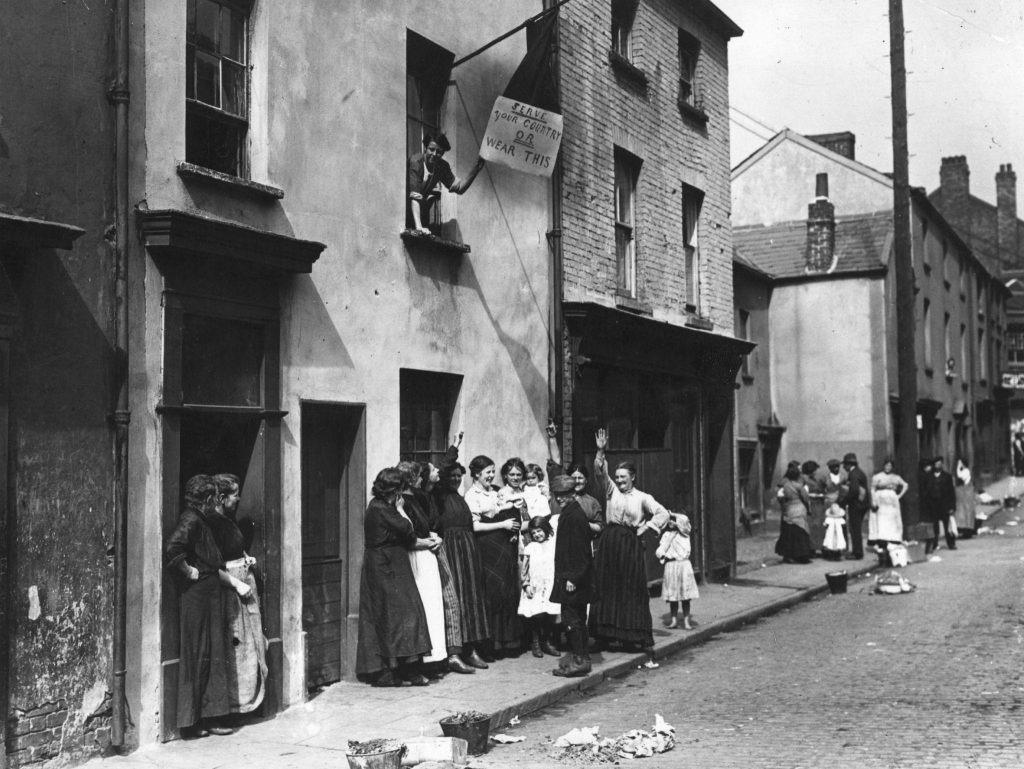
There is an older and rather darker precedent for the feather as a symbol governing relations between women and men, for the White Feather movement itself emerges out of the revolutionist and radical communist suffragettes. With the outbreak of the First World War in August 1914, the WSPU abruptly suspended the militant campaign which had included arson, bombing, destruction of property, and attacks upon public institutions; Emmeline and Christabel Pankhurst redirected their organisation towards patriotic mobilisation and recruitment. The White Feather campaign was not formally created by the WSPU: it began at Folkestone on 30 August 1914, when retired Admiral Charles Penrose Fitzgerald enlisted thirty women to present white feathers, the traditional emblem of cowardice, to young men seen out of uniform. Yet it belonged to the same wartime mobilisation of feminine pressure upon men, and Sylvia Pankhurst later specifically recalled WSPU supporters distributing feathers while her mother toured the country making recruiting speeches. Modern scholarship cautions against treating the White Feather campaign as a centrally administered WSPU programme; what is clear is that the Pankhursts’ militant wing had abandoned its pre-war violence and thrown its organisational energy behind recruitment at precisely the moment when the feather campaign arose.1
The White Feather signified cowardice, and more particularly the alleged failure of a civilian man to fulfil the martial obligations expected of his sex. Its symbolism considerably pre-dated the First World War: the expression ‘showing the white feather’ derived from cockfighting, in which a white feather in a gamecock’s tail was taken as evidence that the bird was ‘not of the true game breed’. During the wartime campaign the metaphor was made literal, as women presented white feathers to men out of uniform in order to shame them into enlistment.2 The accusation therefore reached beyond mere unwillingness to serve: the feather impugned the recipient’s courage, fighting spirit, masculine honour, and even, by implication, his quality of breeding. The White Feather thus accused the man of failing the expected masculine standard; the Black Feather deliberately reverses the judgement, marking the woman who is held to have failed the expected feminine standard.
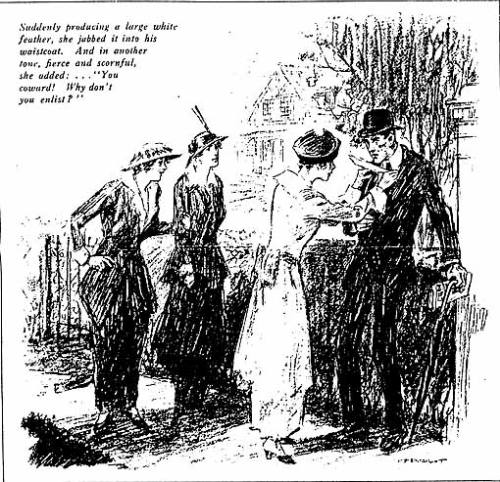
The method was deliberately psychological. Women approached civilian-clothed men in streets, railway stations, theatres, and public transport and marked them publicly with the feather, turning supposed cowardice into a visible stigma before women and other onlookers. The cruelty of the device becomes particularly apparent in the cases of boys who were not even legally old enough to enlist. Surviving testimony records sixteen-year-old Frederick Broome rejoining the army after being publicly humiliated with feathers, while seventeen-year-old Sebastian Lang was similarly shamed and immediately taken to a recruiting office; another man recalled volunteering under age after receiving one and spending his eighteenth birthday in the trenches. Men already wounded, rejected on medical grounds, performing indispensable civilian work, or home from military service could likewise find themselves accused by women who knew nothing whatever of their circumstances.3
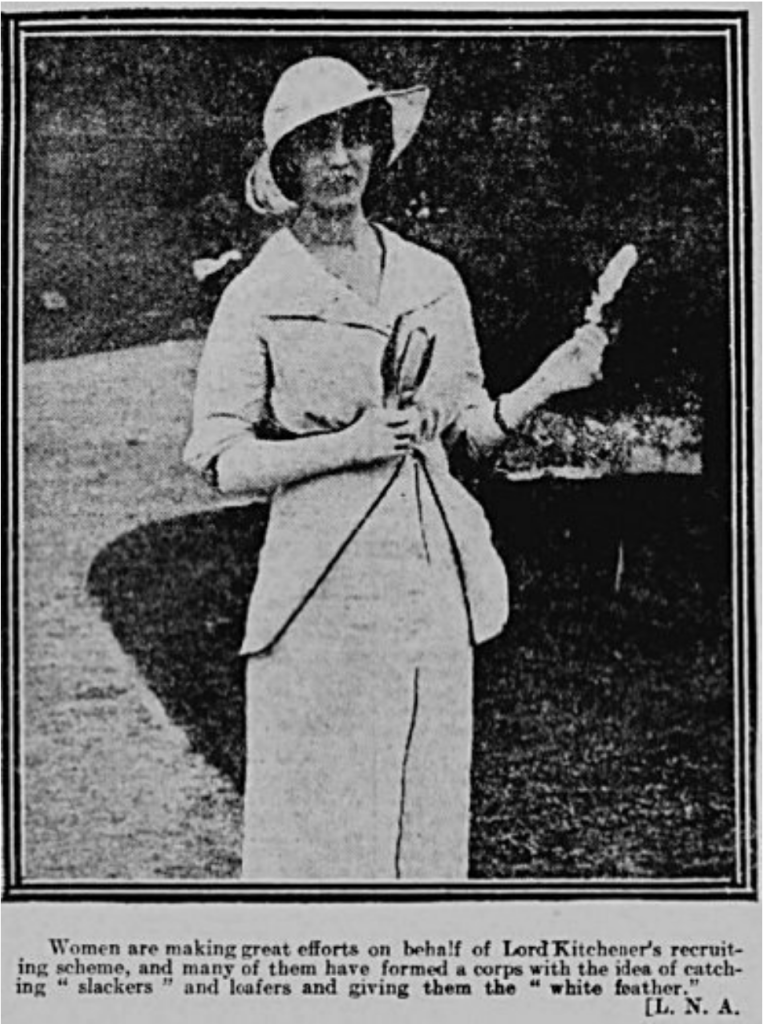
Thus a feminine judgement of masculine worth became an unofficial instrument of wartime recruitment: a young man could be made to prove his courage by placing his body at the disposal of a war in which the women condemning him bore no comparable expectation of combat. More than 750,000 British men died in the First World War, amounting to roughly nine per cent of British men under forty-five.4 From the standpoint of Britain’s long-term imperial strength, the bargain was ruinous. Although the Empire temporarily attained a still greater territorial extent through the post-war mandates, the underlying country had lost an enormous part of a generation, accumulated great financial burdens, and entered the troubled 1920s with an economy which the National Archives describes as ‘floundering’, with public services being cut under the pressure of war debt. The war therefore enlarged the map of Empire at the very moment that it weakened much of the human and financial power upon which that Empire depended; it belongs to the beginning, rather than the culmination, of Britain’s twentieth-century imperial decline.
There is a striking sequel. When Parliament finally enfranchised women in 1918, it deliberately refused to enfranchise them on the same terms as men. Virtually all men received the parliamentary vote from twenty-one, with serving soldiers and sailors able to vote from nineteen; women were admitted only from thirty and remained subject to qualifying conditions. Parliament’s own historical account states explicitly that the higher female voting age was adopted to prevent women from becoming the majority of the electorate. The resulting settlement enlarged the electorate from 7.7 million to 21.4 million while keeping women to approximately 43 per cent of voters.5
The demographic anxiety was quite real. Women had already numerically exceeded men before the war, but the destruction of young male life greatly aggravated the imbalance in the generations most directly affected. The 1911 Census recorded approximately 18.6 million females against 17.4 million males in England and Wales; by 1921 the figures had become 19.8 million females against only 18 million males, with the disparity especially pronounced among people in their twenties and thirties. The same census found 239,000 women receiving war-widow pensions and more than 730,000 children aged fourteen or younger recorded with their father dead.6
Only in 1928, through the Equal Franchise Act, were women placed upon the same voting-age terms as men. The demographic consequence feared in 1918 immediately materialised: women became 52.7 per cent of the potential electorate, and hence its absolute majority.7
Scholia
- Nathaniel F. Gullace, ‘White Feathers and Wounded Men: Female Patriotism and the Memory of the Great War’, Journal of British Studies, 36.2 (1997), pp. 178–206; UK Parliament, ‘Suffrage in Wartime’; see also Sylvia Pankhurst, The Suffrage Movement: An Intimate Account of Persons and Ideals (1931), p. 594.
- Stirling Moorey, ‘Step Forward the Cowards! – Humiliation, Shame and Countershame in Memories of the White Feather Campaign’, British Journal for Military History, 7.3 (2021), pp. 39–56, esp. pp. 39–43; Imperial War Museums, ‘On War Service Badge’ and ‘Voices of the First World War: A Total War’.
- Jessica Meyer, ‘The First World War White Feather Campaign: Shame and the Construction of Masculine Identity’, British Journal for Military History, 7.3 (2021), esp. pp. 42–50; testimony of Frederick Broome and Sebastian Lang, Imperial War Museum sound archive.
- Imperial War Museums, ‘12 Things You Didn’t Know About Women in World War 1’.
- UK Parliament, ‘Representation of the People Act 1918’ and ‘The Vote for Some’.
- Office for National Statistics, ‘Census Unearthed: Population, Widows and Orphans in 1921’, 12 April 2022.
- UK Parliament, ‘Equal Franchise Act 1928’.
Thanks for the timely suggestion to an anonymous contributor from the old Italian wine country.